The occasional, often ill-considered thoughts of a Roman Catholic permanent deacon who is ever grateful to God for his existence. Despite the strangeness we encounter in this life, all the suffering we witness and endure, being is good, so good I am sometimes unable to contain my joy. Deo gratias!


Although I am an ordained deacon of the Catholic Church, the opinions expressed in this blog are my personal opinions. In offering these personal opinions I am not acting as a representative of the Church or any Church organization.

Saturday, August 25, 2012

Art Restoration

My first visit to the SistineChapel was in the year 2000, several years after the remarkable restoration of Michelangelo's work had been completed. I can recall the moment when Dear Diane and I first stepped through the doorway and tried to take in the overwhelming beauty of that work. It was truly breathtaking. I remember thinking that what we saw, all 5,000 square feet of it, was pretty much was Pope Julius II saw when the frescoes were finally finished after four years of work by the master. The restoration, accomplished by some of the best experts in the field, actually required 12 years to complete, which says much about the poor condition of the frescoes after nearly 500 years.


Unfortunately, all restorations are not handled quite so professionally. The other day I came across an article describing the "unofficial" restoration of a fresco in the church of Santuario de la Misericordia in Borja, Spain. The fresco, "Ecce Homo" (Behold the Man), which depicts Jesus crowned with thorns, had suffered damage over the years due largely to flaking as a result of moisture in the church walls. It seems a local parishioner, an elderly woman, decided to undertake its restoration with less than desirable results. The photos below show the fresco as it originally looked, in it's damaged state, and after its "restoration". One hopes it can be repaired.


- Posted using BlogPress from my iPad

Wednesday, August 22, 2012

Pseudo-Catholic Joe

Over the years I've tended to avoid politics on this blog since there are so many more honorable things to write about. I'll admit that occasionally I haven't been able to resist touching on things political, but these have been rare occasions when the politicians forced the issue. This has been happening more frequently lately as some politicians have injected themselves into the religious sphere. I would ignore them if they showed any respect for religious views, but sadly most of these power-hungry hacks get the world backwards and believe religion should be subservient to the state.

For example, when Nancy Pelosi, the Bay area's self-proclaimed leading theologian, waxes eloquently on the teachings of the Catholic Church, I cannot often stay silent. I should, of course, simply ignore her since Mrs. Pelosi is just a make-believe Catholic of little understanding and no one with a working intellect need listen to her theological musings. The President, too, likes to lecture the Catholic Church on its teachings, but since no one, including Barack Obama himself, seems to comprehend the nature of his peculiar religious beliefs, I think we can ignore him as well.

And then there's Vice President Joe Biden, another cafeteria Catholic who obviously despises the Church to which he ostensibly belongs. Joe is a strange mixture of beliefs. During his earlier (2008) campaign for the Democrat nomination for the presidency, he displayed his personal racist beliefs when he described candidate Obama using the following words:

"I mean, you got the first mainstream African-American who is articulate and bright and clean and a nice-looking guy. I mean, that's a storybook, man."

Yeah, man, nothing like a "clean" black man. Would that Joe were as articulate as the subject of his thoughts.

And then a week ago, in front of a Danville, Virginia audience made up largely of African Americans, good ol' Joe tells them the Republicans are "gonna put y'all back in chains." Uh, Joe, in case you've forgotten, it was the Republicans who cut the chains of slavery in the South. Remember that guy named Lincoln? He was a Republican. And it was the Democrats who tried to keep black people enslaved for the century between the end of the Civil War and the Civil Rights Act of 1964. Joe, you might want to check the congressional voting tallies for that act: 80% of Republicans supported the act but only 64% of Democrats. But what are history and facts to a demagogue like Joe Biden? C'mon, Joe, what are you, racist or race pimp? Enquiring minds want to know.

Years ago, at a business meeting in Wilmington, Delaware, I met a man who lived next door to Biden. At the time Joe was a freshman senator and I asked his neighbor what kind of man he was. His answer was telling. "Joe Biden," he said, "is the stupidest man I have ever known." Because he said nothing else, I dismissed the comment as something one might expect from a likely disgruntled neighbor, until Joe became Vice President and spent the next three plus years confirming his neighbor's opinion.

I've come to believe, as some have suggested, that the President and his staff keep Joe Biden around as a guarantee against assassination.

Aren't we blessed that God is in charge and not us?

Pax et bonum...

- Posted using BlogPress from my iPad

Tuesday, August 21, 2012

Hate and Religion in Pakistan

From the Washington Post:

ISLAMABAD — A Christian girl was sent to a Pakistani prison after being accused by her furious Muslim neighbors of burning pages of the Islamic holy book, the Quran, in violation of the country’s strict blasphemy laws.

A police official said Monday there was little evidence that pages of the book had been burned and that the case would likely be dropped. But hundreds of angry neighbors gathered outside the girl’s home last week demanding action in a case raising new concerns about religious extremism in this conservative Muslim country.

Some human rights officials and media reports said the girl was mentally handicapped. Police gave conflicting reports of her age as 11 and 16.

Under Pakistan’s blasphemy laws, anyone found guilty of insulting Islam’s Prophet Muhammad or defiling the holy book, or Quran, can face life in prison or even execution. Critics say the laws are often misused to harass non-Muslims or target individuals.

Police put the girl in jail for 14 days on Thursday after neighbors said they believed a Christian girl had burned pages of a Quran, gathering outside her house in a poor outlying district of Islamabad, said police officer Zabi Ullah. He suggested she was being held for her protection.

“About 500 to 600 people had gathered outside her house in Islamabad and they were very emotional, angry and they might have harmed her if we had not quickly reacted,” Ullah said.

Almost everyone in the girl’s neighborhood insisted she had burned the Quran’s pages, even though police said they had found no evidence of it. One police official, Qasim Niazi, said when the girl was brought to the police station, she had a shopping bag that contained various religious and Arabic-language papers that had been partly burned, but there was no Quran.

Some residents claimed they actually saw burnt pages of Quran — either at the local mosque or at the girl’s house. Few people in Pakistan actually speak or read Arabic, so often assume that anything they see with Arabic script is believed to be from the Quran, sometimes the only Arabic-language book people have seen.

But one police officer familiar with the girl’s case said the matter would likely be dropped once the investigation is completed and the atmosphere is defused, saying there was “nothing much to the case.” He did not want to be identified due to the sensitivity of the case.

A spokesperson for Pakistani President Asif Ali Zardari, Farhatullah Babar, said the president has taken “serious note” of reports of the girl’s arrest and has asked the Interior Ministry to look into the case.

In Washington, State Department spokeswoman Victoria Nuland called the case “deeply disturbing”.

“We urge the government of Pakistan to protect not just its religious minority citizens but also women and girls,” she said.

The Associated Press is withholding the girl’s name; the AP does not generally identify juveniles under 18 who are accused of crimes.

The case demonstrates the deep emotion that suspected blasphemy cases can evoke in a country where religion Many critics say the blasphemy laws are often abused.

_____________

Let's see...a pre-teen Christian girl in Pakistan is accused, falsely it appears, of burning the Koran and the local Imam says she should be burned alive for this "crime" against Islam. (He was quoted in another report of this story.)

Think about it. This Down-Syndrome developmentally disabled child has been put in prison because the local Muslims want to kill her, burn her to death. This disabled child. This mob. This hate.

- Posted using BlogPress from my iPad

Sunday, August 5, 2012

Homily: Wednesday, 17th Week in Ordinary Time

Readings: Jer 15:10,16-21 • Ps 59 • Mt 13:44-46

I seem to come across a lot of unhappy people these days. Young folks worried about their future, anxious about what lies ahead, asking whether it even makes sense to get married and bring children into this world. Retirees bored by the freedom of their new lives and wondering about the meaning of all those decades of work. Young and middle-aged couples afraid that their jobs, their homes, their children’s futures – all they’ve worked for – could disappear overnight. And so many afraid of death, unwilling to accept either its inevitability or our faith-driven hope in eternal life.

I suppose we’re all searching for something better, something that will bring true and lasting happiness. How sad that so many look only to the world for what the world can never provide.

This is what today’s Gospel passage is about – about Jesus pointing the way for us, telling us that what we’re searching for only He can provide. He calls it the Kingdom of God or Kingdom of Heaven – a phrase that appears nearly 100 times in the Gospels. But what exactly is it?

Listening to Jesus, we know it’s something to strive for; that it’s harder to enter if you’re rich, but easier to enter if you’re childlike. We know it belongs to the poor, the humble, and the persecuted. It has humble beginnings and grows like seed and expands like yeast. It’s neither here nor there, but it’s among us. But even though it’s among us, we pray for its coming whenever we pray the Our Father.

The Kingdom is near because Jesus is near. It’s proclaimed throughout the whole Gospel. It’s been coming ever since the Last Supper, and in the Eucharist, it’s in our midst. But there’s more…

We learn it’s supremely valuable, something for which we should give up everything. This seems impossible, but Jesus says no. He likens possessing the Kingdom to a man who discovers buried treasure or a merchant who finds a precious pearl. Each sells everything to secure what is so very valuable. If we value God’s Kingdom and help build it up, we will possess it; if we hinder its growth by putting ourselves or other things first, we’ll lose it.

You see, brothers and sisters, to be part of God’s kingdom is to be part of God’s family, to be children of God, to become brothers and sisters of Jesus. To possess God’s Kingdom is to achieve the end for which we’re made, to enter into an eternal, intimate relationship with God.

This is Jesus’ message of hope, a message St. Paul repeats when he tells us that for those who belong to God’s Kingdom, all things work for good. Not only is God’s Kingdom the fulfillment of our destiny, but it also brings nothing but good. Just as there’s joy in finding the Kingdom, there’s joy in helping to build it – exactly what you and I are called to do every day.

We build the kingdom whenever we trust completely in God, whenever our selflessness overcomes our selfishness, whenever our love conquers sin and our faith overcomes suffering.

We build the kingdom whenever our hope conquers despair; whenever we visit the sick, comfort the dying, feed the hungry, shelter the homeless.


When married couples live their lives as an example to others, they build the Kingdom.

When our parishioners work courageously for life, changing the hearts of those who would promote the culture of death through abortion, euthanasia, or capital punishment, they build the Kingdom.

When our pastoral visitors bring love, compassion, companionship, and the Eucharist to the sick and the homebound, they build up the Kingdom.

When our catechists help parents build a solid foundation of faith for their children, they build the Kingdom of God.

When our outreach ministry assists families in need, they build the kingdom of God.

When prayer groups come together in praise and petition, they build the Kingdom.

And we build it in a special way in the Eucharist, when Father, acting in the person of Christ, makes present His redeeming sacrifice on the Cross.

Someday we’ll be asked: “Did you work to build up the Kingdom or to tear it down?“ Are we like all those unhappy people I encounter these days? Are we so caught up in our earthly lives that we define ourselves only by our work, or our family, or our political party? Are we willing to sacrifice everything for nothing? Or have we learned that happiness comes not from the things of this world; that only God can bring the lasting happiness we all seek.

Life is short, brothers and sisters, but it’s filled with opportunities to build the kingdom. Let’s not waste them.

Homily: 18th Sunday of Ordinary Time


Readings: Ex 16:2-4,12-15; Psalm 78; Eph 4:17,20-24; John 6:24-35

Some years ago – far too many years ago – during one of his vacations, I took one of our sons out to lunch at a local pub in our Cape Cod town. As we chatted over our meal, I couldn’t help but notice how he seemed to be enjoying his food. As I watched him, he looked up at me and said with a big smile, “You know, Dad, there’s only one thing better than food. And that’s free food.” I started to remind him that the food he was consuming with such gusto wasn’t entirely free, at least not from my perspective…but then I thought the better of it. No sense bursting his bubble. He’d learn soon enough that there’s no such thing as a free lunch. Perhaps I shouldn’t have been so tolerant.

Indeed, in today’s passage from chapter 6 of John’s Gospel, we find Jesus speaking about this very thing to the people of Galilee – for they had just received what they thought was a free lunch. As you’ll recall, in last Sunday’s passage Jesus performed the great miracle of the loaves and fishes, feeding a hungry crowd of thousands. The miracle so excited the people they wanted to make Jesus their king, proclaim Him the Messiah, the one sent by God to return Israel to its former glory.

Yes, the only thing better than food is free food. And they want more of the same. They want more miracles, more healings, more food, more of everything. They want it all. If Jesus can feed them all so easily, if Jesus can heal the sick, if He can free the possessed, raise the dead…well, if He can do all these things, what can’t He do? He can do everything. And that’s what they want. Just imagine it. All our troubles, all our drudgery, no more working for our daily bread – all this is over.

But before they can grab Him and proclaim Him their king, he leaves them. But they will not be dissuaded. They track Him down and find Him. Jesus, though, turns the tables on them. He confronts them with the truth about themselves.

You don’t want Me. You just want your bellies filled. You just want the free food that I can give. You just want someone who can miraculously relieve all the hunger in your life.

Can you picture that crowd, brothers and sisters? Can you see them pushing against each other, pressing in on Jesus, not really sure what they want, but knowing somewhere, somewhere deep within their being, that Jesus can provide it? And so they ask Him, “What can we do to accomplish the works of God?”

Yes, indeed, people hunger for food. But humanity’s deepest hungers are not expressed by the rumblings of its collective stomach. We hunger for meaning in our lives: “What can we do to accomplish the works of God?” We hunger for the hope that comes with the promise of eternal life. We hunger for peace – peace in our world, peace in our families, peace of mind, and the peace that only Jesus can bring: peace of soul – God’s peace.

Do we see ourselves in that crowd? Do we hear those same words come from our lips? Do we realize that even after 2,000 years, we’re still asking the same question? Can we accept the answer?

No, it’s not the bread from the deli, the belly food, that will satisfy our deepest hungers. What we seek, what all humanity seeks, is the food that only God can provide. We seek His very life, His divine life within us. We seek God’s presence, His indwelling in our hearts; for this and only this can give us “the peace of God that surpasses all understanding.”

Some in the crowd sensed this. Some realized that Jesus spoke of something greater, something beyond their understanding: “bread…which comes down from heaven and gives life to the world.” They begged Him, “Sir, give us this bread always.” Yes, they’re thinking…what wonderful bread this must be.

And what is this bread, this gift? The manna in the desert was a mere foreshadowing of God’s greatest gift to His people. For this bread, this gift, is Jesus Himself. You know the words: "I am the bread of life; whoever comes to me will never hunger, and whoever believes in me will never thirst."

This is Jesus Christ, the Bread of Life, the Bread that comes down from heaven. He showers Himself upon us, multiplying the bread made by human hands, sanctifying it, making it divine, filling it with His own life, His own being, offering us a gift so great it boggles the mind. It is pure grace, food for our souls, food that will never leave us hungry, food that will lead us to holiness despite all that the world can throw at us.

Yes, when the nights are long and painful, and dawn brings only more hardship and hurt, Jesus answers our question not simply with words, but with an act of divine generosity. “The Word became flesh and dwelt among us.” And it remains with us through the gift of the Eucharist.

You see, brothers and sisters, the only free food is the world’s junk food, the food that perishes. Jesus wants us to work for “the food that endures for eternal life” – for we are called to repent and believe in the Gospel. Instead of junk food, we must seek God’s true soul food, the bread of life, the food that always satisfies, always fills, no matter what we encounter in life.

Like the one who pleaded with Jesus, we too can demand, “Sir, give us this bread always.” Did they know what they were asking of Jesus? Do we know? For like the father who takes his son to lunch, Jesus too must pay. But He pays with His very life. He pays for our sins, our hungers, and does so on the Cross.


The result? Well, here it is, brothers and sisters, right here on this altar…the Eucharist, the bread of life, Jesus Christ, true God and true man, Body, Blood, Soul and Divinity. The heart of humanity cries out in hunger and God places His answer right in front of us, a gift from God Himself, of God Himself.

“Sir, give us this bread always.” We sure do demand a lot of the Lord, don’t we? And yet He complies. He gives us this bread. The Father invites us to the living table of His only Son, and at this table, the Holy Spirit fills our hearts with the peace that only God can give.

Behold the Lamb of God, behold Him who takes away the sins of the world. How blessed are we to be called to the supper of the Lamb.


Homily: 17th Sunday in Ordinary Time

Readings: 2 Kings 4:42-44; Psalm 145; Ephesians 4:1-6; John 6:1-15

As some of you know, Diane and I are pretty heavily involved with the Wildwood Soup Kitchen. And if there’s one thing that involvement has taught us it’s that God takes care of His people. It’s really remarkable, you know. Well, I suppose it’s really not all that remarkable because we should expect God to take care of His people. After all, He’s promised to do so again and again. And the history of salvation we encounter in Scripture is all about God fulfilling those promises.


Anyway, last year we served over 75,000 meals and this year we’ll serve even more, and do you know what? We always have enough. We never run out. Just like the crowd on the mountainside, everyone gets fed. Whenever we need something – whether it’s a few hundred pounds of frozen chicken, or money for a walk-in freezer, I don’t care what it is -- we don’t have to ask people for it. Someone just shows up on our doorstep with exactly what we need. Or a large check arrives in the mail. It just appears. And I’m not exaggerating. I don’t have to, because God takes care of his people.

And this is certainly one message that comes across loud and clear in today's readings. Not only does He feed them with food for the body, He also provides food for the soul, and everything else they need to live fully human lives in close union with God, the Source and Goal of all life.

So far this liturgical year we’ve been listening to Mark’s Gospel, but today, instead of hearing Mark tell us of the feeding of the 5,000, we hear John’s version, a Eucharistic version, an introduction to Jesus’ discourse on the Bread of Life. Indeed, we’ll stay with the 6th chapter of John's Gospel for the next five Sundays.

John begins by telling us that Jesus and His disciples crossed over to the opposite shore of the Sea of Galilee. And as we heard in Mark, the crowds had gone before them on foot. What made people walk nine miles to see Jesus? Well, John tells us…because "they saw the signs that Jesus was doing for the sick". Like people everywhere, like us, they had a deep hunger and longing for healing and wholeness in their lives. Of course, some were simply curious, and wanted to see this Jesus perform one of the miracles they’d heard about.

You and I won’t be any better than these if we see this story only as a miraculous multiplication of a bread and fish. All gospel stories are steeped in symbolism and this is especially true of John.

We’re told first that Jesus "went up the mountain" – a reference to Moses on the mountain bringing God's Law to the people. But there’s a significant difference: Jesus is no mere intermediary; He speaks with the same authority as His Father. Unlike Mark, who has Jesus teaching the people first, in John the teaching, as we’ll see in the coming weeks, flows out of the multiplication experience. And, while Moses went up the mountain alone, Jesus brought His disciples with Him. They would be partners in His work, continuing that work after His resurrection. And just as Moses gave the Jewish people God's teaching in the form of the Law and later fed them with manna, so Jesus, the new Moses, will feed the bodies and souls of those who come to Him.

John also mentions that "now the Passover festival was near". Passover, the great feast of the Jews, celebrates their liberation from slavery in Egypt when God led them into freedom as his chosen people. At the Last Supper, just before his death, Jesus gave His disciples -- and the Church -- the great ongoing sign of a new Passover, the Eucharist.

And in today’s miracle, Jesus anticipates that Last Supper scene where He "took the bread, gave thanks, and distributed it to them all…" For in this new Passover Jesus is the central figure, and His suffering, death and resurrection will liberate us from sin and death.

But let’s step back a moment and look first at what leads up to today’s miracle. There is the dialogue with Philip, who always comes as across as rather naive and simple; the guy who takes things literally; who says the things the rest of us think of but are too embarrassed to say. Jesus sets the stage by asking Philip, “Where will we get food for all these people?" Philip looks at the crowd and says, “Two hundred days’ wages worth of food would not be enough for each of them to have a little.”


A little like our first reading, isn’t it? Elisha asks God, "How can I serve this to a hundred men?" "Give it to the people to eat," is the simple answer. How does the Gospel promise it? "Give and gifts will be given to you; a good measure, packed together, shaken down, and overflowing, will be poured into your lap.” [Lk 6:38] Then Andrew breaks in to tell of a gift: "There is a small boy here with five loaves and two fish." And echoing the words of Elisha adds, "But what use is that among so many?" The next thing we know Jesus has taken those few loaves and fish, and, after blessing them, begins to distribute them.

Note that Jesus didn’t feed the people with nothing. He started with something that was already available. This miracle was made possible because a young boy was willing to share what he had with others, including thousands of strangers around him. You see, God gives life through what is already available to us. But someone has to be the little boy and start the ball rolling.

People are dying of hunger and malnutrition in our world, and it’s not because there isn’t enough food. In some instances they’re being intentionally starved because of hatred. They practice the wrong religion, or come from the wrong tribe or ethnic group. Others are starving because their governments are unbelievably corrupt…still others simply because of inefficiencies and selfishness on the part of others.

You and I can’t do much about some of these things, but we are called to do something, because just like the miracle on the mountainside, the Eucharist we celebrate today is also about giving and about loving. Jesus gave His life on the cross for our salvation, and in the face of such love, we are almost overcome. But He does even more. For the God of the universe makes Himself our food. He gives everything to us, even Himself.  And He does so day after day…and He does so miraculously.

For the bread and wine we offer here today will be consecrated, miraculously changed into Jesus’ Body and Blood, broken, divided, given out to many. But to benefit from this miracle, to receive the Eucharist worthily, we must reflect it in our lives. St. Paul has some harsh words for Christians who want to celebrate the Eucharist but refuse to help the needy members of their community.

There’s another detail worth noting here. In all three of the Synoptic Gospels, the disciples are told to distribute the bread and fish among the people. This of course is a sign of their future mission to bring Christ to the world. But here in John, it’s Jesus Himself who distributes. As we will see in the coming weeks, Jesus will proclaim Himself to be the Living Bread that gives life to the world. You see, John wants to emphasize that Jesus is the source of all spiritual and bodily nourishment. And even though He will use intermediaries, it is always Jesus who comes to us in Word and Eucharist.

In the end, what happened? After 5,000 people had their fill, the leftovers filled twelve baskets -- another sign of the liberality with which God cares for us. The people are so excited they want to make him King, declare Him the Messiah. And they’re right: He is King and Messiah, but they’re also wrong. They’re wrong because of what they missed. They saw the miracle, but missed the message. The only King they’ll see is one in nakedness and shame, a falsely convicted criminal among criminals, hanging on a cross. And where will these crowds be then?

No, the real teaching here is that Jesus is the true source of nourishment for our lives. And if we want that nourishment we must obey the Father who declared, "This is my beloved Son. Listen to him". As St. Paul instructs us in the 2nd reading, we must “live in a manner worthy of the call you have received…striving to preserve the unity of the spirit through the bond of peace.”

Brothers and sisters, be prepared to enter totally with Jesus into the paschal mystery of His love-centered life, to mirror His self-giving as a way to life. For when we as a people listen to Him and trust in Him…well, as we’ve already seen, God takes care of His people.


Wednesday, August 1, 2012

Happy Birthday, Milton Friedman

Perhaps the 20th century's greatest apostle of economic freedom was the late great economist and Nobel laureate, Milton Friedman (July 31, 1912 – November 16, 2006), whose hundredth birthday was yesterday. If you're unfamiliar with Friedman, read his books. His 1962 book, Capitalism and Freedom, taught me a great deal and years later I read and enjoyed his Free to Choose, another excellent book.

Let me say at the outset that I am unabashedly in favor of a free market economy over any other economic system that has been tried by humanity. This preference for the free market is especially strong when compared to socialism in any of its forms. Communism, fascism (including Hitler's "national socialism"), the cleaned-up social democracy practiced in much of Western Europe -- they're all just socialism dressed up in other clothes. All eventually lead to either totalitarianism or collapse, or both. The free market, what Karl Marx cleverly but incorrectly called "capitalism", is the only economic system that has brought prosperity to the greatest number of people. The free market fails when government gets involved. For example, Lyndon Johnson's "War on Poverty" should more properly be called a War on Prosperity since the poverty rate has only increased since the federal government began waging this war in such an ill-advised manner.

When I was in graduate school and forced to suffer through more than one tedious course in economics taught by dull, unthinking professors, it was the books and articles of Milton Friedman that helped me maintain my sanity. These professors of economics were always making remarkably stupid statements. For example, one once exclaimed to our class, "The nice thing about government spending and so-called national debt is that the government can always print more cash to pay its debts. Businesses can't do that, so the government is obviously the better economic engine." Another actually complained about the expression "free markets" stating that there was nothing very special about the so-called free market because markets were anything but free. "You've got to pay for all that stuff," he added somberly. (With thinking like this I suspect these men are probably holding down jobs in the current administration.) In my own perverse way, I used to enjoy asking seemingly innocent questions based on Friedman's thought, questions that forced the professor to try to defend what was logically indefensible. They never succeeded.

I discovered that yesterday was Friedman's 100th birthday when I stumbled across an article celebrating the fact by offering five of the famous economist's best known quotes. They're worth repeating here...
 "Concentrated power is not rendered harmless by the good intentions of those who create it." 
"Governments never learn. Only people learn."

"Hell hath no fury like a bureaucrat scorned."

"I am in favor of cutting taxes under any circumstances and for any excuse, and for any reason, whenever it's possible."

"If you put the federal government in charge of the Sahara Desert, in five years there'd be a shortage of sand."
These are good, but I have a few other favorites:
"The strongest argument for free enterprise is that it prevents anybody from having too much power."
"A society that puts equality before freedom will get neither. A society that puts freedom before equality will get a high degree of both."
"Political freedom means the absence of coercion of a man by his fellow man, The fundamental threat to freedom is power to coerce, be it in the hands of a monarch, a dictator, an oligarchy, or a momentary majority."
"The free man will ask neither what his country can do for him nor what he can do for his country. He will ask rather 'What can I and my compatriots do through government' to help us discharge our individual responsibilities, to achieve our several goals and purposes, and above all, to protect our freedom?"
Contemplating these truths today will help us understand better why our nation is facing its current crisis. At its core it is less an economic crisis than a crisis in freedom, and as history clearly tells us, freedom is a very rare commodity.

The following is a brief video of a Friedman appearance on the Phil Donahue Show in 1979. Donahue, in denouncing free market economics, tried to rename the "pursuit of happiness" by calling it greed. Friedman comes to the defense of free markets leaving Mr. Donahue almost speechless.


- Posted using BlogPress from my iPad

Sunday, July 29, 2012

Homily: Feast of St.James the Greater, Apostle - July 25

Readings: 2 Cor 4:7-15; Ps 126; Mt 20:20-28

Ambition can be a funny thing. It's not always a bad thing, since it's a necessary trait when it comes to setting and achieving goals for oneself or for an organization. But when it becomes an end in itself, when it loses any sense of balance and ceases to consider its effect on others...well, then it can corrupt. 

Yes, the overly ambitious, those obsessed with achieving their own ends regardless of the consequences, can become very ruthless people. Most of us have probably known a few. I even worked for one for about a year, and it was not a pleasant experience. He ended up letting his overreaching ambition cloud his sense of morality and one day he was suddenly escorted from the building by security guards.

We get a little taste of runaway ambition in today's Gospel passage from Matthew. James and his brother, John, who with Peter are the favored three Apostles, approach Jesus accompanied by their mother. According to Matthew, mom is the one who asks Jesus to promise her sons the highest places in His Kingdom. Now, whether Mrs. Zebedee did this on her own or the boys put her up to it, we don't know.

Jesus, of course, isn't fooled and responds not to their mother, but directly to James and John. Recognizing the potential for corruption in their ambition, He nips it in the bud by asking them, "Can you drink the chalice that I am going to drink?" Without fully understanding what they are agreeing to, they say they can. Jesus concurs with their agreement because he knows what awaits them.

Jesus with the mother of James and John
Like a parent counseling an adolescent by offering a realistic view of the adult challenges that lie before him, Jesus reveals they will have much to suffer. And indeed it was James, whose feast we celebrate today, who became the first martyr among the apostles. Jesus also knows that ambition, when properly ordered, isn’t a bad thing, and He doesn’t want to totally extinguish His disciples’ enthusiasm. After all, it’s an enthusiasm focused on eternal life, a goal we should all have. Indeed, great things are rarely achieved without enthusiasm, or without pain. Jesus just wants to refocus their ambition, to ensure they understand not only the goal, but also the true nature of the path required to achieve it.
Of course, in this small group, the other apostles overheard the exchange and got all upset at James and John. But in their petulance they demonstrate that they too can succumb to the temptations of personal ambition. And so Jesus gives all twelve a little lecture about power and authority – reminding them that authority in the Kingdom must not imitate the authoritarianism so prevalent in the world.
Their job as apostles, as the first shepherds of His Church, is not to rule but to serve…and to serve all equally. And He doesn’t just tell them to serve each other and the lowly, but He offers Himself as an example –revealing that He will even go so far as to sacrifice His very life for humanity.
“…the Son of Man did not come to be served but to serve and to give his life as a ransom for many.”
He must increase...
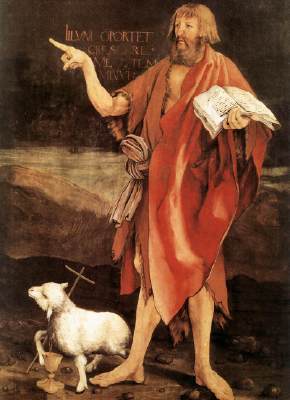
The apostles could also look to another as a model, someone they all knew. For when it comes to controlling ambition, is there a better example than John the Baptist? Like all the great prophets, John pursued his goal with remarkable single-mindedness. He announced the Lord’s coming, preparing a path for Him, a path of repentance among God’s chosen people. And in doing so he stated clearly that “He must increase, I must decrease.” This was John’s ambition: to give greater glory to the Lord in all that he did.
This is really what Jesus is telling the James, John and the others: that the ambitious are certainly blessed, but their ambition must be driven not by self-assertion, but by self-extinction.
And so the message for us is the same: that we always act in thanks and praise: In thanks, because all we have, all we are, all we achieve – all of this is due solely to the grace of God. And in praise, because all we do must be done for God’s glory, not for ours.
As the psalmist said: “Not to us, Lord, not to us, but to your name give glory.”

Saturday, July 28, 2012

Olympics and other things

I must be getting old, turning into a kind of curmudgeon, because I find myself increasingly at odds with what our society offers up as good and worthy. No, that's not quite right. Society doesn't simply offer these things to us and tell us they're good; rather it throws them at us, rubs our noses in them, submerges us in their squalor, and then tells us to inhale deeply. It then attacks and intimidates any who might in the smallest way object to such treatment. Examples abound...

The reaction to the comments of Chick-fil-A President Dan Cathy are beyond belief. Well, they should be beyond belief, but in our increasingly decadent society, you can safely believe them. Mr. Cathy, speaking of his company, simply said:

"We are very much supportive of the family -- the biblical definition of the family unit. We are a family-owned business, a family-led business, and we are married to our first wives. We give God thanks for that. We intend to stay the course. We know that it might not be popular with everyone, but thank the Lord, we live in a country where we can share our values and operate on biblical principles." 

Omigosh! The man unwittingly pulled a half-dozen politically incorrect triggers and apparently exposed himself as an ignorant, intolerant, homophobic troglodyte. No doubt Eric Holder has already put together a team of prosecutors to investigate the criminal acts that obviously lie behind such comments. The reactions from across this once-great land were near instantaneous.

Mayor Menino "talking"
Mayor Tom Menino, perhaps the most inarticulate mayor in America, reacted with remarkable stupidity and declared that Chick-fil-A didn't belong in Boston, the city that boasted the Freedom Trail. It would seem Mr. Cathy, by exercising his freedom of speech in support of values held by the vast majority of Americans for over two centuries, is to be denied that freedom in a city that played such a major role in our nation's fight for freedom. The mayor only reinforces my decision almost a decade ago to leave Massachusetts for Florida. In Chicago too -- where else but corrupt, murderous Chicago? -- Chick-fil-A's despicable values were declared not to be "Chicago's values." Similar comments gushed forth from many of the nation's self-proclaimed smart people.

Personally, I'm with Mr. Cathy. Homosexual marriage is an abomination. The homosexual lifestyle is sinful, just as fornication and adultery and abortion and theft and murder are sinful. One cannot engage in any of these and lead the kind of holy life God wants for us.

I've also decided to visit our local Chick-fil-A on Monday and consume one of their salads (I'm on a diet) in support of Mr. Cathy and his family. I'd go tomorrow after Mass, but Chick-fil-A, in open defiance of market economics, has a "closed on Sunday" policy. Our local Chick-fil-A has also supported one of the ministries dear to my heart: the Wildwood Soup Kitchen, thus giving me another reason to support them in turn.

To read more on Chick-fil-A and its maniacal detractors, check out Mark Steyn's latest column.

Some still enjoy the Olympics
Then there are the Olympics. In truth, I really don't care about the Olympic Games. I don't care if the US athletes win or lose. I don't care about gold medal count or new world records. Why bother? The Olympics are no longer the global venue they once were for amateur athletes to compete worthily in a display of true sportsmanship. The games have simply become another arena for professional athletes to display their oversized egos on a grander scale. Gone is any pretense of gentlemanly competition among amateur athletes. The Olympics have been transformed into a series of in-your-face events, more similar to Roman gladiatorial bouts than real sport. The fact that all athletes must be tested for drugs, blood doping, and other performance enhancing techniques says much about the place of sportsmanship in the Olympics and our society at large. And have you noticed the almost religious nature of so many of the Olympic ceremonies? Watching them is like participating in some ancient pagan ritual -- all very bizarre. Most readers probably disagree with me, but, hey, we all have a right to waste our time in different ways. For me, I will find something else to occupy me during the next few weeks

Perhaps one of the best indicators of the direction of our society is how much we pay professional athletes and entertainers. Have you noticed how business people come under constant attack for the money they make, but we rarely hear a word about the compensation enjoyed by celebrities? And yet businesses create jobs for the rest of us and provide useful products and services rather than mere entertainment. I suspect, though, that celebrities and even many business people make far more money than they truly deserve, and I fear for their salvation because so many never seem satisfied with what they have. Don't they realize that their talents aren't self-generated but are gifts from God? Their praise and thanks should be directed toward Him and not toward themselves. And their energies should be directed not toward the pursuit of more money, but toward the pursuit of good. How did St. Paul put it?
"For the love of money is the root of all evils, and some people in their desire for it have strayed from the faith and have pierced themselves with many pains." [1 Tim 6:10]

Excess is never attractive, nor is it good for the soul. (All you celebrity junkies might want to read this article on celebrity excess -- both sad and funny.)  I certainly don't envy the rich, whether they are business people or athletes or rock stars or actors or corrupt politicians. Money has never been a particularly strong motivator for me and certainly no sane person can possibly enjoy being envious. (I am far more susceptible to other of the deadly sins.) The trouble is, the extravagant lifestyles fueled by all this money can be very attractive to young people. This becomes evident when one observes the more talented college athletes as they enter the ranks of professionals. They seem to be afflicted with a sense of entitlement, an attitude nourished and encouraged by parents, coaches, and school administrators from the time their talent first manifested itself. At some colleges, and Penn State is just one obvious recent example, the standing of the school's athletic programs trumps most other considerations, even basic morality. Many of our society's newly discovered "values" have apparently migrated from the world of professional sports and entertainment to the rest of society. Of course, many of these values originated in the academic halls, so it is only fitting that they should ultimately infect the field house and the stadium.

Focusing only on the health of the college and university, I offer a most radical solution: the complete elimination of intercollegiate sports and their replacement with intramural athletic programs. This, of course, will never happen, not because of a love for sport, but because of a love for money. These programs are simply too profitable. And, as always, St. Paul is proven correct.

Lest I sound too pessimistic about our society, let me conclude with a more positive observation. It relates to one of the good things that came out of the tragedy in that Aurora, Colorado movie theater. The manly virtue of sacrifice above self is still alive within many Americans. A number of the men who lost their lives did so by intentionally placing their own bodies in the line of fire to protect the women they were with. God bless them and keep them. You see, it's the good people of this country, the hard-working folks we know and see every day, who live and keep the values we hold dear, who truly set this nation's standards. It's not the politicians or the baseball players or the movie actors. It is the people who give me hope, not the president.

Sunday, July 22, 2012

Homily: 16th Sunday of Ordinary Time

Readings: Jer 23:1-6; Ps 23; Eph 2:13-18; Mk 6:30-34

Watching the news yesterday morning, I caught an interview of a young pastor named Darrel Wilmoth who had been in the theater in Colorado when the shooting began. Calling on his military training, he and several others took it upon themselves to treat many of the wounded with first aid and to help get them to ambulances. He mentioned that once they had taken care of the survivors’ physical needs, he realized there were a lot of unmet spiritual needs. He and several others moved from person to person, comforting them, asking if they could pray with them. Not a single person said, “No.”

Like so many in our world today, these distraught, confused people were like sheep without a shepherd, and this young, faith-filled pastor readily accepted his calling to be the presence of Jesus Christ in their midst, offering them the peace they needed and sought. During the interview he also remarked how all the experts were offering their opinions on TV, opinions as to the causes of all the carnage. As they tried to make sense out of what had happened, all they could provide was a kind of worldly understanding to others. But neither we nor the experts can understand such things, because they will never make sense. Referring to St. Paul's Letter to the Philippians, Pastor Wilmoth added,  
“We were promised not peace and understanding, but the peace that surpasses all understanding.” [See Phil 4:7]

This, brothers and sisters, is the peace that Jesus Christ gives us. We don’t need to understand why men do what they do because the peace of Jesus Christ surpasses all understanding; it transcends all the evil in the world. And so today, we should follow this young pastor’s example and pray for peace, not for peace as the world understands it, but for Christ’s peace, for peace in our hearts. This is the peace so sought after by the survivors and by the families of those who lost their lives. The need to turn to God in prayer was this pastor’s first inclination, and judging by his comments it  remains so today, days after his on-the-scene work as a shepherd was done.

In today’s Gospel passage from Mark we encounter the Apostles as they return to Jesus from their first mission. It was a mission of healing and teaching and preaching, and they were no doubt exhilarated by the experience. They had witnessed firsthand the power of God's Word, the power of Jesus' Name. But they were also hungry and exhausted, in need of rest, as well as physical and spiritual refreshment. They needed time alone, time to pray, time for peace.

Jesus, too, needed a break from the crowds who constantly pressed in on him, demanding his attention. Can you picture the scene? Listen again to the words of the Gospel:
"People were coming and going in great numbers, making it impossible for them to so much as eat." [Mk 6:31]
It must have been chaotic. To make matters worse, Jesus knew that his cousin, John the Baptist, had just been executed by Herod. This surely affected him deeply.

Yes, Jesus and the Apostles needed some time alone, a period of retreat, brief respite from the world. As Mark tells us,  
"So Jesus and the Apostles went off in the boat by themselves to a deserted place." [Mk 6:32]
But that’s not the way it worked out, is it? The crowd figured out where they were going and arrived before them. And it was a huge crowd, over 5,000 people. Most of us would have been annoyed to have our plans disrupted that way. But not Jesus. Instead of telling them to go home, that He’d done enough for one day, He sees their need, places it above His own and that of the Apostles, and takes pity on them. For the crowd, too, needed that same physical and spiritual nourishment. Jesus provides food for their souls with His teaching, and food for their bodies with His miraculous multiplication of loaves and fishes. In doing this, Jesus sends us all a message: If there’s no rest for Him, there can be little rest for His followers either.

For the Christian, the disciple of Christ, the needs of others must always outweigh his or her own. I think again of that young pastor in Aurora, Colorado. Suppressing his own need to get to safety, to escape the carnage and chaos and danger, he shepherds those in dire need of Christ’s peace.

How often do you and I place others’ needs above our own? Once a week? Once a day? That’s nice, but Jesus is telling us to do this always. You see, by virtue of our baptism, we all received a calling. Like the Apostles we’ve all been sent into the world on a mission. Indeed, that’s the very meaning of the word "apostle": one who is sent out. And like Jesus, we all have a certain amount of shepherding to do.

This doesn't mean we are all called to work in the foreign missions. For most of us, our mission is much closer to home; actually, it begins right in our homes. We can feed, clothe, and care for our children physically, but if they’re not nourished spiritually, if they’re given no Christian direction, they’ll lose their way and wander aimlessly through life without lasting purpose. And husbands and wives, do you know your primary mission is to help each other get to heaven? That’s right, all else is secondary. Husbands, shepherd your wives. Wives, shepherd your husbands.

How sad that so many people, the young and the not so young, people from nominally Christian homes, lead empty, self-centered lives devoted only to pleasure or the accumulation of material wealth. Is there no one to shepherd them? Perhaps even worse, we see people throughout the world, many of them Christians, seemingly motivated only by national or ethnic hatred. Where are the shepherds in their lives?

In today's second reading from Ephesians, St. Paul tells us explicitly that through the sacrifice of Christ, all people are brought near to God in a covenant of brotherhood. Listen again to his words as he describes how Christ destroys that which separates Jew and Gentile and brings peace:
"It is He who is our peace, and who made the two of us one by breaking down the barrier of hostility that kept us apart...reconciling both of us to God in one body through the cross which puts that enmity to death." [Eph 2:14-16]
Our mission extends beyond home and family. It extends to the workplace, to friendships, to those seemingly chance encounters with those in need.

In the first reading we heard Jeremiah tell of God's promise to send shepherds to His people, so they will no longer live in fear. It’s a promise fulfilled by the gospel, with the arrival among us of Jesus, the Good Shepherd, the Son of the Living God.

Jesus calls on each of us to continue His work, to be shepherds of God's people. But being a good shepherd can be a hard line of business. And so He gives us a road map with the path clearly marked. We’re asked only to obey His commandments and to love -- to love Him with all our being and to love each other.

Loving God demands that we find a quiet spot in our lives where we can be alone with Him in prayer. Like Jesus and the Apostles, we sometimes need to refresh ourselves spiritually, to get away from the pressures that bear down on us, to listen to God's healing voice. If we allow Jesus to make His home in our hearts, He will give us the strength we need to cope with the challenges of life and the courage we need to accept our calling. He will give each of us a new heart, a heart filled with the Spirit of God.

Do this, brothers and sisters, and He’ll take care of the rest.

In the midst of a senseless, chaotic world, only Jesus Christ can give us peace, the only true peace, the peace that surpasses all understanding.

Tuesday, July 17, 2012

Rome, Catholicism and the Papacy

Taylor Marshall, a former Episcopal priest and now a Catholic, has written several wonderful books, chief among them The Crucified Rabbi: Judaism and the Origins of Catholic Christianity. He has just written another, soon to be published, which focuses on the the question of why Rome and not Jerusalem is the center of the Catholic Church.

This morning I came across a video of a recent interview with Dr. Marshall in which he addresses this very subject. Although it's almost an hour long, it's well worth listening to. I have included it below...


Dr. Marshall's blog, Canterbury Tales, is also worth a frequent check.

Monday, July 16, 2012

Photographic Fun

As some readers of this blog know, I'm an amateur (very amateur) photographer. It is a hobby I truly enjoy, and for a couple of reasons. First of all, photography permits me to capture and relive unique places, things, and moments in time. I simply enjoy preserving at least a glimpse of those things in our world that I find especially interesting and surprisingly beautiful. Photography allows me to stop time and enjoy these things again and again.

But photography also offers a kind of unexpected revelation, a surprising disclosure of detail or symmetry or color or light or contrast or beauty that was not fully grasped when the photo was taken. In other words, I especially enjoy being surprised by a photograph, when it seems to capture a moment and scene so differently or so much more completely than the reality I experienced when I took the photo.

Dad and his Leica in Germany
As with many of my traits and likes and dislikes, I seem to have inherited this interest in photography from my father. Like me, he always had a camera close by and the results of his six decades of picture taking are stacked on shelves here in my study -- thousands upon thousands of 35mm slides that I have been sorting through and scanning a few at a time for several years now. Of course, all of his photos were taken during the days of film, before the advent of digital photography. My goal, then, is to digitize his photographs and pass them on to his descendants. I'm especially interested in preserving the many photos he took at the end of World War II and during the subsequent occupation of Germany.

Dad always had the latest and greatest when it came to the things he enjoyed. He seemed to believe that one should never approach true interests hesitantly, but should jump in enthusiastically. I'm sure he would have loved digital photography and the tremendous freedom it offers the photographer. And, yes, I know there are still purists out there who use only film, but as digital technology continues to improve, I expect most will eventually make the transition.

For those of you who do no more than take occasional snapshots with your cell phone or point-and-shoot digital camera, I will give you a simple example of the capabilities of digital photography.

This afternoon, while going through some photos I took on a trip to Italy in 2010, I came across a picture taken of a portion of Siena's Piazza del Campo, one of the great medieval squares of Europe. The Campo is a large, oddly shaped square in the center of Siena in which the Palio, the city's famous annual horse races, are held. As Diane and I strolled along the edge of the piazza trying to choose a restaurant for lunch, I took a few photographs. I especially like one of these photos which depicts some of the locals and tourists enjoying the beautiful sunny afternoon following a rainy morning. Using Photoshop software, I gave the photo an "artsy" brush-stroke look, and printed it on my wide-format printer as an 11x14 color print. I will eventually print it in an even larger format on "canvas paper" to enhance the effect of a painting rather than a photograph. The doctored photo is below. Click on the image to enlarge it and you will better see what can be done quite simply with digital photography.


Siena's Piazza del Campo on a sunny afternoon
I also played with another photo taken on an earlier trip to Italy. This one is of a church in the Borgo district of Rome, adjacent to the Vatican. The Church, Santa Maria in Traspontina, has a beautiful old bell tower which I photographed. I thought the photo would be more dramatic in black and white so I used software to convert it and then printed it as a large 12x18 inch print. (See below)
Santa Maria in Traspontina (Rome)


Sunday, July 15, 2012

Homily: 15th Sunday in Ordinary Time


Readings: Am 7:12-15; Ps 85; Eph 1:3-14; Mk 6:7-13

I’ve always loved to travel. I suppose that’s why I spent all those years in the Navy. You remember the recruiting ads: “Join the Navy and see the world.” Well, I saw a good piece of it, before, during and after my Navy years. Actually, I think it’s hereditary. My father was the same way. He loved to travel as well. I suspect there’s some geographic gene in our DNA.

Of course, just because I enjoy traveling doesn’t mean I travel well. You see, for years I over-packed. I’d bring one, and sometimes two, of almost everything I owned. You just never know when you might need a second laptop computer, or a third travel mug, or a fourth camera. Going somewhere for a week? Better bring a dozen shirts. Hey, you might spill coffee at breakfast.  Going up north in mid-Winter. Don’t forget that pair of shorts in the event of global warming. And so, wherever we went, I’d end up lugging a humongous suitcase, along with a backpack full of electronic gadgets. Of course, I never even touched half of what I took with me.

This wasn’t a big problem when I was young. But now that I’m…not so young, it’s become an issue. Lugging heavy bags, even with their little wheels, is simply too much work for this aging body. In recent years, I‘ve learned how to pack light…well, lighter. And I’ve also discovered you can actually wash clothes away from home.

Given this personal history, you can imagine what I thought when I first read Jesus’ instructions to his disciples as they set out on their missionary journey. I try to imagine what Jesus would have said to me – for example, before Diane and I set off on our last pilgrimage to Rome a couple of years ago lugging our huge suitcases.

He’d probably say pretty much what He said to the disciples: “No food. No sack. No money…not a second tunic.” I suppose those Little Debbies and Mounds Bars in my backpack count as food? That mammoth suitcase probably counts as a sack. And all those shirts, and trousers, and jeans, and shorts, and jackets…I suppose they all fall into the tunic category. Then there’s the money, the credit cards, the debit card, the cash…

Yes, I take entirely too much of everything when I travel, but it’s still hard to imagine bringing only what Jesus asked the Twelve to bring on their mission.  It seems rather limiting, at least for us today. We’ve become so very attached to our material possessions – all our useful little tools: our digital cameras, our cell phones and iPods, our Nooks and Kindles…all the things we just can’t do without. So caught up in the stuff of our own time, we tend to hear this Gospel passage as I did – thinking only of that which Jesus tells the Apostles to leave behind. No food, no money, no sack…well, okay, but, you know, Jesus, I really need my iPad.

Perhaps, though, we should be focusing on something else. Maybe the real message is to consider what the Apostles can take with them. Jesus mentioned only two things. Do you remember what they were?

A walking stick and sandals – two things that provide support – physical, material support – for the journey they are undertaking. He sends them out with very little so they can avoid the distractions that personal possessions generate and learn to trust in God.

But what else do they take with them? Why, they take each other. That’s right. Jesus doesn’t send them out alone. He sends them out in pairs. He sends them out two-by-two, as companions, so they must rely on each other and not on things. Together they can help each other remain focused on the purpose of their mission: to do what Jesus does – to teach everyone they encounter about the Gospel, the Good News of the Kingdom, to preach repentance, and to heal.

Jesus knows the Apostles will sometimes encounter hostility instead of hospitality, closed minds instead of open hearts. Sometimes they will have to shake the dust of a place off those sandals they wear. Yes, they’re sent in pairs so they can remind each other that the mission is God’s mission not theirs, that it’s God’s Kingdom, not theirs, that it’s God’s Word, not theirs, that it’s God’s power, not theirs.

And when that power appears, when the healings and exorcisms and the Spirit-filled preaching begin to go to one’s head, there will always be another standing right behind him to tap him on the shoulder -- to remind him of the truth, to remind him of the source of that power, and to remind him of his own weakness.

Yes, Jesus sent the Twelve out in twos so that each could remind the other where he came from. And that awareness, of one’s roots, of one’s true identity, is a sign of an authentic prophet. God’s prophets, his messengers, always know and accept their roots.

Just look at Amos, the prophet of our first reading. He certainly had no delusions of grandeur. I am a sheep herder, a pruner of sycamore trees, he tells the corrupt leaders of Israel. It’s not my word I bring to you. It’s God Word. Don’t listen to me because of who I am. I do what I do because God told me to. Listen to me because of who God is.

In the same way, Paul tells the Ephesians that he does what he does, he preaches God’s Word simply because he was chosen to do so. He did not merit this favor. It was God’s choice. The true prophets, the apostles, they all simply mirror the humility of Jesus Himself.

Jesus, the Son of God, whose roots ran as deep as creation itself; and Jesus, as Son of Man, who in His prophetic role, was rooted soundly in the will of the Father. Amos and Paul, like Jesus, understood their calling, their mission. Each knew where he came from and why he was sent.

As simple travelers, with few possessions, journeying only with a companion, the disciples too would keep that mission, that call, in mind. “Why are we doing this?” one might ask the other. “Because Jesus told us to” the other would likely respond.

How often do we ever ask that question? Or are we too busy stuffing our suitcases, the trunks of our cars, and our homes with all those possessions. Do we realize we’re not just hanging out in this life, but that we’re on a journey? Are we aware that not only has God given us companions on that journey, but we’re also companions to others?

Brothers and sisters, this journey of ours is a mission, one assigned to us by Jesus Himself – a mission to preach the Good News and to heal -- to take God's love to others. Have you done any preaching and healing lately? Well, why not? It’s the mission you’ve been given.

A few moments from now, gathered here around this altar, we will come together and share the Bread of Life with one another. Like the two disciples on the road to Emmaus, let us be companions of the Lord -- companions, a word whose Latin roots mean “with bread.” For those disciples walked that road to Emmaus with Jesus, with the true Bread from heaven, with the Bread of Life.

Let us join them in this companionship, so that we too may recognize the Lord in the Breaking of the Bread and take up the calling He has for each one of us.