The occasional, often ill-considered thoughts of a Roman Catholic permanent deacon who is ever grateful to God for his existence. Despite the strangeness we encounter in this life, all the suffering we witness and endure, being is good, so good I am sometimes unable to contain my joy. Deo gratias!


Although I am an ordained deacon of the Catholic Church, the opinions expressed in this blog are my personal opinions. In offering these personal opinions I am not acting as a representative of the Church or any Church organization.

Tuesday, May 21, 2013

Early Morning Thoughts


So far our trip to Massachusetts has been wonderful. We've already visited our elder daughter and younger son and their families and are now spending time with our elder son and his wife and daughter. Tomorrow we begin the final leg of our trip and head for N. Andover, Massachusetts to visit our younger daughter and her family. Our children have certainly been a blessing, but these nine grandchildren are God's special gift, living reminders that our lives have been truly fruitful. 

At the moment, though, I sit here in our hotel room in Dartmouth, Massachusetts, sipping a nice, hot cup of coffee and trying to be quiet. Dear Diane, you see, is still asleep. I, on the other hand, have been awake since 5 a.m. I've read the morning paper, a disappointing fish-wrapper called The Providence Journal, prayed Morning Prayer, checked out the "breaking news" online, and now sit in the dark basking in the glow of my iPad screen. And so I might as well share a few early morning thoughts with my steadily tiny audience.

The Second Amendment. I'll probably catch some flak for this one: a post by a deacon in support of the 2nd Amendment to our Constitution. Yep, I'm all for it. 

One of the few things that stands in the way of a government becoming totalitarian is an armed citizenry. This is why one should always mistrust the motives of politicians who want to disarm the people. 

George Orwell, a socialist who could never be accused of being a right-wing conservative, once wrote:

"That rifle hanging on the wall of the working-class flat or labourer's cottage is the symbol of democracy. It is our job to see that it stays there."

Our Founding Fathers recognized this as well when they included the 2nd Amendment in the Bill of Rights:

"A well regulated militia being necessary to the security of a free state, the right of the people to keep and bear arms shall not be infringed."

There seems to be a lot of infringing going on these days, just as there are far too many politicians and others who aren't all that enamored of a truly free state.

You'll notice there's nothing in that brief constitutional statement about hunting or target practice. No, the Founders had just lived through a struggle for freedom, a War of Independence, in which an armed citizenry was one of the keys to victory. They knew full well that without that rifle over every fireplace the United States would never have been born.

The Danger of Elites. Have you noticed how those who seek power these days always claim that their overriding goal is to fix things they believe to be broken? In all humility they are determined to right the wrongs that the people umknowingly inflict upon themselves. Only they can accomplish this selfless task because they are so much smarter than the rest of us. Accordingly, their ideas and their decisions should be accepted without question. Although they'll never admit it publicly, they really do not like the idea of representative government. To represent the people is such a passive act, one that puts the people in charge, and we can't have that, can we? The elites, then, those an uninformed and lazy people inflict upon themselves, feel the need to impose their order on the rest of us. And we go along with it. We the people have rejected our sovereignty and become mere enablers of those who seek power. As Lord Acton astutely remarked, "Power tends to corrupt and absolute power corrupts absolutely." This is borne out by today's elitists who believe themselves to be like little gods possessed of the right to oppress all who resist their efforts to right the perceived wrongs of the world.


And so we end up with elitists like Mayor Michael Bloomberg of New York who doesn't trust the people to make even the most trivial decisions. He, the all-knowing all-wise super parent, tells us what we should drink and how much. He instructs mothers on how best to nurse their newborns. Nothing escapes his attention. And he doesn't simply tell us; no, he enforces his beliefs through regulation and law. We must obey because it's for our own good. And if we don't obey, we shall be punished. We see the same arrogance displayed at the national level by the administration's use of the IRS to punish those who simply do not share its statist ideology.


Ahhh. Dear Diane awakens, and it will soon be time for breakfast. Today we plan to visit a farm so our little granddaughter can enjoy the animals. Should be fun.


Thursday, May 16, 2013

God and Babies

Dear Diane and I have four children, now all grown up, either past forty or pushing It. We've been blessed as well with nine grandchildren and, although all four families live in Massachusetts and we live in Florida, we manage to spend time with them fairly frequently. Of course we wish their parents would just pack up and move to one of the southern states, but that's unlikely to happen anytime soon. And so we're spending the month of May here, making the rounds, hugging and kissing and blessing and spoiling as much as possible. 

This week we're with Alana Claire, the newest of our grandchildren. Just seven weeks old, she's reached the age at which a baby comes to realize that everyone else has just one purpose: to please her. At this point Alana has limited needs, perhaps a half-dozen or so, but only one way of expressing them: she cries. And then her parents and grandparents struggle mightily trying to identify which of these needs has just taken priority over all the others. As you might expect, her mom excels at this. Eventually the need is satisfied, the crying stops, and our efforts are rewarded with coos and smiles and other expressions of contentment. And make no mistake, the reward far outweighs the inconvenience or worry or panic that preceded it. It's just one more of God's gifts to us; for He wants us to love and cherish and care for these little ones that He has loved into being. The Father wants us to be like Him, to love as He loves. He wants us to love with His perfect love. What a lesson this is for our world, a world so self-absorbed that it would destroy babies by the millions rather than suffer a moment's inconvenience.

Another of God's gifts that accompanies the arrival of a new baby is a lesson in humility. This is especially true of first-time parents. Quite suddenly this new little person becomes the centerpiece of the household, pushing all other considerations aside. The new parent -- and I believe this applies particularly to fathers -- is quickly cured of any pretence of self-importance and discovers that his family's well-being takes precedence over everything else. For the unprepared father, this revelation can be a humbling and unexpected shock. I really believe it's more shocking and more humbling today because many couples marry and have children later in life. Dear Diane had her fourth child on her thirty-first birthday, but none of our children had even their first child before the age of thirty. Times have certainly changed.

The weather here on Nantucket is a bit dreary this morning, but the professional weather-guessers promise us a sunny afternoon with temperatures in the almost tolerable mid-sixties. We have decided, therefore, to take little Alana on an outing for which I must now prepare.

God's peace...


Wednesday, May 15, 2013

A Few Brief Thoughts

I haven't posted anything for some time now, and can offer no excuse other than busyness. And for the past few weeks Dear Diane and I have been away from home visiting children and grandchildren. Our trip north has been a joy. We witnessed grandson Carlos' First Communion which took place last Sunday during the Latin Mass celebrated at his family's parish, St. Francis Xavier Church in Hyannis, Massachusetts. (Photos are forthcoming, once I transfer them from camera to iPad.) We spent most of last week catching up with Carlos, his four siblings, and their parents.

After our week on Cape Cod we took the ferry to Nantucket to visit with our newest grandchild, seven-week-old Alana Claire, and her doting parents. We will remain on this beautiful island for the rest of the week basking in the sunny aura that surrounds the lovely Alana. Alana and her father (our youngest, Brendan) can be seen below.

After leaving Nantucket we'll go on to visit our two other children and their families before returning home.

Despite the sunniness of our family's world, the rest of the world seems bent on continuing its spiral into darkness. But there have been some bright spots. I was saddened to read that Jesuit-run Boston College had selected Irish Prime Minister Edna Kenny as the 2013 commencement speaker. Kenny has been an outspoken supporter of abortion and would not, one would think, be selected to speak at a Catholic university and receive an honorary doctorate. But BC ceased being a true Catholic university some time ago. The good news is that Boston's archbishop, Cardinal Sean O'Malley, chose not to attend the commencement ceremonies because of Kenny's involvement. Kudos to Cardinal Sean. Here's a link.

Another bright spot is the conviction of Philadelphia abortionist Kermit Gosnell of three counts of first degree murder for the brutal killing of babies that survived abortions Gosnell performed. Kudos to the jury that convicted him and sentenced him to life imprisonment rather than the death penalty. Truly a pro-life jury. Here's a link. Ironically, the "doctor's" attorneys blame the media for his conviction -- the same media that virtually ignored the arrest and trial. Go figure.

Alana, her parents, and Dear Diane are calling me for breakfast, so I will, I hope, continue this soon. Blessings...and take a moment today to tell your children and grandchildren and parents how much you love them.


Sunday, April 21, 2013

Homily: 4th Sunday of Easter, Year C

Readings: Acts 13:14,43-52; Ps 100; Rev 7:9,14b-17; Jn 10:27-30

Today, the 4th Sunday of Easter, is often called “Good Shepherd Sunday,” a day in our liturgical year when we celebrate God’s great love for us.

But did you know, it’s only in John’s Gospel that Jesus calls Himself the Good Shepherd? In the other Gospels He relates a parable that describes a shepherd who goes out in search of one lost sheep. We’ve all seen pictures describing this parable, pictures of the shepherd with the little lamb draped over his shoulders.

It’s a nice story, isn’t it? One of those heart-warming parables with which we can all identify. It’s easy to see oneself as the lamb that has strayed and is now being carried to safety by our forgiving Lord. How wonderful that God cares so much about each of us that He’d search for us and carry us home – reminiscent of the father in the parable of the Prodigal Son.

But in John’s Gospel, where Jesus describes the work of the Good Shepherd, we find a very different story. It’s told in the verses immediately preceding today’s brief Gospel passage.

In John’s Gospel we don’t hear about just one lost sheep, one little lamb that wandered off. No, here we find that the entire flock of sheep is threatened. They’re threatened by wolves and thieves and robbers. In Jesus’ words, “they come only to steal and slaughter and destroy.”

And what about the shepherd, the good shepherd? Do we encounter a different shepherd in John’s Gospel? Yes, indeed we do.

Jesus provides the first part of the answer when He says, “I am the good shepherd, and I know mine and mine know me, just as the Father knows me and I know the Father…” What a wonderful revelation this is! In effect the Lord is telling us that our relationship with Him can mirror the depth of His relationship with the Father.

Do you realize what that means? How did He put it in today’s reading? “The Father and I are one.” And so He’s telling us that we can become one with Him. Indeed, this is exactly what happens at every celebration of the Eucharist. By receiving the Body and Blood of our Lord, we are truly in communion with Him. We become one with Him. And because we all share in this, we are in communion too with each other.

This communion, the gift of this unique relationship, is no less than the mystery of St. Paul’s Mystical Body of Christ brought into the reality of the here and now. Yes, Christ is the head and we are the body. We are that intimately connected, joined together in love, in the Holy Spirit. As St. Paul wrote, “For in one Spirit we were all baptized into one body…and we were all given to drink of one Spirit.” This communion foreshadows the unimaginable union with God and each other that we all hope to experience in eternity.

But this isn’t all Jesus tells us about the Good Shepherd; for the Good Shepherd is very different from the shepherd who goes out in search of the one lost lamb. For Jesus adds, “…and I will lay down my life for the sheep.” And just so we don’t misunderstand Him, He goes on to say, “No one takes it from me [speaking of His life], but I lay it down on my own. I have power to lay it down, and power to take it up again. This command I have received from my Father.”

This, then, isn’t just a matter of going out and bringing back a stray lamb. No, this shepherd, this “good shepherd” willingly goes out to face the wolves, the robbers, the murderers and in doing so knowingly gives His own life. Yes, He sacrifices Himself, offers Himself to the forces of evil, and for what end? To save those whom He loves.

Do you see the trade-off here? He makes this remarkable sacrifice and in doing so He tells us, “I give them eternal life, and they shall never perish.” When we tie this all together we encounter the revelation of a relationship, a relationship of remarkable love. Do you see the kind of God we have, this Good Shepherd who cares so much for us?

And then, to ensure we get the point of all this, Jesus turns to us and tells us to love others as he has loved us, to be willing to give our lives for them, even for those the world tells us are beneath us. Our love for God, Jesus tells us, must be mirrored in our love for others. We are not strangers to one another; for those who are one with our Lord Jesus Christ cannot be strangers.

Of course, when things get rough, the temptation is to think more of ourselves than of others. But in the midst of this temptation, Jesus reminds of His presence. When we’re in danger, when we’re threatened, when our world seems so bleak, so hateful, so broken, Jesus is with us. He is one with us, just as He and the Father are one. We are, in a very real sense, inseparable.

Amidst all the chaos of this world, He is there with us, reminding us, “Be not afraid.” When the bombs of terror strike down and maim entire families, when hatred becomes so real that it takes the lives of children and teachers, when it becomes so convenient to slaughter thousands of the most innocent among us every day…

Yes, when evil draws near, that’s when we are confronted by the power, the terrible reality, of sin. And it’s not just the sin of the terrorists, or the murderers, or the abortionists…No, it’s every sin, our sin as well, your sin and my sin. And it empowers all those wolves, and thieves, and murderers.

But something else happens when evil draws near: our God draws even closer. And in that closeness, in that communion with Him, He empowers us. He empowers us to be one with Him. He empowers us to be Good Shepherds.

The Good Shepherd – the teacher who shielded the six-year-old with her body.

The Good Shepherd – the young Bostonian who ran to the blast site and used his belt as a tourniquet to save a life.

We’re all called to be Good Shepherds, brothers and sisters. We’re all called to be like Christ, willing to lay down our lives for another.

“I am the Good Shepherd,” Jesus reminds us. “I have ransomed you all.” We are His flock. We must confront and resist the sin of the world and protect those who are weak, those who are innocent.

I suppose only one question remains: Are we willing to do so?

Tuesday, April 9, 2013

Through the Looking Glass...Again!


Every so often I come across news stories that cause me to suspect that I've wandered into Wonderland. Here are a few that cannot be ignored.

The Extremist Catholic Church. The U. S. Army has apparently classified the Catholic Church (among others) as a "religious extremist" organization. You think I'm joking? Think again. As you can see, the following slide, from a U. S. Army Reserve PowerPoint presentation, lumps the Catholic Church and Evangelical Christians, into the same category with the Islamist terrorist organizations al Qaeda, the Muslim Brotherhood, and Hamas. 


Since Catholics and Evangelicals make up over 50% of our population, it's interesting that the Department of Defense believes a majority of the people it serves and protects are extremists. The real reasons behind the inclusion of the Catholic Church on this list are well known: the Church's stance on both abortion and so-called same-sex marriage. For today's leftists -- and make no mistake, today's DoD is managed by the left -- these issues trump everything else. If the Church would only agree to kill the babies and let the sodomites marry, it would immediately be removed from the list. Of course, the Church will never change it's teaching because it reflects divine law, something which no man can change. Ironically, the Army author of the presentation used the Southern Poverty Law Center as his primary source. The SPLC is perhaps the leading hate group of the American left. 

At this point I suppose I can now claim, without fear of contradiction that, as an ordained member of the Catholic clergy, I am officially a religious extremist who can reside comfortably on President Obama's enemies list. For more on this story, check out these links:

Original story from The Washington Times.

Follow-up from  Human Events.

Images from The Daily Mail.

Jesuit colleges in need of reform. Many Catholics expect Pope Francis to initiate reforms within the Church and especially within the Vatican's Curia. Personally, while I'm sure some reform of the Curia is needed, I really believe the new Pope should first turn his attention to his own order, the Society of Jesus (Jesuits). My reasons stem from a couple of other Wonderland stories:

Loyola Marymount University, a Jesuit institution of higher learning located in Los Angeles, has a Bioethics Institute which, according to its mission statement, enables "students to reflect systematically on contemporary issues in bioethics and healthcare principally through the prism of the intellectual heritage of the Roman Catholic philosophical and theological tradition." One would think, therefore, that this "Catholic philosophical and theological tradition" would reflect the teachings of the Catholic Church. One would also expect the director of the Institute to agree with these teachings. Such expectations, of course, do not take into account that Loyola Marymount is run by the Jesuits. 

It seems the university is conducting a search for a new director of the Bioethics Institute, and that two of the three finalists are -- irony of ironies -- pro abortion. One of the candidates, Professor Ann Mongoven of Michigan State University, has stated that abortion and contraception are acceptable beliefs within the Catholic tradition. Another candidate, Professor Denise Dudzinski of the University of Washington, has also written about the moral permissibility of abortion. The question, asked from beyond the borders of Wonderland, is why are these two people finalists? Read more about it here: National Catholic Register.

Not to be outdone by Loyola Marymount, those who administer Gonzaga University in Spokane, Washington, another Jesuit institution, have decided not to recognize the Knights of Columbus as a student organization because...drumroll...the K of C is a Catholic organization and, sin of sins, limits membership to men. That's right, the Catholicity of the Knights betrays the university's “commitment to non-discrimination and inclusivity.” One certainly has to be careful in today's Catholic university, especially one run by the Jesuits, and not be too Catholic. Interestingly, the Knights are the largest fraternal organization in the world. Read more here: The Daily Caller


Turning my attention to Florida, I read that Mother Teresa's Missionaries of Charity have been issued a "notice of violation" by the city of Miami, Florida alleging that they are "operating a business without a license." A certain city inspector, a bozo named Cornellius Pierre (May I call someone a bozo? Sure. Why not.), issued the violation despite the fact that the good sisters have been ministering to Miami's poor for more than 30 years and doing so with the city's full approval. Read more here: Catholic News Agency

There are more similar stories, many more, but I am being paged by my visiting three-year-old granddaughter, who must be obeyed.

Pax et bonum...

- Posted using BlogPress from my iPad

Sent from my iPad

Friday, March 29, 2013

Lenten Reflection: Stations of the Cross

A reflection given at the Stations of the Cross on Friday, March 22.

As we pray the Stations together I suspect that, like me, most of you focus on Jesus and His sufferings. Joining Him on the Way of the Cross, we’re so saddened that our God was treated so abominably. But with this deep sorrow comes joy, the recognition that He did this out of love, that we are loved so greatly. It’s why we call next Friday, “Good Friday.” For it was through His passion, death and resurrection that He brought redemption to a sinful world and, with it, the gift of eternal life. And so I suppose this odd mixture of sorrow and joy is as it should be.

But if our reflection goes no further, if we focus solely on Jesus’ sufferings and our thanksgiving for His act of redemption, then we’ve missed a key element of this devotion. For the Stations of the Cross, like this holy season of Lent, is a call to conversion. It’s a time to examine ourselves and our response to Jesus’ call. Indeed, at each station Jesus pleads with us to reform our lives, to turn away from sin, to accept the Gospel. It’s the same call He proclaimed as He began His public ministry: “Repent and believe in the Gospel.”

Consider the first station. As He is condemned by Pilate, He looks into my heart and your heart and reminds us of the times we have condemned others. It’s the same look He gave Peter in the high priest’s courtyard after His friend had denied Him, betrayed Him, again and again. And we hear Him say to us, “Who are you to condemn? Who are you to exalt yourself above another and confine that child of God, that sister or brother of mine, to the category of human debris?”

Yes, standing there before Pilate, Jesus tells us, “There’s only one Lawgiver and Judge…and it is I, not you! Leave God’s justice to me, and love one another.” Once again He issues the call: “Repent and believe in the Gospel.”

Then we watch as Jesus, for love of us, takes up His cross. Bloodied and beaten, He looks up at us, and if we listen we hear His words:
“…whoever does not take up his cross and follow after me is not worthy of me.”
But you and I, as we strive mightily to avoid any kind of cross in our lives, find ourselves alone, unable to accept the burden.

…the burden of a terminal illness

…or the death of a spouse or a child

...or failure, rejection, loneliness or pain, or the memory of our own past sinfulness.

Again Jesus looks at us, again with love, and says:
“I have to do this alone, for that is the Father’s will. But you don’t. You need only ask and I will help carry your burden. Come to me...For my yoke is easy, and my burden light.”
Again, we hear the call to conversion: “Repent and believe in the Gospel.”

And then Jesus falls. Indeed, He falls three times…and the world simply watches. No one goes to help Him. How often are we just the observers? People fall in a thousand ways all around us – and we do nothing. They hunger, they thirst, they become ill, they’re imprisoned, they’re rejected by others, they’re confined at home…and we watch.

And then we fall…and suddenly you and I know the pain, the pain of absence, the pain of being watched but not helped. Don’t they know what I’m suffering? But He knows. He’s been there. He looks up at us from under the heavy cross and reaches out a wounded hand, a hand larger than the universe itself, and holds you in His forever-pierced palm. And then He speaks, encouraging us, pleading with us to love one another, as He loves us…
“…whatever you did for one of these least brothers of mine, you did for me.”
And so it goes. Every station along that Way of the Cross is a call to conversion. At every point Jesus speaks to us, pleads with us, begs us, calls us to conversion, to holiness. In His Cross we see the ultimate expression of love and the power for overcoming evil. Only God's love and grace can set our hearts and minds free from the tyranny of our own sinfulness.

Pope Francis speaking to the crowd gathered last Sunday in St. Peter’s Square for the Angelus, reminded us all of God’s love and mercy:
“God never tires of forgiving,” the Pope said, “but at times we get tired of asking for forgiveness. Let us never tire, let us never tire! He is the loving Father who always pardons, who has that heart of mercy for us all. And let us too learn to be merciful to everyone.”
But we must ask for that grace. We must ask for the virtues of mercy and kindness, virtues that spring from a divine heart full of love and forgiveness. We need to discover, grow, and ultimately take responsibility for building the Kingdom right here, right where God has placed us.

Lent is almost over, brothers and sisters. Let’s approach these final days filled with childlike joy, knowing that we’re the cherished children of our Father. We aren’t in charge of our salvation, nor are we the best judges of how much we’re achieving. So let God be God and just go about the work He’s given us to do, that of being His joyful children.

This, I think, is the holiness to which He calls us.

Praised be Jesus Christ.

Wednesday, March 20, 2013

Homily: Wednesday, 5th Week of Lent

Readings: Dan 3:14-20, 91-92, 95; Dan 3:52-56; John 8:31-42
_________________

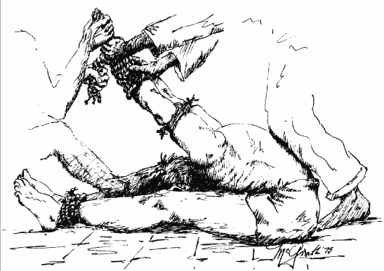
Torture at the Hanoi Hilton
A US Navy pilot who’d been shot down over North Vietnam was once more dragged from his prison cell, interrogated, beaten and tortured, and then interrogated again. The first thing his interrogator asked him was, “Wouldn’t you like to go home? Wouldn’t you like to be free?”

Barely able to stand, the American looked down at him and said, “I don’t understand your question. I am free.”

“Free? You call this free? Are you a fool? Do you understand nothing? Don’t you realize you are under our total control?”

“Well,” the young officer replied, “you do have control over my body, and my surroundings, but nothing more.”

“There is nothing more.”

“Ah, spoken like a true communist. Sadly for you, you’re wrong. There is so much more. There is the Good News of Jesus Christ, the truth of the Gospel. Because I believe in that truth, I am free. But because you don’t believe, you remain a slave.”

His interrogator shouted at him, “You dare to call me a slave. You’re the one in chains.”

“Yes, and I thank you for the leg irons. They remind me of how much Jesus suffered for us all…for you too. Maybe that’s why I’m here: to help you find him.” And with that the session ended. He was again beaten and dragged back to his cell where he spent the next five years.

And so now we fast-forward forty years or so and find ourselves worried about all sorts of things, earthly things, imagining the worst, and forgetting the truth. Too many people today are like that interrogator in Hanoi. They look around them and they see nothing more. Like Pontius Pilate they can look at the Son of God and sneer, “What is truth?”

Pope Francis: "Pray for me..."
Yes, so many folks today deny the very existence of truth. Pope Benedict aptly called it, the “dictatorship of relativism,” a kind of radical political correctness that forces itself on the world and screams, “How dare you claim to have the truth.”

It has infected even the Church. Christians want to take the Gospel, rewrite it to fit their own personal wants, and get rid of that pesky Cross. Pope Francis, in the very first homily of his papacy, a homily preached to the cardinals who elected him, stated:
“When we walk without the Cross, when we build without the Cross, and when we profess Christ without the Cross, we are not disciples of the Lord. We are worldly; we are bishops, priests, cardinals, Popes, but not disciples of the Lord.”
Yes, the truth, the Cross of Jesus Christ, can be very inconvenient; for if we really accept it, we must come face to face with our own lives, our own sinfulness, our own slavery. But to accept the truth of the Gospel is to change. To accept the truth is to become a disciple. That’s why Jesus could say,
“If you remain in my word, you will truly be my disciples, and you will know the truth, and the truth will set you free” [Jn 8:31-32].

The truth not only sets us free, but we are free only in truth. It’s common for people to think freedom means the right to choose good or evil. But that’s not what Jesus tells us. True freedom is only the freedom to choose what is good – for once we choose evil, we cease being free. Instead we become slaves, slaves to that evil, slaves to sin.
King Nebuchadnezzar's Fiery Furnace
Brothers and sisters, our lives are marked by thousands of everyday decisions and actions, but at crucial moments in our lives we are expected to be heroic. Like Shadrach, Meshach, and Abednego in the furnace, like that young pilot in Hanoi, if we want to be truly free, we have no other choice. It’s then, when we act in true freedom, that our true selves emerge most fully, most courageously, most divinely.

Do you believe that? Really believe it? I hope so because it’s the truth. And the truth – the truth of that deep divine life we are all called to share -- will set us free.

God's peace.

Tuesday, March 19, 2013

Pope Francis: An Interview

Some months ago, the Catholic television network, EWTN, interviewed Cardinal Bergoglio of Buenos Aires. At the time, of course, neither the network nor the Cardinal, knew that just months later he would be Pope Francis. Since so many want to know more about this man, I have included the interview below.


Saturday, March 16, 2013

Pope Francis Surprises

While I certainly didn't expect Cardinal Bergoglio to be elected Pope, I did, however, expect to be surprised. And for me, at least, his election was definitely a surprise, although a most pleasant one.

Pope Francis Smiling
There are some, however, who are not at all pleased with his election, and many media outlets were only too happy to parade the disaffected through their studios almost as soon as the Holy Father's name was announced. With the DVR recording EWTN, I channel surfed the other networks to see what the self-appointed experts had to say. One network, obviously displeased that the new Pope was not a Unitarian, introduced an ex-priest and a (former?) nun who also happened to be a practicing lesbian. As you might expect they were very unhappy that the College of Cardinals had elected a man who strongly supported the Church's consistent teaching on moral issues. On another network, one interviewee, while admitting that Pope Francis appeared to support the poor, went on to question the depth of that support because he had long ago rejected liberation theology. I was amazed the network had been able to find someone who still equated Marxism with helping the poor. And then there was our new Pope's fellow Jesuit who added with some suspicion: "I've never seen him smile."

I encountered much more of the same that first evening of Pope Francis' papacy. I suppose all this was to be expected since most of the secular media are hostile to the Catholic Church and its teachings. Their usual tactic is to shine the spotlight on Catholics who share this hostility. This, they believe, will allow them to brush aside any charges of anti-Catholic bias. Their selection of commentators, however, only confirms the bias they try to disguise.

What interests me most about the secular media is their belief that the Catholic Church will somehow toss aside 2,000 years of magisterial teaching simply to appease them and those who share their ideology. They believe this because they've been able to find some nominal Catholics who agree with them. I say "nominal" because a Catholic who openly rejects the magisterial teaching of the Church is really rejecting the Church as well. Indeed, once a person rejects one set of teachings, what's to keep him from rejecting all the rest whenever it becomes convenient to do so? Moreover, one who believes the Church can change its teaching on such issues as abortion or homosexual marriage simply does not understand the Church. It's not that the Church stubbornly refuses to change its teachings in the face of the prevailing zeitgeist; rather, the Church cannot change because these teachings are founded on divine law, not human law.

I expect this truth will eventually and grudgingly be accepted, and result in either schism or a massive apostasy. In this I tend to agree with Pope Benedict XVI who foresees a future Church that will be smaller, holier and persecuted.

Over the past few days, as I've thought about Pope Francis and what he will mean for the Church, I've come to believe that he will probably surprise us all again and again throughout his papacy. He is fully Catholic, fully the Apostle, the one sent by God to serve His people. He is a man of orthodox belief, who, like his predecessors, will be unwavering in his teaching. And by choosing the name "Francis" he has shown us that he is a man of the poor, a man who understands better than most what Catholic social teaching really means.

Peter and John at the Temple Gate
When I first saw Pope Francis standing on that balcony, I thought immediately of St. Peter on the day of the first Pentecost when he and St. John encountered the crippled man begging at the "Beautiful Gate" of the Temple:
When he saw Peter and John about to go into the temple, he asked for alms. But Peter looked intently at him, as did John, and said, “Look at us.” He paid attention to them, expecting to receive something from them. Peter said, “I have neither silver nor gold, but what I do have I give you: in the name of Jesus Christ the Nazorean, rise and walk.” Then Peter took him by the right hand and raised him up, and immediately his feet and ankles grew strong. He leaped up, stood, and walked around, and went into the temple with them, walking and jumping and praising God. [Acts 3:3-8]
This was the image that came to mind when I first saw Pope Francis. He, too, was standing at a "Beautiful Gate," but today's temple gate looks out over St. Peter's Square and from there to the entire world; and the world was certainly watching. "Look at us," Peter said. And Pope Francis asked us to look at him and pray for him. This humble man bowed low to the people, to the Church he will serve, asking, begging for our prayers. Then he spoke to all of us, and blessed us all, knowing that like the crippled beggar outside the gate we, too, are broken and in need of healing, knowing that we are poor in both body and spirit. In his humility he reached out to us with the hand of the shepherd asking us to take hold so that, together, we can raise each other up, we can, through God's grace and in the name of Jesus Christ Crucified, make each other strong. Yes, together, we can enter the temple "walking and jumping and praising God."

This was what the Spirit showed me when I first saw Pope Francis. And on the next day the Pope reinforced this image in the first homily of his papacy as he spoke to the Cardinals who elected him, asking them "to walk, to build, to profess Jesus Christ Crucified."

Keep Pope Francis in your prayers, for he will need both strength and humility as he leads the Church. He will surprise the world, and the world will respond. Some will cheer him on and join in his work of walking and building and professing; too many will attack him; others will wonder what he's about; and perhaps the largest number will be forced to examine their own faith and how they live it.

Pax et bonum...

Thursday, March 14, 2013

Pope Francis: His First Homily as Pope


Pope Francis celebrated his first Mass as Pope on Thursday afternoon in the Sistine Chapel. This Missa pro Ecclesiae was celebrated with the cardinals who elected him.

The following is the full text of the Pope's homily. (Translation provided by Vatican Radio).

_________________

In these three readings I see that there is something in common: it is movement. In the first reading, movement is the journey [itself]; in the second reading, movement is in the up-building of the Church. In the third, in the Gospel, the movement is in [the act of] profession: walking, building, professing.

Walking: the House of Jacob. “O house of Jacob, Come, let us walk in the light of the Lord.” This is the first thing God said to Abraham: “Walk in my presence and be blameless.” Walking: our life is a journey and when we stop, there is something wrong. Walking always, in the presence of the Lord, in the light of the Lord, seeking to live with that blamelessness, which God asks of Abraham, in his promise.

Building: to build the Church. There is talk of stones: stones have consistency, but [the stones spoken of are] living stones, stones anointed by the Holy Spirit. Build up the Church, the Bride of Christ, the cornerstone of which is the same Lord. With [every] movement in our lives, let us build!

Third, professing: we can walk as much we want, we can build many things, but if we do not confess Jesus Christ, nothing will avail. We will become a pitiful NGO, but not the Church, the Bride of Christ. When one does not walk, one stalls. When one does not build on solid rocks, what happens? What happens is what happens to children on the beach when they make sandcastles: everything collapses, it is without consistency. When one does not profess Jesus Christ - I recall the phrase of Leon Bloy – “Whoever does not pray to God, prays to the devil.” When one does not profess Jesus Christ, one professes the worldliness of the devil.

Walking, building-constructing, professing: the thing, however, is not so easy, because in walking, in building, in professing, there are sometimes shake-ups - there are movements that are not part of the path: there are movements that pull us back.

This Gospel continues with a special situation. The same Peter who confessed Jesus Christ, says, “You are the Christ, the Son of the living God. I will follow you, but let us not speak of the Cross. This has nothing to do with it.” He says, “I’ll follow you on other ways, that do not include the Cross.” When we walk without the Cross, when we build without the Cross, and when we profess Christ without the Cross, we are not disciples of the Lord. We are worldly, we are bishops, priests, cardinals, Popes, but not disciples of the Lord.

I would like that all of us, after these days of grace, might have the courage - the courage - to walk in the presence of the Lord, with the Cross of the Lord: to build the Church on the Blood of the Lord, which is shed on the Cross, and to profess the one glory, Christ Crucified. In this way, the Church will go forward.

My hope for all of us is that the Holy Spirit, that the prayer of Our Lady, our Mother, might grant us this grace: to walk, to build, to profess Jesus Christ Crucified. So be it.

--------------------

What a wonderful homily. If all of us in the Church, all members of the Body of Christ, profess Christ Crucified, and do so constantly in all that we say and do, Jesus Christ will transform us and the Church will transform the world.

Wednesday, March 13, 2013

Pope Francis

Pope Francis greets Rome and the World.


Yes, we have a Pope! And he is Pope Francis, the former Archbishop of Buenos Aires, Jorge Cardinal Bergoglio.

The College of Cardinals has surprised the world by choosing this holy, humble man. He is first in so many ways: the first Francis; the first Jesuit Pope; and not only the first Argentinian, but also the first Pope from the Americas.

As the people of Rome shouted from St. Peter's Square: Viva il Papa!


- Posted using BlogPress from my iPad

Habemus Papam!

We have a new Pope, although the world does not yet know his name. Like so many others I'm sitting here at home glued to the TV screen in anticipation.

The balcony is empty, but will soon show us our new Vicar of Christ.


God be praised!


- Posted using BlogPress from my iPad

Atheist Defends the Church...Against a "Catholic"?

This brief video is truly remarkable. In it Piers Morgan, a nominal Catholic who disagrees with pretty much everything the Catholic Church teaches, turns to well-known atheist, Penn Jillette, apparently expecting to encounter someone who agrees with him. Instead, Jillette defends the Church and, in effect, asks Morgan why he doesn't just leave the Church since he can't seem to accept any of its teachings. Good question. Of course, Morgan, as usual, asks questions and then constantly interrupts, not allowing his guest to answer. Fortunately, Jillette perseveres and manages to make his case.


Homily: Wednesday, 4th Week of Lent

Readings: Is 49:8-15; Ps 145; Jn 5:17-30

The other day, while running a bunch of errands in the car, I happened to hear a radio preacher telling his listeners that their sins would lead inevitably to God’s punishment. “Your sins will open wide the gates of hell,” he told us, “and there’s not much you can do about it.” My first reaction was, “Well if we can’t do anything about it, why are you even telling us?” Later on, though, he did soften his message a bit and mentioned the need for repentance. But even then he didn’t sound very hopeful.

By the time I’d arrived at the post office, I realized I’d been listening to him for about 15 minutes and not once did he mention the Good News of Jesus Christ. It caused me to wonder how many Christians think of God only in terms of judgment and punishment. I suspect, too many. And it’s certainly no way to evangelize.

Of course we must understand that we’ll all be judged. Indeed, in today’s Gospel passage Jesus tells us explicitly that the Father gave Him the power to exercise judgment [Jn 5:22]. Yes, we will be judged.

But we will be judged by a God of mercy, a God of forgiveness, a God who gave His life for us, and a God who gives us a lifetime in which to return to Him in repentance. What could be better than that? And so the Good News is truly good.

Realize, too, that this Good News, this Gospel, isn’t new to the New Testament. It’s the same news proclaimed throughout the Old Testament as well. The prophets, after all, were in the business of pointing exclusively to one thing: to the Good News. Perhaps more accurately, they pointed to one person: to Jesus Christ.

Turn again to today’s reading from Isaiah. Can’t you hear the prophet preaching the Good News of Jesus Christ? As he tells the prisoners to “Come out!” and pleads with those in darkness to “Show yourselves!” No longer shall you hunger and thirst, “For the LORD comforts his people and shows mercy to his afflicted” [Is 49:9-10,13].

And our passage ends with perhaps the most comforting words in all of Scripture:
“Can a mother forget her infant, be without tenderness for the child of her womb? Even should she forget, I will never forget you.” [Is 49:15]
Such prophetic, consoling words…and such fitting words for today when so many are without tenderness for the infants in the womb.

Yes, Isaiah preached the Good News 700 years before the Incarnation, and gave the world a taste of God’s love, God’s forgiveness. Like John the Baptist, whom he foretold, Isaiah also walked in the wilderness to “prepare the way of the LORD!” [Is 40:3] – to prepare the way for Jesus Christ.

For it is Jesus, Who forgives the sins of the repentant.

Jesus, Who heals bodies and minds and souls.

Jesus, Who offers eternal life to those who believe.

Jesus, Who preaches this Good News to all.

Jesus, Who gives us His Church, the sacramental font of God’s grace.

And He does it all out of love for the Father, and love for us.

Do we really hear and accept the Good News Jesus offers us? Or do we only pretend to hear, remaining closed to the Word of God because sharing it demands a changed heart?

Ask Christ to touch your heart today and bring you the gift of openness to His Word. And never doubt God’s love, but recall those words from Isaiah: "I will never forget you."  -- words intended to strike the heart, words we all long to hear from those who love us.

Today, let’s just keep this simple truth in mind: God will never forget me.

I will go to Calvary in my prayer and pray:  "God will never forget me."

I will go to the Empty Tomb in my prayer and pray:  "God will never forget me."

I will bring my brokenness and worries, my problems and joys to God and pray "God will never forget me."

And then, filled with God’s love, let me then ask, “Who is God asking me to "never forget?"


The New Pope...Doing an Awesome Job?

Okay, it's time for a little levity amid all the in-depth commentary and oh-so-serious prognostications by the wags and pundits who have gathered in Rome to report on the conclave. The below video was made several days ago, before the College of Cardinals even entered the conclave, and consists of interviews of people on the street in which they are asked their opinions of the "new Pope". The scary thing, of course, is that these people probably vote in our elections as well...


Tuesday, March 12, 2013

No Pope Today

The Church remains "Pope-less" this evening after the electors of the College of Cardinals took their first secret ballot and, as expected, did not give one man the necessary two-thirds majority. Indeed, the black smoke seemed especially black as it poured out of that little chimney on the roof of the Sistine Chapel. Knowing there would be only one ballot on this first day of the conclave, the huge crowd in St. Peter's Square dispersed within minutes and either headed back to their homes or made their way to one of Rome's wonderful restaurants, many within easy walking distance of the square.

I must admit, I feel a slight touch of envy toward those fortunate enough to be in Rome during this exciting time. At my age this might well be the last conclave in my lifetime. For the first time in my life, many of the papabili are either my age or younger. As a priest friend of mine said to me some years ago, "You know you're getting old when you're older than the Pope."

How long will it take before the Cardinals decide on the man who will be the next Vicar of Christ on earth? I noticed that Timothy Cardinal Dolan of NY predicted a brief conclave, just a couple of days. And yet others think it will take more time than usual because there is no obvious "front-runner", if I may be excused for using this obviously political term.I suppose the only correct answer is, "Only the Holy Spirit knows."

"Where will be next Pope be from?" is the question the media never tires of asking. From Milan, or Brazil, or the Philippines, or Hungary, or Africa, or Canada, or even the United States? The truth is, it doesn't matter. If the Catholic Church is truly catholic, if it is the universal Church founded by Jesus Christ, the Church that displayed its catholicity under the leadership of St. Peter on that first Pentecost, the Church that spoke that very first day in the tongues of the entire world -- if this is the One, Holy, Catholic and Apostolic Church, then the nationality of the next Pope is unimportant. Far more important that he be holy and humble and strong and Catholic.

Let's all join together tonight in prayer, and ask the Holy Spirit to give us the Pope that the Church and the world needs.

How exciting it will be to once again hear those words, "Habemus Papam."

- Posted using BlogPress from my iPad

Sunday, March 10, 2013

Homily: 4th Sunday of Lent

Readings:  Jos 5:9a, 10-12; Ps 34; 2 Cor 5:17-21; Lk 15:1-3, 11-32

It’s a wonderful story isn’t it? The parable of the prodigal son is really a gospel within a gospel, the heart of the good news that Jesus brings to a sinful world. It’s so simple that even I can understand it; and yet it’s so profound that no one can fully plumb its depths. And so today we’ll just skim the surface and see if we can take away some little nuggets of God’s wisdom that might help us better know God and ourselves.

Let’s begin by asking: Who’s described as the happiest, the more joyful in this parable? The answer, of course, is the father. Now, I’m sure the younger son is also happy, but that’s not mentioned, is it? Because it’s not the main point of the story.

You see, this story is all about the joy of Our Father, Our God – and because of this, I’ve always thought it should have been called the parable of the merciful father. Just recall how happy the Father is when his son returns. The Father’s joy is the last thing the son expects, but the first thing he encounters. This joy is the heart of the parable and a sign of the depth of the Father’s love.

You see, love reaches its completion in forgiveness. And since God is love, He is also forgiveness. This is why He finds such joy in mercy. The joy of the Father! The Father who rejoices in finding us, in forgiving us. And it’s in this joy, that Jesus lives! It’s this joy He wants to share with us. What did He say to the Apostles?
“I have told you this so that my joy might be in you and your joy might be complete” [Jn 15:11].
He wants us to be totally happy, something that happens most completely when we experience His forgiveness.

This is the joy that Jesus desires to bring us, so He can reveal the Father to us, so we can enter into His relationship with the Father. How did St. Paul put it?
“For you did not receive a spirit of slavery to fall back into fear, but you received a spirit of adoption, through which we cry, ‘Abba, Father!’” [Rom 8:15]
So we’re allowed to say, “Abba Father,” the way Jesus says it. We’re allowed to call God the Father our Daddy. This is what we’re all called to do, to know and love the Father so well that we too can pray to our Daddy God, our “Abba Father,” with the childlike love that the He desires.

Now, the father isn’t the only person in the parable, is he? There are also the two sons. And both are sinners.

The younger son is the obvious kind of sinner, the kind we all see and recognize because his sins are so large, so public, so in your face. Oh, yeah, he’s a sinner all right. His journey begins with selfishness, a selfishness that takes him from the home of his father to a place of sin and personal gratification, to a place where relationships never last. When his money disappears, so too do his "friends." And then he’s alone, mired in the mud of a pigpen, just as he’s mired in sin. And it’s there, immersed in his sinfulness, in the midst of all that filth, that his conversion begins.

Before he ever gets out of the pigpen, he admits his sinfulness, and finds two things: Contrition: "I will say to him, 'Father, I have sinned against heaven and against you...” And the need for penance: “Treat me like one of your hired hands." [Lk 15:18-19]

Keep in mind that penance is for growth, not for punishment. That’s the difference between God’s justice and our justice. Our prison systems, although we like to call them correctional institutions, are really places of punishment. Rarely are they places of reparation, repair and correction; rarely are they places of growth.

Penance is reparation, repairing or correcting a sinful lifestyle; and its purpose is to help us change that pattern. "Doing penance" means taking steps to change your life, to make room for something new.

Of course, conversion can’t happen or even begin, unless we expect forgiveness. And forgiveness awaited the younger son, didn’t it? The father, in his wisdom, expected his son to return. Why else would he wait and watch for him? Seeing his son in the distance, the father runs out to meet him with an embrace and a kiss. Through one loving gesture, the father forgives the son—and the son hasn't even made his confession yet!

When the confession comes, the father hardly listens, because the important thing isn’t confession, but that his son has returned. The son doesn’t need to beg for forgiveness, he’s already been forgiven. This is the glorious Good News! God's forgiveness, just like His love, doesn't stop. This is the loving God Jesus reveals to us: the loving God who can’t not forgive!

Ah, but there’s another son, isn’t there? There’s the elder son, who seems like the perfect son. He honors his father. He works hard. He doesn’t ask for favors. Yes, he’s the perfect young man, the kind we’d all like our daughters to marry.

Oh, he seems respectable, but beneath that perfection, beneath the surface, there’s a hardness, a simmering hatred that bursts through the surface when his sinful brother returns and is given the royal treatment.

What does he do? He becomes angry and stays outside, pouting in the darkness. It’s always in the darkness where the worst sins are committed. He hates his younger brother, the foolish one who took the money and ran, the son who spent his birthright on sin. But he hates someone else as well.

He also despises his father, because he can’t stand the thought of his father’s forgiveness. You see, he’s also motivated by selfishness, but it’s a darker kind because it hides under the cover of respectability, the kind that says, “I’m better than you. I’m holier than you. I deserve more than you.”

Oh, the elder son was a sinner all right; he just didn’t think he was. He despises his father for being so forgiving, but it never crosses his mind that he needs that same forgiveness.

Yes, like the two brothers, you and I are also sinners. But the question each of us must ask today is: Which kind of sinner am I? Am I the in-your-face, party hearty kind of sinner, weak of will and easily led astray? Or am I the hateful, resentful, unforgiving, pouting kind of sinner, the sinner who places himself above all others? I suspect, for most of us, we have a bit of each in us.

But once we answer that question, once we know who we are, only then do we come to realize not only that we need forgiveness, but also that we need to forgive. It’s this knowledge, or the lack of it, that determines where we go from here.

Brothers and sisters, forgiving is no big thing for God. On the contrary, He delights in it, because forgiveness completes God’s love. In forgiveness, love is at its strongest. In forgiveness, love, especially God’s love, generates new life.

Yes, God’s delights in forgiveness. And that’s a good thing, isn’t it? Yes, it’s truly the Good News!