The occasional, often ill-considered thoughts of a Roman Catholic permanent deacon who is ever grateful to God for his existence. Despite the strangeness we encounter in this life, all the suffering we witness and endure, being is good, so good I am sometimes unable to contain my joy. Deo gratias!


Although I am an ordained deacon of the Catholic Church, the opinions expressed in this blog are my personal opinions. In offering these personal opinions I am not acting as a representative of the Church or any Church organization.

Showing posts with label Apostles. Show all posts

Tuesday, January 20, 2026

Homily: Tuesday, 2nd Week in Ordinary Time - Year 2

Readings: 1 Sam 16:1-13 • Psalm 89 • : Mk 2:23-28

What a wonderful Gospel passage, where Mark clearly shows the New Testament fulfilling the Old. 

Mark tells us that Jesus and the disciples were walking through a wheat field on the Sabbath; and as they walked the disciples picked the heads of grain and ate them.

Several places in Exodus, Leviticus, and Deuteronomy apply here. In fact, the Law allows the gleaning, or picking grain from another’s field [Dt 23:25], but only with your hand. Pick just enough to satisfy your hunger. You can’t roll through someone else’s field with a combine. Then there are the Ten Commandments, requiring the observation of the Sabbath day by doing no work [Ex 20:10; Dt 5:12-15].

The Pharisees, of course, were shadowing Jesus, intent on finding fault, so they challenged Him, asking why His disciples were violating the Law. As usual, they interpreted the Law narrowly, but Jesus, as usual, turned the tables on them.

Jesus began by criticizing their ignorance of Scripture: “Have you not read what David did…?” Here He referred to the 1st Book of Samuel. David and his companions were fleeing King Saul. Hungry, David approached the priests of the sanctuary at Nob and requested bread. But the only bread available was the Bread of the Presence, which, by Law, was reserved for priests alone [Lev 24:9]. But Abiathar, the high priest, gave the bread to David. In his anger, Saul later slaughtered the priests at Nob, not because he thought they had violated the Law, but because they had helped David.

Jesus uses this event to explain the true meaning of the Sabbath, that the letter of the Law is not more important than helping those in real need. The letter of the Law might be violated, but not the good the Law intends. Jesus summed it up:

“The Sabbath was made for man, not man for the Sabbath” [Mk 2:27].

God instituted the Sabbath, Jesus reminded the Pharisees, not for its own sake, but for our benefit. For Jesus the deepest intention of the Law is not to bind us but to set us free. How did He put it? The truth will set you free. When you think about it, this isn’t surprising. Surely God wants to set you and me free: our freedom is God's gift. Did not Jesus come “to set captives free” (Lk 4:18)?

And then Our Lord said something remarkable:

“The Son of Man is Lord of the Sabbath” [Lk 6:5].

Mark doesn’t reveal the Pharisees’ reaction to these words, but they must have been horrified. For them this was blasphemy. Using the Messianic title “Son of Man” was bad enough, but He also claimed the divine title, “Lord of the Sabbath.” Yes, Jesus in effect proclaimed His divinity, as He who gave the Law to Israel, the Lord of the Sabbath, with authority over the Law, over creation.

In our first reading from 1 Samuel, we encounter the young David, a shepherd, the seventh and least likely of Jesse’s sons. And yet, he is God’s choice. He will become the greatest of the kings of God’s People, and a type of Jesus Himself.

This is the David Jesus praises to the Pharisees who have conveniently forgotten the true meaning of God’s Law, the David who act points a thousand years ahead to the Lord of the Sabbath.

Perhaps, you and I should consider how we celebrate the Sabbath, the day on which we proclaim Jesus’ glorious Resurrection. Other than taking part in a vigil or Sunday Mass, what do we do to keep the day holy? Is it just another day to spend on the golf course, or in front of the TV?

Or do we take time to help those who are far from free, perhaps the lonely, the homebound neighbor with no family and few friends, someone who yearns for a visit and for words of kindness.

And like the disciples, do we also take some time to walk with Jesus, to talk with Jesus, to pray with Jesus on the day He has declared holy?


Sunday, May 18, 2025

Homily: 5th Sunday of Easter - Year C

Readings: Acts 14:21-27; Ps 145; Rev 21:1-5; Jn 13:31-35

_________________________

Early in the morning, while it’s still dark, I often take a fast walk through our extended neighborhood. Sometimes I pray the Rosary as I walk. On one of those mornings, a few months ago, as I passed a house on a nearby street, I heard the front door slam, followed by a man’s voice shouting a few choice words that I’ll not repeat here. The man who shouted jumped into his golf cart and backed out of his driveway almost running into me. It was dark. He wasn’t looking, so I doubt he even saw me. He then drove off at full speed…in a golf cart, 20 miles per hour

Now, I didn’t know him. And I certainly don’t know what took place in that house that made him so angry that he left in such a hurry, driving off into the morning darkness. But because it was early on a Friday morning, I was praying the Sorrowful Mysteries...

I don’t know, it must have been the Sorrowful Mysteries, but there I was on a street in The Villages, and my aging brain carried me off to Jerusalem. I took me to John’s Gospel, to the 13th chapter, to the passage we just heard, when Judas left the upper room, when he left Jesus and the others. Did he leave muttering, swearing, slamming doors…probably not. We don’t know. John doesn’t tell us.

But John does tell us “Satan had entered him.”

Knowing this, Jesus looked at Judas and said: “What you are going to do, do quickly.”

John also tells us, “…it was night.”

Where did Judas go so quickly that night? Out into the darkness, into the world that had rejected Jesus, the world that wanted Him dead. Judas left Jesus and he left the Apostles. In essence he left and rejected the dual institution of the priesthood and the Eucharistic Church…for that’s what took place at that Last Supper. Yes, Judas ran into the darkness away from the Jesus, the Light of the world, away from the Church.

Pope Leo XIV, our new pope, celebrated his first Mass to a congregation of cardinals. And in his homily, he spoke about the world, and how it perceives Christians, how it perceives our faith:

“…today,” he said, “there are many settings in which the Christian faith is considered absurd, meant for the weak and unintelligent...where other securities are preferred, like technology, money, success, power, or pleasure.”
Pope Leo went on, “…where it is not easy to preach the Gospel and bear witness to its truth, where believers are mocked, opposed, despised or at best tolerated and pitied…
“A lack of faith is often tragically accompanied by the loss of meaning in life, the neglect of mercy, appalling violations of human dignity, the crisis of the family and so many other wounds that afflict our society.”

As I listened to his words, I realized they were timeless, and in truth addressed what the Church has faced for 2,000 years.

When we return to that 13th chapter of John’s Gospel, Jesus really teaches us how to live the Christian life, how to live it then and today. He’d just washed the feet of the Apostles, giving us an example of humility and service, one that even symbolized His giving His life for us on the Cross. But He washed all their feet, including the feet of Judas whom He knew would soon betray Him. Then Jesus did more. He dipped a morsel of bread into His dish and offered it to Judas. Another sign of His love.

John began that 13th chapter with the words:

“…having loved His own who were in the world, He loved them to the end.”

“To the end.” What does it mean?

To the Cross? Is that what it means? To Jesus’ death?

Or is it something beyond that? As one theologian told me, to the fulfillment of God’s purpose, the salvation of humanity. Is that what is means?

Or perhaps, when John says, “He loved them to the end” it’s more personal…

The washing of feet, the dipping of the morsel of bread – to remind us of the extent, the very depth of His love for every person…not just His love for Judas, but His love for each one of us. Perhaps it meant:

...that Jesus loved Judas, who would betray Him;

…that He loved Peter who would deny Him three times;

…that He loved all of them gathered there, all of them who would abandon Him.

Yes, I think that’s what it’s all about.

It’s about loving the Apostles who let fear smother their faith.

It’s about loving the soldiers of an empire, men who knew nothing of Jesus, and yet mocked Him, flogged Him, nailed Him to a Cross.

It’s about loving the Jewish leaders who saw Him as a threat and wanted Him dead.

And Jesus’ response to it all?

“Father, forgive them, for they know not what they do.” [Lk 23:34]

Judas left Him. Walked into the night, to meet with those who despised Jesus, who thought He was an absurdity…And after Judas left, what did Jesus do?

He looked to the Cross, the means of redemption, and told the eleven:

“Now is the Son of Man glorified, and God is glorified in him.”

Jesus speaks here of the crucifixion, an ugly, horrific agony of pain, of torn flesh and death. Adding to it…the mocking, the rejection, the betrayal, the denial, the abandonment.

But in all that darkness, Jesus tells us to behold the glory of God, to understand who God truly is. We can do this because this redemptive act is the manifestation of God’s love for us. For as John reminds us twice in His 1st Letter: “God is love.”

Jesus continues:

“I give you a new commandment…As I have loved you, so you also should love one another.”

Oh, yes, we are called to “Love your neighbor as yourself” but Jesus adds something new. We are called to love “As I have loved you…” – to love as Jesus loves, to love each other as God loves.

You see, sisters and brothers, it’s also about you and me. And as we live our busy lives, how often do we think of God’s sacrificial love for us? As we encounter all the garbage, you know, the petty betrayals, the snide remarks, the personal attacks, the lies…as we plan our responses to those responsible, how often do we stop and recall…

“As I have loved you, so you also should love one another.”

At the end of Mass, I will do one of those deacon things, the dismissal, and send you all into the world. But why are we sent? Simply to glorify God in all we do. As Pope Leo reminds us, to carry the Light of Christ into a world shrouded in too much darkness. Yes, we belong to the Light, the Light of Christ, which the darkness can never overcome.

Like Paul and Barnabas in our first reading, we’re sent to do something new, to take the Good News to others, to be true disciples of Jesus. And there will be hardships, and much that will hurt us. But others will know, despite themselves, that we are called by Christ.

Because Jesus gave us His new commandment:

“This is how all will know that you are my disciples, if you have love for one another.”

It’s not so much what we say, it’s what we do; it’s what we are!

At its core, the world hasn’t changed much over the millennia of human history – the same sins, hatreds, violence, lies – yes, the same darkness.

But then, Christ comes and offers us newness beyond our imagining. John tells us what he saw – “a new heaven and a new earth” – and Christ proclaims from the throne:

“Behold, I make all things new!”

Now, I can’t speak for you, but I’m getting old, so this newness God offers us is very attractive.

Indeed, God’s promises, proclaimed in our second reading from Revelation, tell of wondrous new things, eternally new things that never get old. Only God can that. Yes, God has a lot of newness in store for us.

We need only turn to Him in the sacraments, repent and receive forgiveness, taste His Eucharistic Presence, and believe and live the Gospel.

Such a deal? There’s a lot of talk about wheeling and dealing these days, but all that is really nothing like the good deal God offers each one of us.

Praise God!

Tuesday, February 28, 2023

Homily: Tuesday, 7th Week in Ordinary Time

Readings: Sir 2:1-11 • Ps 37 • Mk 9:30-37

_______________________

Okay, here’s a question for you…It’s really a rhetorical question; you don't have to answer, but at least think about it. And try to be honest. 

Do you prefer serving or being served?

If you give it some thought, it’s not an easy question to answer honestly.

Back in my consulting days, I was a frequent flyer on almost every airline. And some of my clients would book me first-class. I certainly didn’t demand it, didn’t even ask for it, but it was nice, especially on long flights. You know, first-class, the first to board and the first to leave, big comfortable seats, a flute of champagne even before take-off, food that was actually edible. Yes, indeed, the service was sure a lot better than I usually received back in coach.

But, you know, I always felt a bit guilty enjoying all that great service. I kept hearing those words of Jesus:

"If anyone wishes to be first, he shall be the last of all and the servant of all" [Mk 9:35].

Here I was, first and certainly not last, not serving but being served. Yes, I heard those words, but I really didn't dwell on them. And I had an excuse. After all, it was strictly a business transaction: my client paid for good service and the airline and its employees provided it. I was simply an accidental beneficiary.

The trouble is, you and I can get used to it, and begin to think of ourselves as deserving only to be served. Kind of like the apostles, as Mark describes them. Jesus, of course, knew exactly what they were talking about as they walked along the road, along the Way; they were arguing about who was the greatest – who was the GOAT? For you non-sports fans, GOAT is the acronym for Greatest Of All Time…you know, the Tom Bradys and Michael Jordans of the world. Yes, indeed, the apostles were still unformed disciples, all caught up in their distorted understanding of where Jesus was leading them along that Way. 

Of course, the irony of the situation, and the hubris of the apostles could hardly be greater. There they were, in the presence of Jesus – How did Peter describe Him later? “You are the Messiah, the Son of the Living God” – and they were just strolling along, arguing about who among them was the greatest.

And to make matters worse for them, Jesus had just told them:

"The Son of Man is to be handed over to men and they will kill him, and three days after his death the Son of Man will rise" [Mk 9:31].
Mark tells us they didn’t understand, that they were afraid to question him. But they knew exactly who the Son of Man was. Afraid to question? Yes, because they didn’t want to hear His answer, because they were pretty sure it too would frighten them.

So, what did they do? What we all do when we don’t like where the conversation’s going. We change the subject, usually to ourselves. Of course, the wonderful thing about all this is we’re confronted here by the unconcealed humanity of the apostles; the realization they’re just like us. You see, Jesus didn’t pick holy men and women to be His disciples. No, He picked folks just like you and me, and then He and His Holy Spirit worked through them and made them holy. And believe me, it was a job only God could do. 

A bit later, once inside the house (a symbol of the Church) Jesus sat down to teach. And He taught them, just as He teaches us through His Church and His Word. We must serve, He commands us. And whom must we serve? All. Everyone. No exceptions. All those you and I encounter as we, too, walk along the Way. And it’s not going to be easy. How did Sirach put it?

“My child, when you come to serve the LORD, stand in justice and fear, prepare yourself for trials.” [Sir 2:1]

Tomorrow, we begin Lent, a time to restart, to reboot our spiritual lives, a time of almsgiving, fasting, and prayer…and a time for service. To serve others is to serve the Lord:

“For I was hungry and you gave me food, thirsty and you gave me drink, a stranger and you welcomed me…” [Mt 25:35]

Jesus emphasized this by choosing a child, a symbol of whom the Jews called the anawim, the lowly, the weak, the vulnerable. By serving them we recognize God’s presence within them.

And yes, there will be trials, and fearful, unjust times. We will be despised and attacked for protecting and serving the most vulnerable among us.

But God will always be with us, for He is Emmanuel!


Sunday, July 10, 2022

Homily: Saturday, 14th Week in Ordinary Time

Readings: Is 6:1-8; Ps 93; Mt 10:24-33

_______________________________

Today we have a few options. We celebrate Saturday in the 14th week in Ordinary Time. But we also celebrate the optional memorial of St. Augustine Zhao Rong and 120 other Chinese martyrs who gave their lives over a period of three centuries. Finally, we celebrate the Saturday memorial of the Blessed Virgin Mary. So, Father and I decided to wear white, knowing that those dear martyrs would gladly celebrate Mary along with us.

Turning to today’s readings, we find they’re all about calling…well at least in part. Calling is what God does, but that’s just one side of the equation. The other side, the part that really makes far more difference to us as individuals, is our response. And that’s really what these readings are all about, how we respond to God’s call. Now the Good News, and Sacred Scripture is all about Good News, is that God never stops calling us.

I’m going to get a little autobiographical today, always a scary thing to do, giving you a glimpse at my many imperfections. Looking back on my own, confusing life, I realize God began calling me very early. In fact, I was ten years old when I first heard His call. Back then, I didn’t think of it as a call. I simply didn’t know God well enough, and thought of it more as a nagging, not a calling.

Anyway, I had no idea what He wanted of me. He really wasn’t explicit, but He wouldn’t stop calling. Did you ever hear a song on the radio, one that just stuck in your head all day. I think the kids call it an “ear worm” – a pretty good metaphor. Well, that’s what God’s call was like for me. It just wouldn’t go away.

But I was involved in a lot of stuff, so I just pushed it aside and tried to go on with my life. High school, Georgetown, the Naval Academy, flight training, marriage, Vietnam, children, graduate school, my career as a Navy pilot, teaching, a consulting business – it was an intense time, but throughout it all I sensed the tug, the unspoken call. But for what, I didn’t know.

And then, when I was about 30, I was sent to teach at the Naval Academy, I discovered my immediate neighbor, an Air Force officer, was also a permanent deacon. That’s when I began to realize what God’s call was all about, but it still took me another 15 years to respond.

In our first reading from Isaiah, we encounter the prophet’s call. Isaiah spent the first 5 chapters delivering a prophecy to the people of Jerusalem and Judea, telling them what they could expect unless they returned to the Lord. Then, in chapter 6, today’s reading, he described his call.

Believe me, Isaiah’s call was a lot more explicit than mine. No Seraphim flew to me or cleansed my lips with coal, so I’d understand what God wanted of me. No, for me God simply sent a stream of wonderful people who pointed the way: deacons, priests, a bishop, and most importantly, a loving wife who apparently saw in me some faint reflection of what God saw.

When we turn to today’s Gospel passage from Matthew, we hear Jesus speaking to His apostles and really to all who must evangelize…and, folks, that’s all of us…every single one of us. He lets us know that we’ll be treated no better than he is treated. What had He said earlier?

"Blessed are they who are persecuted for the sake of righteousness..." [Mt 5:10]

What did the Apostles think when they heard those words? When you go out and preach the Gospel, you'll be persecuted, handed over to courts, be scourged, hated, and probably killed. Yes, indeed, like sheep among wolves.

Had I heard and through about that, I suspect in my weakness I would have been a bit slower to respond to God's call. But not the Apostles! Their love for Jesus was so strong, His message so compelling, that they went out willingly into the world, into persecution. Because of them, because they responded, not to fear, but to love, we are here in this Church today.

Three times in this brief Gospel passage, Jesus tells the Apostles, as He tells us, not to be afraid. If our love of God is just another form of fear -- fear of His power and judgment -- then it's not love at all. As St. John reminds us in his first letter, "Perfect love casts out fear" [1 Jn 4:18]. Jesus calls us not to fear, but to love, to love as God Himself loves. St. Francis de Sales, addressing fear and love, once wrote: "Those who love to be feared, fear to be loved."

25 years ago, on my day of ordination, as I lay prostrate before that altar in St. Anthony’s church in New Bedford, Massachusetts, I could only think of those words of Isaiah: “I am a man of unclean lips…” Perhaps a momentary touch of fear…and then I heard again the Lord’s response, another question:

“Whom shall I send?”

Yes, indeed, send me, unclean lips and all.

And that’s the same question each of us, each of you, should respond to today. God is calling each of us and continues to do so. He calls us despite our many imperfections, with all those fears that we just can’t seem to let go of.

God is calling you. You need only respond, and He will lead you.


Thursday, January 27, 2022

Homily: Conversion of St. Paul

Readings: Acts 22:3-16; Ps 117; Mk 16:15-18                          

The call to conversion by Jesus can come at the most inopportune times. Recall how Peter and Andrew, James and John were working hard at their profession as fishermen when Jesus showed up and called them away.

“Follow me and I’ll make you fishers of men” [Mk 1:17].

They probably didn’t have a clue about what this would mean for them, but they followed, nonetheless.

Then there was Matthew, the tax-collector. He had a sweet deal going, collecting taxes for the Romans, and pocketing plenty of cash for himself. But Jesus comes along and simply says, “Follow me!”, and Matthew drops everything [Mk 2:14].

Imagine what their friends and relatives thought. You’re doing what? With whom? And you’re leaving everything behind…your business, your family, everything?

Called by Jesus these practical, down-to-earth men willingly gave up everything for something they did not yet understand. Yes, Jesus wasn’t just some itinerant preacher. Obviously, there was something very different about Him, something beyond normal human experience.

Imagine, too, what the future apostles thought when John the Baptist pointed out Jesus to them: "Behold! The Lamb of God!" [Jn 1:29] Behold the sacrificial lamb, the one who will give His life for the world. Jesus was something more than special. He was, as Peter would later profess, “The Christ, the Son of the Living God!” [Mt 16:16]

But not everyone agreed. One was a young Jew named Saul. He was a Pharisee, a Jew of the tribe of Benjamin, a native of the cosmopolitan city of Tarsus in the region of Celicia in Asia Minor. As Paul later described it, Tarsus was “no mean city” [Acts 21:39].

Yes, indeed, Saul was no peasant. Paul’s family was apparently distinguished enough that the emperor had made them Roman citizens, a rare honor. And for his fellow Jews, he had the prestige of being schooled by the famous and learned Gamaliel.

As a Pharisee, now in Jerusalem, Saul had no patience for the new and dangerous sect that worshiped this Jesus of Nazareth as Messiah and Son of God. What a blasphemy! This Jesus could be only a false Messiah, for He had been crucified as a criminal, and had preached such foolishness as the brotherhood of Jew and Gentile.

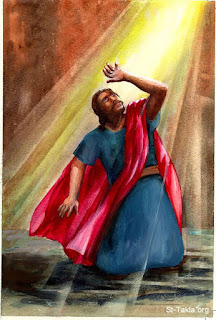
Certain of himself and his mission, arrest warrants in hand, Saul was on his way to Damascus, 135 miles distant, to root out the followers of this Jesus and bring them back in chains for prosecution. But it is here, along this road to Damascus, that Jesus calls him. 

Knocked to the ground, blinded, overwhelmed by the voice of God, Saul is accused of persecuting Jesus Himself. But Jesus has plans for Saul. Renamed Paul, he is in God’s own words, “His chosen instrument.” This zealous Jew will now carry Jesus, the living and incarnate Word of God, to the world, to both Jew and Gentile.

Paul’s calling might have been exceptional in manner, but it was really no different from the calling of every Christian. For, just like Paul, we are all called to follow Jesus in holiness, to enter into an ongoing conversion; and like Paul it is our response that makes the difference. We are all called to the apostolate, to be apostles of Jesus Christ, to be the ones who are sent.

God’s voice comes to us all, that inner voice that brings both a calm acceptance and a restlessness to obey. It speaks to us in the words of the prophet, revealing all that God wants of us, dispelling uncertainty and fear, calling us to respond with our entire being.

Can we abandon ourselves, our autonomy? Can we accept that we too are called, we too are chosen to do, to give, to speak, to pass on to others all that He has given us, done for us? Can we make this our prayer? “What would you have me do, Lord? Tell me and I will do it.”

As Pope Paul VI preached: “…it becomes a need to hasten, to work, to do everything one can to spread the Kingdom of God, to save other souls, to save all souls."

Of course, God gives us a choice. But how did St. Paul put it?

Christ Jesus has made me his own” [Phil 3:12].

That’s right, like Paul we belong to Jesus Christ now. To turn away from that would be foolishness indeed.


Thursday, October 7, 2021

German Bishops: Paganism and Schism

Did you hear the latest out of Germany? A Synod of German bishops and lay leaders of the Catholic Church, perhaps predictably, voted overwhelmingly (168 to 28) to approve the blessing by Catholic clergy of what the synod calls “same-sex partnerships.” This vote was in response to a Vatican decree that explicitly prohibited such blessings. Of the 196 who voted at the synod, I don’t know how many were bishops. I believe there are 27 German dioceses, but there are certainly a greater number of bishops. But even so, this vote is a definite step toward schism. I find it especially troubling that the synod apparently believes, unlike Pope Emeritus Benedict XVI, that truth is determined by majority vote. I certainly cannot confirm my suspicions, but I wonder how many of the voters are active homosexuals. 

To read a more detailed discussion of the synod’s vote, see the coverage by CATHOLICVOTE.ORG. There you will also learn that the synod went even further on related issues:
Friday’s statement included not only the approval of blessings for homosexual couples, but also advocacy for “more tolerance for contraception and masturbation,” Rocca reported. The statement amounts to “an appeal to the pope, acknowledging that many of its proposals ‘essentially fall within the teaching competence of the Bishop of Rome and can therefore not be undertaken by the Church in Germany.’”
The vote, of course, is openly heretical, since it contradicts 2,000 years of Church teaching. In a very real sense it returns us to the pagan world faced by the apostles as they fulfilled Jesus’ command to preach the Gospel throughout the Roman Empire and beyond. In those days homosexuality and the sexual abuse of women and slaves was for many a way of life, especially among the upper classes. But St. Paul didn’t hesitate to challenge the zeitgeist by preaching the Gospel teaching that marriage between a man and a woman is a sacramental and sacred bond and that sexual activity outside of marriage is sinful. The difference today is that members of the Church in Germany are siding and sinning with the pagans while denying the truth of the Gospel. 

Where this will lead, I cannot say. But one hopes the Holy Father will be firm in repudiating the conclusions of the German synod. We shall see. I find myself thinking again of the words that a German theologian, Joseph Ratzinger, wrote in 1970, long before he became Pope Benedict XVI:
"From the crisis of today, the Church of tomorrow will emerge. She will become small and will have to start afresh more or less from the beginning. She will no longer be able to inhabit many of the edifices she built in prosperity. As the number of her adherents diminishes, so will she lose many of her social privileges…she will be seen more as a voluntary society, entered only by free decision…Undoubtedly she will discover new forms of ministry and will ordain to the priesthood approved Christians who pursue some profession…Alongside this, the full-time ministerial priesthood will be indispensable as formerly. But…the Church will find her essence afresh and with full conviction in that which was always at her center: faith in the triune God, in Jesus Chris, the Son of God made man, in the presence of the Spirit until the end of the world…
"The Church will be a more spiritual Church, not presuming upon a political mandate, flirting as little with the Left as with the Right. It will be hard going for the Church, for the process of crystallization and clarification will cost her much valuable energy. It will make her poor and cause her to be the Church of the meek. The process will be all the more arduous, for sectarian narrow-mindedness and well as pompous self-will will have to be shed…But when the trial of this sifting is past, a great power will flow from a more spiritualized and simplified Church. Men in a totally planned world will find themselves unspeakably lonely. If they have completely lost sight of God, they will feel the whole horror of their poverty. Then they will discover the little flock of believers as something wholly new. They will discover it as a hope that is meant for them, an answer for which they have always been searching in secret."

Pope  Benedict’s view of the future Church is probably close to what we can expect in the years to come. Prepare your children and your grandchildren because they will have to live through it.


Sunday, February 28, 2021

Homily: 2nd Sunday of Lent - Year B

 Readings: Gn 22:1-2,9-13,15-18;Ps 116; Rom 8:31-34; Mk 9:2-10

---------------------------

Not long ago I thought my wife’s hearing might not be what it used to be, so I decided to conduct a little test. I stood some distance behind her and said softly, “Diane, can you hear me.” Getting no answer, I moved closer and again asked, “Diane, can you hear me?” Again having received no answer, I moved right up behind her and said softly, “Diane, can you hear me?” And that’s when I finally heard her say, “For the third time, Yes!”

Well, that’s pretty much how you and I communicate with God. We’re so intent on making sure He’s listening to us, that He doesn’t miss all those needs and wants we’re always placing before Him, that we neglect the more important task: We fail to listen to Him. We forget, or simply can’t believe, that God hears our every prayer, that He knows our every need. Not only does God hear us, but He also speaks to us…and He does so definitively.

We need only listen, listen as the Father commanded us. That’s right, twice in the gospels the Father speaks aloud regarding Jesus. At Jesus’ Baptism the Father said:

This is my beloved Son, in whom I am well pleased.

As Jesus begins His ministry that culminates in His death and resurrection, and in our salvation, we learn that the Father sent Him to become one of us; that He is Emmanuel, God with us. Yes, the Father states unequivocally, that He is well pleased with His Son: this Jesus, My Son, has met all My demands for holiness, for righteousness, for goodness. What greater statement could God have made about His Son?

And then, in today’s Gospel passage, the Father again speaks aloud:

This is my beloved Son; listen to him.

With these words we are given our primary responsibility as disciples of Jesus.

Listen to Him.

It’s a simple message, for God never complicates, He always simplifies. Simple but profound, God’s message isn’t obscured by some long to-do list of responsibilities and behavioral expectations; rather, it consists of one, simple command, “Listen to him.” For this is the essence of discipleship, and it hasn’t changed since the days of Abraham.

I can remember as a child -- I think I was about seven years old -- being fascinated by our family Bible. Every week my father would open it up, read aloud whatever passage happened to interest him that day, and then discuss it with us. To be honest, I was probably more interested in the remarkable illustrations in our Bible.

One in particular both fascinated and terrified me. It was a brilliantly clear picture of an old man forcibly holding the body of a young boy against a stone altar. Even more disturbing was the large knife in the man’s hand, a knife pointed straight at the boy. That painting, by Caravaggio, was my introduction to Abraham and Isaac, and the caption beneath it consisted of a single word: “Ready!”

I remember thinking, ready for what? And so I asked my father, and he said, “Ready to sacrifice his son.” Well, that certainly didn’t help; nor was it very reassuring. I asked more questions and received more puzzling answers that pretty much boiled down to: “Because God asked Abraham to do it, and because Abraham loved God.”

It was all very confusing. I also found myself looking at my father a little differently, wondering if God might ask him to do what He’d asked Abraham. Eventually, though, I came to realize that Abraham and Isaac were a kind of special case.

God might not test us as He tested Abraham, but He still wanted us to listen, to obey, to be ready. Yes, Abraham loved and trusted God so deeply, He believed in God so faithfully, that he was ready to do whatever God asked of him. And God, seeing Abraham’s readiness, provided the ram to be sacrificed in place of Isaac. Years later, I learned that this readiness to do God’s will is the mark of the true disciple.

Brothers and sisters, in today’s Gospel passage, they apostles are generations away from Abraham, on another mountain where they encounter another who is ready. Peter, James and John follow their Master up its slopes, separating themselves from the world.

On that mountaintop Jesus gives them a glimpse of what is to come, a glimpse of the promise they don’t yet understand, a glimpse of God, of eternity – and they see it all through Jesus. Standing in His glory with Moses and Elijah, Jesus is fulfillment of the Law and the Prophets.

There was no caption explaining that scene for the apostles, but maybe Peter was starting to get the picture. Maybe deep down he’d come to realize another Biblical sacrifice was about to be offered. Like Isaac, another Son would carry his own wood of sacrifice up yet another hill.

Unable to grasp this fully, Peter is overwhelmed by the moment: Let’s build tents and just stay here forever. It’s so good to be here. But to be content with the present is not a statement of readiness, is it? It’s a statement of complacency. And complacency isn’t the mark of the disciple.

To help Peter and the others understand this, God speaks, and Peter hears the voice of God, the voice that causes a healthy fear:

This is my beloved Son – listen.

In this Lenten season, as we page through our history as a people…as we are presented each week with the stories of God’s faithfulness…as we picture the scenes and try to understand the captions God writes beneath them…as we do all these things, let’s remember what we’re called to do: to listen and to be ready to act.

Will we listen to Jesus as he speaks to us in so many ways: through the Gospel; through the Church; through each other?

But are we ready, ready to act, ready to sacrifice? We’re asked to make only one sacrifice: total dedication to God – to be ready to serve Him always.

Ready to listen and respond to His call.

Ready to put sin behind us.

Ready to name grace when we see it.

Ready to love the unloved.

Ready to defend Christ and His Church in the public square.

Ready to challenge the world when it turns its back on Christ, when it embraces not life but death.

Here lies the very essence of our Christian spirituality: having hearts and minds spiritually tuned to hear what God is telling us. These days of Lent should be our listening time.

Days begun with a moment of quietness, a moment when we pray young Samuel’s simple prayer: Speak Lord, your servant is listening.

Days when we look for God and His message in life’s simple experiences and our encounters with others.

Days that end with a moment of thanksgiving.

Do we thank God for the love that gave us our very being?

Do we thank Him for the sacrifice that promises us eternal life?

Do we thank Him for each other?

Brothers and sisters, the Father who spared Isaac’s life, spared nothing in sacrificing His own Son.

You and I are asked to do no less. But are we ready?


Wednesday, February 24, 2021

Homily: Eucharistic Adoration

Readings: Jas 3:13-18; Psalm 122; John 14:23-29

Listening to St. James is always a bit of an awakening. He certainly didn’t pull any punches. His Letter is filled with wonderful truths about living our faith; but when reading this passage, I was especially struck by his words, “…in the humility that comes from wisdom” [Jas 3:13].

I'm pretty sure He's telling us that wisdom means having a true sense of the reality of things. And perhaps the greatest of all realities is the vast difference between us and the God who created us. Recognizing this difference can do nothing but fill us with humility. Yes, indeed, humility comes from wisdom, the acceptance of God’s greatness and our seeming insignificance.

And yet, our God created us in love…

He wants us to spend an eternity with Him, out of love…

He humbled Himself to become one of us, out of love…

He blesses us with His greatest gift, the gift of Himself in the Eucharist…again, out of love.

And as St. James reminds us, the fruit of it all is God’s peace, a peace that frees us from anxiety and fear.

Of course, we hear much the same from Jesus.

“Do not let your hearts be troubled or afraid” [Jn 14:17], He told the Apostles – a message for all of us.

Are you afraid? If so, you're in good company. The apostles were certainly afraid and confused.

Jesus spoke to them about His death, His execution at the hands of His enemies. In our passage from John, we can almost sense their confusion. 

If He’s the Son of God, one with the Father, how can this happen? How would they cope without Him? Would they also be arrested and executed? Yes, they were afraid, and fear undermined their faith. They began to doubt. 

These fears remained, throughout Jesus' Passion and Death, and even after His Resurrection. Only with the arrival of the promised Holy Spirit on Pentecost did their fears evaporate, replaced by God's peace.

“Peace is my farewell to you; my peace is my gift to you” [Jn 14:27].

And, yes, God’s peace is so very different from the peace the world offers.

For God doesn’t promise the absence of war or conflict. His peace doesn’t free us from suffering or persecution, from pain or illness. It’s not the peace of a tranquil life, nor is it peace of mind.

This is the peace the world promises, always unfulfilling, superficial, misleading, ephemeral, and unjust.

It’s not the peace Jesus gives us. How did He put it?

“Not as the world gives do I give it to you” [Jn 14:27].

Because the peace that Jesus promises completely transcends anything the world can offer us.

Victor Frankl, an Austrian psychotherapist who died in 1997, spent much of World War II as a prisoner in Auschwitz and other death camps.

Frankl, a Jew, wrote a book of his experiences called, “Man's Search for Meaning.”

In it he describes how, in the midst of brutality and degradation, he encountered so much remarkable faith and unselfish love.

Amazed by those who had achieved victory over the sinfulness that surrounded them, Frankl had a revelation. He wrote:

“Then I grasped…The salvation of man is through love and in love.

For the first time in my life, I was able to understand the meaning of the words, ‘The angels are lost in perpetual contemplation of an infinite glory.’”

Yes, in the midst of the horror that was Auschwitz, Victor Frankl had encountered God’s peace. 

This is the peace proclaimed by Christ, a peace that is achieved by victory over sin, something that comes only through the power of God.

The basis of peace, the peace of soul Jesus promises, is God and God alone.

And the very soul of peace is love, which comes only from the love of God and expresses itself through us in our love for others.

Only by turning to God can we rid our lives of all that is driven by selfishness and greed, by hatred and bitterness. For whatever takes away God’s peace from your soul cannot come from God.

Only by turning to God can we replace the evil in our lives with love for God and neighbor, with forgiveness, with the will to help others, and the desire to share the Good News of Jesus Christ.

The secret of peace? Trust, trust in the will of God.

Too often we trust only in ourselves. We think we can achieve peace in our lives by our own efforts, but in doing so we become only like the Pharisees.

How different are the saints…who sought only to love and serve God.

For the saints knew that one doesn’t become a saint. It is God who makes saints…out of sinners who trust in Him and accept His will for them.

No saint ever had a plan to become a saint. Had this been the case, he would have become only a perfectionist, not a saint.

Brothers and sisters, we can possess the peace of Christ, a fruit of the Holy Spirit, but only if God’s Spirit lives within us.

As Jesus promises us:

"If anyone loves me, he will keep my word, and my Father will love him, and we will come to him and make our home with him" [Jn 14:23].

And that’s exactly what our loving God does when we receive Him worthily in the Eucharist.

When God dwells within you, there’s no room for anything else, no room for anything but God's peace – and certainly no room for fear.

Fear never comes from God. To escape it simply turn to our Lord in total trust.

And remember, wherever Jesus is, so too is the Holy Spirit – with us to guide us, strengthen us, encourage us, just as He guides, strengthens, and encourages the Church.

Anyway, what is there to fear when you have been promised eternal life?

As St. Paul tells us again and again, Christ – and only Christ – is our peace [Eph 2:14].


Thursday, October 1, 2020

COVID-19 Bible Study Reflection #17: Faith, Doubt, Fear and Divine Mercy

Today, I hope to address the gift of faith, while touching on the doubts and fears that attack those who do not fully accept this gift from God. That’s right, brothers and sisters, faith is a gift – as the theologian would say, a gratuitous gift. You and I neither deserve it, nor can we work to achieve it. It’s not something we can conjure up on our own. Instead it’s something God offers us in the divine hope that we will accept it.

I’ll begin today by turning to the Gospel according to John, where the evangelist recounts the first post-Resurrection appearance of Jesus to the disciples. Listen to God’s Word and read these verses from John, chapter 20, verses 19 to 31:

On the evening of that first day of the week, when the doors were locked, where the disciples were, for fear of the Jews, Jesus came and stood in their midst and said to them, “Peace be with you.” When he had said this, he showed them his hands and his side. The disciples rejoiced when they saw the Lord. Jesus said to them again, “Peace be with you. As the Father has sent me, so I send you.” And when he had said this, he breathed on them and said to them, “Receive the holy Spirit. Whose sins you forgive are forgiven them, and whose sins you retain are retained.”

Thomas, called Didymus, one of the Twelve, was not with them when Jesus came. So, the other disciples said to him, “We have seen the Lord.” But he said to them, “Unless I see the mark of the nails in his hands and put my finger into the nail marks and put my hand into his side, I will not believe.” Now a week later his disciples were again inside, and Thomas was with them. Jesus came, although the doors were locked, and stood in their midst and said, “Peace be with you.” Then he said to Thomas, “Put your finger here and see my hands, and bring your hand and put it into my side, and do not be unbelieving, but believe.” Thomas answered and said to him, “My Lord and my God!” Jesus said to him, “Have you come to believe because you have seen me? Blessed are those who have not seen and have believed.”

Now Jesus did many other signs in the presence of his disciples that are not written in this book. But these are written that you may come to believe that Jesus is the Messiah, the Son of God, and that through this belief you may have life in his name. [John 20:19-31]

It’s really a remarkable passage, isn’t it? In fact, there’s so much there, I suppose we could spend the rest of our lives plumbing its depths. But today all we can do is scratch the surface, and hope that by doing so, we can deepen our faith, cast aside the doubts, and relieve the fears.

Our Gospel passage relates an event that takes place in the evening of that first Easter Sunday, when the Risen Jesus appears to the Apostles in the upper room.

They’d hidden there since Friday’s crucifixion. Told of the empty tomb by Mary Magdalene, Peter and John had gone to see for themselves. John claims he “saw and believed,” but followed this by admitting he and Peter really didn’t understand the Resurrection …at least not yet.

Then Mary told them of her personal encounter with the Risen Lord; but did they really believe her? We know they doubted, and we know, too, they were afraid. Indeed, fear kept them hidden behind the locked doors of the upper room. One suspects their faith was weak, plagued by those same doubts and fears.

But then, despite locked doors, despite doubts and fears, Jesus is there, standing in their midst. He is alive! And he speaks to them:

“Peace be with you” [Jn 20:19].

He shows them the marks, the nail marks, the gash in his side, the wounds He suffered for their salvation and the salvation of the world. And, yes, they rejoice in His presence, even though they don’t yet understand how this all came to be.

Again, he greets them,

“Peace be with you,” but then He adds, “As the Father has sent me, so I send you” [Jn 20:21].

His words, though, are a mystery. Sent? Sent where? Sent when? Sent to do what? They don’t know. All that will come later.

But Jesus isn’t quite finished with them this evening. He has more to do and to say.

He breathes on them, and they feel it, the breath of His mouth, coming from His Risen Body. Yes, He is certainly alive, for dead men don’t breathe. And as He breathed, He says,

“Receive the holy Spirit. Whose sins you forgive are forgiven them, and whose sins you retain are retained” [Jn 20:22-23].

Once more, they’re lost in His words. Did He just say we’ll be forgiving sins? How does that work? All this sending out and forgiving of sins…for now it remains a mystery. And so, in joy they focus only on what they can see, the living, Risen Jesus. And with that He leaves them, just as He had arrived.

It seems, however, one Apostle, Thomas, wasn’t there. Where was he? We don’t know. John never tells us. But just imagine how Thomas felt when the others told him,

“We have seen the Lord” [Jn 20:25].

Did he simply disbelieve what they told him? Or was he angry with Jesus for coming when he wasn’t there? Perhaps he wondered why Jesus came when he, and only he was absent. We don’t know because John doesn’t tell us that either. All he tells us is what Thomas said:

“Unless I see the mark of the nails in his hands and put my finger into the nail marks and put my hand into his side, I will not believe” [Jn 20:25].

With these words, Thomas secures the title we hear so often: doubting Thomas. His words, after all, were hard words from a man who had spent three years with Jesus. For three years Thomas had witnessed the miracles, had seen hundreds healed of every illness, had even seen the dead brought back to life. Yes, for three years Thomas had been in the presence of “the Christ, the Son of the living God” [Mt 16:16]. But Jesus gives him another week to think about it. For Thomas, it must have been a long week. What did he do as he waited? John, of course, tells us nothing, but we can guess.

Once again, it’s Sunday, the Lord’s Day of the New Covenant, the Second Sunday of Easter, the day we celebrate as Divine Mercy Sunday. The Apostles are still locked in the upper room, still afraid, and likely still troubled by doubts. But this time all eleven are there. Thomas is with them.

Once again, Jesus stands in their midst, and once again, He says,

“Peace be with you” [Jn 20:26].

But then He turns to Thomas and says,

“Put your finger here and see my hands and bring your hand and put it into my side, and do not be unbelieving, but believe” [Jn 20:27].

Does Thomas reach out and touch those wounds? John doesn’t tell us, but I don’t believe he did. For there was no need. He can see the wounds with his eyes. And he can feel the shame, the guilt, overflowing in his heart. Like the women who ran from the empty tomb the week before, Thomas, too, was surely “fearful yet overjoyed” [Mt 28:8]. But in the face of Our Lord, Thomas sees only love, forgiveness, and divine mercy.

He answers with five words, making a perfect act of faith:

“My Lord and my God!” [Jn 20:28]

Yes, doubting Thomas is now believing Thomas, the apostle who later died a martyr for the faith he expressed that Second Sunday of Easter. He became a messenger, an Apostle of Mercy, a missionary to India where he shed his blood for his Lord and his God. Like his brother Apostles, like you and I, like all the baptized, Thomas was sent.

John uses this encounter between Apostle and Lord to break open in the Gospel account the implications of the bodily Resurrection of Jesus, a profoundly important aspect of our Christian faith. Jesus, who stands before the Apostles, is no ghost, no ethereal apparition [Lk 24:37]. The Risen Jesus is the Living Jesus. His body bears His wounds. He speaks. He breathes. He lets Himself be touched [Lk 24:39]. He eats with them [Lk 24:43] He is alive, glorified, but alive.

These first two meetings between Jesus and the Apostles are actually deeply Eucharistic. Jesus comes to them, Body and Blood, Soul and Divinity, in communion, and they receive Him in a shared communion with each other. It’s a renewal of the communion of the Last Supper, celebrated here in that same upper room, the first Christian Church, on the Lord’s Day.

And today, millions of us all around the world, utter those same faith-filled words of Thomas when faced with Jesus’ Eucharistic Real Presence at the elevation during Mass: “My Lord and my God!” [Jn 20:28].

Pope St Gregory the Great (590-604), preached a marvelous homily on this encounter between Thomas and the Risen Lord. He tells us it’s good to remember that there are no coincidences with God. It was not by chance that Thomas was absent on that first Sunday. He returned, he heard, he doubted, Jesus returned, Thomas saw, even touched, and he believed. All happened according to God’s plan. The wound of Thomas’ disbelief was healed by the wounds of Our Lord’s Living, Risen Body. Thomas, then, becomes the witness to the reality of the Resurrection.

Before He leaves the Apostles on this Second Sunday, Jesus leaves Thomas with a kind reminder of his doubts, but then addresses you and me:

“Blessed are those who have not seen and have believed.”

That’s us, brothers and sisters. We’re the non-seers who believe. As such we are called to bring the risen Christ to others. Like the Apostles, we are invited to become living witnesses in our own day to the reality of the Resurrection of Jesus Christ.

On that first Divine Mercy Sunday, Thomas confronted the wounds of his beloved Savior so they could heal the wounds of our own disbelief. Let us then approach the throne of Mercy and cry out with Thomas:

"My Lord and My God" [Jn 20:28].

Those who do will be forever changed, just as the Apostles were changed. But the Resurrection was so utterly miraculous that even after being with the risen Jesus, many disciples still harbored doubts. As Matthew described their last meeting with Jesus right before His Ascension:

"The eleven disciples went to Galilee, to the mountain to which Jesus had ordered them. When they saw Him, they worshipped, but they doubted" [Mt 28:16-17].

“…they doubted.” It would take the Holy Spirit to cure them of their doubts, which He did 10 days later on that first Pentecost Sunday. And what a difference He made.

Just consider Peter, who became a messenger of mercy. He was so filled with the Spirit of the Risen Lord that Jesus could continue His redemptive mission through him, accomplishing miraculous deeds. In the Acts of the Apostles we read that even the shadow of Peter brought merciful healing [Acts 5:15].

John, the “beloved disciple” and evangelist, was imprisoned on the Island of Patmos. There he would continue to receive the consoling and liberating mercy of the Savior. There the Spirit inspired him to write these words of the vision he had received:

“Do not be afraid. I am the first and the last, the one who lives. Once I was dead, but now I am alive forever and ever. I hold the keys to death and the netherworld” [Rev 1:17-18].

And then there was Thomas. Jesus turned Thomas’ doubt into an event of Mercy for generations to come. Out of the repentance born from seeing Mercy Incarnate and the wounds of His Divine love, came that response, those wonderful words that have formed the most profound of personal prayers for centuries: “My Lord and My God”

Pope St Gregory was so right, “Thomas’ doubt healed the wounds of all of our doubts”

At the Liturgy of Canonization for Sister Mary Faustina Kowalski, on Sunday, April 30, 2000, the Pope St. John Paul II proclaimed:

“…Jesus shows his hands and his side. He points, that is, to the wounds of the Passion, especially the wound in his heart, the source from which flows the great wave of mercy poured out on humanity. From that heart Sister Faustina Kowalska, the blessed whom from now on we will call a saint, will see two rays of light shining from that heart and illuminating the world: ‘The two rays,’ Jesus himself explained to her one day, ‘represent blood and water’ …Divine Mercy reaches human beings through the heart of Christ crucified.”

Contemplating Jesus’ sufferings, you and I, then, are faced with a question. How do we take Christ’s Divine Mercy to others? How do we respond to the sufferings of our neighbors? Do their sufferings fill our hearts as well. For that’s what compassion truly means: to “suffer with.” As St. Faustina wrote, “I would like all their sorrows to fall upon me, in order to relieve my neighbor."

God places each of us, each uniquely created individual, in a certain time, in a certain place, and with certain gifts, and does so for a certain reason. We cannot choose our time and place, only what we do with the time given to us. But of one thing we can be certain: each of us is called to be a messenger of His Divine Mercy, an instrument of the peace of Christ in our own little corner of the world.

Jesus also told St. Faustina that, “Humanity will not find peace until it turns trustfully to Divine Mercy."