The occasional, often ill-considered thoughts of a Roman Catholic permanent deacon who is ever grateful to God for his existence. Despite the strangeness we encounter in this life, all the suffering we witness and endure, being is good, so good I am sometimes unable to contain my joy. Deo gratias!


Although I am an ordained deacon of the Catholic Church, the opinions expressed in this blog are my personal opinions. In offering these personal opinions I am not acting as a representative of the Church or any Church organization.

Showing posts with label Dachau. Show all posts

Tuesday, September 13, 2022

Life and Death

Today is my birthday, and at 78 I can no longer deny the fact that I’m gradually turning into…well, an old man. Other than occasional aches and pains, though, I don’t feel very old. And unlike many others, I’m certain I don’t look my age, but then I really don’t spend much time in front of mirrors. I’m still active, and try to make my doctor happy by slimming down to a healthier, more comfortable weight. I don’t run anymore, but my dog, Maddie, and I walk a few miles each day. My brain seems to be a reasonable facsimile of the brain I used as a younger man. Okay, I admit I suffer from occasional short-term memory lapses, but I blame this on the fact that my brain cells must store 78 years of rather intense memories and a tremendous amount of largely useless information, so there’s probably not much room in there for a lot of new stuff. And searching all those cells for memories, new or old, takes some time. I suppose, then, I should be happy given that I’ve been up and about and doing fairly well since leaving the womb on September 13, 1944. But whenever I start to feel so very good about myself, God comes along and points to someone who reminds me of my weaknesses and the amazing strength of others.

This afternoon, while searching through my messy, unorganized bookcases for a particular book, I came across another, a book I bought and read many years ago. I recall spotting it on a shelf in a used bookstore and being intrigued by its unusual title, Noor-un-nisa Inayat Kahn (Madeline)After flipping through its pages, I bought the book for just a couple of dollars. But once I began reading, I couldn't put it down and finally finished it late that evening. 

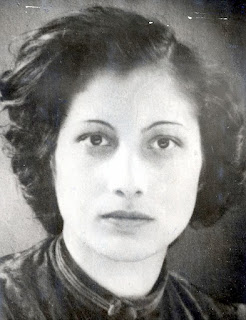
I was captivated by the subject of this true story about a remarkably brave young woman. It was the story of Noor Inayat Khan, an Indian-born, Sufi Muslim who volunteered as an undercover agent for the British Special Operations Executive during World War Two. 
In June of 1943 she was flown to a secret landing site in France. For the next four months she worked with the French resistance radioing critical information back to London. While in Paris, she was betrayed to the Germans and captured in October 1943. She underwent a month of vicious interrogation during which she revealed nothing. Labeled an "extremely dangerous prisoner," she was sent to Germany where she was imprisoned for months in solitary confinement with her hands and feet shackled. Eventually Noor was sent to Dachau and summarily executed along with three other female undercover agents captured by the Germans: Yolande Beekman, Elaine Plewman and Madeleine Damerment. Their bodies were burned in the camp's crematorium.
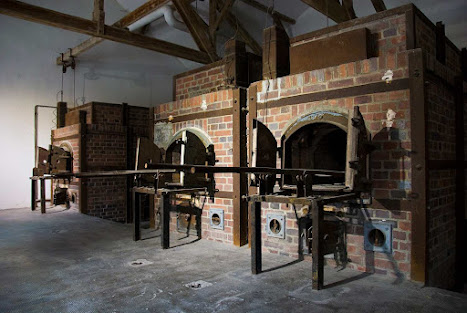
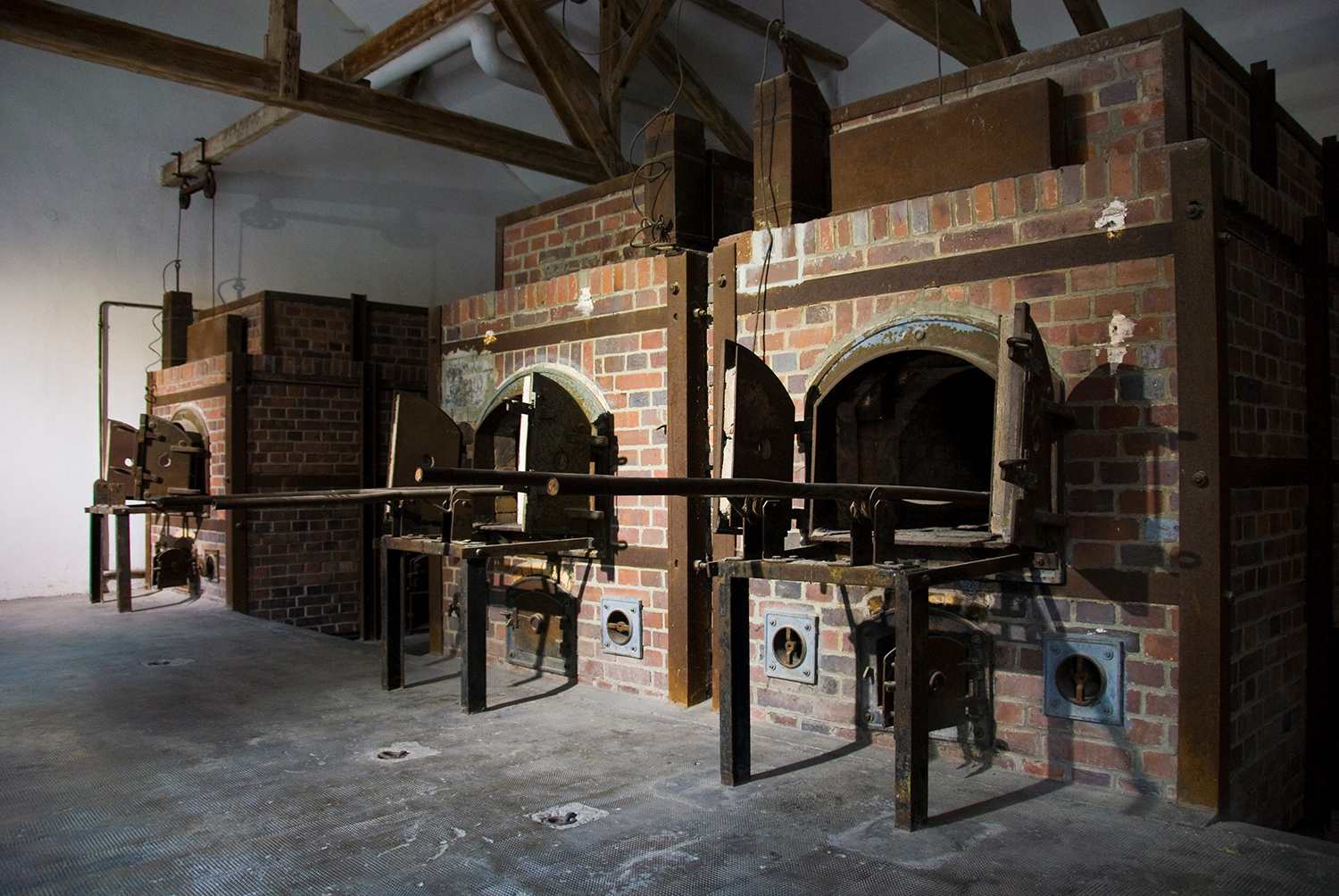
Dachau Crematorium 

It was then I discovered that all four women were executed on the day I was born, September 13, 1944. I found this particularly moving since I had actually visited Dachau with my family in the winter of 1951, not that many years after their deaths. Although I was just seven years old at the time, that visit made a lasting impression on me, especially the crematoria. Now, 78 years after their deaths, I find myself celebrating a birthday while at the same time thanking God for Noor Inayat Kahn are her three courageous, freedom-loving companions whose lives ended just as mine was beginning. 

Life and death, beginnings and endings -- every ending, every death, brings a new beginning, new life. How did Jesus put it?
“Truly, truly, I say to you, unless a grain of wheat falls into the earth and dies, it remains alone; but if it dies, it bears much fruit. He who loves his life loses it, and he who hates his life in this world will keep it for eternal life” [Jn 12:24-25].
When I once related this story to a friend, who lives a rather closed version of Christianity, he stated it was too bad the Kahn woman was a Muslim because she could never be saved. I, of course, disagreed and chastised him for assuming he could tell God to whom He could extend His mercy. Before he could respond I just quoted Jesus:
"Greater love has no man than this, that a man lay down his life for his friends” [Jn 15:13].
Though these four women never knew me, I think of myself as one of their friends. I pray for the souls of these wonderful women every day and especially on this day when so many wish me a "Happy Birthday." For them, we pray, it was a happy day of new birth.

Wednesday, August 10, 2022

Homily: Tuesday, 19th Week in Ordinary Time

 Readings: Ez 2:8-3:4 • Psalm 119 • Matthew 18:1-5,12-14

___________________

Jesus spent a lot of time shaping His disciples’ hearts, opening them to the Kingdom, to the Church they would soon be called on to lead. In today’s passage from Matthew, we see this shaping taking place.

The disciples ask Him a question: “Who is the greatest in the Kingdom of heaven?” Jesus answers with a little “show and tell.” He calls a child to join them, instructing the disciples to be like this child, who acts in faith and humility.

“Do not despise one of these little ones…their angels in heaven always look upon the face of my heavenly Father.” [Mt 18:10]

We all know how different, how wonderfully innocent, children are from adults. Over 45 years ago, when our eldest was just a little girl, we lived on campus at the U.S. Naval Academy in Annapolis where I was teaching. One morning our two daughters were playing with a bunch of neighborhood children, when the youngest came running up to us crying.

When Diane asked her older sister what had happened, she said, “A boy pushed her, and she fell down.” Diane asked, “Which boy?”, and our six-year-old responded with, “The boy in the red shirt.” We looked out at the mob of children, and there was only one boy in a red shirt. He was also the only black child there, the son of a friend and neighbor, another Navy pilot.

Now, almost any adult would have responded differently, probably saying, “the black kid.” But not a child. You see, there’s no bigotry; to the child the only differences are the externals, the red shirts, all those things that really have nothing to do with who we are.

This reminded me of our saint today: St. Teresa Benedicta of the Cross, perhaps better known as Edith Stein, a Jew who became an atheist, then a Catholic, and then a Carmelite nun. But her Jewish roots brought her to Auschwitz where she died a martyr 80 years ago today. She was certainly no child, but rather a brilliant philosopher who came to love the Lord. But Jesus, speaking of children and the Kingdom, brought her to mind.

You see, when I was a child of seven, we lived in Heidelberg Germany. On one of our vacation trips to Bavaria, our father took us to see Dachau, one of the Nazi death camps, this one near Munich.

You might think this would be too traumatic for a seven-year-old, but, no, it wasn’t, and my dad wanted us to see what people were capable of when they turned away from God.

I remember much of that day because it changed my life. For the first time, I saw a Godless world. I remember not understanding why anyone would do such things to others…all because I was a child, still innocent enough to disbelieve or excuse sin.

But for many, God’s love is so incomprehensible, they actually despise how God approaches us in Jesus. They hate it for the same reason Cain despised and killed his brother, Abel. The motive is clear: Jesus presents us with the reality of our better selves, but too often it’s the self we left behind when we grew up.

Like St. Teresa Benedicta, Jesus allows Himself to fall into the abuse and violence of men’s hands. But when they wound Jesus, they are covered by the tide of His Precious Blood flowing from Calvary, and from this very altar and thousands like it. For His blood has the power of absorbing into its love, and therefore neutralizing, the worst hatred of which we are capable.

Victor Frankl, the Austrian Jewish psychotherapist who spent much of World War II as a prisoner in Auschwitz, wrote a remarkable book of his experiences called, Man in Search of Meaning. In it he describes how in the midst of unbelievable brutality and the most degrading conditions he found so many examples of remarkable faith and unselfish love.

Again and again, he encountered people who had achieved victory over the sinfulness that surrounded them. And out of this experience of abject suffering Frankl had a revelation. He wrote,

“Then I grasped the meaning of the greatest secret that human poetry and human thought and belief have to impart: The salvation of man is through love and in love. For the first time in my life I was able to understand the meaning of the words, ‘The angels are lost in perpetual contemplation of an infinite glory.’”

The Apostles, with the help of the Holy Spirit, also came to understand what Jesus meant when He asked them to be childlike. Let’s learn from them and today turn to the Holy Spirit. Invite Him into our hearts, to shape us, to give us the joy that only the love of God can bring. For the Spirit waits patiently, always listening for our invitation, always responding to our prayer.


Thursday, May 11, 2017

Homily: Wednesday, 4th Week of Easter

Readings: Acts 12:24 -13:5a; Psalm 67; John 12:44-50
------------------------------
If you've ever lived outside the US, especially in a country that doesn't respect freedom, you probably know what it's like to be less than free.

Back in the fifties the parochial school I attended welcomed two new children who had just arrived from Hungary. Their parents had managed to escape that country in the midst of the turmoil surrounding the 1956 uprising, and had made their way to the United States and eventually to our town in New York. Having lived under both the Nazis and the Communists, this family, especially the children, had never really experienced freedom of any kind. I remember how amazed they were when they discovered they could actually do even the simplest thing without worrying about the authorities watching them or their parents being arrested. Like so many before them, they marveled at the Statue of Liberty and the light of freedom she held high over the harbor.

But in our exuberance for political freedom, we forget that the light of such freedom, powerful metaphor though it is, doesn't burn forever. Earthly freedom always passes, because it's a flawed freedom, a freedom derived from our human imperfections. Only one freedom truly lasts; only one is eternal: the freedom only God can offer, the freedom Jesus Christ promises. That's what eternal life is, brothers and sisters; it's true freedom, a freedom unlike anything we will ever experience here on earth.

Jesus doesn't just carry the light of this eternal freedom; Jesus is the light. "I am the light of the world" [Jn 8:12], He tells us. And so, without Jesus, the world plunges into darkness. If you want proof of this, just pick up a newspaper. Read the headlines. Watch the evening news. Look at a world that tries its best to evict Jesus from it.


Even in this country, where freedom has long been cherished, true religious freedom is under attack. But such attempts always fail. Christ will not be denied. The light of the world can't be extinguished. Just as the rising sun overcomes the darkness of night and exposes what is hidden, so the light from the Son of God, God's Word, exposes the sinfulness of this world and leads all who will follow to the safety of the Father's embrace.


Back in 1951 my family spent a year in Germany. On a visit to Bavaria My father took us to see the Dacau concentration camp outside Munich. I remember entering the gate and seeing the words "Arbeit Macht Frei."  I spoke enough German to know this meant "Work makes you free" which of course was a pleasant sounding euphemism for it's real meaning: Here you are slaves.

But when we view the world through Christ, our Light, we can recognize these manmade lies and see the truths of God's kingdom. How did Jesus put it? "You shall know the truth and the truth shall set you free" [Jn 8:32]. It's not the work of the slave that makes one free, but the Truth of Jesus Christ.

Just as sunlight brings warmth and allows living things to grow, Jesus' words produce life - the very life of God - within those who receive it with faith. To see Jesus is to see God.  To hear his words is to hear the voice of God.

He, the light of God, overcomes the darkness of sin, ignorance, and unbelief, and brings healing, forgiveness, and transformation.  God's light shines on everyone. He excludes no one from His love. It is we who exclude ourselves by rejecting that love, by rejecting His Son.

We really have only two choices: Either we are of Christ or we are of the world.

Jesus didn't come to condemn us, but rather to bring abundant life and freedom from the oppression of sin, ignorance, and evil. No, Jesus doesn't condemn. We condemn ourselves when we reject God's wisdom and truth. 

It's one thing to live in simple ignorance, but it's something else entirely to reject the Word and those chosen by God to bring it to us. In our first reading from Acts, Paul and Barnabas make the choice to carry the light of Christ into a darkened world, and we are called to do the same.

Jesus tells us that God's Word has the power to judge; it also has the power to transform our lives. Fortunately we have a merciful God, who cares deeply for us. When, in our sinfulness, we slip into the shadow of darkness, He calls us back, into the light. And it's His light, the light of Christ, the light of eternal freedom. Bathed in the light we can let the Word of God and His Eucharistic Presence transform us.

The alternative, brothers and sisters, is only more darkness.

Saturday, June 28, 2014

Endings and Beginnings, Life and Death

Mom...R.N.
Today, June 28, is my mother's birthday. Martha Catherine McCarthy, née Cavanaugh, was born 105 years ago in Fairfield, Connecticut. She died far too young at the age of 67 and is buried on Cape Cod next to my father, John McCarthy, and my brother, Jeff, in Chatham, Massachusetts. Mom was a wonderful, faith-filled woman, a woman of tremendous patience and empathy who always seemed to know exactly what to say and do to ease the hurts and pain of others. The youngest of eight children, she hadn't yet entered her teens when her mother died, leaving her, until her father remarried, as the "woman of the house." I suspect she grew up quickly. Mom went on to graduate from nursing school and worked as an RN for several years before she and my father married on July 4, 1935. No day passes when I don't think of her. She is always with me, reminding me in her quiet way of what is right. Sometimes I actually listen.


Franz Ferdinand and Sophie
Back when I was in high school, I came home one afternoon all excited about a fact I had come across in my tenth-grade World History class: "Hey, Mom, did you know that Archduke Franz Ferdinand was assassinated on your birthday?"

"Yes," she said, "I'm well aware of that. I was just a little girl at the time, only five"

"Do you remember it?"

"Just vaguely. I remember my father saying something about the 'stupid Europeans' but I don't think he or many others thought it would lead to war."

So ended the conversation. Both of my maternal grandparents had immigrated from Ireland and I expect they were happy to forget about all things European.

Memory's an interesting thing. Because of its connection to my mother's birthday, I've always known the date of that fateful event that occurred in 1914, one-hundred years ago today. The assassination of the archduke and his wife, Sophie, in faraway Sarajevo meant far more than the tragic deaths of two of Europe's royals. It not only put into motion the chain of events that led to World War One, but also precipitated the global insanity that made the 20th century the bloodiest in human history. Hitler's National Socialism, Mussolini's odd brand of Italian fascism, and the Communist slavery of Lenin and Stalin all grew out of this horrendous war. And yes, "the war to end all wars," the war that would "make the world safe for democracy," did neither but instead gave us an even more horrendous global war. 

Interestingly, although that first war ended with an armistice on November 11, 1918 -- at the 11th hour of the 11th day of the 11th month -- it wasn't officially over until the grossly irresponsible Treaty of Versailles was signed, interestingly on June 28, 1919, exactly five years after the Sarajevo assassination. This was also my mom's tenth birthday, a day I'm sure she remembered more clearly than the earlier date.

Yes, life and death often coincide on the calendar. Gavrilo Princip, the Bosnian Serb who assassinated the archduke and his wife, was born on July 25, 1894, exactly 105 years before the birth of my eldest grandchild, Pedro Santa Ana, who will celebrate his 13th birthday in a few weeks. The young assassin -- He was only 19 at the time -- died in prison of tuberculosis several months before the end of the war brought about by his actions.

Noor Inayat Khan
About 20 years ago, maybe a little more, I came across a book in a used book store in Norfolk, Virginia. Tucked away on a shelf labeled "Military History", it bore the intriguing but cryptic title, Noor-un-nisa Inayat Khan (Madeline). After flipping through its pages, I bought the book for all of three dollars. Once I began reading I couldn't put it down and finally finished it late that evening. 

I was captivated by the subject of this true story about a remarkably brave young woman. It was the story of Noor Inayat Khan, an Indian-born, Sufi Muslim who volunteered as an undercover agent for the British Special Operations Executive during World War Two. In June of 1943 she was flown to a secret landing site in France. For the next four months she worked with the French resistance radioing critical information back to London. While in Paris, she was betrayed to the Germans and captured in October 1943. She underwent a month of vicious interrogation during which she revealed nothing. Labeled an "extremely dangerous prisoner," she was sent to Germany where she was imprisoned for months in solitary confinement with her hands and feet shackled. Eventually Noor was sent to Dachau and summarily executed along with three other female undercover agents captured by the Germans: Yolande Beekman, Elaine Plewman and Madeleine Damerment.Their bodies were burned in the camp's crematorium.


Crematoria at Dachau
It was then I discovered that all four women were executed on the day I was born, September 13, 1944. I found this particularly interesting since I had actually visited Dachau with my family in the fall of 1951. Although I was just seven years old at the time, that visit made a lasting impression on me, especially the crematoria. Now, years later, I can't celebrate a birthday without thinking of this brave woman and her three companions whose lives ended just as mine was beginning.

Life and death, beginnings and endings -- every ending, every death brings a new beginning, new life. 

Friday, June 6, 2014

D-Day, 70 Years

In September I'll celebrate (very quietly, I hope) my 70th birthday. This is an undeniable fact that I seem to have trouble accepting. Turning 30 didn't bother me, neither did 40 or 50 or 60. There's something about 70, though -- three score and ten, the natural allotment of years, after which we have no guarantee -- that has made me pause and realize this life is definitely coming to an end. It's not that I worry about aging or fear death, because I don't. Both aging and death are natural elements of life itself. I accept them. No, I'm simply surprised that my life has reached this point so quickly. But time doesn't pause; it moves right along.

This came to mind today as I watched some of the news coverage about the 70th anniversary of the D-Day invasion at Normandy. For the first time I realized that perhaps a majority of Americans know little, if anything, about the events we're celebrating. When I was a child, World War II was not the distant memory it is today. After all, I was born during the war. And most of the men I knew -- neighbors, local businessmen, relatives, scout leaders, and, yes, my father -- had served during the war and many told me of their experiences which ran the gamut from the mundane to the heroic. They were normal men, just average American guys, who were called into service, responded willingly, did their duty and much more, and then returned to their civilian lives thankful they had survived the war. The survivors didn't consider themselves heroes; that was an honor they bestowed on those who never returned. If anything they experienced a sense of guilt that they had survived while so many good men had died.

The point or all this? I was too young to recall the war years, and yet World War II was a definite presence during my childhood. As a child I listened to the adult conversations around me, and much of what I heard was about the war. It was what people talked about, and it was fascinating. And then, when I was only seven, my family spent a year in Germany and I saw first-hand the destruction that country had brought on itself. The scars left by the bombing were still visible in many of the cities, and when I walked through the gate at Dachau I could sense the evil that spawned the horrors of that camp.
Berlin 1945: Photo taken by my father

The Gate at Dachau
The men who landed on those Normandy beaches on D-Day began the long process that would take the ground war to Germany itself and ultimately bring an end to all the destruction, all the horror. Far too many of them, especially the young Americans who landed on Omaha and Utah Beaches, sacrificed their lives that day. But their deaths were not in vain because enough of their buddies made it across that beach and many other beaches across the globe, and eventually drove our enemies to surrender.
D-Day: Seawall at Utah Beach

Although I was born three months after D-Day, it remains for me a day to remember. Teach your children and grandchildren about that sad and glorious day so they, too, will always remember.

Pray daily for those who put their lives on the line in defense of our country, in defense of freedom, in defense of you. And pray for peace.

Saturday, July 7, 2012

Homily: 14th Sunday of Ordinary Time

Readings: Ezk 2:2-5; 2 Cor 12:7-10; Mk 6:1-6

Today’s readings are really about three groups of people: the Jews who rejected God’s Word preached to them by the prophet Ezekiel; the people of Nazareth, Jesus’ home town, who rejected God’s Word in the flesh; and lastly, us, the people of today. And perhaps not so obviously, these readings are also about evil.

Evil is a very strange commodity. Sometimes it’s so evident, so blatant, that you can actually feel its presence. Let me give you an example from my own experience.

In 1951, not long after the end of World War II, my family lived in Germany where my father was stationed. Instead of living in Army housing, he felt we should experience the local culture, and so we lived on the economy and went to local German schools. It was a remarkable experience for my brother and me. As a family we also took many short trips to different parts of the country, where I saw the unbelievable devastation that Hitler had brought to his own people, not to mention the rest of Europe.

On one of those trips we visited Dachau, one of the infamous death camps. There I saw first-hand the mass graves, the ovens, the tools of death, all the implements devised by men for only one purpose, to murder the innocents among them. Although it was over 60 years ago, I remember that day as though it were yesterday. The evil, the unbelievable cruelties that had taken place there only a few short years before, was so palpable, so real, I could literally feel it. Evil like that is hard to ignore, even though, at the time, many did just that.

But evil isn’t always so obvious. It often shows up looking clean and shiny, well-scrubbed and well dressed. It can look and sound very reasonable, always ready with a compliment, saying all the right things…and yet beneath the veneer, there is nothing, only misery and despair. Evil rationalizes itself with fine-sounding words and ultimately entraps those who fail to reject it.

As adults we can’t be forced to become ensnared by an evil power like in the horror movies…no, we set the trap ourselves. We make our own choices.

It’s not their sins that characterize those guilty of the greatest evils – for everyone is a sinner – rather it’s the persistence and consistency of their sins. It’s their willingness to choose evil over good, and to do so again and again. You see, the central defect of evil isn’t the sin itself, but the refusal to acknowledge it as sin.

We see this in today’s reading from Mark’s Gospel. Jesus has returned to his hometown of Nazareth, where He preaches in the local synagogue. Those who hear Him have to make a choice, a choice between good and evil…and they make the wrong choice. They reject goodness. Their choice, like so many of the choices we make, stemmed from pride. They simply couldn’t believe that one of their own, someone they had known all their lives, could be so special.

How did they put it? “Is He not the carpenter, the son of Mary…?” How could this common man, this laborer, this man to whom many of them were related…how could He have anything worthwhile to say?

Their rejection of Jesus followed directly from Jesus’ faith and commitment. It was easier for them – as it is for us – to be negative rather than positive. Easier to be destructive rather than creative. Easier, in short, to confuse good with evil.

Edmund Burke summed it up pretty well when he said, that “the only thing necessary for the triumph of evil is for good men to do nothing.”

Like so many people today, the people of Nazareth didn’t want to hear the truth, especially when the truth hurt. For that’s what a prophet does: he speaks the truth. And all too often the truth reminds us of our failings and weaknesses. A prophet’s job is to upset people. His job is to challenge and rebuke people. His job is to demands that they change, that they do more than nothing. Jesus’ neighbors, listening to him in the synagogue, became like their ancestors to whom God had sent the prophet Ezekiel. With stern faces and hardened hearts, they rejected God’s prophet, they rejected God’s Word.

But this time it wasn’t God’s Word spoken by a prophet that they rejected. This time it was Jesus, the Word of God personified…Jesus, much more than a prophet… Jesus, the Son of God Himself, who stood in their midst. He is the Truth.

Had we been there, would you and I have rejected Him as well? Perhaps the better question is: do we reject Him today? The truth? Jesus is still with us. He speaks to us through His Word, read to us daily at Mass. He instructs us through the teachings of the Church. He feeds us with His precious Body and Blood in the Eucharist, entering into our very being, calling us to constant conversion through the “inexpressible groanings” of the Holy Spirit.

And yet, how often do we listen and act on what we hear? Do we fear the change Jesus demands of us and prefer instead to do nothing? Do we excuse ourselves from difficult teaching? Do we rationalize our acceptance of evil, because …well, these are complicated and controversial issues?

Pope John Paul II, one of the great prophets of our time, warned us frequently about the acceptance of a culture of death, the same kind of culture that resulted in a place like Dachau. And yet many of us choose to ignore the warnings.

The right to choose, we are told, is more important that the right to life. Yes, the right to choose death, the right to choose evil. Assisted suicide and euthanasia aren’t really all that bad. Yes, the culture tells us, these are quality of life issues. Capital punishment? Don’t listen to the Church. It’s a secular issue, a law and order issue. It has nothing to do with morality.

Ah, yes, evil can come to the table all dressed up, with fine manners, and sound so civilized, so very reasonable.

The culture condemns the homeless and despises those suffering from AIDS or enslaved by addictions. They brought it on themselves didn’t they? Why should we help them? The culture of death protests loudly when the Church addresses the ills and immorality of society.

It tells the Church that religious freedom is defined not by God but by the state. It tells the Church to keep its religion quiet. Stay out of the public square. Stay out of politics, it says. Stick to your prayers and your Masses. Stay inside the walls of your church.

They seem to believe we live in two worlds, one religious and one secular. What a bizarre notion!  No, brothers and sisters, we live in one world, God’s world. He created it, and He’s the One in charge, not us.

We have only two choices. We can accept Jesus Christ and His Truth, or we can reject Him. There is no middle ground, no seemingly safe place where we can straddle both sides and remain uncommitted.

A few moments ago, we joined together to sing the words of the psalmist, “Our eyes are fixed on the Lord.” This is one of the things that differentiates good from evil.

Are our eyes fixed on the Lord? Or like the people who rejected Ezekiel and Jesus are we fixed on other things?

Let’s pray today that, like Paul in today’s 2nd reading, we may find strength in our weakness. Pray for goodness, brothers and sisters. Pray that God will make us as courageous as Ezekiel to speak His word to our world, even when the world seems unwilling to listen.

Wednesday, July 27, 2011

Blessed Titus Brandsma, Martyr at Dachau

Blessed Titus Brandsma at Dachau
On several previous occasions I have mentioned the visit I made to the Nazi concentration camp at Dachau as a child, just a few years after World War II. That visit had a tremendous impact on me and played a significant role in the formation of my worldview. Although Catholic priests and nuns were imprisoned and killed in all of the Nazi camps, I'm pretty sure Dachau held the largest contingent. Today the Church celebrates one of these, Blessed Titus Brandsma, a Dutch Catholic priest of the Carmelite Order, who was murdered at Dachau in 1942. Considered a martyr by the Church, he was beatified by Pope John Paul II in 1985. Today, July 27, is his feast day.

Fr. Brandsma was a remarkable man, a professor of philosophy, one of the founders of a major Catholic university in the Netherlands, a journalist, and a staunch and outspoken enemy of the Nazis. Perhaps his most courageous act, and likely the one that resulted in his arrest and subsequent death, was his authorship of a pastoral letter by the Dutch bishops which was read in every parish in the country. In this letter, he condemned the vicious anti-Jewish actions of the Nazi occupiers, especially the first deportation of Jews to camps throughout Europe. He also made it clear to Dutch Catholics that the Nazi ideology was completely incompatible with the Catholic faith and the teachings of the Church. As a result he was arrested and ultimately sent to his death at Dachau. Interestingly, the first 3,000 Dutch Jews deported by the Nazis were all converts to Catholicism. And while the Nazis likely considered this a strong message to Dutch Catholics, it ended up having an effect opposite to that intended.

Fr. Brandsma spent very little time in Dachau. He arrived in June 1942 and was given a lethal injection by an SS doctor on July 26 of that same year. He was 61 years old. With Christlike forgiveness, Father Brandsma gave this doctor a rosary.

The following is a letter written by Fr. Brandsma (Inmate #30492) from Dachau on June 12, 1942.

Dear Brother-in-law and Sister,

If until now I wrote to the Prior of Nijmegen, now it is better to write to you. You forward the letter to the Prior. He will take care for further expedition and also for the answer in your name. The answer must be written in German. No abbreviations that are not easily understandable. If not, the letter is not passed on. I have been allowed to read the letter the Prior sent to Kleve but not to keep it, as it was in Dutch.

Many thanks for all the kind words, from yourselves, the Prior and all the others. I am all right. One has to adapt oneself once more to new circumstances and with the help of God, I'll succeed here also. Our dear Lord will also continue helping. I may write once a month only. This is now for me the first occasion. Best greetings to all. I was pleased to receive information about the number of new novices, the new priests, the results of Oss and Oldenzaal, the health of Hubert, Cyprian, Vitalis and the other patients. Best wishes for a good recovery of Fr. Subprior. If one wishes, one can send me each month 40 Marks. The Prior will gladly look after that. As Henry wrote, Kaeter the pastor has been transferred to Ribergen. Congratulate him for me. Have any other pastors whom I know been transferred? I'm still waiting for news from Akke Kramer regarding his brother John.

Many greetings to the parish priest and curates at Bolsward, to Father Provincial and all the Confreres. Let us remain united, under the protection of Jesus, Mary and Joseph. Not too much worrying about me.

In Christ yours
His humility is evident as is his concern for others who are obviously living in much better conditions than he. We can only hope and pray that we will also possess such courage and humility should we be placed in a similar position...and believe me, brothers and sisters, this is not beyond the realm of possibility.

Pax et bonum...

Wednesday, May 18, 2011

Dachau Memories & Beatification

There are moments and events in life so intense that one can never forget them. For me one of these events was a visit to Dachau, the Nazi concentration camp near Munich, in December of 1951. I've written about this experience on several other occasions -- on September 27, 2010 and on August 19, 2008 -- but I thought it deserved another visit after reading about the beatification of Fr. Georg Haefner. More on Fr. Haefner later.

My father, an Army officer, was stationed in Heidelberg, Germany and had taken the family on a two-week Christmas vacation to Bavaria that included stays in Munich, Berchtesgaden, Garmisch-Partenkirchen, and even a brief visit to Salzburg, Austria. 
American GIs in the remains of Hitler's Eagles Nest
Although I was only seven years old at the time, I can recall vividly many of the places we visited. I remember walking through the shell that remained of Hitler's "Eagles Nest", his alpine retreat overlooking Berchtesgaden, and being struck by the breathtaking view. I also recall my dad commenting that he could not understand how someone could live in such beautiful surroundings and be so filled with hate.

I remember staying three or four days in a charming gasthaus (a country inn) in a small Bavarian village where my brother Jeff and I got to share a room in which the twin beds were equipped with soft, feather mattresses that did all but swallow us. The gasthaus was owned by a couple who so epitomized Bavaria that they were veritable caricatures: he with his sweeping mustache, lederhosen and knee socks and she with her low-cut blouse that revealed much of her ample figure. She apparently took a liking to me because she surprised me several times a day by picking me up and hugging me in a way that more than embarrassed this seven-year-old boy. I tolerated such behavior because she was always giving me sweets behind my mother's back.

We also spent four or five days at a small ski-lodge owned by a family that treated my brother and me like celebrities. Our ski instructor, Horst, a wounded veteran of the war who spent a year in England as a POW, had only one arm but could ski as well as an olympian. He spent every morning with Jeff and me teaching us to negotiate the equivalent of a novice slope. He also accompanied us and our dad on daily hikes along mountain paths and through the surrounding forest. I especially remember the joy I experienced when my parents bought me a pair of leather boots that looked just like the boots Horst wore when we went hiking. I felt very grown-up that day when I put on my new Bergschuhe (or mountain boots).

As our Bavarian vacation neared its end, we spent a few days in Munich, including a visit to the city's famous Hofbräuhaus, where Dad and I joined a thousand Germans singing the beer hall's signature song: In München steht ein Hofbräuhaus... As I recall my more introverted mother and brother were a bit embarrassed by our enthusiasm. Mom was also upset when Dad rewarded my performance with a sip of beer from his large one-liter mug. I've had a distinct preference for German beer ever since. Here's a video on the Hofbräuhaus made by European travel expert, Rick Steves:


Dachau Gas Chamber
But my most distinct memory, and one not nearly so pleasant, is of our last day in Munich. Dad drove to the suburb of Dachau to visit the concentration camp where so many innocents perished. The war had ended only six years before and the camp was largely unchanged. As I recall, at the time, in the early 50s, much of the camp was being used to house some Nazi prisoners as well as refugees, but Dad was able to obtain permission to view certain sections of the camp. I remember the gas chamber as well as the ovens used to dispose of the bodies of those who were murdered or who died of starvation and disease. That experience engendered in me a lifelong prejudice against cremation. We walked through one of the barracks used to house the political prisoners and could imagine the horrible conditions under which they were forced to live. 

These and other Dachau memories are among the most vivid of my childhood. And I relived many of them the other day when I read of the beatification of Father Georg Haefner, a German priest  who died of starvation and disease at Dachau in 1942. Dachau contained a "priest-block" where priests and other ministers were segregated from the rest of the camp's population so they wouldn't pollute them with their religious views. 

Speaking of Fr. Haefner, Pope Benedict said, "In the confusion of National Socialism, Georg Haefner was willing, as a faithful shepherd, to protect his flock and deliver the sacrament and the water of life to many people, until the end of his life. He forgave his tormentors from his heart, for as he wrote to his parents from prison: 'Let us seek to be good with everyone.' Let us entrust ourselves to his intercession, so that we too may hear the voice of Christ, the good shepherd, and so be led to life and joy in abundance."  Blessed Georg's feast day will be celebrated on August 20, the day of his death.

To get a sense of what it was like to be a Catholic priest imprisoned at Dachau, read Fr. Jean Bernard's memoir of his time as a Dachau inmate: Priestblock 25487: A Memoir of Dachau. It is a marvelous and moving book. 

I've included a slide show of the day Dachau was liberated by US troops.


Monday, September 27, 2010

A 20th Century Martyr's Beatification

When it comes to beatifications, most of the recent news has focused on John Henry Cardinal Newman, the 19th Century English convert from Anglicanism whose writings have had such a positive impact on the Church during the past 150 years. At a Mass in Birmingham on September 19, Pope Benedict declared the cardinal "blessed" and established his feast day as October 9, the anniversary of his entry into the Catholic Church in 1845. Blessed Newman's beatification received much deserved attention in both the religious and the secular press, not only because he was beatified by the Holy Father during his highly publicized visit to the UK, but also because the cardinal was so well known during his lifetime and afterwards.

But Blessed Newman wasn't the only person beatified on September 19. Acting for Pope Benedict on that same day, Joachim Cardinal Meisner, archbishop of Cologne, celebrated a beatification Mass in the cathedral at Munster for Father Gerhard Hirschfelder, a martyred German priest who died of starvation and illness in 1942 while imprisoned by the Nazis in the concentration camp at Dachau. Born in 1907 he was only 35 years old when he died.

Blessed Hirschfelder was one of those many brave priests who publicly resisted the Nazis, especially by urging the young people of Germany to ignore the government's incessant propaganda. Even after he was strongly denounced by the authorities -- a clear warning of things to come -- he continued to preach on the evils of Nazism in his homilies. In one of his last homilies he stated that "He who tears from the heart of young people their faith in Christ is a criminal." This was apparently too much for the Nazi authorities and he was arrested by the Gestapo while he was leading a youth meeting. He was sent first to Glatz prison, where he wrote a beautiful "Way of the Cross" along with a number of reflections on the priesthood, marriage and the family. On December 15, 1941, after four months at Glatz, Blessed Hirschfelder was sent to Dachau where he died on August 1, 1942.

In 1951, just nine years after Blessed Hirschfelder's death, my family was living in Heidelberg, Germany where, as a seven-year-old, I attended a one-room schoolhouse run by the lovely Frau Scharmer. We would often take road trips to different parts of Germany and during a visit to Munich, my parents took my older brother and me to the camp at Dachau so we could see first-hand the evil of which men were capable. I still recall that visit as if it were yesterday. Over the years some people have suggested that it was cruel of my parents to take such young children to a place like Dachau, but I disagree. Indeed, I have always been grateful for that day, a day that indelibly colored my worldview and taught me to trust not in men but in God alone.
Dachau right after its liberation by US Troops
Dachau inmates - slow death by starvation and illness
Ovens in  the Dachau crematorium - photo taken right after camp was liberated
Interestingly, Dachau contained a separate area where over 3,000 Christian clergy were imprisoned, including Father Hirschfelder. The vast majority of these clergy were Catholic priests. By isolating them the Nazis hoped to keep them from "infecting" the general camp population with their religious views. Father Jean Bernard wrote a wonderful book, Priestblock 25487: A Memoir of Dachau, about his years spent imprisoned at Dachau. It is well worth reading.

On September 13, Pope Benedict, in an address to the new German ambassador to the Holy See, spoke of the beatification of Father Hirschfelder. In his address the Holy Father placed the martyrdom of this young German priest into its proper perspective and showed its relevance in today's world where so many have abandoned the Faith to the detriment of our culture and society. I have included below the Vatican's press release of this address by Pope Benedict (Zenit News Agency).
______

Pope's Address to German Envoy

"Marriage Is ... Between a Man and a Woman"

CASTEL GANDOLFO, Italy, SEPT. 13, 2010 (Zenit.org).- Here is a translation of the address Benedict XVI delivered today upon receiving the letters of credence of Walter Jürgen Schmid, the new German ambassador to the Holy See.

* * *

Mr. Ambassador,

I am pleased to take advantage of the occasion of the solemn handing of the Letters of Credence that accredit you as ambassador extraordinary and plenipotentiary of the Federal Republic of Germany to the Holy See, to welcome you and to express my best wishes for your high mission. My heartfelt thanks for the kind words you addressed to me, also in the name of the federal president, Mr. Christian Wulff, and of the federal government. I am pleased to extend the greeting of blessing to the head of state, to the members of the government and to all the citizens of Germany, with the hope that the good relations between the Holy See and the Federal Republic of Germany will continue in the future and develop further.

Many Christians in Germany are looking forward with great attention to the imminent celebrations of the beatifications of several martyr priests of the time of the Nazi regime. This Sunday, Sept. 19, Gerhard Hirschfelder will be beatified in Munster. During the coming year ceremonies will follow for Georg Hafner in Wurzburg, in addition to those for Johannes Prassek, Hermann Lange and Eduard Muller in Lubeck. Commemorated also with the chaplains of Lubeck will be Evangelical pastor Karl Friedrich Stellbrink. The attested friendship of the four ecclesiastics is an impressive testimony of the ecumenism of prayer and suffering, flowering in several places during the dark period of the Nazi terror. We can see these testimonies as luminous indications for a common ecumenical path.

Contemplating the figures of these martyrs, it seems ever clearer and exemplary how certain men are willing, given their Christian conviction, to give their own life for the faith, for the right to exercise freely their own creed and liberty of speech, for peace and human dignity. Today, fortunately, we live in a free and democratic society.

At the same time, however, we observe how among our contemporaries, there is no strong attachment to religion, as in the case of these witnesses of the faith. One might ask if there are today Christians that, without compromises, make themselves guarantors of their own faith. On the contrary, many show a general inclination toward permissive religious conceptions also for themselves. Instead of the Christian's personal God, who reveals himself in the Bible, they posit a supreme, mysterious and indeterminate being, who has only a vague relationship with the human being's personal life.

Such conceptions increasingly animate discussion within the society, especially in regard to the realm of justice and legislation. However, if one abandons faith in a personal God, the alternative arises of a "god" who does not know, does not listen and does not speak. And, more than ever before, does not have a will. If God does not have his own will, in the end good and evil are not distinguished, good and evil are no longer in contradiction to one another, but are in an opposition in which one is complementary of the other. Thus man loses his moral and spiritual strength, necessary for the complete development of the person. Social action is dominated increasingly by private interest or by the calculation of power, at the expense of society.

Instead, if God is a Person -- and the order of creation as well as the presence of Christians of conviction in society is a sign of this -- it follows that an order of values is legitimized. There are signs, which can also be found in recent times, that give proof of the development of new relations between the state and religion, also beyond the great Christian Churches which up to now were determinant. Hence, in this situation Christians have the task of following this development positively and critically, in addition to refining the senses for the fundamental and permanent importance of Christianity, in laying the bases and forming the structures of our culture.

However, the Church sees with concern the growing attempt to eliminate the Christian concept of marriage and the family from the conscience of society. Marriage is manifested as a lasting union of love between a man and a woman, which is also directed to the transmission of human life. One of its conditions is the willingness of the spouses to relate one to the other forever. Necessary, because of this, is a certain maturity of the person and a fundamental existential and social attitude: a "culture of the person" as my predecessor John Paul II once said. The existence of this culture of the person depends also on social developments.

It can be seen that in a society the culture of the person is lowered; often it is derived, paradoxically, from the growth of the standard of life. In the preparation and support of the spouses, it is necessary to create the basic conditions to build-up and develop this culture. At the same time we must be aware that the success of marriages depends on all of us, on the personal culture of each citizen. In this connection, the Church cannot approve legislative initiatives that imply a reappraisal of alternative models of the life of a couple and of the family. These contribute to the weakening of the principles of the Natural Law and thus to relativizing the whole of legislation and also to confusion on the values in society.

It is a principle of the Christian faith, anchored in Natural Law, that the human person be protected precisely in a situation of weakness. The human being always has priority in regard to other objectives. The new possibilities of biotechnology and medicine often put us in difficult situations that seem to walk on the razor's edge. We have the duty to study diligently to what point these methods can be of help to man and where, instead, it is a question of the manipulation of man, of violation of his integrity and dignity. We cannot reject this progress, but we must be very diligent. Once one begins to distinguish -- and this now happens often in the maternal womb -- between a worthy life and a life unworthy of living, no other phase of life will be safe, and even less so old age and infirmity.

The construction of a human society requires fidelity to truth. In this context, lately, certain phenomena that are operating in the realm of the public media make one reflect: being in an ever greater competition, the media feel driven to arouse the greatest possible attention. In addition, there is the contrast made by the news in general, even if it goes against the veracity of the report. The subject becomes particularly problematic when authoritative persons take a public position in this respect, without being able to confirm the aspects adequately. The attempt of the federal government to be involved in these cases, in so far as possible, in a pondered and pacifying way, is received favorably.

Mr. Ambassador, you have my best wishes for your work and for the contacts you will have with representatives of the Roman Curia, with the diplomatic corps and also with priests, religious and lay faithful involved in ecclesial activities who live here in Rome. I implore from my heart for you, for your distinguished consort, for your men and women collaborators in the embassy an abundant divine blessing.
 __________

Blessed Hirschfelder, pray for us.

Tuesday, August 19, 2008

On Death Camps, Hope and Love

Last week, at his general audience at Castel Gandolfo, Pope Benedict focused on two 20th Century martyrs, St. Teresa Benedicta (Edith Stein) and St. Maximilian Mary Kolbe, who both suffered martyrdom at the hands of the Nazis in Auschwitz, Poland. I was particularly struck by one the Holy Father's comments: "It would seem that their existence could be regarded as a defeat, but it is precisely in their martyrdom that the brilliance of Love shines which conquers the darkness of egoism and hatred. Attributed to St. Maximilian Kolbe are the following words which it is said he pronounced at the height of the Nazi persecution: 'Hatred is not a creative force: Love alone is.'"

His comments had special meaning to me because of an experience I had back in 1951, when I was just a lad of seven. My father, an Army Reserve officer, was recalled to active duty and sent to Germany. My mom, my older brother and I joined him soon afterwards in Heidelberg where we lived "on the economy" in a fourth-floor, walk-up, cold-water flat on a little street called Schlosserestrasse -- quite a change from our nice, suburban home in Larchmont, NY. It was an interesting experience. I attended school in a tiny one-room schoolhouse run by Frau Scharmer, a lovely young teacher. As I recall there were about a dozen students, and I was one of two Americans. The other was a girl of eight -- an older woman. I avoided her.

This was in 1951-52, so the war was by no means a distant memory. Germany, along with much of the rest of Europe, was still digging out from under the rubble and, with the help of the Marshall Plan, was rebuilding its devastated infrastructure and at the same time building a new nation.

My father, who believed that a person learned as well from experience as from formal education, took us on frequent short trips to help us experience the country and its people. On one trip to Munich, he decided we should visit Dachau, one of the notorious concentration camps where so many perished. Some might think it cruel and abusive to take young children to such a place with its crematoria and mass graves and bleak barracks, but believe me I have often thanked my dad for the experience. Although many of my childhood memories are vague and indistinct, I can recall those few hours at Dachau with remarkable clarity. And if I learned anything from that day in Dachau it was the same lesson stressed by Pope Benedict: that hatred only destroys, and that God's love is the only true creative force.

It seems odd to me that Auschwitz and Dachau and the Gulags and 911 and the myriad other examples of man's capacity for hatred and cruelty lead so many people to question the existence of a loving God. To me these are instead proofs of it. Left to our own devices we would have destroyed ourselves long ago. It is only through the love and mercy of God that we are able to survive and overcome the effects of original sin . And such martyrs as Teresa and Maximilian and the countless others who preceded and followed them are beacons of hope to the world, outward manifestations of God's love and its power to transform us all...if only we let it.

Storm update: It would seem that Fay has wimped out...thanks be to God. We will likely get lots of needed rainfall, accompanied perhaps by some moderate winds -- just enough bad weather to intensify the grandchildren's cabin fever, but mild enough to keep us all safe and sound. Life is good. Being is good.

Praised be Jesus Christ, now and forever...