The occasional, often ill-considered thoughts of a Roman Catholic permanent deacon who is ever grateful to God for his existence. Despite the strangeness we encounter in this life, all the suffering we witness and endure, being is good, so good I am sometimes unable to contain my joy. Deo gratias!


Although I am an ordained deacon of the Catholic Church, the opinions expressed in this blog are my personal opinions. In offering these personal opinions I am not acting as a representative of the Church or any Church organization.

Showing posts with label Paris. Show all posts

Tuesday, September 27, 2022

Homily: Memorial of St. Vincent de Paul

Readings:  1 Cor 1:26-31; Psalm 112; Mt 9:35-38

A wonderful day today, the memorial of our parish’s patron saint, St. Vincent de Paul, who devoted his life and ministry to serving the poor and the forgotten, and had a lasting impact throughout the world. How blessed we are that he intercedes for the good of our parish and the needs of our community.

Back in May of 1985, on a business trip to Europe, I spent a weekend in Paris. It wasn’t planned as a pilgrimage, but it kind of turned into one. I visited Notre Dame Cathedral and Sacre-Coeur, but I also went to the Lazarists Mission where the remains of St. Vincent de Paul are interred. His remains are inside a waxy effigy that’s not easy to find, but I’d been tipped off in advance and so managed to find the saint.

As I spent a few minutes in prayer, I noticed the small crucifix in his hands. Later I was told by a friend that Vincent was called to the bedside of King Louis XIII in May 1643 and held that crucifix before the eyes of the dying king. That this man, so devoted to the poor and dispossessed, should have been called to the bedside of the king tells us much of the effect Vincent had on every element of French society. St. Vincent’s deep love for the poor was not so exclusive that he couldn’t assist a king in his dying hour. As St. Paul reminded us in today's reading:

“God chose the weak of the world to shame the strong, and God chose the lowly and despised of the world, those who count for nothing, to reduce to nothing those who are something…” [1 Cor 1:27-28]

You can be sure Vincent reminded the dying king that he would leave this world powerless and in poverty, and yet would still be showered by the Father’s love. After all, at the very heart of the Gospel are those words from John, “For God so loved the world that He gave His only Son…” [Jn 3:16] -- precious words that reveal to us the cost to the Father’s heart: ‘He gave…”

This shouldn’t surprise us, here in a parish dedicated to this remarkable saint, who mirrored God’s loving care for those forgotten by the world. We, then, are called to be a community of love, a work in progress, with a heart that strives to emulate Vincent and serve all who come to us in need.

The love in St. Vincent’s heart, and I hope in ours as well, is the same love of God Paul told the Romans “has been poured out into our hearts through the Holy Spirit that has been given to us” [Rom 5:5]. Yes, indeed, it’s the Holy Spirit who works through us to do God’s work in the world. And that’s what we must always remember…

As the Psalmist reminds us: Non nobis, Domine, non nobis…Not to us, Lord, not to us, but to your name give glory. It’s God’s work, not ours. It’s for God’s glory, not ours. You and I must draw our inspiration and strength, just as St. Vincent did, from Jesus Christ crucified, from Jesus whose Good News broke down the barriers that separate us, making peace by the Blood of His Cross.

I have a feeling that St. Vincent, were he here with us today, would just say one word to us: “More!” Not more for ourselves, but more for the poor, the forgotten of the world…more justice for them, more time for them, food for the hungry, healing for the suffering, more love. Because St. Vincent recognized Jesus’ presence in the poor, he would ask us not only to do more, but also to do all with the gentleness and love of Jesus.

He was motivated, not by politics or sociology or any human cause, but by the love he had for the person of Jesus Christ. As St. Vincent often said, “Nothing pleases me but in Jesus Christ.”

And like Jesus in today’s Gospel passage from Matthew, St. Vincent was always on the move, always sharing God’s love with those who most needed to experience it, always sharing God’s Word with those who most needed to hear it.

Jesus’ plea in the Gospel echoes through the centuries. The harvest today is even more abundant and there are certainly not enough laborers. Far too many Christians seem to believe only the clergy and religious are called to do God’s work in the world. But in truth we’re all called to serve, to serve others, and to witness to Jesus, every single one of us. As the Fathers of the Second Vatican Council instructed the laity:

“They are consecrated for the royal priesthood and the holy people, not only that they may offer spiritual sacrifice in everything they do, but also that they may witness to Christ throughout the world.”

Here the Fathers simply followed the command of Jesus who, right before His Ascension, told the disciples:

"But you will receive power when the Holy Spirit comes upon you, and you will be my witnesses in Jerusalem, throughout Judea and Samaria, and to the ends of the earth" [Acts 1:8].

Yes, indeed, Jesus calls each of us, so that through the Holy Spirit we can make disciples, and serve, and witness wherever we are, in Wildwood, in The Villages, and to the ends of the earth.


Monday, April 15, 2019

Notre Dame

Because I'm tasked with preparing our parish's liturgies, especially during the annual Triduum of Holy Thursday, Good Friday, and Easter Vigil, I've been more than a little snowed under lately. With lots of liturgy guides to prepare and a rehearsal to plan, there's much to do and little time to do it. I must also practice the Exsultet which I will chant at the start of our Easter Vigil Mass this Saturday evening. And in the midst of it all, I had to meet with my tax guy. I haven't received a refund in years, and have always owed the U.S. Treasury more than a few dollars. I believed it was better that I, rather than the government, be able to use what little money I had. But thanks to the recent tax cut, this year I will actually see a modest refund  What a pleasant surprise. My thanks to the president.

And so today, after completing most of these liturgical preparations, I had intended to post a few comments on current issues facing our nation. But then this afternoon Dear Diane told me of the fire that apparently is destroying Paris' Notre Dame Cathedral. Sitting here in my comfortable easy chair, I am filled with sorrow as I watch the flames consume virtually all of this magnificent structure that has graced God's earth for almost a millennium. 
The Cathedral of Notre Dame Ablaze
Let me share with you a personal irony of sorts. On the table next to my easy chair sits a stack of about a half-dozen books I am currently reading. I suspect Diane has always considered this unusual. My guess is she would prefer I read only one at a time thus eliminating this small pile of books that disturbs her sense of order and neatness. As for me, I find my reading of multiple books comforting, allowing me to adjust my reading to my state of mind. Sometimes I need good fiction, sometimes a little theology, and sometimes a dose of history, whatever... 

Anyway, among these few books on the end table is a delightful history written (and autographed) by Robert Gordon Anderson, and first published in 1944, the year of my birth. The book's title? The Biography of a Cathedral and, yes, it describes the construction of Notre Dame this iconic Gothic church, but more than that, it offers a wonderful history of Paris from the days of Julius Caesar to Saint Louis. I have already read 90% of the book, and tonight will turn sadly to those final pages.

I visited the cathedral twice, once in the summer of 1965, 54 years ago when I was a Naval Academy midshipman, and again 20 years later on a business trip in 1985. On this latter trip I took many photographs inside and outside the church -- all Kodachrome slides -- but the Kodak processor somehow managed to destroy many of the photos, leaving me with only a few dozen slides from the many rolls of film I had taken. But at least I have these few, even though most of them were also badly processed. In reparation, I thought Kodak should finance a return trip to Paris, but no, they decided an apology and five or six new rolls of film were sufficient. 
One of my few photos of Notre Dame (1985)
Like many of Europe's great cathedrals, Notre Dame is filled with magnificent works of art. On that first visit in July 1965, my 20-year-old predecessor was touched most deeply by a beautiful Medieval sculpture in wood. It depicts St. Thomas, the doubter, as he places his hand in the wound in the side of the risen Jesus. Gazing at the sculpture those many years ago, I could hear Thomas' words calling to us and echoing through the ages: "My Lord and my God." 
Thomas and the risen Jesus
The memory of this sculpture hit me today as I realized it had likely been destroyed. This was followed by the thought that Thomas might actually foreshadow today's Western Europe, a collection of nations that has largely rejected its Christian roots and lost its faith in a cloud of self-absorbed, fact-seeking, materialistic doubt. 

Perhaps by allowing the destruction of her cathedral, our Blessed Mother is giving Europe, and all of us, a not too subtle wake-up call that will lead many doubters back to the faith. Moment ago, I watched thousands of secular Parisians standing in the streets, tears flowing down their cheeks, as they witnessed the cathedral's destruction. I could only hope and pray that they would come to realize that the true cause of those tears is not the burning of a building, but the lost faith the destruction of that cathedral represents. How did St. Paul put it?

"We know that all things work for good for those who love God, who are called according to His purpose" [Rom 8:28].

Saturday, January 28, 2017

Homily: Saturday, 3rd Week of Ordinary Time

Note: Today, at our daily Mass, we also celebrated the 50th wedding anniversary of our dear friends, Deacon Claude and his wife, Patricia. They spend part of the year here in Florida and in the warmer months return to their lovely home in Penn Yan, NY on beautiful Lake Seneca. When they're here they spend much of their time involved in many of our parish ministries. I was honored that Claude and Patricia asked me to preach at today's Mass. Happy Anniversary, and many more!

-------------------------------------

Readings: Heb 11:1-2,8-19 • Lk 1:69-75 • Mk 4:35-41

I've always been intrigued by that verse in today's reading from Hebrews in which the author describes the patriarchs - Abraham, Isaac, and Jacob - as men who "acknowledged themselves to be strangers and aliens on earth"  [Heb 11:13].

It's seems like such an odd thing to say, doesn't it? After all they were born here on earth, lived on earth, and died on earth. How could they consider themselves aliens? 


That verse troubled me for years...until one day I realized I was getting old...or at least older. It was then, from my perspective as a more mature Christian, that I began to see the earth -- the world we live and die in -- as a fairly hostile place. I came to realize that this world, so hostile to all that I believed, so hostile to our faith, was not our home; that it was really a place of preparation, a place that would lead us to our true home, the home for which we were created. 

But if we let it, the open hostility of this world can drive us to respond not in faith, but in fear. The antidote to that fear is described in that far more famous verse from the same reading of Hebrews:
"Faith is the realization of what is hoped for and evidence of things not seen" [Heb 11:1].
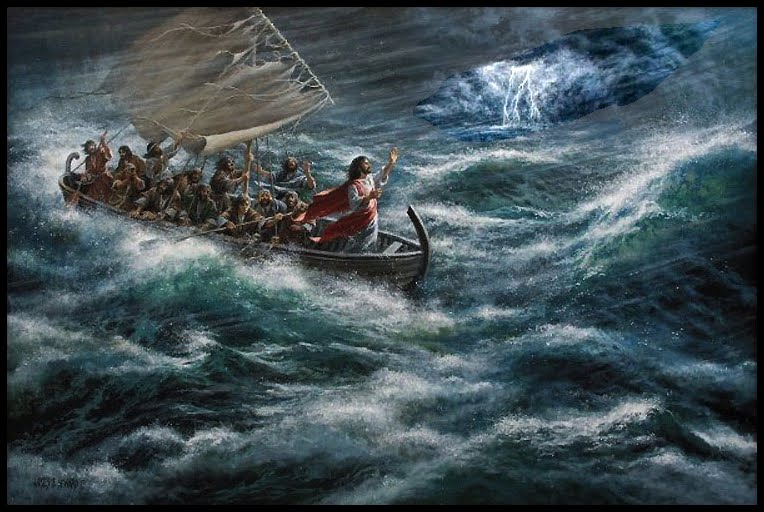
You know, most people, if asked, "What's the opposite of faith?", would probably answer, "Doubt." And yet, that's not what Jesus tells us, is it? In our Gospel passage from Mark, and indeed, throughout all four Gospels, Jesus seems to be telling us that faith is opposed mainly by fear. What did He say to the apostles in today's passage?
"Why are you terrified? Do you not yet have faith?" [Mk 4:40]
Jesus Calms the Wind and the Sea
Yes, it's fear, isn't it? It's fear in the face of this hostile world that challenges our faith. And so many today are so very afraid.

Fear, of course, is a normal human emotion, one that if it's controlled can actually aid us in our survival. As a Navy pilot I occasionally found myself in rather scary situations. Fear certainly kicked in, but so did my training, and I managed to overcome the fear. My faith was there, too,  supporting me, but I was more focused on simply doing what had to be done.

If we allow fear to control us, it will turn against us, and paralyze us. We see this manifested by the apostles in our Gospel passage. Jesus sleeps, in complete trust in God, but the apostles panic, overcome by fear. That they still call Him "teacher" tells us they do not yet understand who He is. But even in their fear and ignorance there's a glimmer of faith; for they awaken Jesus, and scold Him, hoping He can do something to save them.

But Jesus simply speaks to the sea as if it were a living thing, another being in this hostile world, something that the devil can manipulate.

"Quiet! Be still!" [Mk 4:39]
It's as if He's scolding an unruly child. The apostles are awestruck. And they ask the question that answers itself:
"Who then is this whom even wind and sea obey?" [Mk 4:41] 
Psalm 46:10
It's an answer found throughout Scripture, especially in the Psalms, where God's rule over creation is proclaimed again and again. And it's in the Psalms where we, too, are told to be quiet, to be still, to step away from the storms of our lives and be with God.

The boat, of course, foreshadows the Church, and over the centuries it too will be tossed about by an increasingly hostile world. But as Jesus reminds us again and again, it will be the faith of the Church that saves us, your faith and my faith that save us; for Jesus is never far away, but always there with us, calming our hearts.

And so today, let's pray that the trust and peace of Jesus will fill our hearts, that in our faith we'll know He is always with us, always ready to calm the storms of our lives.

Now...one more thing...

Today is the feast of the great 13-century theologian, St. Thomas Aquinas, a man whose influence on the teachings of the Catholic Church can hardly be overstated. A Dominican, he was a brilliant philosopher and theologian, but also a man of deep faith, a man of prayer, goodness, and simplicity. In addition to being the patron saint of teachers, students, and schools, St. Thomas is also fittingly the patron against storms.
 
Church - St. Thomas Aquinas, Paris
Thomas studied under St. Albert the Great, and the two of them spent a number of years studying and teaching at the Sorbonne in Paris. Today we have another Parisian connection, one that goes back not to the Middle Ages, but to the spring of 1965.

Yes, it was April in Paris of that year when Claude and Patricia first met. Like Thomas Aquinas both were studying in Paris. And less than two years later, they married. I'm sure over the years they've encountered a few storms, but in their deep faith, together they have weathered them all.

And so today we join Patricia and Claude as they celebrate their fifty years of marriage, and call them forward to renew their vows and receive Father's blessing.