The occasional, often ill-considered thoughts of a Roman Catholic permanent deacon who is ever grateful to God for his existence. Despite the strangeness we encounter in this life, all the suffering we witness and endure, being is good, so good I am sometimes unable to contain my joy. Deo gratias!


Although I am an ordained deacon of the Catholic Church, the opinions expressed in this blog are my personal opinions. In offering these personal opinions I am not acting as a representative of the Church or any Church organization.

Showing posts with label Synagogue. Show all posts

Monday, August 31, 2020

Homily: Monday, 22nd Week in Ordinary Time (Year A)


Readings: 1 Cor 2:1-5; Ps 119; Luke 4:16-30 

--------------------------

Some people just don’t like to hear the truth. Just look at our Gospel passage from Luke.
Jesus visits his hometown of Nazareth, enters the synagogue, and reads the words of Isaiah. He then makes that amazing claim:
“Today this Scripture passage is fulfilled in your hearing” [Lk 4:21].
"The Spirit of the Lord is upon me..."
At first the townspeople looked at each other in amazement, overcome by wonder and pride. Jesus, the young carpenter, the son of Joseph, is one of their own. He grew up and played with their children, went to synagogue with them. But how is it He speaks with such wisdom, such authority?
Nazareth was a small, quiet village, a place where nothing much ever happened, a village on the road to more exciting places. But on this day, the people heard Isaiah – the Word of their Fathers – claimed to be fulfilled right there.
Isn’t this the son of Joseph?
They’d heard of the miracles in Capernaum, the healings, and the crowds and probably hoped He’d do the same in Nazareth – perhaps much more. But they kept thinking: Isn’t this the son of Joseph?
If He’s a prophet, a miracle-maker, shouldn’t His own people be the first to benefit? After all, we’re his people! His family! His friends! God knows there are plenty of sick people here. How about some healings, a miracle or two? Then we’d know God is with him, with Him right here in Nazareth.
But what does Jesus do?
No miracles. Instead, He speaks of Elijah and the famine that spread throughout the country in those ancient days. Although the Chosen People were starving, God sent Elijah to a pagan widow of Zarephath, and it was she and her son whom Elijah miraculously fed.
And no healings. Instead, Jesus speaks of Elisha and the leper God sent him to heal, a pagan from Syria — this when Israel, too, had many lepers.
The people of Nazareth were in that synagogue to see and hear Jesus, this son of Joseph, who had done wondrous things. They hoped to be amazed by His words and to marvel at His mighty deeds. Yes, they wanted the hometown boy to be a prophet who’d bring them signs of God’s favor, one to do their bidding, not God’s.
But instead, Jesus told them stories of God’s grace poured out not on Jews, not on friends and neighbors, but on Gentiles, aliens and unbelievers. 
"...they were filled with fury."
Infuriated, they rose up, drove Him to the brow of a steep hill, hoping to hurl Him off the cliff. No, Jesus wasn’t their kind of Messiah.
Today you and I meet these Nazoreans across a vast gulf of time, traditions, language, and experience… and although these differences are great, perhaps we’re more like them than we know.
We ask for forgiveness when we fail to do God’s bidding, but then demand that he do ours.
We want a just and merciful God, as long as we’re the ones who benefit from his justice and mercy.
A truly omnipotent and omniscient God can be more than a little scary. Much nicer to have our God who conforms to our vision of what God should do.
So many, today, just like the people of Nazareth, want a God they can tame.
For on that day Jesus reminded his friends and neighbors that God’s ways are not our ways. God’s grace cannot be constrained by our boundaries or controlled by our prayers.
When Jesus spoke in the synagogue, he gave notice that his ministry would embrace the stranger and include the outsider. Indeed, He will embrace the sinner, those we’re so sure don’t deserve God’s forgiveness.
It’s a message both confrontational and comforting; a teaching both sharp and hard, and often so difficult to accept, or even hear. This is why so many today find Jesus and His Church unacceptable.
I remember walking with thousands of others on a “walk for life” in Boston many years ago. It was a peaceful event. And as we walked down Commonwealth Avenue in support of the unborn, the silence was broken only by the prayers and hymns of the participants…until we reached one corner. There a small group of protesters confronted us and fouled the air, screaming obscenities and blasphemies aimed at Jesus Christ and His Church.
You see, brothers and sisters, Jesus’ Word can be hard, and those who can’t accept and embrace it may find themselves filled with fury and standing on the brow of a hill ready to hurl Him, His message, and His Church headlong off the cliff.
Jesus didn’t go elsewhere because he was rejected; he was rejected because he intended to go elsewhere. That elsewhere beckons us, too; or at least it should, for we too are called. We have heard God’s Word. It has been fulfilled in our hearing. We are called to travel on hard paths, and to take up our cross, carrying it with us as we go.
How did Paul put it?
“For I resolved to know nothing while I was with you except Jesus Christ, and him crucified” [2 Cor 2:2]
This is our God – our crucified and risen Lord, the God who lives, still bearing the wounds of His love.
This is our God, not a God to be tamed or controlled, but a God to be loved, a God who demands our complete trust.
This is our Christian calling, to abandon ourselves in trust, to abandon ourselves into His hands, allowing His will and not ours to be done in our lives.
To the world it appears as weakness; but believe me, it can be the hardest thing you will ever do.
The question is: Are you and I willing to do it?

Saturday, November 11, 2017

Homily: Monday, 30th Week of Ordinary Time

Readings: Rom 8:12:17; Ps 68; Lk 13:10-17
------------------------------
While I was teaching a group of teens in a pre-Confirmation class, a young man asked me an interesting question: "How come Jesus doesn't just perform some miracle that everyone can see? That way everyone would believe."

A reasonable question, but I responded by saying that many would still reject Our Lord. And then I had him turn to today's passage in Luke's Gospel.

The leader of the synagogue had just witnessed a remarkable miracle, and yet all he could do was castigate Jesus for healing on the Sabbath. So caught up in law and ritual he lost sight of God's mercy and goodness, and couldn't recognize God working right before his eyes. He didn't deny the healing. Indeed, it was the legality, the timing of the healing that bothered him. But Jesus healed on the Sabbath because God never rests from mercy and forgiveness and love.  No, the official didn't reject the miracle; he rejected Jesus - something we encounter again and again in the Gospels. And we still encounter it today.

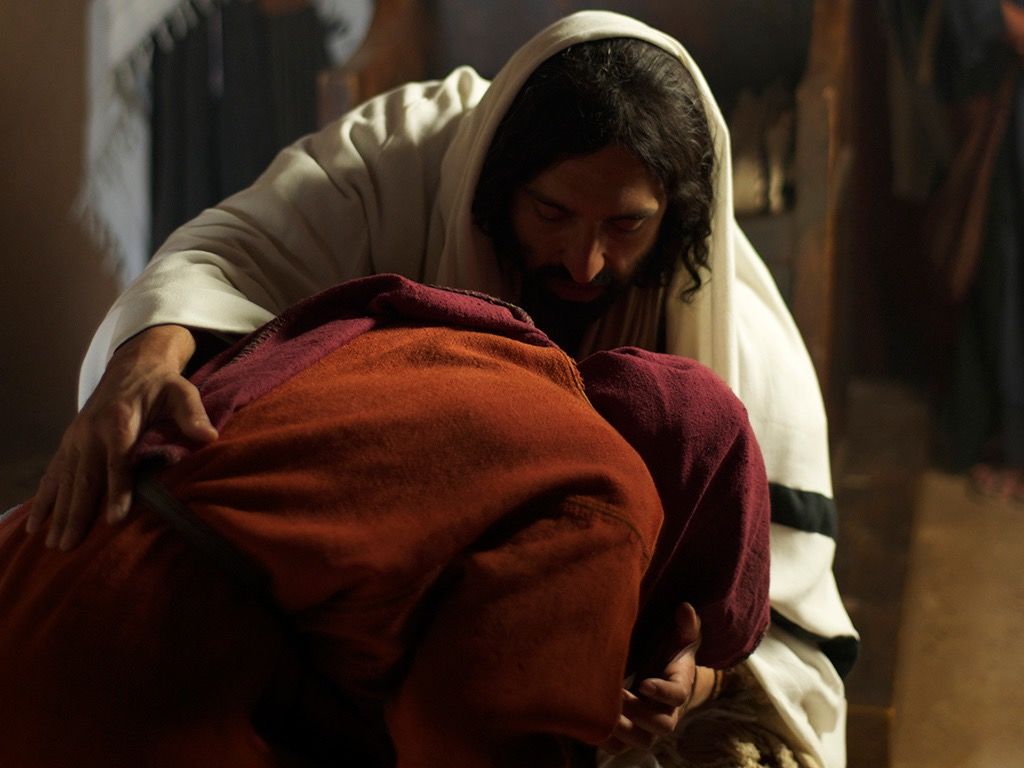
But what a healing it was...a healing of hope. The woman had said nothing, asked nothing of Jesus. It was simply her presence that moved Him. Despite her affliction - bent over, unable to stand erect, probably in constant pain - still she makes her way to the synagogue on the Sabbath. This faithful Jewish woman comes to offer her prayer of thanksgiving and to hear God's Word proclaimed. She doesn't blame God for the suffering she's endured for 18 years. She hasn't turned from God; she's turned to God.

Jesus sees her, and in seeing her, He knows her. He peers into the deep recesses of her heart. He knows her faithfulness and He knows her suffering. And it calls to mind those beautiful words from Psalm 139:
O Lord, you have searched me and known me. You know when I sit down and when I rise up; you discern my thoughts from afar. You search out my path and my lying down, and are acquainted with all my ways. Even before a word is on my tongue, behold, O Lord you know it altogether.  You beset me behind and before and lay your hand upon me. [Ps 139:1-5]
And because Jesus knew her better than she knew herself, "He called to her," and uttered those healing words:
Woman, you are set free... [Lk 13:12]
Set free from the chains that bind those who suffer.. Set free from the doubt and despair through which Satan challenges our faith. Yes, she was free. But notice, Jesus didn't exercise His healing power through Word alone. No, He touched her - "He laid His hands on her" [Lk 13:13]

Just think about that. God's Word is certainly enough. It alone can heal. After all, that same divine Word brought the entire universe into being. Jesus reaches out to this woman and touches her with his hands, and immediately she stands straight.

Jesus touches because He is one of us. He took on human form and human flesh, and he knows we need the touch of another. But His touch is holy. Yes, His flesh, His holy flesh, bears within it the presence and the power of God.

And the woman senses this; for how does she respond? She glorifies God. She knows it is God working through the hands, working through the holy flesh of Jesus. And it is this same healing flesh, this Body and Blood of Jesus, we receive in the Eucharistic feast. Is it any wonder that she is healed? Like us, she has experienced a Holy Communion. The love of God, the healing grace of Jesus Christ, and the power of the Holy Spirit have entered her and set her free and returned her to the wholeness God intended for her.

How often do I struggle bound and bent double, my soul unable to stand upright? And yet the weight of my sin inclines me toward the Merciful One, and in my repentance He heals me.

For You, Lord, alone are our Protector.
You turn your eyes to us, and call us to You,
You speak Your Word, and touch us with Your holy hands.
You touch us with Your Body and Blood.
You set us free.

Monday, October 24, 2016

Homily: Monday 30th Week of Ordinary Time

Readings: Eph 4:32-5:8; Ps 1; Lk 13:10-17
---------------
While I was teaching a group of teens in a pre-Confirmation class, a young man asked me an interesting question: “How come Jesus doesn’t just perform some miracle that everyone can see? That way everyone would believe.”

A reasonable question, but I responded by saying that many would still reject Our Lord. And then I had him turn to today’s passage in Luke’s Gospel.

The leader of the synagogue had just witnessed a remarkable miracle, and yet all he could do was castigate Jesus for healing on the Sabbath. So blinded by law and ritual he lost sight of God's mercy and goodness, and couldn’t recognize God working right before his eyes.

He didn’t deny the healing. Indeed, it was the supposed illegality, the timing, of the healing that bothered him. But Jesus healed on the Sabbath because God never rests from mercy and forgiveness and love. The official didn’t reject the miracle; he rejected Jesus – something we encounter again and again in the Gospels. And we still encounter it today.

But what a healing it was…a healing of hope.

The woman had said nothing; she had asked nothing of Jesus. It was simply her presence that moved Him.

Despite her affliction – bent over, unable to stand erect, probably in constant pain – still she makes her way to the synagogue on the Sabbath. This faithful Jewish woman comes to offer her prayer of thanksgiving and to hear God’s Word proclaimed. She doesn’t blame God for the suffering she’s endured for 18 years. She hasn’t turned from God; she’s turned to God.

Jesus sees her, and in seeing her, He knows her. He peers into the deep recesses of her heart. He knows her faithfulness and He knows her suffering, something that calls to mind those beautiful words from Psalm 139:


O Lord, you have searched me and known me. You know when I sit down and when I rise up; you discern my thoughts from afar.
You search out my path and my lying down, and are acquainted with all my ways.
Even before a word is on my tongue, behold, O Lord you know it altogether. 
You beset me behind and before and lay your hand upon me. [Ps 139:1-5]
And because Jesus knew her better than she knew herself, “He called to her,” and uttered those healing words:
“Woman, you are set free…” [Lk 13:12]

Set free from the chains that bind those who suffer. Set free from the doubt and despair through which Satan challenges our faith. Yes, she was free.


But notice, Jesus didn’t exercise His healing power through Word alone. No, He touched her – “He laid His hands on her” [Lk 13:13]

Just think about that. God’s Word is certainly enough. It alone can heal. After all, that same divine Word brought the entire universe into being. Jesus reaches out to this woman and touches her with his hands, and immediately she stands straight. Jesus touches because He is one of us. He took on human form and human flesh, and he knows we need the touch of another. But His touch is holy. Yes, His flesh, His holy flesh, bears within it the presence and the power of God.

The woman senses this, doesn’t she? For how does she respond? She glorifies God. She knows it is God working through the hands, working through the holy flesh of Jesus. And it is this same healing flesh, this Body and Blood of Jesus, we receive in the Eucharistic feast.


Is it any wonder that she is healed? Like us, she has experienced a Holy Communion. The love of God, the healing grace of Jesus Christ, and the power of the Holy Spirit have entered her and set her free and returned her to the wholeness God intended for her.

How often do I struggle bound and bent double, my soul unable to stand upright?

And yet the weight of my sin inclines me toward the Merciful One, and in my repentance He heals me.

Lord Jesus, You alone are our Protector. You turn your eyes to us, and call us to You. You speak Your Word, and touch us with Your holy hands, with Your Body and Blood.

You set us free.

Sunday, February 8, 2015

Homily: 5th Sunday in Ordinary Time - Year B


Readings: Jb 7:1-4, 6-7; Ps 147; 1Cor 9:16-19, 22-23; Mk 1:29-39
----------------------------
A day in the life of Jesus – this is what we see in today’s brief Gospel passage. Here at the beginning of his Gospel, Mark offers a glimpse into Jesus’ ministry throughout Galilee. Indeed, I suspect Mark had a purpose here: to let us experience the urgency surrounding Jesus’ public ministry; that from the very start Our Lord was driven by the Spirit to teach and to heal as He preached the Good News to all He encountered.

Jesus had just called the first of His Apostles to Him: two sets of brothers, Peter and Andrew, James and John. He had called and they hadn’t hesitated. They dropped everything to follow Jesus. Together they entered Capernaum. It was the Sabbath, so the day began in the synagogue.

“…He entered the synagogue and taught” [Mk 1:21], Mark tells us.


The synagogue was a place for prayer and for teaching. Jews spent serious time on the Sabbath reading and commenting on Scripture, so you can be sure Jesus’ teaching wasn’t presented in little, ten-minute homilies.

Mark goes on to say, “The people were astounded at His teaching” [Mk 1:22].

They were astounded because never before had they encountered someone like Jesus. He was different. Unlike the scribes, “He taught them as one having authority” [Mk 1:22]. To punctuate this authority, to prove its divine source, He cured a man possessed by a demon, a demon who openly proclaimed Jesus’ identity: “the Holy One of God” [Mk 1:24].

And so Jesus’ fame spread…

Leaving the synagogue, he and His four companions go to Simon Peter’s home, probably for the day’s main meal. But as soon as He arrives, He’s told that Peter’s mother-in-law is ill with a fever. This telling is in itself a form of prayer.

We’ve seen this prayer before. At Cana Mary simply said, “They have no wine” [Jn 2:3] – no request, just a statement of fact, just a telling. And Jesus responds and does so miraculously. Here in Capernaum Peter need only tell the Lord that his mother-in-law is ill, and Jesus heals her quietly with just a touch. The effect is instantaneous.


Has a miracle taken place? Certainly. It all happened because Jesus is there. That’s the one precondition for every miracle: God’s presence. But the miracle seems almost incidental to the reality of the new relationship between Jesus and the woman He has healed. We come to understand this when Jesus comes near to us; for when He approaches us, something good must happen. When Jesus draws near, the gift of faith deepens, conversion begins, vocations are defined, miracles happen.

All these things and more will follow when, in the presence of Jesus, we allow Him to take us by the hand and lift us up. Instead of simply telling God of our sorrows, our joys, our problems, how often does our prayer consist of telling God how He should do things? How often do we try to drag God to our way of thinking, to do what we want? In truth, though, we need only come to Our Lord with our problem and let Him deal with it.

What does this grateful woman do? Jesus has reached out to her, so she lets Him take her hand and help her up. She then waits on Him and the others. She thanks the Lord by serving the Lord.  This, too, is a prayer.

Brothers and sisters, God's healing power restores us not only to health but to active service and the care of others. God has given each of us a service ministry and this is what it’s all about. It’s a prayer, a form of thanksgiving to God for enabling us to serve Him by serving others. But first we must be healed.

You know you’re in need of healing, don’t you? We all are. But have you allowed Jesus Christ to heal you? Have you come to Him, thrown your sins down before Him in the sacrament of Reconciliation and asked for healing?

In the midst of our short lives, our limited, less than transformed lives, Jesus approaches each of us. He calls us by name. He grasps our hand, heals us, and frees us with a touch. And then He helps us up, lifting us up to the freedom He wants for each of us, energizing us so we can respond to His call, so we too can serve.

What about the Apostles? Do you think they knew what He was calling them to do? Probably not. They were likely too overcome by the wonder of it all. Imagine having been called by Jesus, by this man who does the miraculous, called to be His companions, His special friends. They don’t yet know that soon enough they will be doing what He is doing; and soon enough they will experience the cost of discipleship, they will experience the Cross.

Paul, of course, knew this when, in our 2nd reading, he told the Christians of Corinth, “I preach the gospel…and woe to me if I do not preach it!" [1 Cor 9:16] Yes, we’re all called to evangelize, and woe to us if we do not. We are called to share the Good News with the world, even if our little corner of the world might be small indeed.


“His fame spread” [Mk 1:28], Mark tells us. Jesus had become an instant celebrity in Galilee. The sick, the possessed, the confused, the curious – all of these and more ether came to Jesus or were brought to Him by others. Many, led by the Spirit, came in faith, begging Jesus to heal.

“The whole town was gathered at the door” [Mk 1:33].

Does Mark exaggerate? I don’t think so. Everyone came to Him. And why not? Wouldn’t you? Wouldn’t you want to see Him for yourself, this man who did such remarkable things. Mark sums it all up briefly:

“He cured many who were sick with various diseases, and he drove out many demons, not permitting them to speak because they knew him” [Mk 1:34].
Interesting, isn’t it? The evil one recognizes Jesus for who He is, but so many others haven’t a clue. What about us? Do we know Him…well enough to take our troubles to Him in expectant faith?

Jesus wants to heal.

He wants to help us with all our troubles.

He wants to free us from every form of bondage.

Again, we need only ask, ask that God’s will, the will of the Father, be done in our lives. We need only ask just as the people of Capernaum had asked. No doubt they asked far into the night.


It had been a long day for Our Lord; and yet an exhausted Jesus rose early and off by Himself, to a lonely place, to pray. Did you notice how Jesus’ time of prayer – His time with the Father – energized Him? It gave Him the strength to continue His mission of bringing the Good News to God’s People. Through prayer Jesus brought healing and comfort to thousands.

How about you and me? Is our prayer like the prayer of Jesus? What do we pray for? Do we pray for strength in carrying out the mission God has given us, in carrying out the Father’s will in our lives?

Jesus walked this earth. He knows our hardships. He knows the sorrows and joys that fill our lives. He knows our sufferings because He suffered Himself. Yes, He became human to conquer death; but he also came to bring hope – not only to the people He encountered 2,000 years ago, but to all of us…today and every day.

“I came,” Jesus proclaimed, “so that they might have life and have it more abundantly” [Jn 10:10].

Life! Life here and eternal life. Today, as we actually partake in God’s Divine Life, as we receive Jesus in the Eucharist, as we experience this miraculous Communion with God Himself, let us remember that we too are called.

Have you responded to His call?

How is He inviting you to come closer to Him?

Can you, with childlike abandon, grasp His hand and let Him lift you up?

Will you join Him on His mission to bring God’s love, to share the Good News, with the world?

For this is our calling.