The occasional, often ill-considered thoughts of a Roman Catholic permanent deacon who is ever grateful to God for his existence. Despite the strangeness we encounter in this life, all the suffering we witness and endure, being is good, so good I am sometimes unable to contain my joy. Deo gratias!


Although I am an ordained deacon of the Catholic Church, the opinions expressed in this blog are my personal opinions. In offering these personal opinions I am not acting as a representative of the Church or any Church organization.

Showing posts with label Unity. Show all posts

Saturday, May 31, 2014

God and Man at Work

How good it is that God's great love causes Him to step into our world, touch it in ways we could never imagine, and save us from ourselves. He doesn't need to send legions of angels to carry out His will; he need only choose a few of us and let His Holy Spirit do the rest. After all, this is how He brought His Church into being -- His One, Holy, Catholic, and Apostolic Church -- when He chose a dozen unlikely men from an distant corner of a hostile empire and sent them into the world to do His work. And He's still choosing, still sending, still guiding.

This truth came to mind as I scanned several news reports over the past day or two. Few of the stories that caught my attention will ever make it into the mainstream media, because they would no doubt seem irrelevant to those who reject the idea of a loving God acting in the world of men. Here are a few examples...

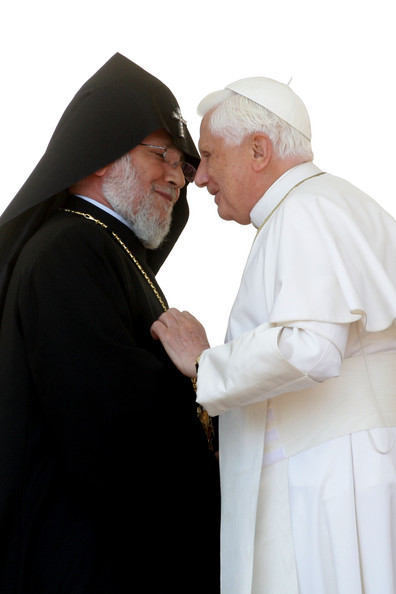
Signs of Catholic-Orthodox Unity. Batholomew I, Ecumenical Patriarch of Constantinople, stated that he and Pope Francis are planning a gathering (a new ecumenical council perhaps?) in Nicaea in 2025 to celebrate the 1,700 anniversary of the 1st Council of Nicaea which convened in the year 325. At that council, the first ecumenical council, the Church, rejecting the Arian heresy, taught the true nature of Jesus Christ and His relationship with the Father and gave us the Nicene Creed. The recent meeting of Catholic Pope and Orthodox Patriarch in Jerusalem took place 50 years after another historic meeting, also in Jerusalem, between Pope Paul VI and Patriarch Athanagoras I in 1964. In an interview with AsiaNews, Batholomew I stated:
"The dialogue for unity between Catholics and Orthodox will start again from Jerusalem. In this city, in the autumn , a meeting of the Catholic-Orthodox Joint Commission  will be held hosted by the Greek -Orthodox patriarch Theophilos III . It is a long journey in which we all must be committed without hypocrisy...I walked with my brother Francis in the Holy Land not with the fears of Luke and Cleopas on their way to Emmaus (cf. Luke 24: 13-35), but inspired by a living hope which we learn from our Lord."
What a wonderful opportunity God offers these two sister Churches! It is an opportunity to come together in prayer and achieve the unity that Jesus desires for His Church. Click here to read the Common Declaration of Pope Francis and Ecumenical Patriarch Batholomew I. Pray for Christian unity.

Greyfriars Return to Oxford. Franciscan Conventual friars, often called "greyfriars" because of the color of their habits, had been sent to England by St. Francis himself and first arrived in Oxford in 1224. In that great university town they not only became a presence in the academic world, but also carried on their traditional work of ministering to the poor. But then, almost 500 years ago, King Henry VIII, upset that Pope Clement VII had refused to annul his marriage with Catherine of Aragon, went on the rampage against the Catholic Church in England. As a result, the Franciscans of Oxford were forced to leave England. They didn't return to the country until 1906 and ever since have been looking for a way to resettle in Oxford. This will now happen, and they will soon take up residence in the former All Saints Convent in Cowley after the sisters who currently live there move to a smaller building. Friar Daniel Geary stated, “There will be 12 of us in the house of formation, with many being involved in training and going to classes. But part of that process is also to become involved with the area. Cowley is a very rich and diverse place and we look forward to joining the community.”

I think the academic world of Oxford could probably use a good, strong dose of Franciscan spirituality. Keep these good friars in your prayers.
Some of the Greyfriars of Oxford
Another Anglican Crosses the Tiber. Greg Griffith, the outspoken Anglican blogger whose traditional beliefs upset so many of his coreligionists, has announced that he and his family have joined the Catholic Church and were confirmed at a recent Easter Vigil Mass. Griffith made the announcement in his blog, StandFirm. For over a decade Griffith has used his blog to share his concerns about many moral and theological positions taken by the Anglican and Episcopal hierarchy. Although I am sure this conversion was a difficult decision for him, we welcome Greg and his family into the Church and trust he will continue to enlighten us.

Fr. Joseph Kentenich
The Schoenstatt Movement.  I suspect that most Catholics have never heard of either the Schoenstatt Movement or its founder, Fr. Joseph Kentenich (1885-1968), a survivor of the Dachau concentration camp who is being considered for sainthood. Perhaps surprisingly this Catholic movement has several million members and is established in well over 100 countries. Fr. Kentenich, joined by a small group of young Pallotine priests and seminarians, founded this Marian movement in 1914 in Schoenstatt, Germany. The movement's spirituality is centered on a Covenant of Love, in which the Blessed Mother, the woman who is close to God and His people, plays a key role. According to the movement:

Love for Mary, expressed in this Covenant, is transformed into the quickest and surest way to live in an alive and permanent contact with the God of our life and of our history. Through the Covenant of Love, we become "Family," since all who seal the Covenant know and feel they are children of Mary, and thus, brothers and sisters to each other.


From this Covenant of Love, lived in depth, a strong sense of mission also comes forth; it leads those who seal it to become effective instruments in the hands of Mary in order to collaborate with her in the religious-moral renewal of the world. Through this Covenant of Love, Schoenstatt fulfills its commitment to construct history in childlike dependence and contact, freely and totally for Christ, the Lord of History through Mary, His permanent Collaborator.

In recent years the Schoenstatt Movement has grown rapidly in the United States and has a presence in several major cities. If you're interested in learning more about this movement, check out its extensive and interesting website.And here's a link to a fascinating article about the movement that appeared in the Washington Post.


Yes, God is good and He's doing His work throughout the world, calling on each of us to lend a hand.


Sunday, September 4, 2011

Homily: 23rd Sunday in Ordinary Time

Readings: Ez 33:7-9 • Ps 95 • Rom 13:8-10 • Mt 18:15-20

As a deacon I’ve conducted my share of marriage preparation sessions over the years.As you might expect, most are enjoyable. After all I’m helping two people as they prepare to take what will likely be the most important step of their lives. They’re in love, with stars in their eyes, and they’re very happy because they haven’t a clue about what marriage will demand of them in the years to come.

I tell them many surprising things. For example, when I ask, “What’s your greatest responsibility as a husband or wife?” I get some strange answers. And when I tell them it’s to aid in the eternal salvation of  their spouse, I get some even stranger looks.

Every so often, though, during one of these sessions, something unpleasant would arise. I’ll never forget one young bride, a local girl with a large extended family in our little town. When I suggested her wedding would no doubt be attended by a large contingent of her relatives, she said: “Oh, no, deacon, my mother hasn’t spoken to any of her family since her marriage 25 years ago. She won’t let me invite any of them.” When I asked why, she said, “Oh, I really don’t know, something personal, I guess. It was a long time ago.”

How extraordinarily sad! None of the many aunts and uncles and cousins, not even the bride’s grandmother, would share in the celebration of this young woman’s marriage…and all because of some foolish reasons that have long been forgotten. For a quarter-century a family was torn apart because no one forgave, because no one asked for forgiveness, because a family never came together to pray for unity, because no one tried to correct the sinner. And yet they all attend Mass on Sunday and pray, “Forgive us our trespasses as we forgive those who trespass against us.”

Don’t they realize what they’re saying? Don’t they know they’re telling God not to forgive them of their own sinfulness? Later, when I brought up the subject to the bride’s mother, she just turned and walked away. Talk about a “hardened heart.” What bitterness. Just consider how that lack of forgiveness poisoned an entire family, and how it will likely drew in another family, that of the groom.

If a wedding won’t bring them together, what will? Perhaps a funeral. Sometimes it takes death to wake people up. Sometimes it takes the tears of grief to wash away the sins of the past.

Of course, such things aren’t restricted to the human family; they also affect our spiritual family. The “God of peace” gathers the Christian community together, and because it is Christ who “is Himself our peace,” the life of the Church, like the life of any family, must be marked by a continual quest for peace and unity.

When the risen Jesus appeared to the Apostles, He said, “Peace be with you.” And St. Paul, in his Letter to the Philippians, promised that “the peace of God, which passes all understanding, will keep your hearts and your minds in Christ Jesus.” Now they weren’t talking about some utopian ideal, some fuzzy peace way out in the future. No, they meant peace and unity fully realized in the here and now. After all, the Church is already the Body of Christ.

And so in today’s passage from Matthew we see Jesus addressing His Church, telling us that peace and unity should be its natural state. When this peace is disturbed, Jesus tells us, the one intolerable attitude is indifference; we must seek reconciliation. This applies to the universal Church, the local church of our diocese, and to the parish church, the church that comes together as a community of worshipers, listening to and living out God’s Word and fed by the miraculous gift of the Eucharist. It also applies to the domestic church, the family.

You see, the Church is essentially and fundamentally holy at the very center of her being. She’s utterly immaculate in her deepest identity as the Bride of Christ whom, as Paul reminds us, the Son washed clean with the blood of His Cross. “Christ loved the Church,” Paul wrote, “and gave Himself up for her, that He might sanctify her… and present the Church to Himself…holy and without blemish.”

Of course, while on this earthly pilgrimage, the Church exists as a community of sinners – and that’s us. It’s within us where the struggle is waged, the struggle between the impulse of the Holy Spirit and that of  the evil one. And sometimes we hide from the truth and cave to the evil one. But when the truth is set aside, peace and unity leave with it.

Today far too many people reject the very notion of truth, preferring to view the world in relativistic terms. As Pope Benedict reminds us, “We are moving toward a dictatorship of relativism which does not recognize anything as definitive and has as its highest value one's own ego and one's own desires.” The result is a moral vacuum, a chaotic mindset and lifestyle in which anything goes, a make-believe world where nothing is evil and nothing is good, a world where sin is rejected.

Ah, but the world can’t just wish sin away, can it? Because it’s there, as big as ever…rationalized, disguised, sometimes even glorified, but it’s still sin. Yes, Jesus knew all about sin. He readily called a sin a sin, never hiding the truth. Indeed, He speaks often of sins and sinners, just as He does in today’s passage from Matthew.

Here He reminds us that we sin against God, and also against one another, against our brother. His use of the word “brother” is significant because in the Church we’re called to see one another as brothers and sisters in Christ, as children of the one heavenly Father and one Mother, the Church.

But correction can be tricky, can’t it? Our own motives can get in the way. Some people correct others simply because they’re busybodies. Some enjoy putting others down, thinking this will make them look better by comparison. Others focus only on their own hurt and are really looking for payback. Yes, judging another isn’t easy, which is why Jesus instructs us first to speak to the other person privately, without an audience.

The true disciple, you see, always intervenes out of love – out of a love for God, and out of love for the sinner himself. As St. Paul tell us, “…restore him in a spirit of gentleness.”

And if the sinner refuses to listen…? “If he does not want to listen to the Church, let him be to you like a Gentile or a tax collector.”  This might sound harsh to our 21st-century ears, but the Jews of Jesus’ day readily understood what Jesus meant. And Paul echoed this when he wrote, “If anyone refuses to obey what we say in this letter, note that man, and have nothing to do with him, that he may be ashamed. Do not look on him as an enemy, but warn him as a brother.”

Just like Ezekiel in our first reading, who was given the responsibility to remind people of their sinfulness, we too are called to be prophets. We are all called to bring God’s Word to His people. We are called to reconcile with love, to remind the sinner that he, too, is a child of God, a God that loves him and wants him united with the Church.

Are you a prophet in your own family? Do you have a wayward child? Are you thinking, “But he never listens, so why bother?” The answer is simple. Because God commands it. Never give up, brothers and sisters. After all, God doesn’t. As a parent, there is no better, no more deserving object of your prayers.

And remember, too, we are all sinners in need of reconciliation, and before we judge others too harshly, let’s look first at ourselves, and be willing to accept the correction of others. See in the love of those who care about the state of our souls a sign to us of God’s love; a plea to turn away from sinfulness and to lives of holiness.

As Paul reminds us in today’s second reading, we owe a debt of love to our brothers and sisters, and real love always seeks to lead others to salvation.

May God's peace be with you always.

Wednesday, June 8, 2011

Homily: Wednesday, 7th Week in Ordinary Time

Readings: Acts 20:28-38; Ps 68; Jn 17:11b-19

Let me tell you a few poorly kept secrets: First, it’s hard not being of the world while living in the world; it’s hard to be like Jesus Christ. Second, unity among Christians is no easier, because unity implies acceptance and obedience, two things we human beings really dislike. And third, few people, Christians included, want to hear the Truth, especially when it conflicts with what they want to do.


Indeed, all of these things -- being Christ-like, maintaining unity, and being consecrated in the truth – are not only hard, they’re flat-out impossible. Well, they’re humanly impossible. And yet, in today’s Gospel reading, Jesus prays for all three, because He knows it’s only through the active help of the Holy Spirit that we can turn these hopes of His into reality.

Let’s just look at one of these hopes: Jesus’ prayer for unity. He’s actually praying for a unity that transcends normal human relationships. Unity’s the main theme of His high priestly prayer at the Last Supper, a prayer that concludes with a petition for Christian unity among all who profess Jesus Christ as Lord. Jesus prays for all men and women who will follow Him as His disciples. And He prays, not just for the Apostles, but for all members of His Body the Church, that we’ll be one as He and the Father are one – in a unity of total love and obedience, a unity based on the strongest of personal relationships, the relationship that exists within the Trinity itself. And, of course, the prayer of Jesus bears fruit, for His prayer is always efficacious.

We see this throughout the Acts of the Apostles, how the disciples, despite divergent opinions, ultimately come together as one, united in their faith and their teaching. The Holy Spirit is the great consensus-maker. Indeed, the distinctive mark of Jesus’ disciples is their love and unity – a unity foretold in Psalm 133: “How good and pleasant it is when the brothers dwell in unity.”

Jesus’ prayer on the eve of His sacrifice shows the love and trust He extends to His friends. Although He knows they will abandon Him in His hour of greatest need, He still entrusts them with the seemingly impossible task of spreading his name throughout the world and to the end of time.  But He leaves His love to support them, and the Spirit to guide them.

Jesus loved us first. In Baptism we are united to Him and to each other; and so we are called to live in a unity of love. He wants no one to be lost. And so He entrust us with the same mission, to make Him known and loved by all. For it is only through unity in Him that the world knows Jesus was sent to redeem us all. This is why Christian disunity is such a scandal.

But Jesus' prayer is also a promise, a promise to be with us as we struggle to follow Him. He will not leave us alone. His gift of the Spirit is our constant help in times of sadness and suffering, of joy and triumph, and a reminder of the great love of Our Savior. Jesus’ prayer reminds us that we, too, must pray for unity, that we can love one another – a prayer as necessary today as it was then. Jesus knows unity is hard for us; it’s not easy to love each other as Christ loves us.

In His Sermon on the Mount He even tells us to love and pray for our enemies, something the world considers the height of folly. Can you imagine praying for the soul of Osama bin Laden? Well, yes, I can, because we’re asked to be different from the world. We’re asked to be like Jesus Himself. You see, the unity Jesus prays for is manifested by how we love and serve all of God's people, not just those who share our Catholic faith. When we exclude others from our lives and concerns, we work against Christian unity.

This doesn’t mean we must water down our Faith so that others, in their disbelief, might accept it. Not at all! Remember what I said earlier: achieving true unity is not humanly, but only divinely possible. And so we must pray and teach and preach God’s complete Word, and let the Holy Spirit bring others to Him and His one, holy, Catholic and apostolic Church. And we must do so in love.

Do we really love and accept all God’s people as our brothers and sisters in Christ? Do we treat everyone we encounter with the love that Christ extends to us? Or do we pick and choose? Today let’s pray that, like St Paul, God will give us the courage to speak the truth and to work for unity among all those whom the Father has given to his Son.

For it’s through us that His work will be done.

Thursday, January 20, 2011

News You Might Have Missed

Here are a few news items that probably didn't receive prominent coverage in the mainstream media:

California Churches Desecrated. It would seem that there are more than a few people in California who have it in for the Catholic Church. In recent weeks quite a few churches have been desecrated in some of the most despicable ways. Here's a link to the complete article in the California Catholic Daily: Same Hate, Different Church

European Union Omits Christian Holidays. Just in case you thought that the European Union hadn't completely dismissed the role of Christianity in European life, here's a story that will likely change your mind. The EU, in its recently published school calendar, has omitted such Christian holidays as Christmas and Easter, but included both Muslim and Jewish celebrations. You can read about it in detail here: EU Calendar Omits Christian Holidays

Islamic Scholars Suspend Vatican Talks. In a rather bizarre, Alice-in -Wonderland sort of twist, Islamic scholars at Egypt’s Al Azhar University have decided to discontinue their talks with the Vatican, claiming Pope Benedict XVI insulted Egypt and Islam when he asked the Egyptian government to protect its Coptic citizens from terrorism and mob violence. By expressing concern over the dangers Christians face in Egypt, the pope apparently engaged in "unacceptable interference" in the country's internal affairs. How weird is that? Sometimes I think that Islam is its own worst enemy. Instead of condemning those who commit acts of terror on their own soil, these "scholars" attack those who express concern for the victims. By the way, Egypt also recalled its ambassador to the Holy See over the same issue. You can read all about it here: Sunni Scholars

Christian Martyrs and Christian Unity. Swiss theologian and president of the Pontifical Council for Christian Unity, Cardinal Kurt Koch, has stated that today's Christian martyrs, regardless of their denomination, are the "most credible witnesses" for the cause of Christian unity. Writing in the Vatican's newspaper, l’Osservatore Romano, Cardinal Koch referred to the "ecumenism of the martyrs" and stated that "We have martyrs in all the Churches....here in Rome we have St Bartholomew's for all the modern martyrs. I think that what John Paul II said, that between the martyrs we have perfect unity and when we see this unity, we can have new forces to make visible the unity that the Holy Spirit has given us." I find myself agreeing with the cardinal, for in times of persecution the Church always strengthens and differences are much more likely to be overcome. We should all be praying daily for Christian unity. You can read about the cardinal 's comments here: Cardinal Koch on Unity. And you can listen to his comments (in English) here: Interview with Cardinal Koch.

Sargent Shriver, faithful pro-life Catholic. Sargent Shriver was a faithful Catholic, a Democrat, and solidly pro-life, a combination we are unlikely to encounter ever again in someone as prominent as he. I disagreed with him on many issues; he was, after all, a man of the political left. But he was certainly consistent in his beliefs and true to his Catholic faith. Father Raymond de Souza, writing in the Canadian National Post, stated that although Shriver was married to a Kennedy (Eunice), "it was Sarge who lived the life of public service and personal integrity the brothers Kennedy only pretended to. Sarge, who died Tuesday at the age of 95, was the son that the corrupt Kennedy patriarch never deserved to have." Read more here: Married to a Kennedy, but Dedicated to God.

Given the world we live in, I can never understand people who claim to be bored.

Pax et bonum...

Monday, September 27, 2010

On the Path to Catholic-Orthdox Unity

On several occasions I've addressed the growing commitment among Catholic and Orthodox theologians to achieve unity after more than 1,000 years of separation. This ongoing effort seems to be picking up steam and I really believe we'll see some form of unity between our two churches in our lifetime.

The most recent step toward this unity was the latest session of the Joint Theological Commission for Dialogue between the Roman Catholic Church and Orthodox Churches. Held in Vienna last week the session reported substantial progress. In the words of one Orthodox metropolitan, "There are no clouds of mistrust between our two churches...If we continue like that, God will find a way to overcome all the difficulties that remain." The participants also emphasized that the two churches could well be on the way to becoming "sister churches" with each accepting the pope as its titular head. This is a remarkable step forward and it's especially heartening to hear such words coming from the representatives of both churches.
Catholic & Orthodox Participants at this Year's (the 12th) Session

This movement toward unity has also been strongly supported by Russian Orthodox Patriarch Krill and Pope Benedict XVI. The two are both focused on returning Europe to its Christian roots, something that would certainly be aided by Orthodox-Catholic unity. They are not alone in their support for this effort for many other Orthodox and Catholic bishops are equally supportive. For example, Orthodox Metropolitan John Zizioulis of Pergamon and Archbishop Kurt Koch held a joint news conference after the session at which they addressed the positive aspects of the recent session in Vienna. Click here to read some of their key comments. You might also want to read the commentary on the session by Deacon Keith Fournier.

Pray daily for the unity that Christ desires for His Church.