
Tuesday, April 27, 2010
More on Peggy Noonan's Ecclesiastical Recommendations
Yesterday I commented briefly on Peggy Noonan's recent Wall Street Journal column and provided a link to a rebuttal from John Haas of the National catholic Bioethics Center. One element of Noonan's argument is that the presence of women in positions of Church leadership would have prevented the ongoing sexual abuse scandal. Here's another take, this time by Gayle Trotter, a Washington attorney who is also a practicing Baptist. Click here to read Trotter's comments.


Monday, April 26, 2010
Archaeology: New Discoveries
One of the more interesting things about many recent archaeological discoveries is how often they result in significant changes in our understanding of those who preceded us. And from my own very amateur observations, most of these changes seem to tell of societies that were more advanced technologically and socially than previously thought. Indeed, I can't recall an instance where the discovery led archaeologists to the opposite conclusion: that the people being studied were actually more primitive than they had thought. As I said, I'm no professional, so there probably are some cases of such unmet expectations, but I suspect they are relatively rare.
I bring this up because of a brief article I read on the Archaeology Daily News website which discusses recent finds in Syria. It seems a joint Syrian/U.S. archaeological excavation uncovered an Ubiad settlement "located at the crossroads of two major trade routes in the rich bottomlands of the Euphrates river valley." The Ubiad period in Mesopotamia roughly covered the years 5,500 to 4,000 B.C. and was, therefore, prehistoric. Accordingly, it preceded such society-changing inventions as the wheel and writing. And yet, based on the findings of this excavation, the archaeologists involved have come to the conclusion that these prehistoric people "engaged in trade [with other societies], processed copper and developed the first social classes based on power and wealth." According to the article, the archaeologists "unearthed important evidence for monumental architecture, widespread irrigation agriculture, copper metallurgy and long distance trade in luxury goods." In other words, the experts have determined that these ancient folks were a lot smarter and more organized than previously thought.

We find this same thing happening in the field of biblical archaeology. Inevitably, the experts who have habitually considered the peoples of the Bible (especially the ancient Hebrews) to be woefully primitive, must eventually eat their words, or try to formulate new incorrect theories, based on the findings of the excavations of biblical sites. This, of course, only reveals more clearly the historical biases that consistently distort the past -- the kind of bias that results in the intellectually insulting garbage one encounters on cable channels like The History Channel or The Discovery Channel. One form of this bias is a "temporal bias" that, quite simply, assumes the people of the past were a lot dumber than us. The other is just sheer religious bigotry of a kind that strives to undermine the historical foundations of Judeo-Christian belief in general and the truth of the Bible in particular. Because these biased beliefs are not based on scientific accuracy and the truth, they will always be proven wrong.
Anyway, it's all very interesting...
By the way, the archaeology website mentioned above sends out a daily email notice to folks like me who are interested in what's happening in the field. If you share this interest, I recommend subscribing. Click here to join their mailing list.
Blessings...
I bring this up because of a brief article I read on the Archaeology Daily News website which discusses recent finds in Syria. It seems a joint Syrian/U.S. archaeological excavation uncovered an Ubiad settlement "located at the crossroads of two major trade routes in the rich bottomlands of the Euphrates river valley." The Ubiad period in Mesopotamia roughly covered the years 5,500 to 4,000 B.C. and was, therefore, prehistoric. Accordingly, it preceded such society-changing inventions as the wheel and writing. And yet, based on the findings of this excavation, the archaeologists involved have come to the conclusion that these prehistoric people "engaged in trade [with other societies], processed copper and developed the first social classes based on power and wealth." According to the article, the archaeologists "unearthed important evidence for monumental architecture, widespread irrigation agriculture, copper metallurgy and long distance trade in luxury goods." In other words, the experts have determined that these ancient folks were a lot smarter and more organized than previously thought.

An example of Ubiad copper work unearthed in the Syrian excavation
We find this same thing happening in the field of biblical archaeology. Inevitably, the experts who have habitually considered the peoples of the Bible (especially the ancient Hebrews) to be woefully primitive, must eventually eat their words, or try to formulate new incorrect theories, based on the findings of the excavations of biblical sites. This, of course, only reveals more clearly the historical biases that consistently distort the past -- the kind of bias that results in the intellectually insulting garbage one encounters on cable channels like The History Channel or The Discovery Channel. One form of this bias is a "temporal bias" that, quite simply, assumes the people of the past were a lot dumber than us. The other is just sheer religious bigotry of a kind that strives to undermine the historical foundations of Judeo-Christian belief in general and the truth of the Bible in particular. Because these biased beliefs are not based on scientific accuracy and the truth, they will always be proven wrong.
Anyway, it's all very interesting...
By the way, the archaeology website mentioned above sends out a daily email notice to folks like me who are interested in what's happening in the field. If you share this interest, I recommend subscribing. Click here to join their mailing list.
Blessings...
Peggy Noonan's Poorly Aimed Shot at the Church
In a recent column in the Wall Street Journal (April 17), Peggy Noonan, who is usually fairly levelheaded on most issues, goes on the attack, charging the Catholic Church with complacency in dealing with the sexual abuse scandal. When I first read the column I was dismayed that Noonan could have misread and overlooked what the Church has done since the scope of the abuse first became public. I thought about responding to her charges here, but then came across a column by John M. Haas, President of the National Catholic Bioethics Center, that specifically addressed Noonan's errors...and does so much better than I ever could. Haas' column appeared on The American Spectator's website on April 23. It is well worth reading and describes in sufficient detail the steps the Church has taken in recent years, steps that have been conveniently ignored by most secular media outlets.
I have long admired Peggy Noonan and, as I mentioned above, usually find myself agreeing with her. But increasingly her thought, and consequently her writing, seems to reflect an elitist worldview. Maybe she's lived in New York City too long or simply spends too much time reading the New York Times Magazine on Sunday afternoons.
Pax et bonum...
Put Not Your Trust In Princes
A periodic reading of Psalm 146 is always worthwhile, and seems to have special application today...
 Hallelujah!
 Hallelujah!
- Praise the LORD, my soul; I shall praise the LORD all my life, sing praise to my God while I live.
- I Put no trust in princes, in mere mortals powerless to save.
- When they breathe their last, they return to the earth; that day all their planning comes to nothing.
- Happy those whose help is Jacob's God, whose hope is in the LORD, their God,
- The maker of heaven and earth, the seas and all that is in them, Who keeps faith forever,
- secures justice for the oppressed, gives food to the hungry. The LORD sets prisoners free;
- the LORD gives sight to the blind. The LORD raises up those who are bowed down; the LORD loves the righteous.
- The LORD protects the stranger, sustains the orphan and the widow, but thwarts the way of the wicked.
- The LORD shall reign forever, your God, Zion, through all generations! Hallelujah!
Sunday, April 25, 2010
Church Support from Unlikely Sources
I've just come across three interesting items, all in support of the Church, but from the most unlikely sources: the mainstream and liberal Washington Post; Alan Dershowitz, the liberal lawyer; and former New York mayor, Ed Koch, writing in the Jerusalem Post.
First, David Gibson, a Washington Post reporter, explores "five myths about the Catholic sexual abuse scandal." Although I don't completely agree with Gibson and believe that a couple of his "myths" are a lot closer to the truth, it's refreshing to read anything in support of the Church in the mainstream, secular press. Click here to read his article yourself.


Oh, yes, my original source for each of these articles was the wonderful website: thecatholicthing.org
God's peace...
God's peace...
Increasingly Pro-life Youth
 Here's some good news. An internal poll conducted by the National Abortion and Reproductive Rights Action League (NARAL) is causing them and the rest of the pro-abortion crowd no end of concern. It seems that young folks are becoming increasingly pro-life, and that's not all. They are also much more passionate in their beliefs than those who call themselves pro-choice.
I've always thought that a majority of young folks will eventually come around to the pro-life cause. After all, anyone born after 1973 is alive only because his or her mother chose life and not death. And do you think that more than a few twenty-somethings wonder whether they might have lost a brother or sister to abortion? One's views can change pretty quickly when the subject matter becomes personal.
To read more about the NARAL poll, click here.
Pax et bonum...and pray for respect for all life.
Religious Restrictions and Persecution: World Report Card
The Pew Forum on Religion and Public Life has conducted a study of religious persecution throughout the world, examining the attitudes and policies toward religion of virtually every nation. The results of the study are presented in the form of a score assigned to each country, as well as geographical or cultural areas. Nations were ranked based on their restrictions on religion, ranging from very high to high to moderate to low. The results are fascinating, even if there aren't too many surprises. Three different PDF documents are available for download:
The report's results are based on the answers to 20 questions that address both government and societal restrictions on religion. Separating the attitudes of a nation's government and its society is actually very helpful. For example, in China government restrictions are very high, but societal restrictions are quite low. Nigeria is exactly the opposite, with benign government policies but societal hostility.
The report does not attempt to judge the appropriateness of particular restrictions imposed by governments. For example, the US policy that removes the tax-exempt status of religious organizations if they endorse political candidates is considered a restriction on religious liberty. In the same way a nation with a policy of supporting religious schools of one faith, but not of others, is also a restriction.
According to the report, a significant majority of governments (86%) subsidize religious groups, and almost 75% discriminate while doing so. Many countries prohibit or severely restrict missionaries or any form of proselytizing, and nearly 70% of governments engage in some form of harassment of disfavored religious groups. Almost half of all governments actually use physical coercion.
A total of 64 nations were ranked high or very high. This represents about 1/3 of the nations surveyed but nearly 70% of the world's population. (It seems that the most populous countries are also those with the worst policies toward religion.) When those nations with moderately restrictive policies are included, we find that 86% of the world's population face moderate to severe restrictions on practicing their religion. (See the below chart)

As you might imagine, the Middle East and North Africa regions have "the highest government and social restrictions on religion." It would seem that Islamic nations, particularly those that have instituted Sharia Law, are not very tolerant of those who belong to other faiths. No surprise there.
At the other end of the spectrum, with the fewest restrictions, are the Americas. Of course, there are some exceptions in the region, Cuba being the most obvious. (Just for comparison it's interesting to note that the score for the Americas is one-fifth that of the Middle East and North Africa.) The United States, Brazil, the UK, Italy, Japan, and South Africa are the least restrictive (most free).
There's a lot more fascinating information in the report, which I recommend reading for yourself.
Blessings...
Friday, April 23, 2010
"I will be with you always..."
I've long believed that the work of the historian is particularly challenging because historians, like the rest of us, are products of the times in which they live. The challenge arises from the tendency to assume that today's crises, successes and failures, those that one has experienced first-hand, are more important and more meaningful than those of the past. In other words, achieving historical objectivity must be difficult when one is bombarded by the products of this temporal bias.
One form of this bias results from the progressive idea that humanity is moving inexorably toward some sort of earthly nirvana. This bias is reflected in the all too common opinion that all aspects of the present -- its people, their achievements, their intelligence, their ideas -- are naturally superior to all that went before. To those afflicted by this bias, any organization or individual who looks to the past for inspiration or guidance is by definition misguided. For them, the Church, and especially the Catholic Church, because of its reliance on Scripture and Tradition, is the prime offender and the greatest obstacle to achieving the progressive ideal.
Another form of this bias seems to result from the natural psychological tendency to assume that the events we personally experience are more important than the events of the past simply because we are participants. Like the old spiritual, we all want to believe that "nobody knows the trouble I've seen." Just as the "war to end all wars" did exactly the opposite and brought us the devastation of World War II.
What led me to these early morning thoughts were comments I have heard and read recently about the challenges faced by the Church today. The sexual abuse scandal, the decrease in priestly vocations, the rejection of Church teaching by so many of its members, the empty churches in Europe, the cradle of Christendom, the specter of a resurgent and aggressive Islamic movement -- all of these things and more have led some to declare the imminent demise of the Catholic Church in particular and Christianity in general.
I expect to hear such comments from secular pundits and others outside the Church since they do not share our faith or our assurance in the promises of Jesus Christ to be "with you always, until the end of the age." But I hear these same sentiments of doom and gloom from some Catholics as well, and that disturbs me.
Some are obviously weak in their faith or they would take seriously the words and promises of Jesus Christ. But most also seem to lack an awareness of what the one, holy, catholic and apostolic Church has been through during the 2,000 years since that first Pentecost in Jerusalem. The Church has survived crises far worse than those of the present.
 Not long ago I read a marvelous little book by Fr. Walter Brandmüller, president of the Pontifical Committee for Historical Science. His book, Light and Shadows, explodes many of the myths and outright lies surrounding the history of the Catholic Church. In light of my comments above, let me quote Fr. Brandmüller as he reviews just a few of the crises faced by the Church in its history. It's a rather lengthy quote (p. 16-17), but well worth reading, as is the entire book.
________________________
"It cannot be said, either, that the shepherds and members of the Church have always and everywhere reacted correctly to the challenges of history. On the contrary, many mistakes have been made that subsequently became notorious. For example, was it not disastrous that Pope Clement V allowed himself to be intimidated by the demands of the French king Philip and abandoned the order of Knights Templar, who as a whole were certainly innocent, to a downfall that was in large part bloody? Entire episcopates -- today we would say bishops' conferences -- fell into heresy during the Arian crisis of the fourth and fifth centuries. In the sixteenth century the bishops of England, with the exception of St. John Fisher, followed King Henry VIII into schism out of weakness and cowardness, and similarly the French episcopate, during the conflict over the freedom of the Church from the state, stood beside Louis XIV against the pope. For almost two centuries the French bishops promoted the heresy of Jansenism. There were not many exceptions. And how did the German bishops conduct themselves during the eleventh- and twelfth-century Investiture Controversy? In 1080 a majority of the German bishops, under the influence of Emperor Henry IV, made an attempt at a synod in Brixen to depose Pope Gregory VII and to elect an antipope. Those German bishops who found themselves confronted with the religious division of the sixteenth century no doubt failed in large measure, too.
"Truly, all of this does not make for glorious pages in the ecclesiastical chronicles. In the end, therefore, we cannot place our trust in the wisdom and power of the shepherds, either. No promise was ever made to the Church that her shepherds and her faithful would be irreproachable or capable. What her Founder, the God-man Jesus Christ, did guarantee, nevertheless, is that she will continue unshakably and stand fast immovably in the truth until his return at the end of time. This means that the Church can never proclaim an error in matters of faith whenever she speaks in a form that is ultimately binding; that her sacraments always produce their characteristic effects of grace, provided that they are administered according to the Church's directions; and that her hierarchical-sacramental structure comprising the ministries of primacy, episcopacy and priesthood will always be maintained intact. Precisely thereby it is guaranteed that the graces of redemption will continue to be availalble to the people of all generations, until the Lord comes again."
____________________
 Yes, the Church has survived crises far worse than those we are experiencing today. And who but God knows what she will have to face in the future? The one thing we do know is that she will survive until the end of time. We know this because Jesus promised it.
God's peace...
Wednesday, April 21, 2010
Oops. URL Error for Vatican's new blog
 Yesterday I gave an incorrect url for the Vatican Information Service's new blog. My apologies for the mistake. Here's the correct address:
http://visnews-en.blogspot.com/
Tuesday, April 20, 2010
Good News: Bishop Thomas Wenski Named as Miami's Archbishop

The above photo shows my current bishop, Bishop Thomas Wenski, with the bishop who ordained me when he was Bishop of Fall River, Cardinal Sean O'Malley, now Archbishop of Boston.
You might also like to see the announcement by the Archdiocese of Miami: click here.
New Vatican Blog
Just an FYI: the Vatican has started a new blog, run by Vatican Information Services. It provides access to Vatican press releases and other news stories of interest. Like many blogs of this type it allows comments. It also includes archives that cover the past 10 years, a particularly nice feature for all you Vatican watchers out there.
Here's a link to the English language version of the blog: http://visnews-en.blogspot.com/
Note (4/21): Oops! My apologies for the error in the URL for the Vatican's blog. It's fixed now.
Here's a link to the English language version of the blog: http://visnews-en.blogspot.com/
Note (4/21): Oops! My apologies for the error in the URL for the Vatican's blog. It's fixed now.
Monday, April 19, 2010
Louis DeMane (1940-2010), R.I.P.
Sometime this evening our elder daughter, her husband, and four of our grandchildren arrive for a nice, long stay. Diane and I are like kids ourselves waiting for them to get here. We've spent the day getting the homestead ready for them (i.e., childproofing) and look forward to doing all kinds of wondrous things with the little guys. I don't know how much I'll post during their stay, but I'm sure I'll have a few minutes now and then.
 Despite all the good things of life -- like grandchildren visiting -- there are sad moments as well. Our neighbor and friend, Lou DeMane, died this morning after a long battle with lung cancer. (The photo at left shows Lou with his wife, Mary.) He was one of those wonderful guys who would do anything for you. I can't count the number of times he came to my rescue and fixed things around our home, things that had far exceeded my limited talents. A good man, a loving husband and father, Lou will be sorely missed by all who knew and loved him. He was able to receive the sacraments before he died and went home to the Father peacefully. Requiescat in pace, Lou.

Sunday, April 18, 2010
Screaming Volcano
A radar image from space of the Eyjafjallajökull volcano has an eerie resemblance to Edvard Munch's famous and often stolen painting, The Scream. Ironically, Munch was inspired by the colorful skies that resulted from the Krakatoa eruption in 1883. In his diary at the time, Munch wrote, "I was walking along a path with two friends - the sun was setting - suddenly the sky turned blood red - I paused, feeling exhausted, and leaned on the fence - there was blood and tongues of fire above the blue-black fjord and the city - my friends walked on, and I stood there trembling with anxiety - and I sensed an infinite scream passing through nature."
Each of the three craters in the radar image is 200-300 meters in diameter.


Each of the three craters in the radar image is 200-300 meters in diameter.


Volcanoes and Modern Man
 Isn't it interesting that a single volcano in a rather out-of-the-way place like Iceland can cause so much disruption to modern society? For several days now, air transportation in Western Europe has been brought to a virtual standstill, all because of the eruption of this one volcano. But that's not all. Ten of thousands of travelers are stranded, unable either to return home or to find suitable, affordable accommodations while they wait for conditions to improve. Some of these people will soon run out of required medications and will have difficulty obtaining them in a foreign country. Businesses that rely on air shipment for their manufactured goods or raw materials are concerned because they have no logistical "Plan B" to address this sort of situation. And travel plans, whether for business or pleasure, are being shelved because vulcanologists and meteorologists are unable even to estimate when the eruption will end and things will return to normal. The volcanic ash that has caused so much concern because of its potentially catastrophic effects on turbine engines is also beginning to leave its high altitude home and come down to earth where it may cause a whole different set of problems. And this may just be the beginning of this volcano's impact.
We moderns seem to believe that our technology can overcome any obstacle or solve any problem, but then we get hit right between the eyes by the power of God's creation and come to realize how completely vulnerable we actually are. Even the President of the world's only "superpower", the United States, had to cancel his plans to attend the late Polish President's funeral in Krakow. Some superpower we are...our president grounded by this one hole in the ground.
 I wouldn't be surprised if God timed these events for maximum impact. And speaking of timing, did you know that many volcanic eruptions go on for months, even years? In other words, this volcano with the unpronounceable name (my apologies to all you Icelanders out there) could continue erupting for quite some time. Click here to view a chart depicting percentages for different lengths of eruptions. Pretty interesting. Care to predict the outcome if it keeps erupting for a year or so?
There's a lesson or two in here somewhere. I suspect, for example, that the products of this one volcanic eruption will have more impact on the earth's weather and climate than several years' worth of man-made emissions. Indeed, we know this to be true of other eruptions in the past, some of which actually led to summerless years. The year, 1816, was one such year and resulted from the eruption of Mount Tambora in Indonesia. And the eruption of Krakatoa in 1883 decreased the entire temperature of the planet for a year afterward because the clouds of ash it generated reflected the sun's light back into space. To my knowledge -- and Al Gore might correct me here -- we've never experienced a yearlong winter (or summer) attributable to fossil fuel emissions.
Another lesson is more theological. We need these events to help us experience humility in the presence of our God's greatness. The power of His creation, manifested through this one tiny and previously unknown opening under a glacier can overwhelm our modern society and all its pomps and works. And it truly is tiny, at least on a universal scale, as any astronomer would tell you. God does have a way of bringing His creatures to their knees, doesn't He?
And so, let's thank God for the good that can come from this event, and for the fact that to date there has been no loss of life as a result.
God is great!
Homily 3rd Sunday of Easter
Readings: Acts 5:27-32,40-41; Ps 30; Rv 5:11 -14; Jn 21: 1-19
I’m not a big moviegoer, but among my favorites is a 1983 film starring Robert Duvall called Tender Mercies. It tells a remarkable story, a story of loss and gain, a story of sinfulness, and pain, and repentance, and forgiveness, and love, and redemption. And blended into this very human mix is the grief that comes from the loss of a loved one and the faithful acceptance of the mercy of God. It's an acceptance that God ultimately brings everything – even those very hard things of life, even the evils that plague our world – that He brings all of this to good.
Tender Mercies tells a story of human happiness, a happiness that is never perfect simply because it is human. It reminds us that what God asks of us in this life doesn’t promise success in the way you and I measure it. The film has a “semi-happy” ending and subtly makes the point that the true happy ending God promises comes later, not here, and those Christians who think otherwise only fool themselves.
A lot of folks are here today, especially during this Easter season, expecting to encounter another happy ending; and their mistake is in thinking that Jesus did all the work on Calvary, leaving nothing for us to do. But the Gospel tells us otherwise, doesn’t it?
In today’s passage from John’s Gospel, Jesus appears to his disciples for the third time after His crucifixion on Good Friday. And if you’re here today just looking for a happy ending to this, you’re going to be disappointed.
You see, this sacred liturgy is no infomercial. It doesn’t promise instant gratification or success. And it certainly doesn’t promise a happy ending in this life. No, instead it challenges us by placing before us something far greater and gives us the opportunity to live out the story God has planned for us. And whether this story has a happy ending is largely up to you and me.
Now, some folks believe that following Jesus will make life all rosy and sweet. But Jesus tells us otherwise. There will be days when your life in Christ will leave you with more questions than answers, more pain and sorrow than happiness, more rejection than acceptance. Yes, Christ is the answer…but only when you and I ask the right questions.
 Each of the Gospel encounters with the risen Jesus – from Mary Magdalene to St. Paul – is different and each is unsettling. Not once does the risen Christ give a crystal clear answer to the questions His disciples ask. Not once does the risen Christ promise a happy ending. Indeed, his message goes against what the world tells us to do.
The world says, “Follow our rules and everything will be wonderful.” But Jesus doesn’t say that. No, Jesus instead tells Peter, “Follow me.” Following the world’s rules may keep us out of trouble in the here and now, but it won’t get us to heaven. Jesus says, “Follow me!” – words that demand a radical change in way we live our lives, a radical change that can turn our lives upside down. When we follow Jesus, status and position and politics and wealth no longer matter, possessions become worthless, disabilities become strengths, all those past mistakes that litter our lives simply disappear.
Just look at Peter in today’s Gospel passage. Peter and his friends were at a loss. They neither knew nor understood what would be expected of them. They knew only that Jesus had risen! He was alive! What need could their risen Lord possibly have of them now, especially since they had all failed Him, abandoned Him in His time of greatest need? And so they had returned to what they knew best: the Sea of Galilee. They went fishing.
But now Jesus is calling out to them from the shore. The beloved disciple, the very one who had brought Peter to the high priest’s courtyard and overheard his denials, announces “It is the Lord!” Peter, filled with remorse and yet overcome by joy, sees his chance for restoration and leaps into the water and wades ashore…toward Jesus.
The last time we saw Peter he had denied Jesus three times, first at the door leading into the high priest’s courtyard, then twice more while warming himself by a charcoal fire. It’s no accident, then, that Peter now stands before another charcoal fire, a fire made by the Lord Himself on the shore of the sea.
And as Peter and his friends watch, the risen Jesus performs the most human of acts, he cooks a meal. He makes breakfast for these men, who are filled with anticipation, wondering what Jesus will say and do, wondering why He has come to them. But Jesus takes His time, doesn’t He?
 Finally, He addresses Peter, asking him to confirm his love: “Simon, son of John, do you love me? Three times Jesus asks this question, echoing Peter’s three denials, and three times Peter answers in love. Oh, it makes the Apostle uneasy, but Jesus makes His point and Peter comes to understand that he has been forgiven, also in love.
And Peter learns something else that day: that he has been commanded to care for and lead this tiny group of disciples, this as yet unformed Church, this flock of sheep that will soon be in need of a shepherd.
In time Peter comes to accept fully the role he has been assigned by God. We see stark evidence of this in our first reading from Acts in which he stands before the high court boldly declaring that the nascent Church must obey God rather than men.
And Peter, too, will come to know what following Jesus can lead to. Peter will carry this knowledge to Rome itself. As an old man, he stretched out his hands, was dressed and girded by the soldiers of Nero, and made to climb. Knowing his unworthiness to die as his Master died, and filled with humility, he will ask to be crucified with his feet upward. And there in Rome its first bishop dies with his face low to the ground, breathing in the dust of men. But In his heart he is still on the shore of Galilee, with the voice of Christ speaking to him, yesterday, today, and forever. "Simon, son of John, do you love me?" "Yes, Lord, you know I love you." Feed my sheep!
 You see, brothers and sisters, when like Peter we encounter the risen Christ up close and personal, all that matters is the love of God, and the willingness not to change, but to be changed.
…to allow the power of God to take our lives and transform them.
…the same power of God that transformed fishermen and tax collectors into apostles who willingly gave their lives to spread the Good News.
…the same power that turned a sinful Samaritan woman at the well into the first missionary.
…the same power of God that transformed the pain of sickness and disability into an opportunity to give witness.
And so, when you and I turn away from all that went before and follow the risen Christ, we shouldn’t be surprised when our lives becomes something very different from what we anticipated.
As Our Lord issues His call to each of us, He sends His Holy Spirit into this church to challenge you, to entice you, to dare you to take the risk of following Him on a path that is less than certain. God calls us from the comforts of our lives, from the fishing on the lake, and tells us bluntly: If you love me, you will stretch out your hands, and follow me, wherever I lead you.
Yes, it’s a path that always includes the cross. But it’s also a path filled with God’s tender mercies, and the only path that leads to eternal life, the true happiness for which you and I were created.
Praised be Jesus Christ!
I’m not a big moviegoer, but among my favorites is a 1983 film starring Robert Duvall called Tender Mercies. It tells a remarkable story, a story of loss and gain, a story of sinfulness, and pain, and repentance, and forgiveness, and love, and redemption. And blended into this very human mix is the grief that comes from the loss of a loved one and the faithful acceptance of the mercy of God. It's an acceptance that God ultimately brings everything – even those very hard things of life, even the evils that plague our world – that He brings all of this to good.
Tender Mercies tells a story of human happiness, a happiness that is never perfect simply because it is human. It reminds us that what God asks of us in this life doesn’t promise success in the way you and I measure it. The film has a “semi-happy” ending and subtly makes the point that the true happy ending God promises comes later, not here, and those Christians who think otherwise only fool themselves.
A lot of folks are here today, especially during this Easter season, expecting to encounter another happy ending; and their mistake is in thinking that Jesus did all the work on Calvary, leaving nothing for us to do. But the Gospel tells us otherwise, doesn’t it?
In today’s passage from John’s Gospel, Jesus appears to his disciples for the third time after His crucifixion on Good Friday. And if you’re here today just looking for a happy ending to this, you’re going to be disappointed.
You see, this sacred liturgy is no infomercial. It doesn’t promise instant gratification or success. And it certainly doesn’t promise a happy ending in this life. No, instead it challenges us by placing before us something far greater and gives us the opportunity to live out the story God has planned for us. And whether this story has a happy ending is largely up to you and me.
Now, some folks believe that following Jesus will make life all rosy and sweet. But Jesus tells us otherwise. There will be days when your life in Christ will leave you with more questions than answers, more pain and sorrow than happiness, more rejection than acceptance. Yes, Christ is the answer…but only when you and I ask the right questions.
 Each of the Gospel encounters with the risen Jesus – from Mary Magdalene to St. Paul – is different and each is unsettling. Not once does the risen Christ give a crystal clear answer to the questions His disciples ask. Not once does the risen Christ promise a happy ending. Indeed, his message goes against what the world tells us to do.
The world says, “Follow our rules and everything will be wonderful.” But Jesus doesn’t say that. No, Jesus instead tells Peter, “Follow me.” Following the world’s rules may keep us out of trouble in the here and now, but it won’t get us to heaven. Jesus says, “Follow me!” – words that demand a radical change in way we live our lives, a radical change that can turn our lives upside down. When we follow Jesus, status and position and politics and wealth no longer matter, possessions become worthless, disabilities become strengths, all those past mistakes that litter our lives simply disappear.
Just look at Peter in today’s Gospel passage. Peter and his friends were at a loss. They neither knew nor understood what would be expected of them. They knew only that Jesus had risen! He was alive! What need could their risen Lord possibly have of them now, especially since they had all failed Him, abandoned Him in His time of greatest need? And so they had returned to what they knew best: the Sea of Galilee. They went fishing.
But now Jesus is calling out to them from the shore. The beloved disciple, the very one who had brought Peter to the high priest’s courtyard and overheard his denials, announces “It is the Lord!” Peter, filled with remorse and yet overcome by joy, sees his chance for restoration and leaps into the water and wades ashore…toward Jesus.
The last time we saw Peter he had denied Jesus three times, first at the door leading into the high priest’s courtyard, then twice more while warming himself by a charcoal fire. It’s no accident, then, that Peter now stands before another charcoal fire, a fire made by the Lord Himself on the shore of the sea.
And as Peter and his friends watch, the risen Jesus performs the most human of acts, he cooks a meal. He makes breakfast for these men, who are filled with anticipation, wondering what Jesus will say and do, wondering why He has come to them. But Jesus takes His time, doesn’t He?
 Finally, He addresses Peter, asking him to confirm his love: “Simon, son of John, do you love me? Three times Jesus asks this question, echoing Peter’s three denials, and three times Peter answers in love. Oh, it makes the Apostle uneasy, but Jesus makes His point and Peter comes to understand that he has been forgiven, also in love.
And Peter learns something else that day: that he has been commanded to care for and lead this tiny group of disciples, this as yet unformed Church, this flock of sheep that will soon be in need of a shepherd.
In time Peter comes to accept fully the role he has been assigned by God. We see stark evidence of this in our first reading from Acts in which he stands before the high court boldly declaring that the nascent Church must obey God rather than men.
And Peter, too, will come to know what following Jesus can lead to. Peter will carry this knowledge to Rome itself. As an old man, he stretched out his hands, was dressed and girded by the soldiers of Nero, and made to climb. Knowing his unworthiness to die as his Master died, and filled with humility, he will ask to be crucified with his feet upward. And there in Rome its first bishop dies with his face low to the ground, breathing in the dust of men. But In his heart he is still on the shore of Galilee, with the voice of Christ speaking to him, yesterday, today, and forever. "Simon, son of John, do you love me?" "Yes, Lord, you know I love you." Feed my sheep!
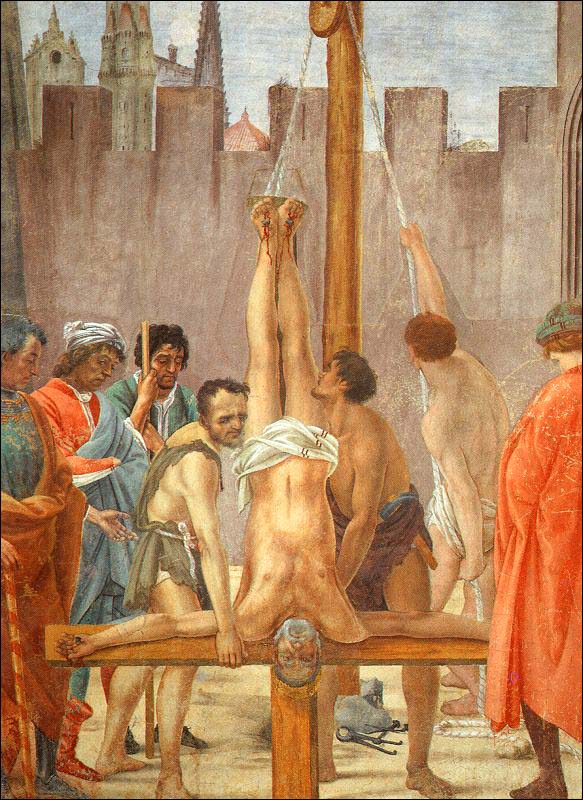 You see, brothers and sisters, when like Peter we encounter the risen Christ up close and personal, all that matters is the love of God, and the willingness not to change, but to be changed.
…to allow the power of God to take our lives and transform them.
…the same power of God that transformed fishermen and tax collectors into apostles who willingly gave their lives to spread the Good News.
…the same power that turned a sinful Samaritan woman at the well into the first missionary.
…the same power of God that transformed the pain of sickness and disability into an opportunity to give witness.
And so, when you and I turn away from all that went before and follow the risen Christ, we shouldn’t be surprised when our lives becomes something very different from what we anticipated.
As Our Lord issues His call to each of us, He sends His Holy Spirit into this church to challenge you, to entice you, to dare you to take the risk of following Him on a path that is less than certain. God calls us from the comforts of our lives, from the fishing on the lake, and tells us bluntly: If you love me, you will stretch out your hands, and follow me, wherever I lead you.
Yes, it’s a path that always includes the cross. But it’s also a path filled with God’s tender mercies, and the only path that leads to eternal life, the true happiness for which you and I were created.
Praised be Jesus Christ!
Saturday, April 17, 2010
Apollo 13 Recovery: 40th Anniversary
It's hard to believe but it's been 40 years since my dear friend (and then commanding officer) Chuck Smiley and I flew the recovery helicopter for the troubled Apollo 13 moon mission. Taking such an active part in this remarkable event was a true privilege, one I will always cherish.
I thought some of you might like to view a PowerPoint presentation on the recovery operation that I put together some time ago. It's come in handy over the years since I've used it as a video accompaniment to the many talks I've been asked to give.
I thought some of you might like to view a PowerPoint presentation on the recovery operation that I put together some time ago. It's come in handy over the years since I've used it as a video accompaniment to the many talks I've been asked to give.
Saturday, April 10, 2010
Mercy, Poverty, Hope
 The deacons of our parish -- there are eight of us! -- have been conducting a Divine Mercy Novena in preparation for tomorrow's celebration of Divine Mercy Sunday. Although other demands -- doctors' appointments, soup kitchen commitments, etc. -- have prevented me from attending every day, I have been able to pray the chaplet at home on those days I could not attend. Praying this novena has been a remarkable experience and has led me to ask some serious questions about how I conduct my own life. I expect it's had a similar effect on others who have taken part.
In addition to the novena, I've spent some time each day reading from St. Faustina's Diary in which the visionary wrote about her visits from the Lord, as well as her own thoughts, reflections and experiences. In it one encounters Jesus in a unique way as He opens His merciful heart for this young saint and for us, patiently explaining the depth of His mercy and how our God expects us, as Christians, to respond. I could probably spend pages and pages writing about some of these messages from our Lord, but one in particular struck a significant chord today: “You are to show mercy to your neighbors always and everywhere. You must not shrink from this or try to absolve yourself from it" [Diary, 742].
There's nothing new about this command; indeed if it were new we would have every right to suspect the validity of the visions and private revelations experienced by St. Faustina. True private revelation can do nothing but confirm and reinforce divine revelation as found in sacred scripture and apostolic tradition. And, of course, this same plea to mercy is stated explicitly in the Gospel: "Blessed are the merciful, for they will be shown mercy" [Mt 5:7]. And we encounter it in greater detail when Jesus depicts the final judgment that we will all experience [Mt 25:31-46], a judgment focused on the mercy we have extended to each other.
As I reflected on Jesus' command, and on my own failure to obey it fully, I came to realize how grateful I am that we have a merciful, forgiving God, one who willingly forgives and forgets the sins of the repentant. In other words, our personal failure to extend mercy to others can be overcome by God's infinite mercy when we come to Him in true repentance. Without this gift of mercy and forgiveness none of us would be saved.
Of course, the temptation, then, is to become a bit presumptuous and assume that God's mercy will come through for us in the end, regardless of how we have lived our lives -- a very dangerous presumption. For the Christian, indeed for every human, life shouldn't be viewed as a gamble during which one lives as one likes and hopes for the opportunity to repent and receive forgiveness at the end. No, the Christian life should be seen and lived as an ongoing conversion, a journey in which we come ever closer to Christ allowing Him to conform every aspect of our being to His perfection.
We see this manifested most explicitly in the lives of the saints. Not long ago, while reading St. Bonaventure's The Life of St. Francis of Assisi, I came across a passage that describes one of those typical Franciscan events in which the saint fuses mercy and poverty and thereby teaches us how to live the Gospel, as Catherine Doherty urged, "without compromise."
 Francis, you see, knew that because everything comes from God, nothing really belongs to us. And because we own nothing, our lives as creatures of God are essentially lives of poverty. Most of us simply haven't yet come to the point where we can accept this, at least not fully. We might accept it intellectually, but that's a far cry from living it. Francis also took Jesus seriously when He said, "...whatever you did for one of these least brothers of mine, you did for me" [Mt 25:40]. And so he believed that anything he had actually belonged to those in greater need, those "least brothers."
In the incident described by St. Bonaventure, Francis had been ill and was wearing a cloak over his habit as he and a companion traveled home. When they met a poor man along the way, Francis, neglecting his own need, gave his cloak to the man. "It is fitting," he said to his companion, "that we should restore this cloak to this poor man, for it is his, and I accepted it only until I should find someone poorer than myself." When his companion objected that Francis was neglecting his own health, the saint responded, "I should be accounted a thief by the great Almsgiver were I to withhold that which I wear from him who has greater need of it than I."
This, of course, was typical of Francis who, as St. Bonaventure wrote, "spared nothing, neither cloak, nor tunic, nor books, nor even the ornaments of the altar, but would give all these things to the poor to fulfill the office of mercy."
All of this reflecting has led me to question how I am called to "fulfill the office of mercy" in my life. Are we all called to be perfect imitators of Christ in the style of a St. Francis? Are we all called to live "the Gospel without compromise"? As I look around me here in my cozy den, I find I am surrounded by "things." They are things that give me pleasure, or make my life easier, or remind me of past accomplishments, but they are still just things. Are these and the other things of my life keeping me from following Jesus' call to mercy? Can I approach poverty in spirit without accepting material poverty? God does, after all, call us to perfection -- "...be perfect, just as your Heavenly Father is perfect" [Mt 5:48] -- but just how far does He want you and me to take this?
And so I am left with questions only God can answer. But I do know that the call to conversion is a call to abandonment. And abandonment to God's will demands that I first remove my own will from the equation. Only then can God work in my life and lead me on the path He has planned for me. Fortunately, God never stops calling and will continue calling me to conversion until I take my last breath.
Praised be Jesus Christ!
Wednesday, April 7, 2010
Government Employees at "Work"
The video I've embedded below is of a Bach concert conducted in one of my favorite places in Rome, the Pantheon. Apparently the concert was scheduled to conclude at 6:15 p.m., but the Pantheon employees (who work for the Italian government) normally stop working at 6 p.m. Since this was a scheduled concert, one would think the employees would be willing to stick around for the extra 15 minutes, but, no, they force the musicians to stop the concert, turn off the lights and try to get everyone to leave. Naturally, the concert attendees wanted to stay and hear the remainder of the concert. If you understand Italian you will hear some of the comments from the crowd, "Vergognatevi, vergognatevi..." (Shame, shame...)
Hey, the way the feds are creating all those new government jobs, pretty soon this is how things will be run in our country as well.
And speaking of government programs, Diane and I got our first taste of Obamacare this morning. Diane, who suffers from severe back pain, has been receiving a specific treatment from a Pain Management doctor in Gainesville for several years. This is the only treatment that has ever worked for her and involves using RF energy to "burn" nerve endings in her spine. It's usually good for six months to a year, and has always been covered by our Tricare military retirement insurance. But this week we received a notice that it is now considered "experimental" and will no longer be covered. They went on to approve four visits to this doctor over the next 12 months, but no treatment! A lot of good that will do. Our doctor indicated that this has been happening more frequently in recent weeks and expects to see more of it, especially when it affects seniors. After all, why waste government funds on "old people"?
Fortunately we have a 90 day window to appeal and Diane's doctor said he will do so, and include all the relevant documentation showing that the treatment is proven and effective and hardly experimental. He also intends to take legal action if they don't accept his appeal. Way to go, Doc!
Get ready for Obamacare, folks; you're going to love it.
Tuesday, April 6, 2010
Women in the Early and Medieval Church
Régine Pernoud (1909-1998) was a French historian and medievalist who wrote some wonderful books aimed at the general reader. We are especially fortunate that Ignatius Press has been reprinting some of these books, making them available in English translation. I especially enjoyed reading Those Terrible Middle Ages: Debunking the Myths and The Templars: Knights of Christ, two books that provide the reader with a more fair and balanced (and honest) view of what life was really like during those remarkable centuries. Although I have not yet read any, I am told that her books on St. Joan of Arc are particularly good.
I have just finished reading another of her books, Women in the Days of the Cathedrals, also published by Ignatius but, unfortunately, now out of print. It is available, however, via some of Amazon's third-party sellers and I am sure used copies can be obtained via such used book resellers as abebooks and alibris. I recently picked up my copy at my favorite Catholic book and gift shop, Sullivan's, on Main Street in Hyannis, Massachusetts.
It is a fascinating and surprising book, one that details the critical and largely underreported role of women in both Church and society during the Middle Ages. Indeed, it depicts women during this era as enjoying far higher status and wielding more influence in society than ever before and, in some ways, than at any time since. The book is filled with marvelous revelations, large and small, about the Middle Ages and those who lived during these interesting times, bits of information and profiles of remarkable personalities that you will be hard pressed to find anywhere else in popular historical literature. I truly enjoyed the book and especially recommend it.
Sunday, April 4, 2010
Photo Contest
I have been pestered for several weeks now to post one of my photos that earned a prize in this year's photo contest sponsored by our local newspaper, the Villages Daily Sun. It earned a 2nd prize, a very generous award by the judges. Another photo received "mention" but no prize. Anyway, to stop my friend's nagging, I have included both photos below.
The first (the one that actually earned a prize) was taken on my birthday in 2008 while Diane and I were in Rome. We were wandering about in the Prati district when we turned a corner and saw this balcony covered with flowers.
 I took the second photo in November 2005 while visiting Orvieto, a small, walled city in Umbria, well known for its beautiful duomo (cathedral church). The facade of the church is breathtaking. Because the piazza in front of the church is not very deep, and without my wide-angle lens (left back at the hotel in Rome) I could not capture the entire facade. I decided instead to get up close and photograph just a portion of the facade against the sky. It turned out well.

The first (the one that actually earned a prize) was taken on my birthday in 2008 while Diane and I were in Rome. We were wandering about in the Prati district when we turned a corner and saw this balcony covered with flowers.


Subscribe to:
Posts (Atom)