The occasional, often ill-considered thoughts of a Roman Catholic permanent deacon who is ever grateful to God for his existence. Despite the strangeness we encounter in this life, all the suffering we witness and endure, being is good, so good I am sometimes unable to contain my joy. Deo gratias!


Although I am an ordained deacon of the Catholic Church, the opinions expressed in this blog are my personal opinions. In offering these personal opinions I am not acting as a representative of the Church or any Church organization.

Showing posts with label Fulfillment. Show all posts

Monday, December 20, 2021

Homily: Monday, 30 December - Year 2

Readings: Is 7:10-14; Ps 24; Lk 1:26-38

Don’t you just love Isaiah? The prophet talks a lot about fulfillment, and usually does so fearlessly, even when he must challenge worldly powers. King Ahaz for example, was not a good man. Indeed, he was especially bad, following pagan abominable practices like human sacrifice, even sacrificing his own son. He did many more nasty things which I won’t go into here. Judah was being attacked by the Syrians on one side and the Assyrians on the other, and Isaiah encourages Ahaz to ask God for a sign. Ahaz rejects the idea, but this displeases God and through Isaiah God gives Ahaz a sign anyway.

What we get is a messianic prophecy: a king and heir to David will bring salvation to God’s people. And He will come to the world uniquely:

“…the virgin shall conceive and bear a son, and shall name him Emmanuel” [Is 7:14]

Emmanuel: "God is with us."  Our Savior, then, will come to us as a child. God will take human form, becoming one of us. This Child not only blesses the world with God's miraculous and divine liberation, but through Him, God becomes present among humanity and the promises heard so often before come true:

“I will be their God and they will be my people” [Jer 32:38]

This fulfillment is proclaimed to us by Luke as Mary is invited to be the Mother of the Savior of the world. This Jesus will be both God's Son and hers. I doubt that Isaiah ever dreamed of this: that the Word would be made flesh and live among us as one of us.
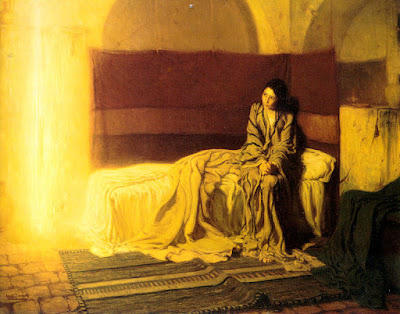
And so, you and I, the entire world, are thrust into the greatest event in all human history: the God of Creation becomes one of us. And what does God do? He makes it all depend on the agreement of a teenage, Jewish girl, simply to convince us that “nothing will be impossible for God” [Lk 1:47].

That’s just how God works: always calling the weakest to greatness. How did Andrew, the future apostle, put it?

“Can anything good come from Nazareth?” [Jn 1:46]

Nothing much, other than the Savior of the World, our Blessed Mother, and the obedient, God-fearing Joseph who devotes his life to protecting his family, protecting God’s family. Yes, indeed, nothing good comes from Nazareth except the Holy Family, except God Himself. And it’s here in Nazareth, not in Rome, or Athens, or Alexandria, where God chooses to enter our world. He appears in a tiny, forgettable Galilean village, in a backwater of the Roman Empire.

But as the prophecies remind us, it’s all been long prepared, a part of God’s unerring plan, so when Gabriel says, “Hail, full of grace, the Lord is with you” [Lk 1:28], we know Mary has been chosen from the beginning of time itself.

“Do not be afraid” [Lk 1:30], Gabriel says, and Mary sheds her fears. But the angel’s words echo down through the ages to our own times.

So many today are filled with fears, fears that try to overcome their faith.

So many have forgotten their calling as Christians, to give birth to Jesus in their lives and the lives of others.

Like Mary we have been called to give an unconditional “Yes” to God’s presence in our lives.

Like Mary, we too must ponder and reflect to discern what God is asking of us.

Like Mary at the foot of the Cross, we can be plagued with questions that seem unanswerable.

But like Mary, we, too, can hear and accept Gabriel’s words, “Nothing will be impossible for God.”

Wonderful, hopeful words that bring us peace as we welcome the Prince of Peace.


Monday, January 18, 2021

Homily: Monday 1st Week in Ordinary Time

Here's my homily from last Monday's daily Mass. Forgot to post it...

______________


Readings: Hebrews 1:1-6 • Psalm 97 • Mark 1:14-20

Today, as we begin the liturgical year’s Ordinary Time, our readings also present us with beginnings. The Letter to the Hebrews opens with a statement that sums up God’s plan as it’s revealed to us through Sacred Scripture:

In times past, God spoke in partial and various ways to our ancestors through the prophets; in these last days, he spoke to us through the Son, whom he made heir of all things and through whom he created the universe… [Heb 1:1-2].

It says it all, doesn’t it? Spanning the countless centuries from creation to Abraham to Moses and the prophets, it all leads ultimately to Jesus Christ and His Church. All that Old Testament revelation, confusing as it sometimes seems, is fulfilled through the Father’s Son, Jesus Christ, who not only comes to us in flesh and blood, but is eternally present with the Father from the moment of Creation.

I remember when I first actually thought about the eternal presence of Jesus Christ. I was a freshman at Georgetown taking an Old Testament course taught by an old Jesuit (who was probably years younger than I am now). Here's what he told us:

“You know all those verses that refer to the patriarchs and others walking and talking with God? Well, most scholars just assume it’s a metaphor. But what if it’s not? Is not the Eternal Word of God present throughout all time? Could the Son not walk and talk with Adam and Noah and Enoch and Abraham and Moses? Time, after all, is no obstacle to our eternal, omnipotent God, to Jesus Christ, the Alpha and Omega, the beginning and the end.”

Well...that certainly got me thinking.Is this what Jesus meant in John 5 when He revealed the Son’s work and challenged the Jews?

For if you had believed Moses, you would have believed me, because he wrote about me [Jn 5:46].

Or at the Transfiguration when Moses and Elijah converse with Jesus about His future redemptive act on Calvary? [Lk 9:30-31]

St. Augustine reminds us, “The New Testament lies hidden in the Old; the Old is made explicit in the New.” Yes, just as God, through His Eternal Word, led the Israelites through the wilderness, so too does His Eternal Word, Jesus Christ, lead His Church.

We see this in today’s Gospel passage when Jesus begins His public ministry with the simple message:

This is the time of fulfillment. The Kingdom of God is at hand. Repent and believe in the Gospel” [Mk 1:15].

A simple message…but what does it mean? Let’s look at the last part first. We use the word, “repent,” but the Greek word is metanoia, and the translation can cause problems. 

Most people think of repentance as being sorry for something. But metanoia means so much more. It means to think differently, to change. We’re not called just to be sorry and then continue on. As Paul reminds us, we’re called to “put on the new self" [Col 3:10], to be something new. We’re not called simply to change what we do; we’re called to change who we are.

Did the Apostles realize this? Did Andrew and Simon, and James and John know what Jesus was calling them to do when He said, “Follow me”? Why did they drop everything – those entangling nets, their work, their homes, and follow Jesus? Did they really understand it all?

No, they didn’t. But they sensed it…they sensed the Presence of the Holy Spirit, the Presence of God, in Jesus and His call. It was overwhelming. They knew they’d been called to something special, even if they didn’t know what it was. And so, they followed.

Brothers and sisters, it’s pretty much the same with us. “This is the time of fulfillment. The Kingdom of God is at hand. Repent and believe in the Gospel”

It’s still the time of fulfillment, the time of Jesus’ Presence in the world.The kingdom, God’s reign, is here, a kingdom founded on love, on our relationships with God and with one another.

He calls us to repent. He calls us to a radical conversion. We don’t know exactly what God has in store for us, but we do know He wants us to change, to renew ourselves in Him. What kind of change? The kind that comes straight from the Gospel, the Good News of Jesus Christ. To “believe in the Gospel.” Not just to accept all the Gospel teachings of Jesus, but to believe in Him, to pattern our lives on Jesus Himself. 

It means living the Gospel without compromise.

It means a new beginning every day, not looking backwards, not regretting the sins of the past; allowing God to forgive you; forgiving yourself; putting on that new self, starting anew with God.

It means forgiving others, letting go of all the pain, all the hurts caused by others…starting anew with all those in your life.

It means following Jesus. The path may not be all that evident, but the destination is eternal life.