Readings: 2 Cor 9:24-27; Ps 63; Luke 1:26-38
____________________
About 1,600 years ago, way back in the year 431
the Council of Ephesus gave Mary the title, Theotokos,
a Greek word meaning “God Bearer” or “one who gives birth to God” or as we say
today, “the Mother of God.” By giving her that title, the council didn’t mean
that Mary was the Mother of God from eternity. But because Jesus Christ is true
God and true man, and Mary gave birth to Him, she is, therefore, the Mother of
God in time.
It’s the misunderstanding of the Church’s
long-held teaching on this relationship between Mary and Jesus that has led
some Christians to think that we Catholics worship Mary as some sort of
goddess. Of course, nothing could be further from the truth. From the reality
of this relationship, we can fulfill her prophecy in the Magnificat and can
call Mary the “Blessed Mother.”
As many of you know, motherhood is no easy
vocation. Both my mother and my wife had to put up with a lot and sacrifice
even more during those years when their time was focused so intently on raising
their children. But can you imagine how it must have been for Mary…to be the
Mother of God…and be fully aware of it? After all, Gabriel hid nothing from
her:
“Behold, you will conceive in your womb
and bear a son, and you shall name him Jesus. He will be great and will be
called Son of the Most High, and the Lord God will give him the throne of David
his father, and he will rule over the house of Jacob forever,
and of his kingdom there will be no end.”
Mary, then, knew from the first that this child
of hers was the “Son of the Most High,” or as Gabriel added later, “the
Son of God.”
What a remarkable family life! Mary and Joseph
raising Jesus who is fully human, all the while aware of His divine origin, His
divine nature. Luke, and to a lesser extent, Matthew, give us a glimpse of life
in the Holy Family. It’s as if the Holy Spirit is telling us, “You don’t need
to know the details of daily life in this holiest of families, but I will share
a few incidents with you, so you will know who Jesus, Mary, and Joseph really
are.” Just consider all that Mary encountered:
The long arduous trip from Nazareth to
Bethlehem, and the unexpected need to give birth in a cave, a stable fit only
for animals.
The Presentation in the Temple, a prophecy of
pain she would suffer, sorrow she would experience.
A life-saving flight to Egypt, refugees in a
foreign land where they await the death of a brutal king.
The quiet years in Nazareth, when she no doubt wondered
how this Son of hers, this Son of the Most High, would fulfill all that had
been prophesied. She knew that He would eventually leave her to carry out the
Father’s will in the world.
And another event Luke shares with us: the
Passover pilgrimage to Jerusalem, when the 12-year-old Jesus is lost in the
crowd of pilgrims. The panic she and Joseph experienced, the frantic search,
the joy of finding him, and their bewilderment when after three days He wondered
at their parental concern.
In each instance Mary wouldn’t fully understand
– just as later she wouldn’t fully understand her Son at Cana, or when He asked
the crowd, “Who is my mother?” or when she cradled her Son’s lifeless body in
her arms at the foot of the Cross.
But always, Mary ponders these things in her
heart. She knows God’s ways are not ours. Could she fully understand the crucifixion of her Son,
God’s Son? And so, she ponders. She steps away, seeks the quiet of
contemplation, and savors all that has been revealed to her.
In doing so teaches us how to pray, how to
accept God’s will, how to abandon oneself to God’s love. She ponders, she
returns to the source, to that day when the angel declared her, “full of
grace,” when her heart overflowed. “…full of grace”, and that’s
exactly what Gabriel meant. Mary is literally full of God’s grace, so full
there’s no room for any sin within her.
And how could it be otherwise? For God
incarnate must enter the world via a spotless vessel, born of woman but a woman
without sin. For her pondering heart is immaculate, perfectly pure, because it
focuses solely on Jesus. Mary is single-hearted. She trusts in God, just as she
trusted when Gabriel asked for her response.
But now, today, that same trusting, pondering,
immaculate heart is focused on you and me, interceding for our salvation. This,
brothers and sisters, is the immaculate heart, the heart of Theotokos,
the Mother of God whom we honor here today. For Our Lady of Guadeloupe presented
the world with a gift of Castilian roses and an image of herself, a virgin
awaiting the birth of our Savior.
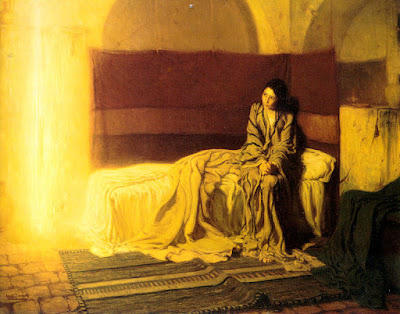
Without Mary’s “let it be done”, her fiat,
without her declaration of faith, without the word of Mary, the Word of God
could not be Emmanuel, God with us. What did the angel tell her? “You
shall conceive and bear a son…the Son of the Most High.” And Mary agrees: “Let
it be done to me according to your word.” With this, Jesus is not simply in
her thoughts and hopes, in her prayers and yearnings. He is in her flesh. His
flesh is her flesh. Hers is His. She waits only to see His face and offer Him
to the world. This is Our Lady of Guadeloupe. She knows she is blessed, for she
told us…
“…He has looked with
favor on his lowly servant. From this day all generations will call me blessed:
the Almighty has done great things for me, and holy is his Name.”
Words
we too should pray every day, because God has done great things for us well. He’s
given us His Son, who in complete humility takes on our flesh, redeems us
through His passion and death, and in His Resurrection defeats death.
But
isn’t it interesting that Christ’s redemption of the world requires the consent
of Mary. We are created in and for love. Had God imposed His will on Mary,
without her free consent, love would be absent, and we couldn’t share His
divine life, which is freedom.
Through
her love for Jesus, Mary is the first disciple, and the one who lived
discipleship to the fullest. Jesus told us clearly what it means to be a
disciple: “Whoever does the will of God is my brother and sister and
mother…the ones who listen to the word of God and act on it.” And that is
Mary: She hears God’s word within her, and she acts.
She visits her older kinswoman, Elizabeth, who was with child and needed Mary’s help. Mary’s first act as Jesus’ mother is to carry him, not for herself, but for someone in need. And how wonderful, when Mary greeted Elizabeth, John the Baptist leapt for joy in Elizabeth’s womb. Yes, Our Lord was first greeted in the world by an unborn infant who sends a message of life to the world.
Mary,
the perfect disciple, follows Jesus. She is blessed, not only because she bore God’s
Son, but also because she is the prime example of those who listen to the word
of God and keep it. She follows Jesus all the way to the Cross, and beyond. She
remains faithful even after her Son’s death, listening to the Lord, joining the
apostles in prayer, waiting for the coming of the Holy Spirit.
And
just as Jesus came to Mary in poverty and human weakness, He comes to us today,
not in glory, but in helplessness. Just as He came to Mary powerless, Jesus
comes to us in the hungry and thirsty, in the stranger, the lonely, the sick
and dying, the confused and troubled, addicted and imprisoned. Again, in the Magnificat,
she sings that
[God] “has scattered
the proud in their conceit. He has cast down the mighty from their thrones, and
has lifted up the lowly. He has filled the hungry with good things, and the
rich he has sent away empty…for he has remembered his promise of mercy.”
Today
God chooses to proclaim His truth to the world through you and me. That’s
right, we must become truth tellers. We must courageously counter the lies and
distortions of the culture of death, all the weeds planted and cultivated by
Satan. For we are a Church of life. Did not Jesus say, “I came so that they might have life and have it more abundantly.” Just as Mary said, “Yes,” to life,
so must we.
So
many cry out to God in their confusion: they hunger for love, for truth, for
justice, for life…It’s more than a human cry; it’s God’s Word calling.
I
can’t tell you exactly what God is calling you to do, for God works differently
through each of us. I can assure you He’s not telling you to do
nothing. We are Jesus’ disciples, in imitation of Mary, but only if we listen
to his word and act on it. Our faith, then, must be a living, active faith. How
did Jesus put it? “Repent and believe in the Gospel.” Yes, indeed,
accept and repent of our sinfulness and accept the gift of faith.
This
kind of discipleship is not without cost; it’s never easy. “A sword shall
pierce your heart,” Mary was told – just as it must pierce the heart of
every true disciple. But like Mary we can take comfort in God’s presence within
us.
As
Jesus told us, if we love Him and keep His word, His Father will love us, and
they will come and make their home with us. Christ all around us. Christ
leading us. Christ within us. We need only listen to Mary. In her words, “Do
whatever He tells you”, and then do it.
Jesus, Mary and Joseph, pray for us.