The occasional, often ill-considered thoughts of a Roman Catholic permanent deacon who is ever grateful to God for his existence. Despite the strangeness we encounter in this life, all the suffering we witness and endure, being is good, so good I am sometimes unable to contain my joy. Deo gratias!


Although I am an ordained deacon of the Catholic Church, the opinions expressed in this blog are my personal opinions. In offering these personal opinions I am not acting as a representative of the Church or any Church organization.

Showing posts with label Pope Paul VI. Show all posts

Wednesday, October 19, 2022

It’s Time for Our Bishops to Act

The other day, during an appearance on MSNBC’s “Morning Joe” program, a senior White House official, Keisha Lance Bottoms (former mayor of Atlanta, but now the director of the White House Office of Public Engagement), was asked about the extent of President Biden’s support for abortion. The program’s co-host, Willie Geist, asked Bottoms, “Does the President, does White House, believe there should be abortion available without limits in the country?” As you might expect from this White House, Bottoms did not provide a clear “Yes” or “No” response, but instead said the following:
“What the president believes is that there should be a fundamental right for a woman to choose what to do with her own body and the President has said this time and time again, that there are basic, fundamental rights, access to health care, this access to health care includes women across this country. And what we expect to see is that, especially college-aged women, women who’ve had to face these very difficult choices will be reminded of this, especially during this season. And it’s something that we can’t ever put too far behind us because, again, we know that elections matter and we know that congressional Republicans want to take us back. I’m 52 years old. In my lifetime, I’ve always known that a woman has a right to make decisions about her own body and what we are seeing being put forth by congressional Republicans right now takes us back more than 50 years.”
It would seem her response confused even the folks at MSNBC; and Geist, trying to elicit a more definitive answer from Bottoms, asked: “So, does that mean the President supports abortion at any time during the pregnancy, whether it’s 3 weeks or 30 weeks?” To this, Bottoms replied: 
“What the President has said very publicly is that he supports a woman’s right to choose. I’ve never heard the President give a timeframe on that. But he has said that he believes that a woman has a fundamental right to make decisions about her own body and her healthcare choices.”
I’m pretty sure this is White-House-Speak for a “Yes” answer, that the administration is telling us President Biden supports abortion at any time during a woman’s pregnancy. Ms. Bottoms certainly didn't say otherwise.

The next question, then, should be asked of the Catholic Bishops of the United States. If President Biden, who frequently declares himself to be a "devout Catholic," absolutely denies the Church’s consistent magisterial teaching on life and a host of other moral issues, should he be allowed to partake in the Church’s sacramental life? Just consider the scandal the President causes as he publicly attacks the Church by denying its teachings and, as one parishioner remarked the other day, “…just gets away with it. Where are our bishops?”

Yes, indeed, where are our bishops? One priest told me they likely hesitate to get involved in what they view as political issues, something that might influence elections. I think my response surprised him. I simply said the Church has always taught that the goal of evangelization is to ensure the Good News of Jesus Christ reaches individuals and also penetrates and transforms cultures, highlighting and lifting up those aspects of culture relevant to the Gospel. 

Too often today we live our Christianity strictly as individuals. Even in societies with large and majority Christian populations, Christian influence on laws and institutions, on education, science, entertainment, sports, and the arts is lacking or completely absent. Some say that this is fine and in keeping with our Constitutional freedoms. And I agree, at least partially. Our Constitution guarantees our religious freedom, prohibiting the government from establishing a state religion, but also prohibiting that same government from "prohibiting the free exercise" of religion by the people. If that's the case, and it is, we can certainly exercise our Church's primary task: evangelization. As Jesus commanded the disciples right before He ascended to the Father:
"Go, therefore, and make disciples of all nations, baptizing them in the name of the Father, and of the Son, and of the holy Spirit, teaching them to observe all that I have commanded you. And behold, I am with you always, until the end of the age” [Mt 28:19-20].
As Pope St. Paul VI reminded us:
“…The split between the Gospel and culture is without a doubt the drama of our time, just as it was of other times. Therefore, every effort must be made to ensure a full evangelization of culture, or more correctly of cultures. They have to be regenerated by an encounter with the Gospel. But this encounter will not take place if the Gospel is not proclaimed” [Evangelii Nuntiandi, 20]
This teaching was echoed by Pope St. John Paul II who wrote: 
“A faith that does not affect a person’s culture is a faith 'not fully embraced, not entirely thought out, not faithfully lived.'” [Christifidelis Laici, 59]
It’s time to act and restore a culture of life in our nation and in the world. We each have a part to play in this drama, but our bishops should lead the way and set the example for the faithful.


Thursday, January 27, 2022

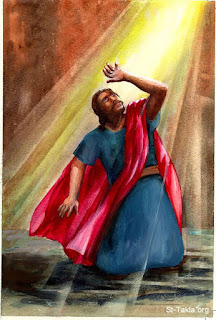
Homily: Conversion of St. Paul

Readings: Acts 22:3-16; Ps 117; Mk 16:15-18                          

The call to conversion by Jesus can come at the most inopportune times. Recall how Peter and Andrew, James and John were working hard at their profession as fishermen when Jesus showed up and called them away.

“Follow me and I’ll make you fishers of men” [Mk 1:17].

They probably didn’t have a clue about what this would mean for them, but they followed, nonetheless.

Then there was Matthew, the tax-collector. He had a sweet deal going, collecting taxes for the Romans, and pocketing plenty of cash for himself. But Jesus comes along and simply says, “Follow me!”, and Matthew drops everything [Mk 2:14].

Imagine what their friends and relatives thought. You’re doing what? With whom? And you’re leaving everything behind…your business, your family, everything?

Called by Jesus these practical, down-to-earth men willingly gave up everything for something they did not yet understand. Yes, Jesus wasn’t just some itinerant preacher. Obviously, there was something very different about Him, something beyond normal human experience.

Imagine, too, what the future apostles thought when John the Baptist pointed out Jesus to them: "Behold! The Lamb of God!" [Jn 1:29] Behold the sacrificial lamb, the one who will give His life for the world. Jesus was something more than special. He was, as Peter would later profess, “The Christ, the Son of the Living God!” [Mt 16:16]

But not everyone agreed. One was a young Jew named Saul. He was a Pharisee, a Jew of the tribe of Benjamin, a native of the cosmopolitan city of Tarsus in the region of Celicia in Asia Minor. As Paul later described it, Tarsus was “no mean city” [Acts 21:39].

Yes, indeed, Saul was no peasant. Paul’s family was apparently distinguished enough that the emperor had made them Roman citizens, a rare honor. And for his fellow Jews, he had the prestige of being schooled by the famous and learned Gamaliel.

As a Pharisee, now in Jerusalem, Saul had no patience for the new and dangerous sect that worshiped this Jesus of Nazareth as Messiah and Son of God. What a blasphemy! This Jesus could be only a false Messiah, for He had been crucified as a criminal, and had preached such foolishness as the brotherhood of Jew and Gentile.

Certain of himself and his mission, arrest warrants in hand, Saul was on his way to Damascus, 135 miles distant, to root out the followers of this Jesus and bring them back in chains for prosecution. But it is here, along this road to Damascus, that Jesus calls him. 

Knocked to the ground, blinded, overwhelmed by the voice of God, Saul is accused of persecuting Jesus Himself. But Jesus has plans for Saul. Renamed Paul, he is in God’s own words, “His chosen instrument.” This zealous Jew will now carry Jesus, the living and incarnate Word of God, to the world, to both Jew and Gentile.

Paul’s calling might have been exceptional in manner, but it was really no different from the calling of every Christian. For, just like Paul, we are all called to follow Jesus in holiness, to enter into an ongoing conversion; and like Paul it is our response that makes the difference. We are all called to the apostolate, to be apostles of Jesus Christ, to be the ones who are sent.

God’s voice comes to us all, that inner voice that brings both a calm acceptance and a restlessness to obey. It speaks to us in the words of the prophet, revealing all that God wants of us, dispelling uncertainty and fear, calling us to respond with our entire being.

Can we abandon ourselves, our autonomy? Can we accept that we too are called, we too are chosen to do, to give, to speak, to pass on to others all that He has given us, done for us? Can we make this our prayer? “What would you have me do, Lord? Tell me and I will do it.”

As Pope Paul VI preached: “…it becomes a need to hasten, to work, to do everything one can to spread the Kingdom of God, to save other souls, to save all souls."

Of course, God gives us a choice. But how did St. Paul put it?

Christ Jesus has made me his own” [Phil 3:12].

That’s right, like Paul we belong to Jesus Christ now. To turn away from that would be foolishness indeed.


Monday, August 20, 2018

Homily: Feast of St. Bernard - Monday, 20th Week in Ordinary Time

Today's homily includes some of the comments I made in an earlier blog posting. But I felt called by the Spirit to address the current news about the Church in a homily. 
-------------------
Readings: Ez 24:15-23 • Dt 32:18-21 • Mt 19:16-22
-----------------------------
In recent days more than a few parishioners have come to me, looking for direction and hope in the face of the headlines and all they see happening in the Church. Why they came to me, I can't imagine, for I am the least qualified, the least able...How often do I find myself praying those words of St. Peter:
"Depart from me, Lord, for I am a sinful man" [Lk 5:8]. 
"Depart from me, Lord..."
And then God humbles me, and I realize it's not me, the man, people come to; it's the deacon, God's servant. Calling on the Holy Spirit, I respond as best I can. Sometimes it takes a while to hear the Spirit, and it was actually through today's readings that I gradually came to realize the fulness of what He was telling me.

Turning first to Ezekiel, we find the prophet faced with a personal loss, the sudden, unexpected death of his wife, whom God lovingly refers to as "the delight of your eyes" [Ez 24:16]. Aren't those beautiful words? - "the delight of your eyes" - words that offer a glimpse into the love that must have bound these two. 

I suspect Ezekiel ultimately came to accept his wife's death as a blessing that would spare her from the calamities about to befall God's People. For God tells Ezekiel not to mourn her death openly, that much more sadness is coming, and he must be the example:
"You shall be a sign to them, and they shall know that I am the Lord" [Ez 24:27].
Babylon's long siege of Jerusalem will end, the enemy will overrun its walls, God's sanctuary, the Temple, will be desecrated and destroyed, and many of God's children will be slaughtered, the rest carried off into exile.
Jerusalem and the Temple Destroyed
God gave Ezekiel the task of leading the people as they faced these tragedies. "What does this mean for us?" they ask him.

They're reminded that sin has entered the Temple, just as today sin has desecrated the Church from within. Innocents have suffered and shepherds have turned away. In Ezekiel's Jerusalem priests and kings had turned from God, had forgotten His Law, just as today far too many in God's Church have done the same.

Blessed Pope Paul VI
In 1972, Blessed Pope Paul VI stated prophetically that, "Through some fissure, the smoke of Satan entered into the Temple of God." With this we're reminded of Moses' words in our responsorial.
"You have forgotten God who gave you birth" [Dt 32:18].
Yes, too many have forgotten God; and we are overwhelmed with sadness and moved by righteous anger. It must always be a righteous, not a vengeful, anger. It must be the kind of righteous anger that cleansed the Temple in Jerusalem. And so we, too, turn to our God and ask, "What does this mean for us? What shall we do?"

We must do what the faithful have always done, which is really little different from what Ezekiel told God's People: Continue to turn prayerfully to our merciful God and ask for the strength to begin over again. That's right! We must begin again as the Church has many times over two millennia.

Francis, Repair My House...
St. Bernard, whose memorial we celebrate today, was called to heal the Church in a time of disunity and schism almost 1,000 years ago. Yes, it was a time to begin again.

Our Lord later commanded St. Francis: "Go and repair my house which, as you see, is falling into ruin." It too was a time to begin again.

Yes, the Church has faced ruin before, but Jesus promised: 
"I am with you always, until the end of the age" [Mt 28:20].
Today we are led by another Francis, a man who must carry on with the task of rebirth. We must pray that God gives him and his bishops the will and the strength to cleanse the One, Holy, Catholic, and Apostolic Church.

Sadly, some in the Church will not accept this. They will turn from Christ's Church, forgetting that the Church remains holy despite the sinfulness of its members. In their sadness and their anger, they will turn away even from the Eucharist - "the source and summit of the Christian life" - and reach after so much that offers so very little. Like the rich young man who came to Jesus in our passage from Matthew, they will turn away in sadness, unable to accept the Gospel without compromise.

50 years ago, when Pope Benedict XVI was a young Father Joseph Ratzinger, he too made some prophetic comments in a radio broadcast:
"From the crisis of today the Church of tomorrow will emerge - a Church that has lost much. She will become small and will have to start afresh more or less from the beginning.
"But in all of the changes at which one might guess, the Church will find her essence afresh and with full conviction in that which was always at her center: faith in the triune God, in Jesus Christ, the Son of God made man, in the presence of the Spirit until the end of the world.
"The Church will be a more spiritual Church... It will make her poor and cause her to become the Church of the meek."
Fr. Ratzinger Speaking About the Church's Future
 [Note: To read the entirety of then Fr. Ratzinger's broadcast, get a copy of his book, Faith and the Future. His remarks on the future of the Church can be found in the last chapter.]
Brothers and sisters, we must become the Church of the meek, a Church of the humble that approaches God in repentance. This is what we are called to do. We, the faithful, are called to "start afresh...from the beginning," and do so in faith, in humility, and in love. We must not, we cannot, accept sin by calling it by another name, and yet we must also forgive the sinner and embrace and console the innocents.

About 20 years ago, as a fairly new deacon, I was asked to speak to a group of seminarians. During the course of my remarks, I told them: 
"The holiest people you will ever encounter are not seated in the sanctuary; they are in the pews of your parish church. They will look to you for truth, for direction, and example, but if you don't provide it, they will rightly turn to God. They will find Him in prayer, in the Sacraments, in Sacred Scripture, and in Sacred Tradition. They will find Him in each other, in the Church, and it is through them that God will keep the Church holy."
That's right, brothers and sisters; through you, God will keep the Church holy.
“Be holy, for I, the LORD your God, am holy [Lv 19:2].
Pray for our faithful priests and bishops.

Wednesday, October 26, 2016

It continues...

On several occasions in recent years I've mentioned how our society is moving not simply away from God, but actively against God and His Church. I'd like to be able to say that this movement is happening only slowly, but I'm afraid Satan realizes he has a better opportunity to work his evil if he acts quickly.


Cardinal Sean O'Malley
Although it's been going on for centuries, the Scatterer has been particularly busy in Western Europe and the USA. For example, some years ago the legislature of the commonwealth of Massachusetts decided that the Catholic Church would have to stop its foster parenting and adoption services unless it agreed to place children with same-sex couples. Ultimately, the Church, in the person of Cardinal Sean O'Malley, refused to agree and, therefore, ceased providing these services. The courts supported the state, in effect saying that these family services had nothing to do with religion. The prohibition, therefore, was not considered to be a violation of religious freedom. In fact, the state courts maintained that any organization refusing to place children with same-sex couples acted for one reason only: it must hate gay people. Although the state legislature that enacted the legislation was (and remains) overwhelmingly Democrat,  the Republican governor at the time -- Mitt Romney -- and the Republican lieutenant governor both did little or nothing to encourage the legislature to revise the law. Although state laws vary, this same prohibition has been adopted by a number of other states causing Catholic Charities and other Church-related agencies to cease adoptions. You can read more about this here and here and here.

Massachusetts, of course, wasn't satisfied with abolishing freedom of religion for its citizens. No, it still has work to do because people might actually speak openly against its enforced political correctness. The state legislature has now enacted legislation designed to protect transgenders from a variety of evils, including the evils of religious belief and religious speech. This new law will be enforced by the Massachusetts Commission Against Discrimination, an agency dedicated to eliminating discrimination against everyone but believers. And so the commission has decided that all churches must comply with the new law. This includes prohibiting the use of improper pronouns by Church leaders and volunteers since doing so would constitute harassment. Bre Payton, of The Federalist, writes:
"The potential infringements upon religious freedom are vast, as this new law basically provides the state and trans activists with a legal tool to force pastors into using terms that violate their beliefs (and basic biological facts).
"It also raises some serious constitutional questions. The Bible states that humans were created as man and woman in part so they would procreate, a blessed event. So if a pastor faces legal consequences for preaching the Bible, these new rules threaten their First Amendment right to the free exercise of religion."
You can read more about this latest governmental assault on the Church in a recent article published in Boston's Catholic weekly, The Pilot.


Archbishop Charles Chaput
One of our great bishops who never shies away from the front lines of this battle is Archbishop Charles Chaput of Philadelphia. In his weekly column, dated October 19, the archbishop shows us exactly where these battle-lines are drawn and who the enemy really is. Read it before you cast your ballot in the upcoming election. Here's a link: About Those Unthinking, Backwards Catholics.

Our nation's founding fathers not only included religious freedom in the Bill or Rights, but placed it in the very first amendment to our constitution. And even there they gave it primacy of place, listing it before freedom of speech, or the press, or assembly. They considered religious freedom to be the most important of all our freedoms. 

Today, however, our society has not only rejected religion, it has largely rejected God Himself. Despite all their religious allusions in stump speeches and public addresses, most of those who enact and enforce our laws are tacit atheists. By this I mean that they have essentially chosen themselves over God. They are convinced that their laws supersede God's laws, and by doing so they have chosen darkness over light. 

So far it's been a bland sort of atheism, but lately it's becoming far more virulent. It exchanges a belief in God for a belief in technology and science as the future saviors of humanity. It thrives on a kind of materialism that seems to have no moral or ethical boundaries. It argues for prosperity and peace but brings only hardship and strife. It's also a clueless form of atheism because it doesn't understand or refuses to accept that it is largely responsible for most of the growing ills confronting our societies today.


Pope Paul VI
I'm reminded of something Pope Paul VI said during a General Audience almost fifty years ago:
"In the world of thought everything is doubted today, and consequently, religion too: It seems as if the mind of modern man finds no peace except in total negation, in abandoning any kind of certainty and any kind of faith. He is like a person with infected eyes who finds no rest except in obscurity, in darkness. Is the realm of darkness to be the final end of human thinking, of man's unquenchable thirst for truth and of his encounter with the living and true God?" [General Audience, 14 June 1967 - Italian Only]
I don't fear the future, because at my age I don't have that much of a future to fear. Anyway, Our Lord told us only a few dozen times: "Be not afraid!" And so I'm determined to do just that until the day He calls me home. But what do we do in the meantime? I suppose we just continue doing what we've been called to do: we make disciples of all nations, starting right here at home. We preach the Word; we teach God's people all that He commanded us; and we touch those who need to feel God's healing hand on body and soul.

And for those of you -- and there are many -- who are worried sick about the upcoming elections, don't be. Each of us can only do our duty as citizens and Christians by voting. Just keep in mind that God's will must always surpass the ways of the world, and we should vote accordingly. And regardless of the outcome, the Lord of History will ensure His New Covenant with His people will be kept.

Saturday, August 6, 2016

The Popes of My Life and Benedict XVI

Our current pope, Pope Francis, has been a remarkable witness to the love, forgiveness and mercy of God. He has taught us to embrace the sinner, to welcome the outcast, to love the unloved, to forgive the unforgiven. He has taught us to look deeply into our own hearts instead of trying to judge the hearts of others. He has taught us to laugh at ourselves and to share the joys and sorrows of those God places in our lives. He has taught us to be Christians by being Christ-like

Pope Francis was preceded by a series of remarkable men.
When I consider those who have been pope during my lifetime, I realize how God has showered his blessings on today's world.

By the time I was born in 1944, Eugenio Pacelli had already been Pope Pius XII for over five years. During the chaotic years of World War II, he not only saved the lives of thousands of Jews and others who were on the Nazis' death lists, but also managed to steer the Barque of Peter through some of history's most turbulent waters. But then, years after the war, he became the target of a constant stream of vilification from a parade of fools whose hatred for both pope and Church led them to lie blatantly about Pius' efforts to save the lives of European Jews from Hitler's Nazis and Mussolini's Fascists. Fortunately, the Church listened only to the Spirit and has consistently preached the truth about this great pope.

In 1958 the saintly Pius XII was succeeded by Angelo Roncalli, Pope Saint John XXIII. Although his reign was brief, less than five years, he gave us the Second Vatican Council (1962-65), the Church's first truly pastoral council. Now, after five decades of study and implementation, the Church has come to understand, accept, and reap the benefits of the comprehensive teachings of the Council Fathers.

After Pope Saint John's death in the midst of the Council, he was succeeded by Giovanni Montini, Pope Paul VI. Like so many of his predecessors, Paul VI was subjected to attacks from both outside and inside the Church. His external attackers were the usual suspects, but he suffered much from the public criticism of his brother bishops and priests. This criticism reached a crescendo with the 1968 appearance of his prophetic encyclical, Humanae Vitae. 48 years after its publication it has become apparent that Blessed Pope Paul was not only remarkably prescient but also possessed a keen understanding of the modern world, its strengths and weaknesses.

With the death of Blessed Pope Paul VI in 1978, the Holy Spirit elevated Albino Luciani to the Chair of Peter. With his election the "Smiling Pope" took the unique double name, Pope John Paul I. Sadly this first John Paul would serve for only 33 days before suffering a fatal heart attack. Although the last in a long string of Italian popes, John Paul would bequeath his name to his great Polish successor. And it would be a well-traveled name recognized throughout the world.

Karol Wojtyla, a man who had experienced totalitarian oppression first hand and personally battled with the two enslaving ideologies of the last century, was elected pope in 1978 and would serve God's people tirelessly for almost three decades as Pope John Paul II. He has been called John Paul the Great for good reason. He carried the Church into the world, literally into every corner of the world, preaching the Good News of Jesus Christ and sharing God's love with the millions he encountered. Devoted to Mary, humanity's Blessed Mother, he credited her with saving him from the assassin's bullet as he greeted pilgrims in St. Peter's Square. As he traveled the world, visiting well over 100 countries, he stressed the "universal call to holiness" building bridges across the world's religions.

With the death of John Paul in 2005, the Church turned to the man who had served the future saint for a quarter-century as his close confidant, lead theologian, and protector of Christian doctrine. Joseph Ratzinger, a humble, soft-spoken German theologian, who had hoped to spend his remaining years in study and writing, was instead elected to the Chair of Peter and chose the name of the patron saint of Europe, Benedict. As pope, Benedict XVI did what he did best: he taught. His catechesis and his writings addressed a wide range of theological themes, including "Friendship with Jesus Christ", something he believed essential to overcoming the great errors and temptations of our time. He also strongly condemned what he called the "dictatorship of relativism" which he believed was the great challenge facing the Church and the world today. Of course, Benedict shocked the Church and the world when, due to the infirmity that comes with old age, he resigned from the papacy in 2013.
Cardinal Ratzinger and I Meet in Rome
Pope Benedict XVI is the only pope I have met personally, although at the time of our meeting he was still Cardinal Ratzinger. I suppose this brief meeting in the year 2000 has placed the man a step above the others, in my mind at least. For that reason I tend to pay a bit more attention to news stories about him. One of these stories (see the below video) relates to a Master's Degree program focused on the theology of the pope emeritus. Offered in Rome by the
Augustinian Patristic Institute it drew 90 students for its first offering. How wonderful that the life work of this wonderful theologian will be studied by so many. If only I were 20 years younger and lived in Rome.


Monday, December 29, 2014

Homily: Feast of the Holy Family of Jesus, Mary and Joseph - Year B

Readings: Sir 3:2-6, 12-14; Ps 128; Col 3:12-21; Lk 2:22-40

From the very beginning the Church has consistently taught that Jesus Christ is true God and true man, that the Incarnation is God coming into the world as one of us. In His humanity, the Church teaches, Jesus is like us in all things except sin.

And yet, over the centuries, many have tried to make Jesus into someone or something He isn’t. Indeed, most of the heresies that plagued the early Church focused on the identity of Jesus, as the world tried to answer the question Jesus asked His disciples: “Who do people say that I am?” [Mk 8:27] And now, 2,000 years later, people are still giving the wrong answers.

I once heard a television preacher say that Jesus possessed complete knowledge of all the sciences. “Jesus, the man,” he said, “was Einstein, Newton, Pasteur, Curie, Hawking…all the great scientists of the world rolled into one, and then multiplied by a thousand.” He went on to state that “Jesus was the most knowledgeable of doctors, for how else could He have cured all those people? How else could He raise the dead to life?”

I couldn’t help but think: well, if that’s the case, he could hardly be human, like us in all things.

And then, moving toward the other extreme, one of my theology professors once stated that the humanity of Jesus prevented Him from grasping that He was divine. Indeed this theologian taught that Jesus didn’t realize He was the Son of God until the Resurrection. What a surprise that must have been! And, the professor taught, because Jesus, in His humanity, was unaware of His divinity, none of those Gospel miracles really happened.

The real problem for the preacher and professor is that the Incarnation is a mystery, something beyond human understanding, and that just bothers the heck out of them. They can’t accept that Jesus is both fully human and fully divine. They can’t understand how Jesus can be truly the Son of God and yet became a man and our brother.

That they’re unable to grasp the mind of God is unacceptable to them, so they manufacture a Jesus they can accept…one, of course, that conflicts with everything the Church teaches.

As the Second Vatican Council stated: “The Son of God…worked with human hands; He thought with a human mind. He acted with a human will, and with a human heart He loved” [Gaudium et Spes, 22.2]. And yet that human will, “does not resist or oppose but rather submits to His divine and almighty will” [Council of Constantinople III: DS 556].

The Church gives us today’s feast of the Holy Family to remind us of Jesus’ humanity, to remind us that the family is the first church, the domestic church. Yes, Jesus chose to enter into the world as an infant, just as helpless as you and I once were. He didn’t place Himself above us. He didn’t reject the human story but entered directly into it, sharing our humanity, our flesh and blood, our physical mortality.
Although a divine person, He accepted everything that came with His humanity, all the messiness, all the ordinariness, all its limitations. In His humanity He accepted these limitations, and as Luke tells us, would “advance in wisdom and age and favor before God and man” [Lk 2:52]. And He did all this within a human family, a Holy Family under the care and love of Mary and Joseph.

In today’s gospel passage Luke relates the events surrounding the presentation of Jesus in the Temple. According to Jewish law, a firstborn son belonged to God. And so, 40 days after his birth, parents would present their son in the Temple, in effect, buying him back with a sacrifice. And for poor Jews, like Joseph and Mary, it would be a sacrifice of turtledoves or pigeons. On that same day the new mother would also be ritually purified. Indeed, the feast was originally known as the feast of the Purification of the Blessed Virgin.

Here we see the Holy Family, a Jewish family, living under God’s Law, doing as the Law prescribed. Yes, Jesus, the Son of God, accepts that His mission is rooted in God’s revelation, expressed in the Law and the Prophets. It’s there, in the Old Testament, that God’s plan of salvation is first revealed; a plan fulfilled and brought to completion by the Incarnation.

And so Mary and Joseph enter the Temple to fulfil the law. There they are greeted by old Simeon who amazes them with what he reveals. Simeon welcomes the infant Jesus with open arms and in Him sees redemption of the entire world: “…my eyes have seen your salvation, which you prepared in sight of all the peoples, a light for revelation to the Gentiles, and glory for your people Israel” [Lk 2:30-32]. He then gives Mary a taste of the sorrows she will experience, for a sword will pierce her heart.

Mary and Joseph then encounter Anna, a prophetess who lived in the Temple, who goes on to reveal more about their child. And just as Jesus advances in wisdom and age and favor, so too does the Holy Family advance in holiness.

But we should also realize that the message of Simeon and Anna is a message for every family. Holiness is nurtured first in the family. In the midst of all the chaos that surrounds any family there are glimpses of God’s presence, moments of grace when God reaches deep into the clutter of our lives and hands us a present that we never expected.

When my mother died, our elder daughter, 6-years-old at the time, told her mother, “Don’t cry, Mommy. Grandma is with Jesus now, happy in heaven.”

In moments like this God ignores all the barriers and debris that we place between ourselves and our redemption and reminds us that we are called to holiness. In those moments, sticky hands are transformed into instruments of grace and stories of the playground and classroom, or the words of a child to her mother become words of wisdom. In those moments, ordinary events take on new meaning and the dinner table can become like an altar.

In my family, those moments didn’t come when the six of us were kneeling piously in church. They were never captured on film or video. No, they were elusive -- sudden and unexpected. And sometimes, as with Mary and Joseph, they came in the form of words that amaze.

Yes, Mary knew her Son was special. What had the angel said? “He will be great and will be called Son of the Most High… the child to be born will be called holy, the Son of God” [Lk 1:32, 35]. But to hear this and more in the Temple from these two holy ones…this too was something she would long ponder and cherish.

This visit to the Temple is a story that strikes a chord in every new parent who has wondered and worried about the future of their child.

It’s a story for every mother who has looked into the face of her newborn, the face of innocence, and prayed that God would help her raise that child to holiness.

It’s a story to remind us that as parents we will experience disappointment, sorrow, and sometimes great tragedy…but in the midst of it all we will encounter Emmanuel, God with us.

It’s a story to remind each of us of the depth of God’s love for us, that He calls us to His open arms with forgiveness and mercy.

It’s a reminder to parents that holy moments of discovery and growth are often sudden and unpredictable.

It’s a reminder that God calls us into families — not just to protect us physically, but to nurture us in faith and love, to prepare us for a journey that leads only to Him.

It’s no accident that Jesus advanced in wisdom and age and favor, and did so in the midst of a family.

It’s no accident that God used that Holy Family — as he uses our families — to reach deep into other people’s lives, to bring them the light of Christ.

The Word became flesh and dwelt among us; and He came as a child born into a family. By doing so, He sanctified the family, making it an instrument of holiness, and reminding us of the awesome obligation we have to protect it.

For the family today is under attack from virtually every quarter. We seem to have stopped investing in children, and now just invest in things. This is the great temptation for us who live in our affluent Western societies with their contraceptive mentality, societies that see children not as our future, but as competitors who threaten future affluence, as things that take something from us.

This is the same mentality that, 45 years ago, Pope Paul VI predicted would lead to increased marital infidelity, a general decrease in morality, especially among our youth, a lack of respect for women, and the continued erosion of respect for human life at all stages. How right he was!

Today, on this beautiful feast of the Holy Family, let us pray for our families, that we may grow together in holiness, love and mutual respect.

Jesus, Mary and Joseph – pray for us.


Tuesday, March 20, 2012

Culture of Death

Did you hear about the Oregon couple who sued their healthcare provider because their daughter was born with Down Syndrome? That's right, it seems the parents of little four-year-old Kalanit Levy are very upset because Legacy Health of Portland failed to identify the girl's condition prenatally and want to be compensated for this "wrongful birth." Had they known of their daughter's condition before she was born, Ariel and Deborah Levy stated they would have aborted her. Kalanit will require all kinds of extra care that her parents are apparently unprepared or unwilling to provide, so they wanted $14 million from Legacy Health. Read more here.

Yesterday a jury apparently agreed that the "parents" should be compensated and awarded them $2.9 million based on the estimated lifetime costs of their child's care. Attorneys who deal with these cases agree that to win a wrongful birth lawsuit "parents must argue that they would have terminated the pregnancy had they been fully informed." And so this Oregon jury in effect decided this one little girl should not have been born. Hers was a life not worth living. And the Levys have been paid off...for what? For not aborting Kalanit because they would have had they only known? Are they then rewarded for doing what thousands, probably millions, of parents do every day: give birth to and take care of their disabled children, not because they have to but because they love them?

The political left seems to be particularly bothered by these disabled children because they represent an overt rejection of abortion, and these days everything is about abortion. Abortion is the political left's cause célèbre against which all else is measured. And so anyone who knowingly gives birth to a disabled child -- e.g., one with Down Syndrome -- better be prepared to be denounced. Back in 2008 when Sarah Palin was added to the Republican ticket, Carol Fowler, the chair of the South Carolina democratic party stated that the Alaska governor's “primary qualification seems to be that she hasn’t had an abortion”; in other words, she hadn't aborted her Down Syndrome son, Trig. Then, on Trig Palin's birthday in 2011, Jack Stuef of the popular leftist blog Wonkette not only attacked Sarah Palin but also three-year-old Trig:
"Today is the day we come together to celebrate the snowbilly grifter's magical journey from Texas to Alaska to deliver to America the great gentleman scholar Trig Palin...What's he dreaming about? Nothing. He's retarded."
It would seem the left's mandate to adhere always to political correctness does not apply to them, and certainly not when abortion is involved.

According to lawyers.com courts have found it difficult to seat juries in these wrongful birth cases because they have to immediately disqualify those with strong pro-life views and there are just so many of us. I find it particularly disturbing that my support for life would disqualify me as too biased when the person who wrote the above comments on Wonkette would be completely acceptable.

Read again  the words of Pope Paul VI in his monumental encyclical, Humanae Vitae (1968), in which he warns of the consequences of the contraceptive mentality:

17. Responsible men can become more deeply convinced of the truth of the doctrine laid down by the Church on this issue if they reflect on the consequences of methods and plans for artificial birth control. Let them first consider how easily this course of action could open wide the way for marital infidelity and a general lowering of moral standards. Not much experience is needed to be fully aware of human weakness and to understand that human beings—and especially the young, who are so exposed to temptation—need incentives to keep the moral law, and it is an evil thing to make it easy for them to break that law. Another effect that gives cause for alarm is that a man who grows accustomed to the use of contraceptive methods may forget the reverence due to a woman, and, disregarding her physical and emotional equilibrium, reduce her to being a mere instrument for the satisfaction of his own desires, no longer considering her as his partner whom he should surround with care and affection.

Finally, careful consideration should be given to the danger of this power passing into the hands of those public authorities who care little for the precepts of the moral law. Who will blame a government which in its attempt to resolve the problems affecting an entire country resorts to the same measures as are regarded as lawful by married people in the solution of a particular family difficulty? Who will prevent public authorities from favoring those contraceptive methods which they consider more effective? Should they regard this as necessary, they may even impose their use on everyone. It could well happen, therefore, that when people, either individually or in family or social life, experience the inherent difficulties of the divine law and are determined to avoid them, they may give into the hands of public authorities the power to intervene in the most personal and intimate responsibility of husband and wife.
Consequently, unless we are willing that the responsibility of procreating life should be left to the arbitrary decision of men, we must accept that there are certain limits, beyond which it is wrong to go, to the power of man over his own body and its natural functions—limits, let it be said, which no one, whether as a private individual or as a public authority, can lawfully exceed. These limits are expressly imposed because of the reverence due to the whole human organism and its natural functions, in the light of the principles We stated earlier, and in accordance with a correct understanding of the "principle of totality" enunciated by Our predecessor Pope Pius XII.
I'm afraid we, as a people, have allowed this power over life itself to pass "into the hands of those public authorities who care little for the precepts of the moral law."

Let us pray for life every day:
Heavenly Father, your cosmic gaze focused on dust and you fashioned in your image and likeness every man and women: give us, we beg you, a keen eye to recognize that image so that respect for all human life becomes our way of life. Grant this through Christ our Lord. Amen.

- Posted using BlogPress from my iPad