The occasional, often ill-considered thoughts of a Roman Catholic permanent deacon who is ever grateful to God for his existence. Despite the strangeness we encounter in this life, all the suffering we witness and endure, being is good, so good I am sometimes unable to contain my joy. Deo gratias!


Although I am an ordained deacon of the Catholic Church, the opinions expressed in this blog are my personal opinions. In offering these personal opinions I am not acting as a representative of the Church or any Church organization.

Showing posts with label Pharisee. Show all posts

Wednesday, February 14, 2024

Homily: Tuesday, 6th Week in Ordinary Time

Readings: Jas 1:12-18 • Ps 94 • Mk 8:14-21

______________________

Yesterday we saw the blindness of a Pharisee asking Jesus for a sign of His authority from God. Today we see the blindness of Jesus’ own disciples, still struggling to understanding who He is. They were neither evil nor stupid; they just hadn’t grasped that Emmanuel – God with us – quite literally meant that God was with them. Of course, this points to you and me as well, to our own blindness in not always recognizing the clear Presence of God in our own lives.

The disciples are traveling across the lake in the boat.  You would think that with 12 of them someone would remember to pack a lunch. But no. They had only one loaf of bread. As they cross the lake, Jesus is talking to them:

“Keep your eyes open; be on your guard against the yeast of the Pharisees and the yeast of Herod.”  

For the Jews yeast was a corrupting agent because it caused fermentation.  That was why at Passover they ate unleavened, incorrupt, bread. As Paul tells the Corinthians: 

“Get rid of all the old yeast, and make yourselves into a completely new batch of bread, unleavened as you are meant to be” [1 Cor 5:7].

Jesus is simply telling his disciples to avoid two opposing kinds of corruption: that of the Pharisees which is based on narrow-minded and intolerant legalism and that of Herod, is based on amoral and hedonistic pleasure-seeking. Of course, the disciples don’t listen; like us they tend to focus on their own little problems. They latch on to the word “yeast” and link it to their current obsession – not enough bread for them all. All they can think about is their lunch.

Jesus knows what is going in their minds. And so, he chews them out, scolding them for being so self-absorbed, for their continued worries of not having enough bread for their lunch. First, he tosses some rhetorical questions at them: Why are you worried about having no bread? Are your minds so closed, your vision so impaired you can’t see what’s right in front of you? Have you forgotten everything you’ve witnessed? Did it mean nothing?

But then He engages in a little Q&A with them: 

When I broke the five loaves among the 5,000, how many baskets of leftovers did you pick up?” 

“Twelve,” they answer.  

“And when I broke the seven loaves for the 4,000, how many baskets of leftovers did you collect?” 

“Seven,” they reply.

“And still, you don’t understand?”

Five loaves for 5,000 people and 12 baskets of leftovers…Seven loaves for 4,000 with 7 baskets of leftovers…And you, a mere dozen men, are worried about being short of food when I am with you?

Mark tends to be hard on the disciples. They neither see nor hear, even when they witness the remarkable faith of others who encounter Jesus.They seem not to understand what is happening right before their very eyes. I suppose that’s to be expected. These were practical, down-to-earth men –fishermen, not mystics. They don’t yet know what to make of all the healings and miraculous things they’ve witnessed. A bit like you and me – so often we don’t see or understand what’s right in front of us.

But the disciples are learning…Indeed, only a few days after this event Peter makes His remarkable, Spirit-inspired testimony at Caesarea Philippi.

“Who do you say that I am? Jesus asks them.

And Peter replies, “You are the Christ, the Son of the living God” [Mt 16:16].

Mark, you see, isn’t really firing his shots at the disciples, because we know the end of their story. No, Mark is concerned about us, about you and me, for Mark knew what he was about. In the Acts of the Apostles, we encounter Mark as an evangelist, companion of Paul, and then Peter, a man who had seen the temptations James addresses in our first reading. 

Can we see? Do we understand? That God is with us? That He loves each of us with a very intimate, personal love? Or is our faith so weak we allow the little things in our lives to drive our thoughts and actions and blind us to the reality of God’s care for us? How about instead we focus on the big things:

On striving for holiness amidst the clutter of our lives.

On deepening our prayer life so we can stay in touch with God’s will for us.

On making disciples by taking Jesus to others

Do these things, the big things, and God will gladly lead us, and help us handle all the rest – the little things like bread, and illness, and family conflict, all the other worries that occupy our minds.

God cares for us, and He loves to take care of faithful ones.


Saturday, March 26, 2022

Homily: Saturday, 3rd Week of Lent

Readings: Hos 6:1-6; Ps 51; Lk 18:9-14

When we look over the broad scope of these 40 days of Lenten readings, perhaps the most common theme is repentance. Today's Responsorial Psalm (Psalm 51) is certainly an example of this. 

But the next most common theme is the call to humility. I suppose that makes good sense because I’ve always considered humility as the pre-requisite virtue, without which no other virtue can stand. After all, if we don’t possess a humble heart there’s only one other possibility: pride. And we all know where pride leads us. Just as humility is the foundation stone of the virtuous life, pride is the foundation stone of the sinful life.

Humility, you see, is nothing less than an acceptance of reality. Humility is the awareness that we are the creatures and God is the Creator. But more than that, humility is the joyful realization that God created you and me, each one of us, in individual acts of love. Humility is the shock of recognition, our breathtaking grasp that this love is supremely manifested in God’s humbling of Himself to become one of us, and give up His life for us. Indeed, can anything be more humbling than an awareness of our poverty before God? True humility also helps us avoid the ephemeral piety condemned in our first reading from Hosea:

"...like morning mist, like the dew that disappears early" [Hos 6:4].

Pride, of course, takes God out of the picture. It must. Pride, you see, is the inordinate love of self, the love of self above all else. How can one be filled with pride, then, and accept the greatness of God, a greatness far beyond our comprehension? In a very real sense, the prideful person substitutes himself for God, placing himself and his needs and wants above God and everyone else. If you are prideful, how can you love the Lord your God with all your heart and with all your soul and with all your mind, and love your neighbor as yourself? [Mt 22:36-40] You can't.

Just consider today’s Gospel passage from Luke. It’s one of those clear, straightforward passages, a parable that exposes pride for what it really is, while at the same time allowing us to grasp the path to true humility.

First of all, Luke tells us to whom Jesus addressed this parable:  

“…to those who were convinced of their own righteousness and despised everyone else” [Lk 18:9].

In other words, to an audience of the prideful.

It’s also interesting that Jesus’ cast of characters includes only two men: a Pharisee and a tax collector. Jesus often castigated the one and the people despised the other. The Pharisee, while seemingly at prayer, took up a position of prominence. But note that he prays not to God but, as Jesus tells us, “…spoke this prayer to himself” [Lk 18:11]. And how does he begin this prayer offered to himself? “Oh, God…” Yes, indeed, as only the prideful can, he substitutes himself for God, even in prayer. He goes on to thank himself for being so much better than the rest of humanity, revealing a heart devoid of humility. And he especially scorns that sinful tax collector who stands far behind him praying humbly with head bowed.

Both the Pharisee and the tax collector are spiritually impoverished, but only one of them realizes it. The Pharisee’s pride prevents him from recognizing the truth about himself, while the tax collector’s humility leads him to a recognition of this truth. Listen again to His prayer:

“O God, be merciful to me a sinner” [Lk 18:13].

With these few words he acknowledges his total dependence on God and willingly exposes his true condition to the only one who can heal him.

Jesus also reminds us that only God knows our hearts, that we should resist making judgments based on our personal biases. Because of his humble prayer, the widely despised tax collector “goes home justified” while the esteemed and self-exalted Pharisee must still be humbled.

The Eastern Church has long encouraged praying a version of the tax collector’s prayer, revealed in a wonderful little book, The Way of the Pilgrim.

Called the “Jesus Prayer,” and prayed throughout the day to the very rhythm of the body’s breathing, it too is simple:

“Lord Jesus Christ, have mercy on me, a sinner.”

Although prayed by the humble, I can think of fewer prayers more exalting.

Maybe we should all try that throughout the day for the remainder of Lent.


Thursday, January 27, 2022

Homily: Conversion of St. Paul

Readings: Acts 22:3-16; Ps 117; Mk 16:15-18                          

The call to conversion by Jesus can come at the most inopportune times. Recall how Peter and Andrew, James and John were working hard at their profession as fishermen when Jesus showed up and called them away.

“Follow me and I’ll make you fishers of men” [Mk 1:17].

They probably didn’t have a clue about what this would mean for them, but they followed, nonetheless.

Then there was Matthew, the tax-collector. He had a sweet deal going, collecting taxes for the Romans, and pocketing plenty of cash for himself. But Jesus comes along and simply says, “Follow me!”, and Matthew drops everything [Mk 2:14].

Imagine what their friends and relatives thought. You’re doing what? With whom? And you’re leaving everything behind…your business, your family, everything?

Called by Jesus these practical, down-to-earth men willingly gave up everything for something they did not yet understand. Yes, Jesus wasn’t just some itinerant preacher. Obviously, there was something very different about Him, something beyond normal human experience.

Imagine, too, what the future apostles thought when John the Baptist pointed out Jesus to them: "Behold! The Lamb of God!" [Jn 1:29] Behold the sacrificial lamb, the one who will give His life for the world. Jesus was something more than special. He was, as Peter would later profess, “The Christ, the Son of the Living God!” [Mt 16:16]

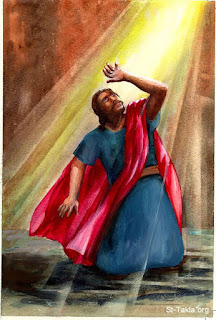
But not everyone agreed. One was a young Jew named Saul. He was a Pharisee, a Jew of the tribe of Benjamin, a native of the cosmopolitan city of Tarsus in the region of Celicia in Asia Minor. As Paul later described it, Tarsus was “no mean city” [Acts 21:39].

Yes, indeed, Saul was no peasant. Paul’s family was apparently distinguished enough that the emperor had made them Roman citizens, a rare honor. And for his fellow Jews, he had the prestige of being schooled by the famous and learned Gamaliel.

As a Pharisee, now in Jerusalem, Saul had no patience for the new and dangerous sect that worshiped this Jesus of Nazareth as Messiah and Son of God. What a blasphemy! This Jesus could be only a false Messiah, for He had been crucified as a criminal, and had preached such foolishness as the brotherhood of Jew and Gentile.

Certain of himself and his mission, arrest warrants in hand, Saul was on his way to Damascus, 135 miles distant, to root out the followers of this Jesus and bring them back in chains for prosecution. But it is here, along this road to Damascus, that Jesus calls him. 

Knocked to the ground, blinded, overwhelmed by the voice of God, Saul is accused of persecuting Jesus Himself. But Jesus has plans for Saul. Renamed Paul, he is in God’s own words, “His chosen instrument.” This zealous Jew will now carry Jesus, the living and incarnate Word of God, to the world, to both Jew and Gentile.

Paul’s calling might have been exceptional in manner, but it was really no different from the calling of every Christian. For, just like Paul, we are all called to follow Jesus in holiness, to enter into an ongoing conversion; and like Paul it is our response that makes the difference. We are all called to the apostolate, to be apostles of Jesus Christ, to be the ones who are sent.

God’s voice comes to us all, that inner voice that brings both a calm acceptance and a restlessness to obey. It speaks to us in the words of the prophet, revealing all that God wants of us, dispelling uncertainty and fear, calling us to respond with our entire being.

Can we abandon ourselves, our autonomy? Can we accept that we too are called, we too are chosen to do, to give, to speak, to pass on to others all that He has given us, done for us? Can we make this our prayer? “What would you have me do, Lord? Tell me and I will do it.”

As Pope Paul VI preached: “…it becomes a need to hasten, to work, to do everything one can to spread the Kingdom of God, to save other souls, to save all souls."

Of course, God gives us a choice. But how did St. Paul put it?

Christ Jesus has made me his own” [Phil 3:12].

That’s right, like Paul we belong to Jesus Christ now. To turn away from that would be foolishness indeed.


Friday, November 8, 2019

Homily: Monday, 31st Week in Ordinary Time

I have embedded a video of my homily from this past Monday of the 31st week in Ordinary Time. The full text of the homily follows the video.


______________________

Readings: Rom 11:29-36; Ps 69; Lk 14:12-14

An old friend of our family, a Jew who converted to Catholicism, used to talk a lot about his father, an orthodox rabbi. I remember him once saying that his father would often criticize his fellow Jews because they tried to turn God into a mensch. Now “mensch” is a German word that in Yiddish evolved into a term for a true human being, a person of honor. “But God,” the rabbi would say, “is no mensch. He’s God.”

St. Paul, a Pharisee, rabbi, and teacher, says much the same thing in today’s reading from Romans:
"Oh, the depth of the riches and wisdom and knowledge of God! How inscrutable are his judgments and how unsearchable his ways!" [Rom 11:33]
In other words, God is no mensch. He’s neither like us, nor a kind of superman. Paul continues, though, with a prayer, a doxology, to ensure we understand that God is…well, beyond our understanding:
For who has known the mind of the Lord or who has been his counselor? Or who has given him anything that he may be repaid? For from him and through him and for him are all things. To God be glory forever. Amen. [Rom 11:34-36]
Yes, indeed, as God reminded His prophet, Isaiah:
"My thoughts are not your thoughts, nor are your ways My ways" [Is 55:8]. 
I think sometimes, perhaps more than sometimes, we forget this and try to re-create God in our image, to turn Him into just another good guy, to turn Him into a mensch. But Jesus disabuses us of this error, and in today’s Gospel passage from Luke, shows us how very different are God’s ways from ours.

Jesus had been invited to dine at the home of a Pharisee, and yet He asked his host to look into himself and examine his motives. 
Who do you bring into your home, the rich and famous? And why do you share your bounty with them? Is it only to ingratiate yourself with them, so they will invite you in turn? Indeed, Mr. Pharisee, why did you invite me here today? Is it just because I’m a local celebrity and you hope my fame will rub off on you?
His words hit home, don’t they? It was the hypocrisy of the Pharisees that Jesus so often condemned. Yes, in their obsessive concern for the minutia of the law, they neglected God’s greatest commandment: the command to love, to love God above all things and neighbor above self.
St. Charles Borromeo, whose memorial we celebrate today, once wrote these words to the priests he supervised:
Be sure that you first preach by the way you live. If you do not, people will notice that you say one thing, but live otherwise, and your words will bring only cynical laughter and a derisive shake of the head.
Sixteen years ago, when Diane and I first began helping out at the Wildwood Soup Kitchen, I encountered a few strange attitudes. For example, one of our volunteers, who served our desserts, expected a certain kind of behavior from our guests. If someone said nothing when she handed them a dessert, she’d challenge with, “You didn’t say, ‘Thank you.’”

This, of course, had to change, so we issued a policy statement that stated: 
Each Soup Kitchen guest honors us by accepting our hospitality, which we interpret as their deepest heart-felt gratitude.
In other words, their being there is thanks enough.

Oh, yes, brothers and sisters, we are so much like the Pharisees. Always looking for a payback, aren’t
we?
We had those new neighbors for dinner six months ago, but they’ve never invited us back. Can you believe it?
But have we opened our homes and our hearts to those who can’t return the favor, to those who thank us only by their presence? Have you and I invited the rejected of the world into our homes? When did the poor, the lonely, the lame, and the blind sit around our table? There are a lot of lonely people in our community, in every neighborhood, people who feel abandoned by others, who think themselves abandoned by God.
But you and I are called to do God’s work, to go to the abandoned and show them God’s love. You don’t have to look for them. They’re all around us; you know who they are.

St. Charles said something else: “With charity – love – no man is lost; without it no man is saved.” 

The call to love others is really just a call to humility, isn’t it? To realize we are no greater, indeed we are often much farther from God than the poor in spirit who cry out silently in their suffering.

Yes, brothers and sisters, humility is a demanding virtue. It takes greatness to become little, strength to become weak, and wisdom to embrace all that Jesus demands of us, to embrace the folly of the Cross. 

And it’s in the Cross, it’s in the crucified Jesus that we encounter the divine paradox: the humility and the greatness and the otherness of God. 

Some years ago I noticed a sign in front of a small, rural church. On it were the words:
His Timing
His Way
His Story
His Glory
Yes, indeed, it's all His.

Thursday, April 18, 2019

Video: Homily for Saturday, 3rd Week of Lent

The lovely Krysten, our parish IT genius, apparently discovered another recorded homily, one I preached at morning Mass a few weeks ago, on Saturday, 30 March 2019. She sent me the video file, so I uploaded it to YouTube and embedded it in this post (below). The text of this homily can be read here: Homily: Saturday, 3rd Week of Lent.


Thursday, March 15, 2018

Homily: Mass and Healing Service -- 10 Macrh 2018

I was once again honored to be asked to preach at this special Mass on Saturday, March 10. Several times during the year we celebrate a Mass which is followed by a healing service. Saturday's Mass drew several hundred people. Most remained afterwards to join one of the many prayer teams located throughout the church. It was a wonderful morning, a morning enlightened by the hope and deep faith of those who took part, seeking God's healing presence in their lives and the lives of others. It was a morning of physical, emotional, and spiritual healing.

My homily was supposed to be available as a video, but a technical glitch resulted in a video with no associated audio. No great loss, unless you actually wanted to hear it. But for those few who might want to read it, I have included the entire homily below:
----------------------

Saturday 3rd Week of Lent
Readings: Hos 6:1-6; PS 51; Lk 18:9-14

Good morning, everyone...and praise God - praise Father, Son, and Holy Spirit. As always, it's wonderful to see so many here this morning, all of you open to God's healing presence. And we praise God too for this.

After the parish mission conducted a few weeks ago by Father Kevin, several people suggested that I might emulate that good Redemptorist priest by adding a bit of levity to my homilies. So I thought the following story just might do the trick.

Of course, most of us here today are old enough to remember the gasoline shortage back in the early 70s and the problems that resulted.

At the very peak of that shortage two nuns were driving the convent station wagon along a state highway when they ran out of gas. One turned to the other and said, "Sister, you're so much younger, would you mind walking back to that gas station we just passed and seeing if you can get some gas?" The younger sister replied, "I'll be happy to do so," and left.

When she got to the station, she posed her problem to the harried attendant who just shook his head and said, "Sister, I'd love to help you, but the problem is we've run out of gas cans. But, you know, there's a pile of junk and debris behind the station. Why don't you go back there and see if you can find a suitable container? If you do, I'll give you some gas."

She agrees and pokes her way through the pile, but all she can find is an old bedpan. She wipes the dust out of it and takes it to the attendant. He fills it with regular and she carries it back to the car.

As she's pouring the gas into the tank, two Methodist ministers drive by, and one says to the other, "By God, there's faith for you."

Coming together here this morning perhaps this little story will remind us of the angel's words to Mary: "...for nothing will be impossible for God."

And especially today, smack dab in the middle of Lent, it's fitting that we should focus on God's will and His power and His love as we turn to our Lord in need of healing, every kind of healing: physical, mental, emotional, and spiritual.

Remember those words of Jesus you heard on Ash Wednesday? "Repent and believe in the Gospel." This, too, is a call to healing, for repentance is the first step on the path to spiritual healing.

Our readings today certainly turn us in that direction, don't they? How wonderful, how providential that God's Word proclaimed here today touches on faith, and healing, and repentance, and prayer, and humility, and hope. Could we ask for anything more fitting today as we - and, brothers and sisters, that's all of us, for we are all in need of healing - as we turn prayerfully to our loving, merciful God?

I've long been a big fan of Pope St. John Paul II, largely because of his message of hope, a message he never ceased preaching. It was a message that inevitably began with the words of the Gospel, words Jesus expressed to so many: "Be not afraid."

If the heart of the Christian is to be filled with the hope God desires for us, it must first expel all fear.
"Be not afraid!" [Mt 14:27, et al.]

We fear so much, don't we? We fear that over which we have no control. We fear the known and the unknown in our lives. We even fear ourselves. Indeed, fear creeps into our hearts like a thief, trying to steal all hope, all faith. And yet, as St. John Paul reminded us, we should have no fear because, quite simply, we have been redeemed by God. Listen to his words:
"The power of Christ's Cross and Resurrection is greater than any evil which man could fear."

That power, you see, gives us hope, for only hope, the great theological virtue, this divine gift -- only hope drives fear from our hearts.

But hope does something else, something greater still. My mother used to say: "Hope moves us; it moves us to faith."  She was quite the theologian when it came to such practical matters. I think that stemmed from her vocation as an RN, a nurse forced to confront the practical issues of life and death. And, in truth, theology should always be practical. It should always help us navigate the path to salvation. Otherwise it's just an academic exercise.

Anyway, getting back to hope - that's what repentance is. It's a sign, an image, of hope. The very fact that we can repent of our sinfulness means that we hope for forgiveness. Indeed, it is our hope that calls us to repentance.

We see this brought to life in our first reading from Hosea, the last prophet of the Northern Kingdom, a prophet called by God to experience in his own life the same unfaithfulness that God experiences when we turn away from Him. Yes, Hosea's marriage to Gomer became a sign, a crying out against all Israel. And yet, despite his broken heart, Hosea becomes the prophet of love.
As Hosea ransomed Gomer, God will ransom us
He reminds us that the God of creation is in love with His creature, in love with those who draw their very life from Him, in love with those who have nothing to give Him. God's forgiveness, God's mercy is not the result of pity or mere compassion; it's the result of love, a love beyond all human imagining. Hosea pleads to God's people:

"Come, let us return to the Lord. It is he who has rent, but he will heal us; he has struck us, but he will bind our wounds. He will revive us after two days; on the third day he will raise us up, to live in his presence" [Hos 6:1-2].


To heal, to bind, to raise up.

It's in this prophetic prayer of repentance that Hosea calls a rebellious people to conversion, that he calls all of us today to conversion.

It's a prayer of hope...the same hope we encounter in today's Gospel passage from Luke.

Jesus offers a parable. He presents us with two men, a Pharisee and a tax collector, two men who represented polar opposites in the mind of the average 1st century Jew. But Jesus, as He does so often, turns everything upside down.

Jesus contrasts a prideful Pharisee, focused on the meticulous, external fulfillment of the Law, with a tax collector, a public sinner despised by all, and yet driven to repentance by humility, by reality. For that's what humility is. It's the grasp of reality, a true understanding of our relationship with God, an awareness of His goodness and our sinfulness.
The Pharisee and the Tax Collector
Both men approach God in the Temple, and both begin to pray. The first thing we notice is how they pray, that the content of their hearts drives their approach to prayer, and even shows up in their posture.

The Pharisee stands erect, right up front where he can be seen and heard, and not just by God.

And the tax collector? He stands "far off" bent over in humility, beating his breast in repentance.

Not surprisingly, out of those two very different hearts come very different words.

The Pharisee, brimming over with self-congratulatory praise, seems to be praying not to God but to himself. And from his words we come to understand that a heart filled only with itself must despise others. Since the Pharisee believes himself righteous, his heart sees no need for humility, for repentance, for conversion.

He's simply perfect, just the way he is. Yes, such is always the way for those who refuse to accept the fact of their dependence on God.

And then, we hear the simple, humble prayer of the tax collector - "O God, be merciful to me a sinner" [Lk 18:13] - and immediately we recognize it for what it is. It's a prayer of poverty, of spiritual poverty, a prayer that shows us what Jesus meant when He said, "Blessed are the poor in spirit, for theirs is the kingdom of heaven" [Mt 5:3].

We see in his words a foreshadowing of the ancient, Eastern Jesus Prayer - "Lord Jesus Christ, Son of God, have mercy on me, a sinner." - another prayer of reality.

The tax collector, you see, has that firm grasp of reality. "Oh God, be merciful..." He knows who God is, mercy personified. "...to me a sinner." And he knows who he is, simply a sinner. In his prayer he remains himself, and he lets God be Himself. And then he leaves it at that, trusting in God's mercy, trusting in God's forgiveness.

Brothers and sisters, his prayer, too, is a prayer of hope, the kind of hope that brought you here today. If you had no hope of healing, would you be here?
A Healing Community
Are we here, filled with hope, coming together in a healing community, a community dedicated to extending God's love to all in need?

Is this why we're here -- driven by hope and moved to faith, yearning for God's Presence?

Do I throw myself at the feet of our Lord Jesus Christ, and beg for the mercy I know I don't deserve?

Or do I come here, as yet unmoved, and just pleading, "Why me, Lord?" It's a question that smacks a bit of the Pharisee's attitude, isn't it? -- as if in my goodness I don't deserve this misfortune.

I suppose these are the questions we're all faced with today.

Think about your answer as you come forward today to receive our Lord's precious Body and Blood, the gift of His Presence until the end of the age. For Christ's Eucharistic Presence, is also a gift of hope, one that moves us to the faith that heals.
God's Healing Presence in the Eucharist
Be not afraid, brothers and sisters, and just open your heart to God's healing Presence.

Saturday, November 11, 2017

Homily: Monday, 31st Week of Ordinary Time

Readings: Rom 11:29-36; Ps 69; Lk 14:12-14

An old friend of our family, a Jew who converted to Catholicism, used to talk a lot about his father, an orthodox rabbi. I remember him once saying that his father would often criticize his fellow Jews because they tried to turn God into a mensch. Now "mensch" is a German word that in Yiddish evolved into a term for a true human being, a person of honor. "But God," the rabbi would say, "is no mensch. He's God."

St. Paul, a Pharisee, rabbi, and teacher, says much the same thing in today's reading from Romans:
Oh, the depth of the riches and wisdom and knowledge of God! How inscrutable are his judgments and how unsearchable his ways! [Rom 11:33]
No, God is no mensch. He's not like us. He's certainly no superhuman. 

Paul continues, though, with a prayer, a doxology, to ensure we understand that God is...well, beyond our understanding:
For who has known the mind of the Lord or who has been his counselor? Or who has given him anything that he may be repaid? For from him and through him and for him are all things. To God be glory forever. Amen [Rom 11:34-36].
"Who has known the mind of the Lord?"
Yes, indeed, as God reminded His prophet, Isaiah:
"My thoughts are not your thoughts, nor are your ways My ways" [Is 55:8].
I think sometimes, perhaps more than sometimes, we forget this and try to re-create God in our image, to turn Him into just another good guy, to turn Him into a mensch. But Jesus disabuses us of this error, and in today's Gospel passage from Luke, shows us how very different are God's ways from ours.

Jesus had been invited to dine at the home of a Pharisee, and yet He asked his host to look into himself and examine his motives.

Who do you bring into your home - the rich and famous? And why do you share your bounty with them? Is it only to ingratiate yourself with them, so they will invite you in turn? Indeed, Mr. Pharisee, why did you invite me here today? Is it just because I'm a local celebrity and you hope my fame will rub off on you?

It all hits home, doesn't it?

Thirteen years ago, when Diane and I first began helping out at the Wildwood Soup Kitchen, I encountered a few strange attitudes. For example, one of our volunteers, who served our desserts, expected a certain kind of behavior from our guests. If someone said nothing when she handed them a dessert, she'd challenge with, "You didn't say, 'Thank you.'"

Well, I quickly realized that had to change, so we issued a policy statement that stated: 
Each Soup Kitchen guest honors us by accepting our hospitality, which we interpret as their deepest heart-felt gratitude.
In other words, their being there is thanks enough.
Oh, yes, brothers and sisters, we are so much like the Pharisees. Always looking for a payback, aren't we?

"We had those new neighbors for dinner six months ago, but they've never invited us back. Can you believe it?"

But have we opened our homes and our hearts to those who can't return the favor, to those who can thank us only by their presence?

When did you and I invite the rejected of the world into our homes?

When did "the poor, the crippled, the lame, and the blind" sit around our table?

There are a lot of lonely people in our community, in every neighborhood, people who feel abandoned by others, who think themselves abandoned by God. But you and I are called to do God's work, to go to the abandoned and show them God's love. You don't have to look for them. They're all around us; you know who they are.

It's really just a call to humility, isn't it? To realize we are no greater, indeed we are often much farther from God than the poor in spirit who cry out silently in their suffering. Yes, brothers and sisters, humility is a demanding virtue. It takes greatness to become little, strength to become weak, and wisdom to embrace all that Jesus demands of us, to embrace the folly of the Cross.

And it's in the Cross, it's in the crucified Jesus that we encounter the divine paradox: the humility and the greatness and the otherness of God.