The occasional, often ill-considered thoughts of a Roman Catholic permanent deacon who is ever grateful to God for his existence. Despite the strangeness we encounter in this life, all the suffering we witness and endure, being is good, so good I am sometimes unable to contain my joy. Deo gratias!


Although I am an ordained deacon of the Catholic Church, the opinions expressed in this blog are my personal opinions. In offering these personal opinions I am not acting as a representative of the Church or any Church organization.

Showing posts with label Vineyard. Show all posts

Friday, August 19, 2016

Death Penalty and the Vinyard Owner

“Late have I loved you, beauty so old and so new: late have I loved you...You were with me, and I was not with you...You called and cried out loud and shattered my deafness. You were radiant and resplendent, you put to flight my blindness. You were fragrant, and I drew in my breath and now pant after you. I tasted you, and I feel but hunger and thirst for you. You touched me, and I am set on fire to attain the peace which is yours.” -- St. Augustine
Decades ago if anyone had asked me if I supported capital punishment, I would have given an unequivocal positive answer. I saw no reason not to execute a criminal who'd been convicted of first-degree murder, especially if the circumstances of the crime were especially horrendous. And as a naval officer and naval aviator who had lost many friends in times of both war and peace, I felt the same about egregious acts of treason. These beliefs were unshakable, or so I thought, although I suppose I'd never seriously questioned them.

Earlier this week, on Wednesday morning, as I proclaimed the Gospel at daily Mass, I could not help but recall another morning, perhaps 25 years ago, when that same Gospel passage (Mt 20:1-16) was proclaimed at Sunday Mass. 

Even then I'd probably heard or read this passage about the generous vineyard owner a hundred times. I'd studied it years before in a New Testament course. And I'm sure I'd discussed it on several occasions with others. But I'd never considered that it had anything to do with capital punishment. Indeed, as the visiting priest began to preach on that long-ago Sunday morning, he focused entirely on social justice and the need to ensure working people received a living wage. I remember thinking he was certainly correct in that a living wage was a just wage, but I also found it curious that he said not a word about the "Kingdom of Heaven" which, at least according to Jesus, was the central theme of the parable. 

Anyhow, once I realized where the homilist was headed and that he intended to take some time to reach his destination, my mind began to wander. In my defense, my wanderings didn't stray too far from the subject at hand. In fact, I found myself thinking about the parable in a quite different way.

My thoughts that morning centered on all those last-hour hired hands in the parable, the ones who'd worked for only one hour and had yet received the full daily wage. I realized how merciful God is, how His justice is so different from the world's justice, how He continues to call us to repentance, and how He offers forgiveness and eternal life to all. If only we could be like God. If only we could be perfect as the Father is perfect. But because we so often insist on equating fairness with equality, God's generosity just doesn't make sense to us.

As I mulled this over my thoughts inexplicably turned to the death penalty, our most extreme punishment, a punishment designed effectively to shorten the lives of men or women convicted of serious crimes. And yet through capital punishment society quite possibly prevents those sinners most in need of God's saving mercy from experiencing the last-hour salvation God offers. God, of course, can and will act regardless of the designs and schemes of human beings. But we should not be testing God, in effect challenging Him to overcome the obstacles we place in the path of His holy will.

Yes, God will always prevail, but how arrogant of us to presume we can just trash God's greatest gift, the gift of life itself. The desired end of both murder and capital punishment is the destruction of life. It is this end, among other things, that makes murder sinful. By taking the life of another person the murderer attempts to usurp that which belongs to God alone, life and death. The use of deadly force in both self-defense and just war is, of course, a moral exception since its desired end is the protection of life and because all other means are either impractical or ineffective. 

Some consider the death penalty a societal form of self-defense from the most violent and depraved among us. This might make some sense if we were unable to incarcerate criminals safely and indefinitely. The Catechism of the Catholic Church (2267) addresses this clearly when it states:

"The traditional teaching of the Church does not exclude, presupposing full ascertainment of the identity and responsibility of the offender, recourse to the death penalty, when this is the only practicable way to defend the lives of human beings effectively against the aggressor. If, instead, bloodless means are sufficient to defend against the aggressor and to protect the safety of persons, public authority should limit itself to such means, because they better correspond to the concrete conditions of the common good and are more in conformity to the dignity of the human person. Today, in fact, given the means at the State's disposal to effectively repress crime by rendering inoffensive the one who has committed it, without depriving him definitively of the possibility of redeeming himself, cases of absolute necessity for suppression of the offender 'today ... are very rare, if not practically non-existent'" [John Paul II, Evangelium vitae 56].
Others call for the need to provide "closure" for the families and friends of victims, as if the death of a murderer will somehow restore the victim's life. Closure, of course, is simply a convenient euphemism for vengeance, and we should call it what it is, because vengeance is antithetical to Christian belief. After all, how can we pray daily the only prayer Jesus taught us, in which we say, "Forgive us our trespasses as we forgive those who trespass against us" [Mt 6:12] -- how can we pray this and still accept the legitimacy of vengeance?

By listening only to the proclamation of the Gospel that Sunday morning, and disregarding a rather boring homily, I had experienced an epiphany, one that forced me to challenge my own opinions regarding capital punishment. I didn't experience an instant change of opinion, and this internal challenging continued for some time, ultimately leading me to question my earlier, strongly held beliefs.

A few years later -- actually on February 3, 1998 -- the state of Texas executed a woman by the name of Karla Faye Tucker. She had participated in two ghastly murders and was the first woman executed by the state of Texas in 135 years.
Karla Faye Tucker

Not long after her incarceration Tucker had experienced a total conversion to Christianity, and spent the next 15 years on death row. Although some questioned the sincerity of her religious beliefs, her final words to those who would witness her execution convinced all but the most cynical -- which, sadly, included then Texas Governor George W. Bush -- of the reality of her conversion. Her words:
"Yes sir, I would like to say to all of you — the Thornton family and Jerry Dean’s family — that I am so sorry. I hope God will give you peace with this. [She looked at her husband.] Baby, I love you. [She looked at Ronald Carlson.] Ron, give Peggy a hug for me. [She looked at all present weeping and smiling.] Everybody has been so good to me. I love all of you very much. I am going to be face to face with Jesus now. Warden Baggett, thank all of you so much. You have been so good to me. I love all of you very much. I will see you all when you get there. I will wait for you."
With Tucker's execution I experienced another epiphany of sorts. It caused me to question the stated purpose of our so-called correctional institutions. What exactly is their purpose? Do they aim to correct, to rehabilitate those who have committed serious crimes? Or are they institutions determined only to mete out punishment according to the latest societal or political whim? If a prisoner, regardless of the seriousness of the crime, truly repents, reforms, and becomes a new person in Jesus Christ, what do we do with him? And if this reformed prisoner -- one who has actually experienced the "correction" advertised by the institution -- is on death row, do we execute him anyway? Is this justice? Or is this simply vengeance?

Such questions lead one to make comparisons, to examine man's justice in light of God's justice. Should we be content as we crawl through life aware that we are more often than not acting unjustly? Or should we strive for the perfect justice God desires of us?

From the Christian perspective, Karla Faye Tucker was very fortunate. She experienced a conversion early in her incarceration, continued along the rocky path of repentance and forgiveness for the next fifteen years, but went to her death fully aware that she was loved by God. Because she had accepted God's forgiveness, she was able to forgive herself. It is noteworthy that she did not beg for forgiveness from the families of the man and woman whose lives she had taken. I'm sure she knew that forgiving her at that moment might be a hard thing for them, and a failure to forgive could even present an obstacle to their own salvation. No, she instead hoped God might give them His peace.

Still another concern related to the exercise of capital punishment by the state involves government's tendency to expand its influence and control over virtually all aspects of society. This is clearly evidenced in totalitarian regimes which try to control not only the actions and words, but even the thoughts of the people. And the most severe method of exercising such control is through the expansion of the death penalty as a punishment for so-called "crimes against the state."

We encounter this as well in some Muslim-majority states where sharia law is established as the law of the land or accepted as a legitimate alternative to a nation's constitutional law. Sharia, of course, rejects the concept of religious freedom and calls for capital punishment for those guilty of such religious wrongs as apostasy and blasphemy. I suppose in an Islamic theocracy, in which religious teachings pervade every aspect of the society and the state functions as Allah's agent, these "crimes" are considered crimes against both Allah and the state.

The citizens of constitutional republics in which capital punishment is permitted must remain vigilant. As the people allow their government to expand and become increasingly authoritarian, they can expect to encounter changes too in the application of capital punishment.

Friday, March 4, 2016

Homily: 3rd Sunday of Lent - Year C

Readings:  Ex 3:1-8a, 13-15; Ps 103; 1 Cor 10:1-6, 10-12; Lk 13:1-9

A priest friend once told me that sometimes, after he’s heard confessions for several hours at a time, he doesn’t just get tired, he gets bored. “There’s nothing more boring,” he said, “than hearing the same sins over and over again, hour after hour.” And then he added, “Fortunately, God doesn’t get bored with them. He enjoys forgiving.”

Hearing that made me recall those words at the end of the book of Micah:


“Who is a God like you, who removes guilt and pardons sin for the remnant of his inheritance; Who does not persist in anger forever, but instead delights in mercy…” [Mic 7:18]
Yes, God delights in mercy and forgiveness. That’s a good thing, isn’t it? And Jesus made sure we knew this when He told the apostles He didn’t come for the righteous, but for sinners. Well, if He came for sinners He must love to forgive. You see, God knows us far better than we know ourselves. He knows we all have our particular sins. He understands our weaknesses.

Because we’re naturally disappointed in ourselves, we’re tempted to think: Hey, that’s really not so bad. It’s a part of me; it’s just the way I am. I’ve even heard some people make the excuse that this is the way God made them. How can He expect anything better? Blaming our sinfulness on God! That’s even worse than saying, “The devil made me do it.”

This, of course, just weakens our sense of guilt and our fervor for repentance and change. It leads us to make false compromises with our weaknesses. It causes us to choose mediocrity over the striving for perfection God desires for us.

We can grow through our faults, but only if we don’t settle for them, but instead learn to live always on God’s forgiveness. Forgiving’s no big thing for God. On the contrary, He delights in it, because forgiveness is the completion of love. Have you ever thought about that? In forgiveness, love reaches its greatest purity, its greatest depth.  In forgiveness, love is at its strongest. In forgiveness, love, especially God’s love, generates new life. God delights in us, in each one of us. He rejoices over us and, unlike us, he shows His love without inhibition.

Of course, if we see God as a kind of Almighty Umpire, we won’t be focused on his forgiveness, but rather on His punishment. Maybe that’s why we cringe when we hear Jesus tell the parable of the fig tree, especially when we hear those words “It has born no fruit, cut it down” [Lk 13:7].  That doesn’t sound very good. And so we try to convince ourselves that a loving God wouldn’t deal with us so severely.

And it’s about this time that the guilt starts to creep in, especially now, in this season of Lent, this time for repentance. But guilt is just a warning and should never lead us to despair. Yes, God will judge us, but He’s also a God of forgiveness. This was something Jesus’ disciples still had to learn. In a sense, although they’d never played baseball, they too saw God as the Almighty Umpire. For when evil happened to someone, they just assumed that God was punishing that person. This was simply a reflection of what they’d been taught. If someone lives a good life, good things happen to him. But if he leads a bad life, well, God will get him.

It’s amazing how many people, even many Christians, still think this way. A few days ago, a parishioner asked me how God could reward a certain wealthy celebrity with so much money when he lived such an immoral life. I simply suggested that God’s attitude toward money and possessions is evident by the fact that it’s spread around pretty randomly among both the faithful and the faithless. He really doesn’t care about it, and perhaps we’d be a lot better off if we did the same.

By adjusting our image of God to His reality, we can better understand how He wants us to live. This is exactly what Jesus does in our Gospel passage. He has to set the disciples straight.

In the parable of the fig tree, Jesus readjusts the disciples’ image of God and, if we listen carefully, He can help us do the same. The emphasis in the parable is not on the vineyard owner’s order to cut down fig tree. No, Jesus highlights the three years of patience that preceded this decision. The real emphasis is on the plea of the vinedresser: “Sir, leave it another year” [Lk 13:8].

Another year…one more year of hoeing and fertilizing, one more year of gentle care, one more chance. Patience extended beyond reason. And that’s the key to this parable: that Jesus, Our Lord, is the patient vinedresser. He’s the worker who trusts our souls will blossom over time. He’s the patient God who trusts in us even when we lose confidence in ourselves.

Yes, God is patient. What appears to the world as dried up and useless, He views differently. To Him we’re always on the brink of producing fruit or brilliant blossoms. But you and I…well, if we’re honest, we’re probably more like the hardnosed vineyard owner. It doesn’t take much for us to write off others when they don’t seem to measure up to our self-defined Christian expectations.

The simple truth is that we still carry a childhood notion of God wielding a chain saw. But that’s not the Father Jesus describes; and so we’re called to thank God for His patience, to thank God for a life measured by all those Lents where we ended up no better than when we started.

God doesn’t dwell on the past, brothers and sisters. He looks only at this Lent, calling us to a deeper relationship with Him. Jesus speaks to us as the vineyard dresser speaks to the vineyard owner. God is patient with us because He has a plan for each of us and the hope that we will accept His gift of grace so we can fulfill that plan. The question is: can we be patient with ourselves?

When we feel dry and lifeless, when our lives seems to be spinning out of control, when our relationships are marked by bitterness and strife, when the death of a loved one drives home the fragility of life, when our children seem to be slipping away from us and from God…When all these things generate unanswered questions in our lives, that’s when we need to trust in our God, our God who is patient and forgiving. 


Equally important, because St. Paul tells us to “Be imitators of God” [Eph 5:1], we need to be patient with each other. We need to treat each other with the same tenderness we see in Jesus…even when the wait takes every shred of patience, even when we’re ready to rev up the chainsaw. Because God is patient with us, because He trusts us to do as He commanded, we too must be patient and trusting with ourselves and with others.

And so, I suppose Lent challenges each of us to ask ourselves, “What’s my image of God?” Is He a cosmic umpire, or is He a patient loving Father? Our answer makes a huge difference.


Tuesday, October 7, 2014

Homily: 27th Sunday in Ordinary Time - Year A

Readings: Is 5:1-7; Ps 80; Phil 4:6-9; Mt 21: 33-43

-----------------
About 30 years ago, after the United States Navy once again transferred me from one coast to the other, Diane and I bought a home in a quiet neighborhood of a then-rural suburb of San Diego. It was the perfect home for our growing family, and beyond the back fence we were blessed with nothing but empty hills. Among its selling points were several mature navel orange trees. It also offered a small corral in the event one wished to own a horse. Why anyone would want to do such a thing has always escaped me.

Anyway, on the fence that circled the corral grew a grapevine. Now this vine intrigued me because it actually had a few bunches of grapes hanging from it. As I examined it on that first day I heard the voice of my neighbor who was peering over the fence.

“Don’t bother,” he said. “Grape vines demand too much attention, lots of pruning and care. And those grapes aren’t very good anyway. But your orange trees are healthy. Just make sure you water them.”

As it turned out, these few words from my nosy neighbor formed the foundation of my future agricultural efforts. Afterwards I often looked at that vine, but since I didn’t prune or water it, or really do anything for it, it produced little, just a few sour grapes. But its mere presence sometimes got me thinking about what Scripture had to say about vines.

Indeed, today we heard a lot of words about vines and vineyards, about good grapes and bad, and about violence and responsibility and love. It all began with the words of our psalm in which we see how God’s chosen ones had long seen themselves as a cherished vine planted by God:

“A vine from Egypt you transplanted; you drove away the nations and planted it” [Ps 80:9].

Yes, I will make it a ruin: it shall not be pruned or hoed - Is 5:6
Then in our 1st reading, as Isaiah begins his prophetic ministry, he speaks poetically to God’s People. We heard an inspired Isaiah agreeing with the psalmist, telling the people they are the vine in God’s vineyard, a vineyard he nurtured with care. But Isaiah’s poem is wrapped in a warning because the people had rejected God’s loving care for them. They were unjust and lawless, and so Isaiah prophesies the destruction of the vineyard. Israel will be no more; its people sent into exile.

If only they had been more attentive to God’s will for them…

If only they had been just…

Yes, if only…they would then have been fruitful.

As St. Paul instructed the people of Philippi in our 2nd reading: “…whatever is true, whatever is honorable, whatever is just, whatever is pure, whatever is lovely, whatever is gracious… think about these things” [Phil 4:8].

This, friends, is how we are called to live. Not as the Israelites did. Not in fear and anxiety. Not in violence and hatred. Not in anger and revenge. Such things should have no place in our hearts. And once we allow God to prune us, once we allow Him to remove those unproductive branches, then, as Paul reminds us, “…the peace of God that surpasses all understanding will guard your hearts and minds in Christ Jesus” [Phil 4:7].

And then, in our Gospel passage from Matthew, Jesus takes Isaiah’s image of the vineyard and vine, and applies it to the chief priests and those who exercise their authority over the people.

In His parable, Jesus describes a vineyard owner whose servants are sent in advance to remind the tenants of all they owe the owner. But the servants are beaten and killed. And believe me; those listening to Jesus knew what He was saying, for that’s exactly what happened to the prophets.

Jesus goes on to predict His own death; for in their willfulness, their lust for power, the tenants commit the horrendous act of killing the owner’s son. Our Lord then asks His audience of chief priests and elders, “What will the owner do to those tenants…?” [Mt 21:40] Prophetically they reply that the owner will punish them and bring in new tenants to replace those motivated by violence and greed. And with that, Jesus turns their own words, their own prophecy, against them: “…the kingdom of God will be taken away from you and given to a people that will produce its fruit” [Mt 21:43].

And so, it’s through the sacrifice of the Son that the Father makes a relationship with new tenants. He does so by establishing a New Covenant. The Father, you see, doesn’t give up on the vineyard into which he had invested so much. No, the vineyard will endure, but it will be tended by others, tended by a Church that will appreciate all that the Father has done for His people.

Incidentally, I've actually heard Christians use this parable as justification for condemning the Jews. Such thinking goes against all that the Church teaches. As Pope Benedict told a delegation of Jews, the Catholic Church is “called to respect the Covenant established by God with Abraham, Isaac and Jacob. She also places herself… in the eternal Covenant of the Almighty, who does not repent of his plan and respects the children of the Promise, children of the Covenant, as her beloved brothers in the faith.” In the words of Pope Pius XII, “To be anti-Semitic is to be anti-Christian.”
The kingdom of God will be given to a people that will produce its fruit - Mt 21:43

This parable, then, isn’t a story about winning or losing. To think so is to misunderstand it. No, it’s about how we must tend the vineyard God has given us. For as the vineyard’s new tenants, we are called to care for it as we wait for the harvest. Unlike me, who did nothing to tend my California grapevine, we are called to be waterers and weeders, pruners and feeders.

Interestingly, brothers and sisters, when we tend the vine and make it fruitful, we do the same to ourselves. You see, my neighbor’s words about my unproductive backyard vine brought to mind the words Jesus spoke to the apostles the night before He died. Remember those words?

“I am the vine, you are the branches” [Jn 15:5].

Well, looking at that backyard grapevine of mine, one thing was obvious. The vine wasn’t at all like one of my orange trees with its trunk and the branches growing from it. No, as I looked at the grapevine I could see that the branches and the vine were one. Indeed, the branches are the vine! You can’t separate them.

Just consider what this means. Through the Incarnation, Jesus became more than just one of us. He became us! That’s right He became you and He became me! This is how He can say so emphatically: “Whatever you did for one of these least brothers of mine, you did for me” [Mt 25:40].

Just think of that! You and I and Jesus are one. And so to exclude another from your life is to exclude Jesus. To exclude another, to exclude Jesus, is to exclude yourself.

The good news? Jesus works right alongside us as we labor in the Father’s vineyard to usher in the Kingdom. Yes, in doing the work of the Father, Jesus does all the heavy lifting. We need only do as He asks.

And, brothers and sisters, the Kingdom bears fruit because the Church – and that’s you and I – is called to be merciful and just, as the Father is merciful and just. The Kingdom bears fruit because, as Jesus promised us, “I am with you always until the end of the age” [Mt 28:20]

And that day is still to come.

Monday, May 7, 2012

Homily: 5th Sunday of Easter

Readings: Acts 9:26-31; Ps 22; 1 Jn 3:18-24; Jn 15:1-8

About 35 years ago Diane and I bought a house in the country outside San Diego. It was really a neat place and even had a small horse corral. Now I suppose a corral is a wonderful thing for those who like horses, but for a city boy like me, well, it was completely useless.

Anyway, on the first day in our new house, I noticed a grape vine in the back yard. It hadn’t been very well cared for and its few grapes looked pretty pathetic. At first I intended simply to remove it, dig it out and replace it with something else, but something stopped me.

For me there’s always been something very spiritual about grapevines. And I couldn’t help but recall the words of today’s Gospel passage from John: “I am the true vine, and my Father is the vine-grower…I am the vine and you are the branches” [Jn 15:1,5]. Now, I’d never owned a grapevine before, but in some strange way, having this vine in my backyard seemed like a direct connection to the Gospel. Digging out that vine would be a little like removing Jesus from my life.

Of course, I knew nothing about grapevines, and I still don’t. Oh, I enjoy the finished product, the occasional glass of good wine, but that’s about it. And because I didn’t know how to care for it, that backyard vine of mine never really flourished.

In Jesus’ time grapevines were likely plentiful, and there were probably a lot of backyard vineyards, all no doubt tended far more carefully than mine. But vineyards weren’t just common; there was also something transcendent about them

This metaphor of vineyard, and vine, and branches was something the apostles had all heard before. And as Jesus spoke to them, I’m pretty sure those twelve men realized that in these mysterious words He was saying something truly important.

Isaiah, in his hymn of the vineyard, revealed God’s plan for Israel. He “planted the choicest vines” [Is 5:2] but those vines, God’s chosen people, were not fruitful. The prophet Jeremiah repeats the claim: “I planted you, a choice vine…”, but they became a spurious vine [Jer 2:21]. Again, Psalm 80 sings of Israel as a vine: “You brought a vine out of Egypt…It took root and filled the land” [Ps 80:9-10]. But those same words are also prophetic, and foreshadow the coming of the Messiah in the person of Jesus Christ, brought out of Egypt by Mary and Joseph [Mt 2:21].

And now these words were being fulfilled in the Apostles’ hearing. Can you imagine what thoughts filled their minds? I know when I hear those words – “I am the vine, you are the branches.” – I am flooded with all sorts of images. I see more than my pathetic San Diego vine. When I hear those words, I’m awed by all of God’s creation, the spectacular wonder of it all, from the microscopic complexity of the living cell to the vast enormity of the universe.

These words, you see, were spoken by the Creative Word of God Himself, and He uses this little piece of His creation – a grapevine – to remind us of just Who our Savior really is. It’s as if He created the vine just for this purpose. These words teach us and touch us in the most profound way and with the most profound truths.

We are called out of ourselves, out of our individual lives of petty worries and little joys and big concerns and heartfelt sorrows – we’re called out of this into God’s life. He wants us to be a real part of that life, of the divine life.

He is the vine; we are the branches. Can you separate the vine from the branches? No, they’re all of one piece. Unless, of course, a branch is cut off completely. This more than intimate connection offers us a glimpse of the relationship the Father desires with us.

But as branches on the same vine, we are also in relationship with each other. As Christians we don’t live our lives in isolation. No, we’re called to live in loving relationship with each other and with Jesus Christ. And any relationship, if it is to develop, must be continually cultivated. That vine and its branches must be cared for. If, like my backyard vine, it’s neglected – if its branches are never pruned, if it’s never watered, it will either become overgrown and fruitless, or it will wither away.

I suppose the question for each of us is apparent: What kind of branch am I?

If our lives are not fruitful we run the risk of being cut off from the vine, of being eternally separated from the divine life God wants for us. For any branch that is cut off soon withers and dies.

But we all need some pruning, brothers and sisters. What needs to be pruned from my life, from your life? What sinfulness separates you and me from the divine life God wants for us? What selfishness separates us from the lives of our brothers and sisters in Christ? Have our lives become little more than a search for material happiness, the happiness that never lasts? Only by pruning these things from our lives will we experience the true joy that God alone offers.

Do I need to be watered with God’s Word? How did St. Jerome put it? “Ignorance of Scripture is ignorance of Jesus Christ.” But knowledge means little if we don’t live in a relationship with Jesus.

Do I need to be fed with His Body and Blood, with the miracle of the Eucharist – the very source and summit of our lives as Christians?

We must tend the vines, friends, and grow in our relationship with the Trinity and with each other. Look at the true vine. See how its branches intertwine, how they wrap around each other, disguising the difference between vine and branches. This is a glimpse of the divine life each one of us was created to share, life with the Trinity itself.

The Father desired each of us to exist. You and I are unique creations, brought into being out of love.

The Son gave His life, suffered and died, for each one of us, and through His Resurrection gave us the hope of eternal life.

And the Spirit, the Spirit does God’s work in the world. He plants the vine; He waters it with God’s Word; He feeds it with God’s grace; and He prunes it lovingly so it will bear perfect fruit.

And so, the vine and the branches are quite simply the Good News of Jesus Christ.

Praised be Jesus Christ…now and forever.

Friday, September 24, 2010

Odd Complaint

I received a complaint via email the other day, suggesting that I was devoting far too much of my "blogspace" (his word, not mine) to family and friends and not enough to theological and ecclesiastical subjects. He stated quite bluntly that "as a deacon you should be using this vehicle to explain our beliefs as Catholics. Our Lord told us to go to 'all nations...teaching them to observe all that I have commanded you.'" The remainder of his highly instructive email made it clear that by focusing so much on family, friends, travels, etc., I was ignoring the Lord's mandate and not using this blog effectively for its "intended apologetic purpose."

I don't know this critic personally and so at first I was nonplussed that anyone would take the time to lecture me on the "intended...purpose" of my own little, insignificant blog. What do you say to someone who would be so presumptuous? My initial reaction was to send off a quickie response saying, "If you want to read a blog that focuses on Catholic apologetics, there are plenty out there. Or start your own. But don't tell me what I have to write about." But then, after a moment's reflection, I thought that perhaps I was partly to blame for this reader's confusion over the blog's intended purpose. This thought lived a very short life, for when I began Being Is Good a few years ago I stated clearly it would contain no more than my "occasional, random thoughts" in support of my joy over God's gift of life. This purpose hasn't changed and has been in the blog's header from the start.

I'll admit that I sometimes drift away from this guiding vision and ramble on about a topic that simply piques my interest, but isn't that really in the very nature of blogging? Anyway, since my intended focus is an appreciation of being itself, I can think of no better subject matter than the lives of those who mean the most to me: family and friends.

I also believe that a life well-lived is a life of balance. An unbalanced life, of the sort that focuses all of one's time and energy on a single aspect of this wondrous existence, seems an insult to the Creator.  I believe it only fitting, then, that this blog should reflect the many aspects of creation that I find particularly interesting. Theology, ecclesiology, apologetics -- these are all wonderful subjects for study and contemplation and evangelization, but I prefer that they don't monopolize my every waking moment.

Now...family and friends.

After leaving our younger daughter and her family, Diane and I made a brief  stop in Schenectady, New York at the home of one of my old high school buddies. Although we had kept in infrequent touch via email, etc., we hadn't seen each other in years, so it was nice to get together once again. Old friendships are among the best of friendships and we just picked up where we had left off at our last meeting over 20 years ago. We stayed at a less than pleasant motel that one night. My friend warned me. I should have listened.

We then drove to the little Finger Lakes community of Penn Yan, New York where we spent three days with another deacon and his wife. They have an absolutely lovely home right on Lake Seneca smack dab in the middle of New York's famed wine country. With our hosts as tour guides, we spent several days visiting wineries and local shops, admiring the well-kept Mennonite farms, and just taking in the beautiful countryside.

Sunrise over Lake Seneca - Finger Lakes, NY
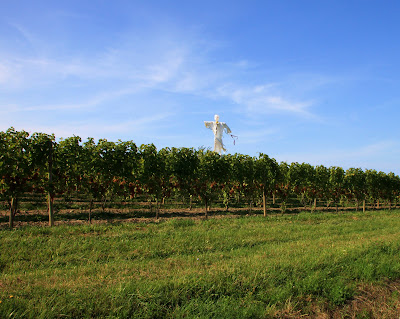
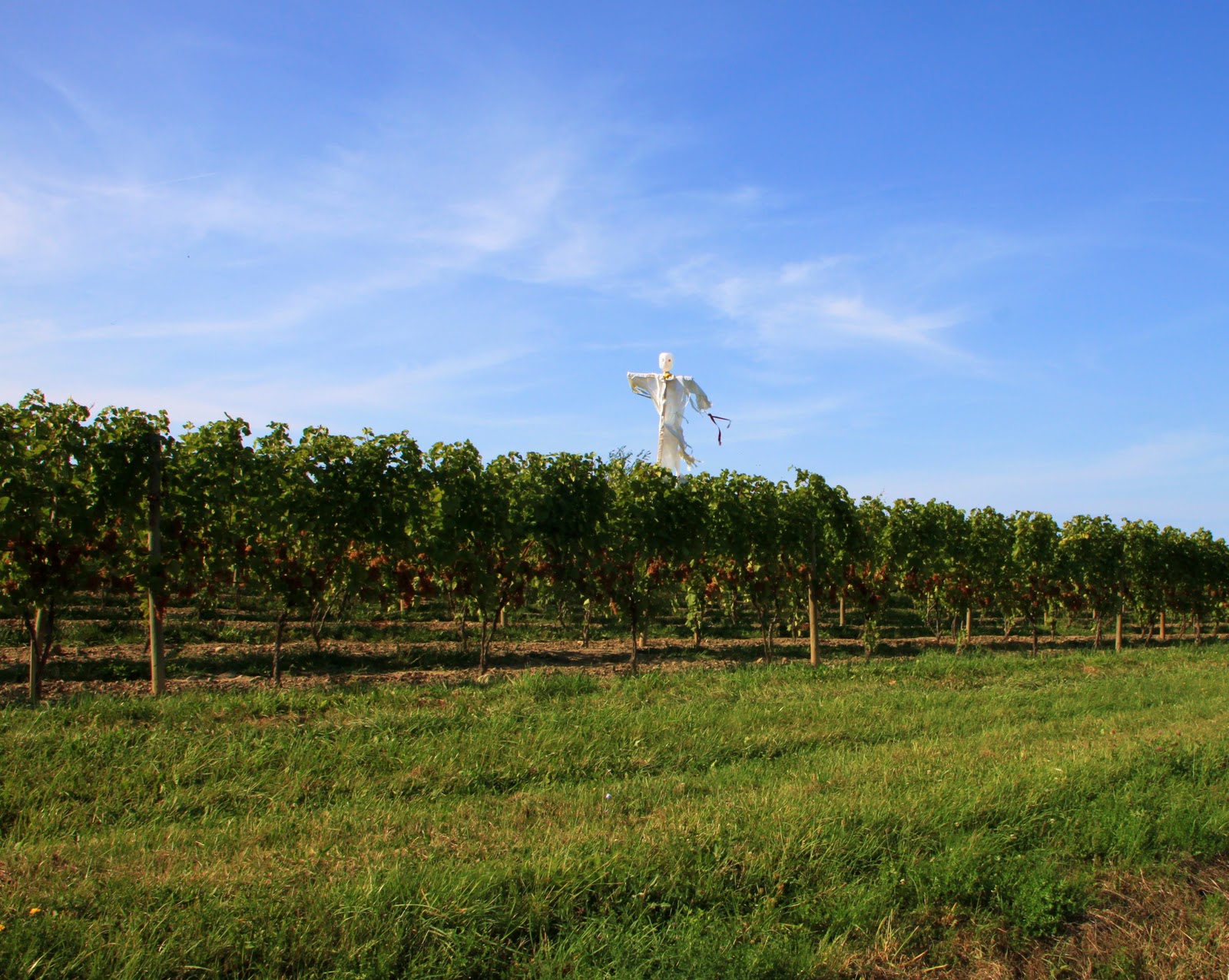
Spooky Scarecrow in Vineyard - NY Finger Lakes
St. Augustine once compared a Bishop who lacked courage
to preach the Gospel and defend the faith to "a scarecrow standing in a vineyard."

Vineyard Windmill - NY Finger Lakes

By now it was time to head south. We'd been living out of our suitcases for nearly a month, and needed to return to the comfortable surroundings of our own home. We left New York and drove to Fairfax, Virginia  where we spent a lovely evening with old Navy friends. We hated to leave, but home beckoned. Indeed, its call was so strong and so loud that yesterday we drove over 800 miles from Fairfax to Florida. The traffic was light, I wasn't particularly tired, and another night in a motel did not appeal to us.

Home at last!