The occasional, often ill-considered thoughts of a Roman Catholic permanent deacon who is ever grateful to God for his existence. Despite the strangeness we encounter in this life, all the suffering we witness and endure, being is good, so good I am sometimes unable to contain my joy. Deo gratias!


Although I am an ordained deacon of the Catholic Church, the opinions expressed in this blog are my personal opinions. In offering these personal opinions I am not acting as a representative of the Church or any Church organization.

Showing posts with label New York. Show all posts

Monday, May 29, 2023

Another Kilmer Poem - for Memorial Day

A few days ago I included Thanksgiving, a little poem by Joyce Kilmer, in another of my posts. It’s one of those poems that challenges us to rethink our understanding of the events and influences that can dominate the times of our lives. It also asks us to accept that nothing is simply coincidental, that God can bring good out of everything, even that which from an objective, human perspective can seem downright evil. I’ve always believed that as he wrote Thanksgiving, Kilmer might well have been thinking of St. Paul’s famous words to the Romans:
“We know that in everything God works for good with those who love Him, who are called according to His purpose” [Rom 8:28].
Kilmer certainly believed this, and realized God is always in control despite our foolish attempts to subvert His plan for humanity. Everything is a gift for those who love the Lord, even though we don’t understand how God will bring good from it. Believing this, we must then thank God for everything. 

The poet was also “called according to His purpose” in both his life and his death. Perhaps most fittingly, Kilmer wrote this poem from the trenches of World War One. Immersed in the chaotic horror of that war, Sergeant Kilmer faced death and destruction daily. He was highly respected by both the troops and the officers of his battalion. Sadly, Kilmer died in that war, killed instantly by a German sniper on July 30,1918. And yet, although an enlisted man, he was buried next to the officers with whom he served, a most unusual honor in those days. But in truth it was more of an honor for the officers than for Kilmer.

Anyway, all this thinking and writing about Joyce Kilmer, brought to mind another of his brief poems that I read years ago. I’d forgotten the name of the poem, so I had to do a little searching, and finally found it. I had mistakenly remembered its title as “Princes,” but it turned out to be “Kings.” I thought it particularly relevant for our world today, especially Kilmer’s description of the perversion of power. Yes, indeed, the “Kings of the earth” will be so very surprised when in their powerlessness they are called to account by the Prince of Peace. Here’s the poem:

                       Kings

The Kings of the earth are men of might,
And cities are burned for their delight,
And the skies rain death in the silent night,
And the hills belch death all day!

But the King of Heaven, Who made them all,
Is fair and gentle, and very small;
He lies in the straw, by the oxen's stall -- 
Let them think of Him to-day!

It’s evident why so many critics disliked Kilmer. He was simply too simple. He wrote for everyone, unlike so many poets who wrote only for each other and for the literati who could get them published in all the right journals. Kilmer also didn’t disguise his Christianity which he displayed prominently in so much of his work. No doubt this was a major irritant to the faithless denizens of New York’s literary circles. 

Of course, as simple as I am, I’ve always enjoyed his poetry. Some of this appreciation for Kilmer might stem from a few rather vague connections. I was brought up in Larchmont, a suburb of New York City, a village where Kilmer also lived for a time. Of course, he died long before I was born, and 30 years before we moved to Larchmont, but we were both parishioners of St. Augustine Parish. Because of this parish connection, he was somewhat of a local celebrity and the Dominican sisters who taught in the parish school introduced us to his poetry early, in the fifth or sixth grade. My parents were also friends with an older woman, who had known Kilmer as a young man. Apparently, her family had lived next door to Kilmer. She spoke about him often and waxed eloquently about the “handsome, young poet.” So, I suppose I was primed to like him and his work, but I think that’s true of most of our earliest influences. 

Today though, on this Memorial Day, we can pray that the "Kings of the earth" will someday actually approach the Prince of Peace on their knees in repentance. But in the meantime, I am called to remember and thank God for so many of my friends and comrades who sacrificed their lives for you and for me and for generations to come. Because of my own involvement, I especially thank God for those who died during the Vietnam conflict. But I also thank God for those who died in so many other conflicts, including Sergeant Joyce Kilmer, another hero who served a nation and its people and selflessly sacrificed his life for us. 

May Almighty God bless them all and keep them.
May His face shine upon them and be gracious to them.
May He look upon them with kindness and give them peace.
May Almighty God bless them, 
   in the name of the Father,
   and of the Son,
   and of the Holy Spirit.
Amen.

Friday, September 11, 2020

Remembering 9/11

I suppose everyone over the age of 25 has a 9/11 story, a story that answers the question, "Where were you when the terrorists attacked?" My own story isn't very dramatic, and compared to those directly involved, I was a mere spectator, and a distant one at that. 

As I recall that day, September 11, 2001 -- like December 7, 1941, a "date which will live in infamy" -- I find it particularly odd that I first heard of the attack from a woman seated in an office in London, England. At the time I was employed by Excel Switching, a manufacturer of programmable telecommunications switches, located in Hyannis, Massachusetts. We had recently been acquired by Lucent Technologies and were integrating into their organization.

That morning I was on a conference call with a dozen or so people from around the world, when the woman in London exclaimed, "Oh, heavens! I just saw it on the telly. A plane flew into the World Trade Center in New York. It looks very bad indeed." I asked her, "Can you see what the weather's like in New York?" I knew it was a beautiful September day on Cape Cod, but it could be very different 200 miles away in New York City. "It looks like a nice, sunny day," she said, "Blue sky and I can see no clouds." Hearing that, and based on some common sense and my years as a Navy pilot, I knew one thing: it was no accident. No pilot accidentally flies into a large building in Manhattan on a beautiful, clear, sunny day. I was certain it was intentional, and, given the target, likely a terrorist attack, and said so. The others were not so certain. Of course, at this point we didn't know the type of aircraft involved. Was it a small civilian plane or a commercial airliner? But knowing a plane had crashed into the World Trade Center was disturbing enough that I suggested we end the call so we could sort out what had happened. I was thinking of our technical support people in the field, especially those who might be in New York working on or installing equipment.

Leaving my office I ran into one of our VPs and together we made our way to our spacious lunchroom where many of our employees had already gathered to witness the events on a large-screen TV. Minutes later we saw the second plane, another large Boeing 767, fly into the south tower and any lingering doubts about the nature of the attack disappeared. The tragedy then accelerated as we heard of the attack on the Pentagon and watched in horror as the two towers collapsed before our eyes. Finally, we heard the news of the crash of United 93 in that farmer’s field in Shanksville, PA. I later learned that two people I knew well, one a Navy intelligence officer and the other an employee of Washington Group International, died in those attacks on the Pentagon and New York. 

The suddenness and enormity of the attacks united the nation. In our grief for the victims and their families, and our outrage over those responsible, we seemed to come together as a nation determined to do what was necessary to bring the terrorist leaders to justice and prevent more attacks. 

Did we accomplish this? Well, during those 19 years we killed a lot of terrorists, along with most of their original leadership. But leadership vacuums fill quickly by those waiting in the wings, and terrorists are especially good at forming new organizations to attract another cadre of discontents. I suspect it wasn’t hard to convince the new recruits that all their problems had Western and Judeo-Christian roots. We also tried to effect major societal change in nations like Afghanistan. But despite our best efforts, we were unable to consummate the marriage of Islam and representative democracy, quite likely a hopeless task that never should have been attempted. 

The costs of all this have been tremendous, both in lives — the lives of young Americans, the very best of their generation — and in national treasure. What should we have done? On this, my thoughts haven’t changed, but this is not the time or place to air them — perhaps some other time.

Today, 19 years later, our nation is certainly different. Seemingly divided by almost every measure — political, economic, racial, spiritual... — as a people most of us stand on the sidelines watching a tiny minority rampage through our cities as they try to destroy the very fabric of the nation that tolerates their gross stupidity. Do we face a new kind of terrorist, one spawned by our own communities and nurtured in families where God has been evicted and replaced by a materialism that never satisfies? Is this new terrorism taught overtly in our schools and universities where academic freedom has been crushed by the political correctness of the far left? I suppose we are all, in a sense, guilty because, wrapped up in our own lives, we have turned away and allowed this to happen. 

Pondering our societal inaction, the lack of courage displayed by our unwillingness to confront that which is tearing us apart from within, I can't help but recall the true courage of the passengers on United 93. As that Boeing 757 flew above Pennsylvania, speeding toward our nation's capital, those passengers knew exactly what awaited them if they did nothing. Faith and courage overpowered their fears that morning and they did what had to be done. How did Jesus put it?
"No one has greater love than this, to lay down one's life for one's friends" [Jn 15:13].
Todd Beamer
Those men and women of Flight 93 are indeed our friends, and we must never forget them and all those others who gave their lives that fateful day. And let us remember, too, all our service men and women who have sacrificed so much so others can live their lives in peace.    

As we struggle to regain our courage as a people, perhaps we should embody those words of Todd Beamer who led the charge on Flight 93. As he rose from his seat to confront the hatred and evil that faced him and his companions, Beamer simply said:

"OK, let's roll!"

I think we've got some rollin' to do.


Wednesday, May 13, 2020

Pandemics and Politics

Life has been strange here in The Villages, certainly not what most folks expected when they moved to "Florida's Friendliest Hometown." But thanks to our governor, things are changing. For weeks Villagers were tucked away in their home, unable to do all those things "active seniors" enjoy. No movies, no concerts, no club  meetings. No pickle ball, no card games, no mahjong, no bingo or bunco. The pools were closed, as were all the recreation centers. OK, they could play some golf.. But what about all that free live evening entertainment at The Villages' three town squares, and the "happy hour" prices? Canceled too. Kaput! Gonzo!

Gone, too, were the frequent dinners at our restaurants and country clubs. Apparently many Villagers can afford to dine out daily. I know this because I've heard the complaints, over and over again. How did they cope with the withdrawal? Did they take advantage of take-out meals offered by some restaurants, or did they resort to frozen dinners from Publix or Winn-Dixie? Maybe a few actually renewed their culinary skills and cooked a few meals at home. But I suspect it just ain't the same as Olive Garden or Red Lobster. The bars, too, were closed and predictably sales at liquor stores went off the charts. Yes, indeed, it's been so hard for so many.

Of course, church attendance has been non-existent, and for us Catholics, the sacraments have been withdrawn. It's almost as if we've been placed under an ecclesial interdict. How did the fathers of the Second Vatican Council describe the Eucharist? "...the source and summit of the Christian life" [Lumen Gentium, 11]. And yet the faithful found themsevles deprived of this life-sustaining gift. Fortunately, the faithful are indeed faithful, and are an example to all of us, even the clergy. So many, thirsting for Word and Eucharist, have taken advantage of recorded and live-streamed Masses -- a sure sign of hope -- as they wait for a return of the sacraments.

Most people I speak with view this crisis rather narrowly, focusing solely on how it has affected them or their families. And this is certaily understandable, especially since most of us are physically separated from children and grandchildren. But there are really two demographic groups that deserve our attention: aging residents of what are euphemistically called "nursing homes" and working families with school-age children.

Of those who have died from COVID-19, the vast majority have been the elderly, particularly residents of nursing homes or other assisted living facilities. We've all heard of the tragic decisions by the authorities in New York, Pennsylvania, and other states to send hospitalized infected seniors back to their assisted living facilities rather than isolating them. City and state authorities in NY certainly had the capability to isolate since President Trump had sent the hospital ship, USNS Comfort, to New York City and also had the U. S. Army turn the huge Javits Center into a hospital. Both were rarely used, despite the seemingly panicked pleas by the governor and mayor for more facilities. Instead, the authorities demanded that when hospitals released infected elderly patients, the nursing homes must re-admit them. The result? Thousands died.

Let's look now at the data -- nationwide data direct from the Center for Disease Control. It covers the three-month period, February 1 through May 2:
  • 80% of those whose deaths were directly related to COVID-19 were over the age of 65 (50,819 of 63,469 total deaths).
  • Of these 63,469 deaths, only 13 deaths were of children under the age of 15. In fact, during that same period, and in that same age group, 107 children died from pneumonia and 85 from influenza.
  • For young people of high school and collage age (15 to 24), 66 died from COVID-19 related illness, again out of 63,469 total deaths. During that same period 143 died from pneumonia and 41 from influenza.
Just think about these numbers. It would seem that all along our emphasis should have focused largely on the elderly. I don't say this because I am in this age group. No, from the very beginning we were told the elderly would be the most vulnerable. And guess what? They are. But apparently some governors consider us old folks expendable. Instead of working to keep us safe, they turned their attention to the economy and proceeded to undermine it. They focused instead on destroying the livelihood of working families by shutting down the businesses that employ them, particularly the smaller businesses that lack political clout. They closed the schools, although children are the least susceptible demographic when it comes to COVID-19. More children and young adults have died from pneumonia and influenza during this same period.

I'm not minimizing the death of a single child, but we've never shut down schools because of pneumonia or influenza, just as we didn't do so because of polio when I was a child. Am I wrong about this? I don't know. Perhaps. But what I do know is that too often we nod with unthinking acceptance at the decisions made by politicians, who are driven largely by political considerations and the opinions of well-chosen "experts." But what is an expert but someone with expertise in a narrow field of knowledge? For example, what does an epidemiologist, especially one employed by a government bureaucracy, know about the economy and employment and the cost of doing business? Not much! And yet we seem to accept their wide-ranging recommendations almost blindly, without considering the long-term effects on our nation as a whole. Only now have we begun to question what they know about their own field when applied to demographics. Their pandemic "models" have been remarkably and consistently inaccurate, largely because they tend to ignore or discount the human element; that is, the cumulative effect of the micro-decisions made by people like you and me.

Too many experts and politicians simply ignore the impact of their recommendations and decisions on what is probably the most important element of our society: the working family. Forced to leave their jobs, deprived of their income, and forced, too, to home school their children, they are plagued not by the coronavirus but by worry about their family's future. And isn't it strange that these same governors consider education (along with religion) the most non-essential of all activities?

Finally, isn't it interesting that the most "liberal" of governors are also the most authoritarian, and seem to thrive on the elixir of power? I won't beat this drum again here since I did so in a recent post: Power and Precedent. 

That's enough. It's late. I'm tired. Good night.

Saturday, January 25, 2014

What In The World?

This will likely be a disjointed post full of seemingly random thoughts, but every so often I'm just overwhelmed by what I see in the world. I'll begin close to home.

Although I was born in Connecticut, I spent most of my childhood in a suburb of New York City and so for years I considered myself a New Yorker. I was, therefore, taken aback when the governor of New York stated that “extreme conservatives who are right-to-life, pro-assault-weapon, anti-gay....have no place in the state of New York, because that’s not who New Yorkers are." -- Also sprach Governor Cuomo from his chair in Albany.

Governor Cuomo and Mayor de Blasio
Hmm...let's see. I am indeed pro-life and I support the right to bear arms as guaranteed by the Second Amendment of our Constitution. I certainly wouldn't call myself "anti-gay" because as a Christian I "hate the sin but love the sinner." Of course, the fact that I believe marriage is sacred and unites only a man and a woman in a sacramental way no doubt makes me "anti-gay" from the governor's skewed perspective. I find it particularly curious that he would label me an "extreme Conservative" because I hold these beliefs which are also held by at least half of the US population. Fortunately for me, I haven't lived in New York since I was 18, so I guess I'm safe from whatever the governor has planned for those who disagree with him. 

Pope John Paul II: Extremist
Not surprisingly New York City's new mayor, Bill de Blasio, agrees with the governor. In his words, “The first point is, we represent our people and Governor Cuomo is right and I believe I’m on firm ground in saying our people, the people in New York State and the people of New York City reject extremists views against a women’s right to choose and in favor of the proliferation of guns in our society. And I stand by that 100 percent.” Why do I get the feeling that the "our people" to which the mayor refers actually includes only those who agree with him. And I always thought those we elected were supposed to represent all the people.

And don't you think there's something a wee bit scary about a governor who wants no one in his state excerpt those who share his beliefs? Will New York change its name to Stepford? Such thinking by someone who holds the reins of political and legal power in New York can lead to all kinds of nasty policies and their enforcement. It's also a rather blatant form of bigotry in that it attempts to exclude from society most Catholics and many other Christians who hold orthodox beliefs; that is, those who, unlike the governor, accept the tenets of their faith and believe what their Church teaches. Apparently the governor objects to the First Amendment as well as the Second. 

Governor Cuomo also provides us with another reason to be against capital punishment. Once you give a government the right to put people to death, what's to stop it from expanding its list of capital crimes? Once political correctness is formulated in law -- and this is already happening in many Western nations -- eliminating some of these "criminals" just might become too tempting for the authoritarians in charge. It's worth noting that the Marxist roots of political correctness can be easily traced back to Germany in 1923 and the Institute for Social Research, also known as the Frankfurt School. According to Bill Lind, PC is a form of Cultural Marxism in which "all history is determined by power, by which groups defined in terms of race, sex, etc., have power over other groups. Nothing else matters. All literature, indeed, is about that. Everything in the past is about that one thing." The history of Marxism put into practice clearly demonstrates how capital punishment can be used by those in power to eliminate any who refuse to toe the party line. (You can read the full text of Lind's comments here.)

And how can we forget another New Yorker, former Mayor Bloomberg, and his soda ban? In the course of his legal battle to keep New Yorkers safe and healthy by forcing them to drink less root beer and cream soda, he made the telling statement: "I do think there are certain times we should infringe on your freedom." Ah, yes, Big Brother knows best and we should just go along.


The Soda Jerk
But honestly, there are worse things than those politicians who despise me for my beliefs and others who are nanny wannabes. Governor Cuomo and Mayor Bloomberg might be small potatoes in the overall scheme of things, but what troubles me most about them and those like them is their willingness to disregard that pesky Constitution of ours. They seem not to realize that the words of this document have meaning and our acceptance of them has been the guarantor of our freedom. 

For example... 

"The right of the people to be secure in their persons, houses, papers, and effects, against unreasonable searches and seizures, shall not be violated, and no Warrants shall issue, but upon probable cause, supported by Oath or affirmation, and particularly describing the place to be searched, and the persons or things to be seized." 
These are the words of the 4th Amendment to our Constitution and like all ten amendments that make up our Bill of Rights, they define the rights of the people, not the rights of the government. The Bill of Rights was added to our Constitution to protect us from the government, from those we elected to positions of power. It you doubt this, just read the Federalist Papers, written by those who also wrote the Constitution. And so I am a bit confused when attorneys for the Department of Justice declare in federal court that American citizens have no right to challenge the government's collection of their personal records. I guess it all boils down to which we believe is more important, freedom or security. Personally, I'll join Patrick Henry who on March 23, 1775 ended his rousing speech to the Second Virginia Convention with the words: "I know not what course others may take; but as for me, give me liberty or give me death!" And one can't help but cheer the people of New Hampshire who have "Live free or die!" as their state motto.

And speaking of life and death, isn't it interesting that pro-choice politicians often claim their policies are aimed at "protecting the children" while at the same time actively supporting the killing of unborn children in the womb? We saw an example of this when the administration joined the world in decrying the deaths of several hundred Syrian children who perished as a result of a chemical weapons attack. But when the federal government's own figures tell of the deaths of 55 million American babies since the Supreme Court's 1973 Roe v. Wade decision, we hear not a peep from that same government.

If we look beyond our borders, things don't seem much better. As a result of our feckless foreign policy, does the international community, in particular the nations of the Middle East, hold the United States in greater respect today than in 2008? If you want a clear answer, just listen to what the Iranians are saying about us now.

And what about the changes that have swept across the Middle East and North Africa, changes our government openly celebrated and supported? As a result of this so-called "Arab Spring" are the people of Egypt, Libya, Tunisia, and Syria better off now than they were living under the despotic regimes of Mubarak, Qaddafi, et al.? Are the Christians (what's left of them) in these countries better off now than they were before? Why do all our real smart people fail to anticipate such "unintended" consequences, while some of us dummies saw them coming from the beginning? Go figure.


And, finally, does it trouble you, as it troubles me, that the nations we have aided and for whom we have expended so much American blood and dollars are now among the worst persecutors of Christians? Our war in Iraq, begun in 2003, has been catastrophic for Iraqi Christians. Not too many years ago, Christians made up nearly 10% of Iraq's population. During the past ten years, however, it's estimated that half the Christian population of the country has fled as a result of violence and other forms of persecution. How and why did we let this happen? Why do we hear little or nothing from the current administration about the murders of Christians and the widespread destruction of Christian churches by Islamist and Jihadist terrorists? Why has the administration openly supported Islamist groups -- for example, the Muslim Brotherhood -- responsible for this persecution?

Ah, well, too many unanswered questions. Thank God for His gift of faith.


Thursday, January 31, 2013

The Inescapable Power of the Cross

Clipper, in Nichols, looking for chickens in the snow
Growing up as a youngster I lived first in rural Connecticut and then in suburban New York. I was only four years old when we made the move and suppose I was too young to notice much of a change between these two very different environments. Although I have many memories of those earliest years in Nichols, Connecticut, almost all center around our home and family. I can recall quite vividly every room of our house, and in my mind's eye can even picture the view from the window-seat in the living room. I remember well our dog, Clipper, a large German Shepherd who, despite his friendly, engaging nature, had developed one bad habit: a taste for a neighbor's chickens. For my brother and me, the highlight of our day was Dad's return from work. We would wait for him at the foot of our long driveway where he would stop so we could stand on the running board of his Packard sedan. He would then move up the driveway, at about two miles per hour, with the two of us joyously hanging on. I remember, too, our immediate neighbors, Dr. and Mrs. Scalzi, who with their children and their collie, Laddie, lived in a lovely Tudor-style home. And the smells...how can one forget the smells? It's the scents of the past that seem to linger longest in the memory. Even today, whenever I smell a wet dog, my thoughts rush back to a day when I helped my mom catch Clipper who stubbornly refused to come inside during a heavy rainstorm. I can still smell the ripening apples on the trees in our backyard as my brother and I watched Dad standing on his stepladder picking them. And when the wind was right, who could forget the ripe, tangy, homegrown odor of Parker's Dairy Farm next door? We lived in a wonderful place and I've often wondered how my life might have differed had we remained there.

But these and the many other memories of those early years in Connecticut never take me beyond our home and its immediate surroundings. I have no recollection of any other place at that time of my life. I know, for example, that I spent some months at a local nursery school, run I believe by a Mrs. Curtis, but can recall nothing of it. I'm also certain Mom took us on occasion to Beardsley Park in Bridgeport; I have photographs, but no memories. Indeed, my earliest memories of places outside the home are of school and church, later memories from our life in New York. I find this very odd, but I suppose memories, especially those of early childhood, are fickle, capricious things. Who knows? Perhaps, as I enter this last phase of my life, memories of those earliest days will come flooding back and overpower the recall of more recent events, like what I had for breakfast.

In the midst of all these, my earliest recollections, one other memory is remarkably clear. It's the memory of a cross, a crucifix really, over the altar of a church. It's a very early memory, a pre-New York memory, and so this crucifix might well have been in the church we attended in Connecticut. I'm not certain about this since I don't even know the name of that church. It could have been in another church somewhere else. I simply can't be sure. But the image, this visual memory of that cross, is very intense. I can picture it as if it were right here on the wall of this room. Strangely, I can see clearly every aspect of the image. I can see the expression on the face of our Lord, one of victory colored with extreme sadness. I can see the nails, the wounds, the crown of thorns, the rough wood of the cross. And I can actually recall my child-like thoughts as I gazed on this symbol of our faith, wondering why someone would do such a thing to Jesus, the one Mom had told me was my friend.

I think it interesting that the very first symbolic object I can recall is a crucifix, the Cross of Calvary. This is particularly pleasing to me. I'm happy that I was blessed with this early memory, a memory that has never faded. For some, as St. Paul reminds us, the Cross remains a stumbling block, and for others a folly [See 1 Cor 1:18-24]. But for the faithful, it is the overpowering sign of our faith and calls to mind St. Paul's wonderful words to the Christians of Corinth:
"For I resolved to know nothing while I was with you except Jesus Christ, and him crucified" [1 Cor 2:2].
Sometimes that's exactly the way I feel. When something triggers the early memory of that crucifix I can think of little else. The image fills my thoughts. The Cross exerts power not just over you and me, but over all of creation. St. Paul, of course, recognized full well the tremendous power of the Cross of Christ:
"But may I never boast except in the cross of our Lord Jesus Christ, through which the world has been crucified to me, and I to the world" [Gal 6:14].
And I find myself  pitying those who reject the Cross, those who actually despise it; for St. Paul also address them in his unambiguous way:
"For many, as I have often told you and now tell you even in tears, conduct themselves as enemies of the Cross of Christ. Their end is destruction. Their God is their stomach; their glory is in their 'shame.' Their minds are occupied with earthly things" [Phil 3:18-19].
More on the Cross of Christ in my next post; but in the meantime, pray for those who "conduct themselves as enemies of the cross of Christ."

Pax et bonum...

Saturday, June 18, 2011

Being Is Good...But in NYC It Can Also Be Dangerous

Every so often I come across something on the internet that merits more exposure, and a few moments ago I found another example. In this instance it's a video of a single intersection, one of thousands of similar intersections, in New York City. It made me recall why I would never drive into the City when I lived in the NY suburbs. I always took the train and the subway, and literally ran across intersections to decrease the time spent in the sights of NY cabbies and other insane operators of motor vehicles. The large numbers of bicycles, driven mostly by messengers with a financial interest in getting to their destinations quickly, are an interesting addition to the chaos that is New York. Put on your seat belt and enjoy the video.

Friday, September 24, 2010

Odd Complaint

I received a complaint via email the other day, suggesting that I was devoting far too much of my "blogspace" (his word, not mine) to family and friends and not enough to theological and ecclesiastical subjects. He stated quite bluntly that "as a deacon you should be using this vehicle to explain our beliefs as Catholics. Our Lord told us to go to 'all nations...teaching them to observe all that I have commanded you.'" The remainder of his highly instructive email made it clear that by focusing so much on family, friends, travels, etc., I was ignoring the Lord's mandate and not using this blog effectively for its "intended apologetic purpose."

I don't know this critic personally and so at first I was nonplussed that anyone would take the time to lecture me on the "intended...purpose" of my own little, insignificant blog. What do you say to someone who would be so presumptuous? My initial reaction was to send off a quickie response saying, "If you want to read a blog that focuses on Catholic apologetics, there are plenty out there. Or start your own. But don't tell me what I have to write about." But then, after a moment's reflection, I thought that perhaps I was partly to blame for this reader's confusion over the blog's intended purpose. This thought lived a very short life, for when I began Being Is Good a few years ago I stated clearly it would contain no more than my "occasional, random thoughts" in support of my joy over God's gift of life. This purpose hasn't changed and has been in the blog's header from the start.

I'll admit that I sometimes drift away from this guiding vision and ramble on about a topic that simply piques my interest, but isn't that really in the very nature of blogging? Anyway, since my intended focus is an appreciation of being itself, I can think of no better subject matter than the lives of those who mean the most to me: family and friends.

I also believe that a life well-lived is a life of balance. An unbalanced life, of the sort that focuses all of one's time and energy on a single aspect of this wondrous existence, seems an insult to the Creator.  I believe it only fitting, then, that this blog should reflect the many aspects of creation that I find particularly interesting. Theology, ecclesiology, apologetics -- these are all wonderful subjects for study and contemplation and evangelization, but I prefer that they don't monopolize my every waking moment.

Now...family and friends.

After leaving our younger daughter and her family, Diane and I made a brief  stop in Schenectady, New York at the home of one of my old high school buddies. Although we had kept in infrequent touch via email, etc., we hadn't seen each other in years, so it was nice to get together once again. Old friendships are among the best of friendships and we just picked up where we had left off at our last meeting over 20 years ago. We stayed at a less than pleasant motel that one night. My friend warned me. I should have listened.

We then drove to the little Finger Lakes community of Penn Yan, New York where we spent three days with another deacon and his wife. They have an absolutely lovely home right on Lake Seneca smack dab in the middle of New York's famed wine country. With our hosts as tour guides, we spent several days visiting wineries and local shops, admiring the well-kept Mennonite farms, and just taking in the beautiful countryside.

Sunrise over Lake Seneca - Finger Lakes, NY
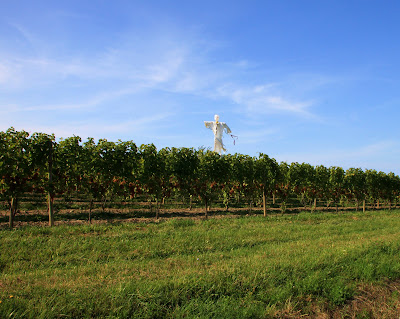
Spooky Scarecrow in Vineyard - NY Finger Lakes
St. Augustine once compared a Bishop who lacked courage
to preach the Gospel and defend the faith to "a scarecrow standing in a vineyard."

Vineyard Windmill - NY Finger Lakes

By now it was time to head south. We'd been living out of our suitcases for nearly a month, and needed to return to the comfortable surroundings of our own home. We left New York and drove to Fairfax, Virginia  where we spent a lovely evening with old Navy friends. We hated to leave, but home beckoned. Indeed, its call was so strong and so loud that yesterday we drove over 800 miles from Fairfax to Florida. The traffic was light, I wasn't particularly tired, and another night in a motel did not appeal to us.

Home at last!