The occasional, often ill-considered thoughts of a Roman Catholic permanent deacon who is ever grateful to God for his existence. Despite the strangeness we encounter in this life, all the suffering we witness and endure, being is good, so good I am sometimes unable to contain my joy. Deo gratias!


Although I am an ordained deacon of the Catholic Church, the opinions expressed in this blog are my personal opinions. In offering these personal opinions I am not acting as a representative of the Church or any Church organization.

Showing posts with label questions. Show all posts

Thursday, September 3, 2020

COVID-19 Bible Study Reflection #15: A Relationship of Love

In today’s reflection I hope to focus on several different but interrelated aspects of our relationship with God:

·  God’s limitless love for us, best expressed by the Incarnation
·  Our love for God, expressed by our obedience to His commandments
·  The manifestation of this loving relationship in how we love each other
——————————-
And so, let’s look first at God’s love for you, His love for me…
“…everyone who acknowledges me before others the Son of Man will acknowledge before the angels of God” [Lk 12:8].
Are you moved and filled with hope when you hear these wonderful words of Jesus? Could we hope for much more than to be acknowledged before the angels? What Good News this is – God’s promise of salvation and His call to evangelization.
And yet, sadly, I encounter so many people who, because of their sins, almost despair of achieving salvation. Among their mistakes, of course, is the idea that they, or indeed anyone, can achieve salvation. We can’t…not on our own. Salvation, like every other good thing, is a gift from God.
A few years ago, in his homily during Mass at St. Martha’s House, the Vatican guesthouse where he lives, Pope Francis said:
“One of the hardest things for all of us Christians to understand, is the gratuity of Jesus Christ’s salvation.”
In other words, because God’s love is so far beyond any human love we could ever experience, we find it hard to understand it, much less accept it. How can God love me in my sinfulness? I always seem to be falling instead of rising, always disappointing myself, always disappointing God.
Yes, we are called to obedience, to do as God has commanded us as a response to His gratuitous love. And yet because we are sinful, imperfect creatures, we often fail to live out our faith. We find ourselves, then, in the midst of a battle, but an internal, self-made, and unproductive battle.
The pope continued by suggesting how much better it would be if we would only focus on God’s great commandment:
“You shall love the Lord, your God, with all your heart, with all your being, with all your strength, and with all your mind, and your neighbor as yourself” [Lk 10:27].
This is the commandment that saves. This is the love that truly reflects God’s gratuitous love for us. How did St. Peter put it?
“Above all, let your love for one another be intense, because love covers a multitude of sins” [1 Pt 4:8].
Do you and I believe the Lord saves us freely, that we have done nothing to merit salvation? I hope so, because it’s the truth, the Good News we’re called to take to others. This is the remarkable love, God’s love, we’re called to share with the world. And it’s through this sharing of God’s love that we can acknowledge Jesus Christ before others. Never forget what St. Paul wrote to Timothy:
“God our savior… wills everyone to be saved and to come to knowledge of the truth” [1 Tim 2:3-4].
Don’t place limits on God’s limitless love, but put aside your judgment of others, and instead do God’s work in the world by helping others “come to knowledge of the truth” which is Jesus Christ...
For He, and only He, is “the Way and the Truth and the Life” [Jn 14:6].
——————————-
Okay, we know that God loves us. But what does He expect of us?
Let’s turn first to the Letter to the Romans, the longest of St. Paul’s letters. In many respects it’s also the most important of his letters in that it touches on all the major themes of the Gospel. It’s really a treatise on the Good News of Jesus Christ.

"Paul, a slave of Christ Jesus, called to be an apostle and set apart for the gospel of God...to all the beloved of God in Rome...called to belong to Jesus Christ...called to be holy [Rom 1:1,6,7].
Romans begins with Paul describing himself as “a slave of Christ Jesus” [Rom 1:1]. Some folks find this a bit odd. After all, as baptized Christians, are we not adopted children of the Father? Doesn’t the Church teach that we’re sisters and brothers of Christ? And doesn’t Jesus call His disciples His friends?

Which, then, are we? Brother, sister, friend, or slave? Well, the only correct answer is “all of the above.”
Here is another wonderful paradox of our Christian faith. Yes, Paul is right: in a sense, we are slaves – servants called to do the will of God. But because we are also God’s children, and because Jesus calls us to be His friends, God doesn’t demand slavish obedience, an obedience of submission. He instead allows us to choose. We obey our God out of freedom, a freedom arising from our close relationship with Jesus. In a sense we are slaves living in freedom. I told you it was a paradox.
As Jesus’ friends, as His brothers and sisters, we want to do as He asks. We respond obediently just as a slave would, but we do so because we recognize God’s great love for us. In faith we know we are loved by the Father who brought us into being. We are loved by the Son who gave His life for our redemption. We are loved by the Spirit who guides us, inspires us, and leads us on our journey of faith. And in faith we return that love by trusting that God will call us to do only that which is good. In faith we accept that God knows best what’s good for us.
When I was a little guy, my parents bought me my first bicycle as a birthday gift. I could hardly wait to ride it, and so I got up early that next morning, climbed on that little bike and tried to ride it. A valiant attempt, but I immediately fell over onto the driveway and skinned a knee and elbow. I was horrified and embarrassed. I had failed to ride this wonderful thing for which I had waited so long.
My dad, who had witnessed this from the kitchen window, came outside and said: “Look, if you want to learn to ride your new bike, you’ll have to let me teach you. Will you do that?”
I had to think about it. I hated to admit I couldn’t do it on my own, but I really wanted to ride that bike. I wanted the freedom it offered, the ability to go wherever I wanted in our little town. And so, I buried my pride and turned myself over to my dad’s instruction.
An hour later I was pedaling up and down our street, about as happy as a six-year-old could possibly be. My father, too, was smiling, happy I had placed my trust in him and learned an important lesson.
That day I learned I couldn’t do everything myself, that first I had to learn and grow, to accept help. Paul teaches the Romans much the same thing by focusing on God’s call to each of us. 
In Paul’s words, he was “called to be an Apostle” [Rom 1:1] and was writing to those “called to belong to Jesus Christ” [Rom 1:6], to those “called to be holy” [Rom 1:7].
That’s our calling: “to belong to Jesus Christ” and “to be holy.” And Paul’s Letter to the Romans goes on to explain this call.
Jesus, then, calls us to follow Him, to deny ourselves, to take up our own cross, for only by doing so can we be His disciples. But that’s just the beginning, for we’re also called to “make disciples of all nations” [Mt 28:19].
Sounds like a tall order, doesn’t it? And so, how do we do it? 
Not by relying on our human strengths, not by thinking we can do it all ourselves, not by trying to fix things, or solve problems, or convince others to be just like you or just like me. Too often we try to force others, to argue them into discipleship. Believe me, it doesn’t work. I know because I’ve tried.
You see, making disciples is God’s work. Let God work through you, especially through your weaknesses. Most often it means simply being there when another is in need. It means seeing Jesus Christ in your spouse, in your children and grandchildren, in everyone you meet…and letting them see Jesus Christ in you.
Jesus calls us to love the unloved, to feed those who hunger and thirst for God’s presence in their lives. And He calls us to be that presence, to be God’s quiet, loving presence.
We are the called, brothers and sisters. This is our identity as Christians. This is the meaning of our lives. Let’s all try to live a life worthy of our calling.
Our loving relationship with God, then, must also extend to others.
———————- 
Jesus was always teaching, wasn’t He? And like any good teacher, He was always being questioned.
Even as a youth, as a twelve-year-old in the Temple, Jesus answered the questions of the wise. Luke tells us that “all who heard him were astounded at his understanding and his answers” [Lk 2:47]. Isn’t that remarkable? They, the Temple’s wise ones, were questioning Him!
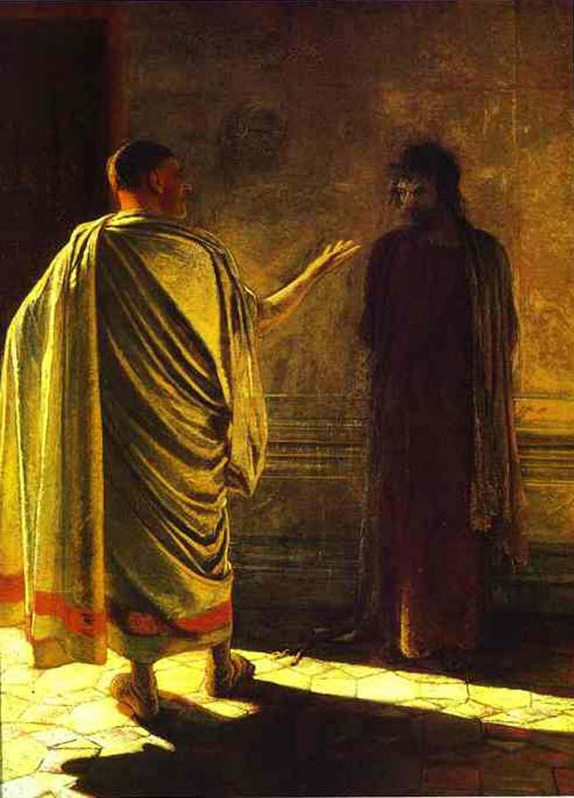
And the questions continued right up to that final barrage Jesus received from Pilate, as He stood before him facing death. Even Pilate, the Roman Patrician who no doubt considered the Jews little more than rabble – even Pilate sought answers from this Jesus, this teacher whom he would soon judge under man's law. 
“Are you the King of the Jews?” [Jn 18:33]
“Where are you from?” [Jn 19:9]
“Do you not you know that I have…power to crucify you?” [Jn 19:10]
And, of course, that other question, sneered by Pilate, that first-century relativist: 
“What is truth?” [Jn 18:38]
Pilate should have asked, “Who is truth?”, because he was in the presence of “the Way, the Truth, and the Life.”
Almost everyone Jesus met asked Him questions. It’s as if, somehow, they all knew, if only subconsciously, who He really was. Those He encountered seemed to sense He was far more than just a teacher. What did the centurion say as he looked up at the crucified Jesus?
“Truly this was the Son of God” [Mt 27:54].
And then there was the scholar who approached Jesus and asked:
"Teacher, what must I do to inherit eternal life?" [Lk 10:25]
The scholar, of course, was testing Jesus. He knew the answer to his question because it was right there in the Word of God. And so, Jesus tests the tester with a question of His own:
“What is written in the Law? [Lk 10:26]
As expected, the scholar went directly to Scripture and provided the correct answer:
“You shall love the Lord, your God, with all your heart, with all your being, with all your strength, and with all your mind, and your neighbor as yourself” [Lk 10:27].
But it’s not necessary to be a scholar to know God and what He expects of us. Indeed, just moments before Jesus had prayed to the Father:
“I give you praise, Father, Lord of heaven and earth, for although you have hidden these things from the wise and the learned you have revealed them to the childlike.” [Lk 10:21]
But not being very childlike, the scholar, hoping more to justify himself than to learn, asks Jesus, “And who is my neighbor?” In His answer Jesus offers us a gift, the Parable of the Good Samaritan, a parable both scholar and childlike can understand: 
“A man was going down from Jerusalem to Jericho...” [Lk 10:30]
But what exactly did the Samaritan do? After all, he was a Samaritan, despised by the Jews, thought to be outside the Law. And yet, he obeys that Law, doesn’t he? Well, at the very least, he listened to his well-formed conscience and acted righteously. And this set him on the path to eternal life. Remember that original question: 
“Teacher, what must I do to inherit eternal life?” [Lk 10:25]
This is what Jesus' answer is all about. Three encountered the wounded man on the road, but only one of the three did anything to help. How did Jesus put it? “Many are called but few are chosen” [Mt 22:14]
And so today, let’s reflect on our own lives. Who are the wounded you and I encounter? The physically wounded? Or mentally wounded? Or spiritually wounded? Do we even recognize them in the busyness of our lives? Or perhaps we see them, but turn away, preferring not to be bothered. Anyway, someone else will take care of them.
Is this how we hope to inherit eternal life? As Christians we should know better. To inherit eternal life, we must come to know God in faith, to know Him as the Way, the Truth, and the Life. 
This knowing of God is really a knowledge of love. As John reminds us: to know the Truth that is God is to know God, who "is Love" [1 Jn. 4:16]. It always comes back to Love, doesn’t it? To love the Lord your God with all your being, and to love your neighbor as yourself.
How did Mother Teresa put it? "If you judge people, you have no time to love them." Yes, indeed, we spend so much time judging others, and so little time loving them.
St. James reminded us all of this when he wrote that "mercy triumphs over judgment" [Jas 2:13].
We should all thank God for that.

Sunday, June 19, 2016

Homily: 12th Sunday in Ordinary Time (Year C)

Readings: Zec 12:10-11;13:1 ;Ps 63; Gal 3:26-29; Lk 9:18-24
-----------
Have you noticed, Jesus asked a lot of questions? Now, when you and I ask a question, we’re usually looking for an answer. We want to know something we didn’t know before. But Jesus asked questions not to inform Himself, but to inform the person being questioned.

Remember that remarkable scene when the friends of a paralytic lowered him through the roof, hoping Jesus would heal him [Mk 2:1-12]. Jesus responds by saying,  
“Child, your sins are forgiven” [Mk 2:5].
Now this really bothered a group of scribes who witnessed the scene and they whispered among themselves, accusing Jesus of blasphemy. So He simply asked them:

“Why are you thinking such things in your hearts? [Mk 2:8]
Jesus knew the answer, but He wanted the scribes to think about what they were doing, to examine their own consciences.

And then there’s that scene in John’s Gospel when almost all of His disciples left Him because they couldn’t accept His teaching on the Eucharist [Jn 6:60-71]. Jesus turned to the Apostles and asked,
“Do you also want to leave?” [Jn 6:67]
Peter responded, and with a question of his own:
“Master, to whom shall we go? You have the words of eternal life" [Jn 6:68].
Yes, Jesus asked a lot of questions, and in today’s passage from Luke, He did it again.

The brief dialogue with the apostles took place at Caesarea Philippi – which was a very pagan place. Nearby were temples devoted to the Syrian god, Baal, and to the Greek god, Pan, the god of the wild, of desolate places. And Herod’s son, Phillip the Tetrarch, built a temple there celebrating the divinity of the Roman emperor, Augustus…hence the name, Caesarea Philippi – Caesar and Philip.
Ruins of Pagan Shrine: Caesarea Philippi
And so, in this pagan setting, surrounded by false gods made by men in their own image and likeness, Jesus confronted the twelve and asked them:
“Who do the crowds say that I am?” [Lk 9:18]
Such a simple, non-threatening question – just tell me what folks are saying. Take a poll, sample public opinion, try a focus group, let me know what the man or woman in the street thinks about me. Today he probably would have said, “Have you Googled my name? What popped up?”

Oh, yes, a lot popped up…lots of things.  And so they told Him. After all, they had no stake in it. They were only passing along the opinions of others. Jesus, of course, knew the answer, for He too had heard the crowds. He knew full well what the people said about Him: He is a prophet, John the Baptist or Elijah or Jeremiah, returned from the dead. And this is exactly what the Apostles told Him.

But, again, Jesus didn’t ask the question to hear what He already knew. No, He wanted the Apostles to question themselves, because their answer would determine their future. Once they came to a firm understanding of Jesus’ real identity, and once they accept the truth of that answer, their lives will change forever. And so Jesus led them into the future and asked them:
“But who do you say that I am?” [Lk 9:20]
Again Peter showed the way. Peter, the de facto leader of the twelve, the boaster who hid his weakness behind a façade of bluster, the disciple who would shed tears of shame in the face of his threefold denial – yes, it’s this Peter who answered by saying:
“The Christ of God” [Lk 9:20].
In Matthew’s Gospel his words are more expressive:
“You are the Messiah, the Son of the living God” [Mt 16:16].
Yes, the Holy Spirit speaks through Peter: You are the promised One, the One sent by God. This is tacitly confirmed by Jesus when He told them to keep quiet about it.
Jesus with Peter and the Apostles at Caesarea Philippi
But then He went on to tell them what would happen to Him: He, the long-awaited Messiah, would be rejected by those who await Him. The One sent by God would suffer greatly and be killed. As Zechariah prophesied in our first reading:


"...they shall look on him whom they have pierced, and they shall mourn for him” [Zec 12:10].
But He also gave them a glimpse of hope: on the third day He would be raised. Of course the disciples understood nothing of this. The very thought of a murdered Messiah simply didn’t compute.

But there’s more…because discipleship has consequences. Jesus led them into their own future, for they must follow Him, take the same path, a path that leads to the Cross. It’s here He introduces the great paradox of Christian life: that we will save our lives, only if we’re willing to risk losing our lives. And if we do, God will raise us just as He raised up His Son on the third day.

Jesus wasn’t looking for a quick one-liner answer to His question. He was looking for an answer that lasts a lifetime. It wasn’t a question just for those first disciples, for Peter and that small band of followers; for Jesus turns to us as well…to you and to me.
You there! Yes, you! "Who do you say that I am?"
Deep down we all know what He means, don’t we? Do I really have to take up those crosses – those hardships, those sorrows, those personal calamities, those people that conspire to make my life so difficult?

Yes, Jesus replies, if you would be my disciple. As Paul reminded us:
"For all of you who were baptized into Christ have clothed yourselves with Christ” [Gal 3:27]
To be “clothed in Christ” is to accept the cost of discipleship, to accept His invitation to love, to love as Jesus loved when He took up His cross. This is what it means to be a cross-bearer who walks alongside Our Lord.

And so He continues to question us, “Who do you say that I am?”

The question just hangs in the air, doesn’t it? It won’t go away, brothers and sisters. We can try to ignore it, drown it out with the sounds of our lives…but it remains, waiting for an answer. Jesus doesn’t want opinions. He wants an answer:
“Who do you say that I am?”
There comes a time when we must answer this question, when, like Peter, we must make our own confession. You see, brothers and sisters, we are called to witness. We are called to spread the word about the Word…to let the world know our answer. And along with that answer comes a promise, the promise of eternal life beyond our imagining.

Jesus is here with us right now, present in this gathering as he always is — the walking, talking, living presence of God in our lives. We have already listened to Him as He spoke to us through His Word, and in a few moments, He’ll be present on this Altar. When we join together and process to communion, when we extend our hands, when we eat and drink, will we be able to give him our final answer?

No opinions, dear friends, just the testimony of our lives, just being the witness Jesus Christ calls each of us to be…as He asks us:
“Who do you say that I am?

Monday, October 5, 2015

Homily: Monday, 27th Week of Ordinary Time

Readings: Jon 1:1-2:1-2, 11; Jon 2:3-8; Lk 10:25-37

Jesus was always teaching, wasn’t He? And like any good teacher, He was always being questioned.

Even as a child, as a twelve-year-old in the Temple, Jesus answers the questions of the wise. Luke tells us that “all who heard him were astounded at his understanding and his answers” [Lk 2:47].

And the questions continued right up to that final barrage of questions Jesus received from Pilate, as He stood before him facing death.

Yes, even Pilate, the upper-class Roman who no doubt considered the Jews little more than rabble – even Pilate sought answers from this Jesus, this teacher whom he would soon judge under man's law.

“Are you the King of the Jews?” [Jn 18:33]

“Where are you from?” [Jn 19:9]

“Do you not you know that I have…power to crucify you?” [Jn 19:10]

And of course that sneering question from Pilate: “What is truth?” [Jn 18:38]

Pilate should have asked, “Who is truth?”, because he was in the presence of the Way, the Truth, and the Life.

Yes, almost everyone Jesus met asked Him questions. It’s as if, somehow, they all knew, if only subconsciously, who He really was. Those He encountered seemed to sense He was more than just a teacher.

What did the centurion say as he stood at the foot of the Cross?
“Truly this was the Son of God” [Mt 27:54].
In today’s passage from Luke, Jesus is again asked a question: "Teacher, what must I do to inherit eternal life?" [Lk 10:25]

Jesus didn’t need to invent an answer, for the answer was already there in the Word of God. And so He answered with a question of His own: “What is written in the Law? [Lk 10:26]

The scholar responded correctly, didn’t he? He simply went to Scripture:
“You shall love the Lord, your God, with all your heart, with all your being, with all your strength, and with all your mind, and your neighbor as yourself” [Lk 10:27].
You see, it’s not necessary to be a scholar to know God and what He expects of us. Indeed, just moments before Jesus had prayed to the Father:
“I give you praise, Father, Lord of heaven and earth, for although you have hidden these things from the wise and the learned you have revealed them to the childlike.” [Lk 10:21]
But not being very childlike, the scholar, hoping not so much to learn as to justify himself, asks Jesus, “And who is my neighbor?” With that Jesus offers us a gift, the Parable of the Good Samaritan, a parable both scholar and childlike can understand:
“A man was going down from Jerusalem to Jericho...” [Lk 10:30]
But what exactly did the Samaritan do? After all, he was a Samaritan, despised by the Jews and thought to be outside the Law. And yet, did he not listen to God’s Word? Did he not obey the Law? Well, at the very least, it seems he listened to his conscience and acted righteously. And this set him on the path to eternal life.

Remember that original question: “Teacher, what must I do to inherit eternal life?” [Lk 10:25] This is what Jesus' answer is all about.

Yes, there were three who encountered the wounded man on the road, weren’t there? But only one of the three did anything to help. How did Jesus put it? “Many are called but few are chosen” [Mt 22:14]

And so today, let’s reflect on our own lives. Who are the wounded you and I encounter? Those who are physically wounded? Or mentally wounded? Or spiritually wounded? Do we even recognize them in the busyness of our lives? Or perhaps we do see them, but turn away, preferring not to be bothered. Anyway, someone else will take care of them.

Is that how we hope to inherit eternal life? As Christians we should know better. To inherit eternal life, we must come to know God, to know Him as the Way, the Truth, and the Life.

But this knowing of God is knowledge of love. As John reminds us: to know the Truth that is God is to know God, who "is Love" [1 Jn. 4:16]. It always comes back to Love, doesn’t it? To love the Lord your God with all your being, and to love your neighbor as yourself. How did Mother Teresa put it? "If you judge people, you have no time to love them."

Yes, indeed, we spend so much time judging others, and so little time loving them. St. James reminded us all of this when he wrote that "mercy triumphs over judgment" [Jas 2:13].

As we look forward to the Year of Mercy declared by Pope Francis, let's make an effort as individuals and as a parish to replace self-absorption with a love for others, to replace judgment with mercy.

Sunday, June 30, 2013

Homily: 12th Sunday in Ordinary Time

Readings: Zed 12:10-11;13:1 ;Ps 63; Gal 3:26-29; Lk 9:18-24

Something we notice when reading the Gospels is that Jesus always seems to be asking questions. Now, when you and I ask a question, we’re usually looking for an answer. We want to know something we didn’t know before. But Jesus asks questions not to inform Himself, but to inform the person being questioned.

For example, I know you all remember that remarkable scene when the friends of a paralytic lower him through the roof, hoping Jesus would heal him. Jesus responds by saying, “Child, your sins are forgiven.” Now this really bothers a group of scribes who witness the scene and they whisper among themselves, accusing Jesus of blasphemy. Jesus simply turns and asks them: “Why are you thinking such things in your hearts? Yes, Jesus knows the answer, but He wants the scribes to think about what they’re doing, to examine their own consciences.

And remember that wonderful incident in Jericho when Jesus confronted Bartimaeus, the blind beggar, and asked him: “What do you want me to do for you?” Bartimaeus simply responded, “Master, I want to see.” No surprise there. But then Jesus says, “Go your way; your faith has saved you.”

Jesus said nothing about healing his physical blindness, but instead addressed the state of Bartimaeus’ soul. Jesus didn’t say, “I have healed you.” No, He said, “…your faith has saved you.” Bartimaeus received his sight immediately, both his physical and his spiritual sight; for we’re told he stayed with Jesus and followed Him on the way.

And then there’s that scene in John’s Gospel when almost all of His disciples left Him because they couldn’t accept His teaching on the Eucharist. Jesus asked the Apostles, “Do you also want to leave?” It’s Peter who responded, and with a question of his own: “Master, to whom shall we go? You have the words of eternal life.

Yes, Jesus is always asking questions, and in today’s reading from Luke, He again questioned the Apostles. This brief dialogue took place at Caesarea Philippi – not a Jewish place, but a pagan place. Nearby were temples devoted to the pagan gods, to the Syrian god, Baal, and to the Greek god, Pan, the god of the wild, of nature. There was even a temple there celebrating the divinity of the Roman emperor. In the midst of all this, surrounded by false gods made by men in their own image and likeness, Jesus confronts the twelve and asks: “Who do the crowds say that I am?”

Such a simple, non-threatening question – just tell me what folks are saying. Take a poll, sample public opinion, let me know what the man or woman in the street thinks about me. Today he probably would have said, “Did you Google my name? What popped up?”

Oh, yes, all kinds of things popped up…lots of things.  And so they told Him. After all, they had no stake in it. They had only to pass along the opinions of others.

Once again, Jesus knows the answer, for He too has certainly heard the crowds. He knows full well what the people say about Him: He is a prophet, John the Baptist or Elijah or Jeremiah, returned from the dead. And this exactly is what the Apostles tell Him.

But, again, Jesus didn’t ask the question to hear what He already knows. No, He wants the Apostles to question themselves about His identity…because their answer will determine their future. Once they come to a firm understanding of exactly who Jesus is, and once they accept the truth of that answer, their lives will change forever. And so Jesus leads them into the future by asking them: “But who do you say that I am?”

And again it’s Peter who shows the way. Peter, the de facto leader of the twelve, the boaster who hides his weakness behind a façade of bluster, the disciple who will shed tears of shame in the face of his threefold denial – yes, it’s this Peter who can answer by saying: “The Christ of God.” In Matthew’s Gospel his words are slightly different: “You are the Messiah, the Son of the living God.”

Filled with the Spirit, Peter exclaims, “You are the promised One, the One sent by God.” It’s confirmed when Jesus tells them to keep quiet. And He goes on to tell them what will happen to Him: He, the long-awaited Messiah, will be rejected by those who await Him. The One sent by God will suffer greatly and be killed.

As Zechariah prophesied in our first reading, “they shall look on him whom they have pierced, and they shall mourn for him.” But He also gives them a glimpse of hope: on the third day He will be raised.

Of course the disciples understand nothing of this. The very thought of a murdered Messiah simply doesn’t compute. But there’s more…because discipleship has consequences. Jesus leads them into their own future, for they must follow Him, take the same path, a path that leads to the Cross. It’s here He introduces the great paradox of Christian life: that we will save our lives, only if we’re willing to risk losing our lives. And if we do, God will raise us just as He raised up His Son on the third day.

You see, Jesus was looking for more than a quick one-liner answer to His question. He was looking for an answer that lasts a lifetime. It wasn’t a question just for those first disciples, for Peter and that small band of followers. For Jesus turns to us as well…

“You there! Yes, you…Who do you say that I am?”

Deep down we all know what He means, don’t we? Do I really have to take up those crosses – those people, those hardships, those sorrows, those personal calamities – that conspire to make my life so difficult?

“Yes, if you would be my disciple.”

As Paul told us, “For all of you who were baptized into Christ have clothed yourselves with Christ.” To be “clothed in Christ” is to accept the cost of discipleship, to accept His invitation to love, to love as Jesus loved when He took up His cross. This is what it means to be a cross-bearer alongside Our Lord.

And so He continues to question us, “Who do you say that I am?” The question just hangs in the air, doesn’t it? It won’t go away, brothers and sisters. We can try to ignore it, drown it out with the sounds of our lives…but it remains, waiting for an answer.

Jesus doesn’t want opinions. He wants an answer: “Who do you say that I am?”  There comes a time when we must answer this question, make our own confessions, as Peter did. But along with the question comes the promise of joy, the promise of eternal life beyond our imagining.

Brothers and sisters, Jesus is here with us right now, present in this gathering as he always is — the walking, talking, living presence of God in our lives. We have already listened to Him as He spoke to us through His Word, and in a few moments, He’ll be present on this Altar. When we join together and process to communion, when we extend our hands, when we eat and drink, will we be able to give him our final answer — no opinions, just the testimony of our lives. “Who do you say that I am?