The occasional, often ill-considered thoughts of a Roman Catholic permanent deacon who is ever grateful to God for his existence. Despite the strangeness we encounter in this life, all the suffering we witness and endure, being is good, so good I am sometimes unable to contain my joy. Deo gratias!


Although I am an ordained deacon of the Catholic Church, the opinions expressed in this blog are my personal opinions. In offering these personal opinions I am not acting as a representative of the Church or any Church organization.

Showing posts with label teacher. Show all posts

Wednesday, April 30, 2025

Homily: Funeral Mass for Deacon Byron Otradovec, T.O.C.

Note: Early Easter Sunday morning our parish community lost a holy man, Deacon Byron Otradovec, 92, a man I often called my BFF (Best Florida Friend). Byron had spent the past six years in a local extended care facility, part of that time with his wonderful wife, Mary Ann, who died in 2019. 

30 years ago, Byron was the first deacon assigned to St. Vincent de Paul, at the time a mission of St. Lawrence Parsh in Bushnell, Florida. I joined him eight years later as the second deacon, and found a dear friend, an older, wiser brother, and a teacher. A man devoted to serving all, especially those struggling through difficult circumstances, Byron recognized the presence of God in everyone he met. 

I was blessed to be asked to preach at Byron's funeral yesterday. My homily follows...

_________________________________

Readings: Wis 3:1-6,9; Ps 23; 2 Cor 5:1,6-10; Mt 5:1-12a

_________________________________

Bishop Noonan, on behalf of Marcia, John, and the Otradovec family, I thank you for being here today to celebrate this funeral mass for one of our own, for our beloved Deacon Byron.

And to you, Marcia and John, I know Bishop Noonan, Fathers Kenny and John, and all my brother deacons join me in extending our loving condolences to you and to Byron’s entire family. 

This has been a sorrowful time for you all, and I know, too, that words are never enough. Indeed, my words here today will soon be forgotten, but not God’s Word, for it never perishes. It remains to nourish us, to heal us, strengthen us, to give us hope. And so today, present here in our midst, Our Lord Jesus offers His peace and divine love.

I can only imagine how much you miss your dad and grandfather, but if you let Him, God will fill this emptiness in the very heart of your family. He'll fill it with His grace, bringing with it His peace and His enduring love. Today I, too, am in need of it, for I loved Byron. He was my friend, my slightly older big brother.

When I arrived here 21 years ago, Byron had already been ministering at St. Vincent de Paul for 8 or 9 years. Of course, back then we were a mission, part of St. Lawrence Parish in Bushnell.

Byron was really the first person I encountered here. Diane and I saw this deacon greeting people after Mass. Just seeing his kindliness, his smile, his warmth…well, we knew we were home. The next day, after meeting with Father Peter Sagorski, Byron and I met officially.

As you might expect, he began by giving me one of his entrapping hugs. I think he was just happy to welcome another deacon. Then he looked at me seriously and said:

“There’s a lot to do here…a lot of good. Will you work with me and do it?”

How could anyone turn down a request like that?

And so, with the blessing of our bishop, I joined Deacon Byron and Father Peter here at St. Vincent de Paul.

It didn’t take long before Byron and I learned a lot about each other. He’d served in the Army for 42 years – oh and coincidentally (or maybe not), he also served 42 years as a deacon. He enlisted during the Korean War, working his way up through the ranks, then to OCS, and ultimately retiring as a LTCOL. Yes, quite a span, serving during Korea, Vietnam, and Desert Storm.

I told him I’d spent 27 years in a Navy uniform and retired as a Captain. And then jokingly remarked, “Of course, that means I outrank you.” Without missing a beat, he said, “Not here you don’t.” And then added, “Here, we’re all rank-less; we’re all just servants.”

Yes, Byron was always teaching me.

I also learned he was a very active Third Order Carmelite, and involved too with Food for the Poor. He and Mary Ann often spend weeks in the Caribbean – Haiti, Jamaica… serving the poor and those too often forgotten by the rest of us.

One day I asked him about opportunities to minister in the local community, beyond the parish walls. He thought for a moment and suggested: “You might try the soup kitchen in Wildwood.”

I really didn’t think much of it until I got home that afternoon. Diane greeted me by saying: “Oh, I signed us up to volunteer at the Wildwood Soup Kitchen.” Assuming she and Byron had conspired, I asked her, “Where’d you hear about that?” Her response: “There was a notice in the parish bulletin asking for volunteers.”

Yes, indeed, the Holy Spirit works in remarkable ways, doesn’t He? And thanks to my friend, Byron, and my wife, Diane, I began to love and learn from those in need. We cooked and fed and ministered there for 16 years.

It didn’t take me long to discover that Byron had a way of teaching you what you thought you already knew. He’d bring it to life simply by doing it and showing you what it really meant. For he was a man always looking to others, one who recognized the seeds of holiness in them, encouraging and loving them.

MaryAnn was the perfect companion. For 64 years, they prayed together, ministered together, and served the Church and the People of God…together. Of course, as Byron aged, and especially after the death of MaryAnn in 2019, his earthly dwelling, that tent, as Paul called it, began to weaken. He lost a leg, but with his prosthesis did his daily physical therapy…and never complained. But few were as ready as Byron to return to the Father. I got the sense that, like Paul, he “would rather leave the body and go home to the Lord.”

I think he spent six years at Cypress Care, a year together with MaryAnn and five more after she died.

I tried to visit him frequently, because he always wanted to know what was happening in the parish. But if I were home, enjoying a good book and maybe a glass of cabernet, and thinking, I suppose I should visit Byron soon, inevitably the phone would ring.

His timing was truly amazing: “When are you coming by?” he’d ask, “Oh, and bring me the Eucharist. It’s been a few days since I’ve received Our Lord.”

Yes, Deacon Byron was always teaching me.

Every few weeks I’d raid my library and take him another book, something I knew he’d enjoy. The next time I’d visit, he’d want to talk about it, share his thoughts, and listen to mine. Then he’d ask, “What are you doing now in your BibIe Study.” I’d tell him, and he’d just serve up some of the most remarkable insights about whatever book we were studying.

But in a lot of ways, Byron was a true blue-collar deacon. He was like the Apostles – a tax collector and a collection of fisherman, not a philosopher among them. Like Byron, they were men of the people, men who sat at Jesus’ feet and listened as He preached the Beatitudes to the crowd, a crowd made up of folks just like them.

Years ago, while we were sharing some of our military experiences, I said something like, “Byron, I guess we we're both peacemakers.” He laughed and said, “I suppose so. But that’s just one slice of what it means to be a Christian. We have to let it all change us."

I then saw the look, and knew I was in for a mini-homily. Later, I jotted down some of what he said.

“To be poor in spirit is to turn from ourselves and comfort those in need, those who mourn, who’ve been overcome by the sorrows and tragedies of their lives.

“We deacons must be meek, yet strong enough to resist the world, strong enough to help others do the same.

“So many hunger and thirst today, so many seek mercy from those who care nothing about them. We must care, and do whatever needs to be done.

“Can we cleanse our hearts so we can worthily serve others, even when it hurts.

“Can we accept the persecutions, and help others through them, the persecutions that are here now and those that are coming?”

In those words, and perhaps a few more, Byron presented the Beatitudes as something very personal and diaconal, making them acts of service.

Yes, Byron was always teaching me.

He and Pope Francis shared more than their return to the Father this Easter. For both understood the call to service, service to the poor, the hungry, the world’s forgotten.

Byron and I prayed together during my visits, always calling on the Holy Spirit to shower us with His gifts. We would usually conclude with Byron recalling Paul’s famous words from Romans 8:

“We know that all things work for good for those who love God, who are called according to His purpose.”

Indeed, life in all its joys and sorrows is a gift, just as Byron’s life was a gift to all of us who knew him.

Don’t get me wrong, though. Like you and I, Deacon Byron wasn’t perfect. But those imperfections we carry around with us …most aren’t horrible things; they’re just human things. As we discover in the Gospel, Jesus, our judge, is remarkably tolerant of them. Yes, those imperfections we notice in others are really the things in our lives that call for forgiveness and acts of love.

And so, this funeral Mass is less a celebration of Byron’s life as it is an act of worship, an act of Eucharistic worship in the form of thanksgiving. 

Today we turn to our loving and merciful God and thank Him for the gift of this dear man’s unique, unrepeatable life, a life we were blessed to both witness and share. But even more important, as Christians, whenever we gather in prayer, we thank our God for the gift of His Son, Who gave His life for us.

For without that gift, we would have no hope…no hope of forgiveness, no hope of mercy, no hope of salvation, no hope of eternal life.

It’s because of this gift that we can gather here today and not be consumed by grief.

Because of this gift we don’t despair.

Because of this gift we can go on…We can continue with our own lives knowing that Byron, and you and I have been redeemed by our Lord, Jesus Christ.

Yes, sisters and brothers, Byron’s was a life well lived. He savored that life, that gift, and accepted its challenges and joys, and the pain and suffering that accompanied his final years. How did the Book of Wisdom put it? 

God tried Byron and found him worthy...

Today we ask our Lord Jesus to take Deacon Byron, his “good and faithful servant,” into His loving embrace. We ask Him to take away the pain, to wipe away the tears, and give him the first taste of that eternal joy we all hope to share.


Saturday, February 22, 2025

Hello Again...Pardon My Confession

"Rejoice in your hope, be patient in tribulation, be constant in prayer." (Rom 12:12)

It's been a while since I've posted anything...almost two months. My excuse? Diane and I were in Italy helping to lead a parish Jubilee Year pilgrimage during late January, and since then have been quite ill trying to recover from a nasty virus. We were actually sick before the trip, but had recovered (we thought) and had been given an OK for travel by our respective docs. Anyway, we're healthy once again and trust we will remain so, at least for a while.

If you know me at all, you'll realize how grumpy I can be whenever I'm ill. And this time around was no exception. Most often I turn to God and, forgetting everything I preach to others, grumble about why He has allowed me to get so ill. Then I inevitably get a little sanctimonious and remind the Lord that by confining me at home He's keeping me from doing His work in my tiny corner of the world: "Don't you understand how much I do for You?" (It's amazing how often we think and say such foolish things to God.) As a confessor told me years ago: "Being a sinner is a fulltime job."

This attitude usually rules for only a few days until I realize that by putting myself at the center of everything, I'm separating myself from reality. Yes, indeed, it's hard to be humble when you're always focused on yourself. Humility, of course, is simply reality, the true understanding of who we are in relation to God and others.

So, eventually, as always (I'm a notoriously slow learner), I began to accept God's will, even though I didn't understand it. And that's when His blessings and His gifts became evident. I realized first that I had become somewhat overwhelmed in my ministries. I used to say "burned out" but that always led me to feel sorry for myself. Truthfully, though, at 80 perhaps I need to slow down a bit and focus my remaining energy on how I can best serve God and His people. Once again, this demands a hefty dose of humility, a willingness to let the Lord take the lead and point me in the right direction. So often He calls us to our weaknesses, not to what we believe are our strengths -- another hard call to humility. The antidote? Prayer, prayer, and more prayer -- listening prayer -- and an openness to God's working through others to show us His will.  

Another blessing was a related and treatable eye infection that I might well have picked up on one of the flights to and from Italy. As a doctor friend once remarked: "Airplanes are perhaps the perfect Petrie dish for the cultivation and transmission of all kinds of nasty bugs." The infection made it difficult to read and use the PC. (I'm not a touch-typist, but hunt and peck at high speed.) So I actually had time to think and pray more than usual. This, then was another of God's unexpected gifts since it led me to thankfulness, quite a change from my earlier grumbling.

Diane and I also grew closer to each other as we flip-flopped in our roles as caregiver and care receiver, depending on who happened to be worse off on any given day. As you might have guessed, I tend to be the neediest, but Diane never complained and took wonderful care of me. I tried to do the same. After 56 years of marriage, we still find new ways to love each other. Diane's well-being is something else I must consider as I examine my way forward in the diaconate. Our mutual needs are more important. After all, those matrimonial promises and vows were made 30 years before holy orders.

I could go on, but there's no need. God is the great Teacher, always leading us to a deeper love for Him and each other. Some of us have to be retaught again and again, but His patience knows no limit and He continues to find new ways to help us grow in holiness.

God's peace, sisters and brothers...


Saturday, June 10, 2023

Maddie: Rest in Peace

Wednesday morning, Diane and I lost our dear Maddie, an absolutely wonderful 15-year-old Bichon Frise. Maddie was born on January 21, 2008 and died on June 7. Diane and I adopted Maddie on March 29, 2014 from the “Brat Pack,” an aptly named Bichon rescue group out of Mt Dora, Florida. Maddie, then, was a part of our family for almost ten years. It really seems as if she had been with us far longer, simply because she joined us so willingly and immediately endeared herself to us. Here’s a photo I took of Maddie on the day she joined our family.

In a conversation with a friend the other day, she suggested that for those our age our relationship with the family dog is more evident, much deeper, perhaps more important. When we're raising children, the family dog is a little less present to the parents than to the children since work, child-rearing, homemaking and all the rest take up so much of our time. We actually spend fewer hours alone with our dogs and when they leave us, we certainly miss them, but our grief is tempered by a home still full of life. But in retirement, the children are grown, raising families of their own, and a dog becomes a far more meaningful member of this smaller, aging family. Diane and I shared in Maddie’s care, and her presence was almost constant, just as Maddie shared her attention with both Diane and me. I suppose from Maddie’s perspective, we became the “pack.” Yes, we were a small pack, just the three of us, but the presence of each was important to the others. It’s remarkable how quickly this little dog became a true part of our family.

Maddie & Hang-out the Window Goggles

This was evident in Maddie’s behavior. When I moved from room to room doing little tasks, she would follow me. If I went into my office to work, she’d join me and plop down and curl up on the little dog bed near my desk. She’d act much the same way with Diane. Maddie especially disliked it when Diane and I happened to be in separate rooms with the door closed between us. This she could not accept. She wanted the pack, the family, together, or at least accessible. Maddie actually taught us quite a bit about relationships, and even about discipleship. Over the years I’ve written a few blog posts about this. Here are links to a couple of them:

The Threesome at the Grand Canyon

Within weeks of Maddie’s arrival we took her with us on a long road trip to California. It was then we discovered that Maddie, unlike all our previous dogs, didn’t especially enjoy riding in the car. Why? I haven’t a clue, but she came to us as a six-year-old with a collection of interesting, but minor, neuroses. Although she adjusted somewhat to car travel, she never fully accepted it, and much preferred to ride along in the golf cart on neighborhood trips. But as we also discovered on that long West Coast trip, she loved being with new people. Other than trying to nibble on the toes of two of our grandsons, she made friends with everyone…well, almost everyone. There was one man in the neighborhood she seemed to dislike. Whenever she saw him, she growled, a response never repeated with another. Who knows why, but I never really trusted him.

Diane and Maddie in Tombstone, AZ

Maddie readily accepted other dogs unless they were aggressive toward her. She wouldn’t put up with those snappy little ankle-biters who seem to regard other canines as potential enemies rather than friends. Usually, she would simply turn and walk away from the aggressive ones. But if another dog actually tried to attack her, Maddie would respond in a way that always sent the other dog running. She wouldn’t pursue, but would then just go about her business of OCS, that is, obsessive, compulsive sniffing. Maddie was often the dominant dog in dog-on-dog relationships.

Possessive Maddie and her Milkbone

Maddie seemed also to accept the presence of wild creatures. She would certainly notice the rabbits, squirrels, armadillos, and our little neighborhood lizards — pretty much any wild four-legged animal — but she never chased them. I think perhaps the predatory instincts had long been suppressed in her breed, or more likely it was just Maddie’s unique personality. Interestingly, the local wild critters rarely saw her as a threat. I’ve seen her stand within a foot of a pair of tall sandhill cranes. She’d just sniff away while they searched for food, each ignoring the others. The same was true when we’d occasionally happen on a flock of 20 or 30 ibis gathered in a neighbor’s front yard. Mutual tolerance was always evident. On our daily pre-dawn walk, we’d often stop by a spot where two frogs (or toads?) hung out, always sitting on the same small concrete slab. Maddie would quietly approach them, bend over, and give them a sniff. Truly amazing, but it happened day after day. If I ever came within five feet of this pair, they would instantly disappear down an access hole in the concrete. 

And here is my all-time favorite photo of the two females who joined forces to rule me for the past ten years. You can see why...
Yes, indeed, Diane and I will miss this wonderful, beautiful little gift from God. For those who love Him, God always provides the perfect gift at the perfect time. I think He did that for us when He gave us our Maddie. Living as we do in our odd version of retirement, aging and in imperfect health of mind and body, we became closer to each other thanks to Maddie. And surprisingly, with her physical departure, I sense that this closeness will only increase. She remains with us in spirit.

Oh, yes, one of my favorite philosopher/theologians is Peter Kreeft, a professor of philosophy at Boston College and a man who has written more books than most folks today have read. One of those books, Every Thing You Ever Wanted To Know About Heaven, is a marvelous read, and I recommend it highly. On page 45 Kreeft offers a wonderful, Scriptural explanation of why our pets will join us in heaven. Buy the book and read it.

In the meantime, Diane and I will still shed some tears and be continually surprised by Maddie's absence. We were good to her, but she was far better to us. And so, we offer her to the Lord, Who made heaven and earth and all creatures great and small. 
 
Blessings and God's Peace...


Sunday, August 21, 2016

Homily - Video

The parish has been perfecting our audio-visual capability to make acceptable videos of homilies preached by our priests. These are then posted on the parish website

We deacons aren't asked to preach too often, but the technical folks made a video of the homily I preached at Mass yesterday morning. The readings were for Saturday of the 20th Week of Ordinary Time. You can read the homily on yesterday's post, but I thought you might want to see and hear it as well, so I have included the video below. 

In the video, the homily is preceded by the Gospel Acclamation (Alleluia) and the proclamation of the Gospel (Mt 23:1-12).


Saturday, August 20, 2016

Homily: Saturday, 20th Week of Ordinary Time - Year II

Readings: Ez 43:1-7ab • Ps 85 • Mt 23:1-12
__________________
As I read this Gospel passage the other day, I thought immediately of Pope Francis and a homily he preached a couple of years ago. It was one of those daily Mass homilies he preaches to the residents of the Vatican’s St. Martha guesthouse where the Holy Father lives.

His homily began with a prayer that echoed the words of Jesus in the Gospel:

"Lord, free your people from a spirit of clericalism and aid them with a spirit of prophecy."
During the course of his remarks, Francis described how the Pharisees, like so many of those who had preceded them, willfully misunderstood the prophets who had all pointed to Jesus. Blind to God's Revealed Word, they couldn't recognize the Incarnate Word as He lived and taught among them.

Today we'd accuse the Pharisees of being "spin doctors," all about image. Yes, for them it was all appearance, an outward display of their holiness, their importance. The Pharisees made a point of exercising their authority over the people, and so they saw Jesus not as the prophetic fulfillment of God's Revelation, but as a threat.

But the people thought otherwise. They seemed to recognize that the words and acts of Jesus were the manifestation of a unique authority that came from within Him. Sadly, the Pharisees, motivated by pride and fear, were concerned only with questioning Jesus' authority:

"By what authority do you teach?"

"By what law do you make these claims of yours?"

"How is it lawful for you to heal on the Sabbath?"

Indeed, Jesus was seen as so great a threat that they plotted to kill Him.

How many of us today are like them?

Brothers and sisters, the Gospel is proclaimed for our benefit and reflection; this is why these words are here for us today. This passage isn't simply the description of some incident involving people in the distant past, so we can say, if only to ourselves, "Oh, yes, those nasty Pharisees..."  and then forget about it.

No, like the entire Gospel, this passage is written to us and for us; but all too often, like the Pharisees, we hear the Gospel, the Good News, but fail to make the connection with ourselves. We, too, focus on authority and legalism; we become so wrapped up in the rules and rites and traditions of the Church -- in themselves all very good things -- that we forget their purpose. They are not ends; they are gifts. They are the means by which we can deepen and strengthen our relationship with God.

As Pope Francis stressed that morning, all too often we forget the promise of Jesus Christ, the Good News, and like the Pharisees focus only on authority. The pope concluded his homily as he had begun it, with a prayer:

"Lord, let us not forget your promise. Let us not grow tired of going forward. Let us not close ourselves in with legality."
Yes, some bishops, priests and deacons are certainly guilty of a clericalism through which they don't practice what they preach. They forget that without humility the other virtues cannot exist.

I suppose we deacons are fortunate. Not only do we minister at the very bottom rung of the clerical ladder, but the word "deacon" itself means "servant." With our name constantly reminding us of our lowly status, we are blessed. If only we could all remember this.

Today's Gospel passage is also used by some Christians to criticize the Catholic practice of addressing a priest as "Father," as well as referring to the pope as the "Holy Father."

Perhaps we should remind them of St. Paul's words to the Corinthians in which he calls himself their father [1 Cor 4:14-16]. This is no contradiction. Paul understood, just as the Church has always understood, that Jesus is making a spiritual point, reminding His disciples of their status as servants of God's people. But in that role as both teacher and father they are also servants. And Jesus reminds His disciples that they must also be teachers. Indeed, with His final command, he instructs them to "make disciples of all nations...teaching them to observe all that I have commended you" [Mt 28:19-20].

Yes, as disciples, we must become like servants. Interestingly, one of the pope's titles is "Servant of the servants of God." 

And so a father, whether in the Christian home or in the sanctuary, whether through sacramental Matrimony or Holy Orders, is called to lead his children, God's children, into the life in Christ.

Jesus simply reminds us not to clamor for honor or respect. It is through service that we become great. It is through humility that we are exalted.

Monday, October 5, 2015

Homily: Monday, 27th Week of Ordinary Time

Readings: Jon 1:1-2:1-2, 11; Jon 2:3-8; Lk 10:25-37

Jesus was always teaching, wasn’t He? And like any good teacher, He was always being questioned.

Even as a child, as a twelve-year-old in the Temple, Jesus answers the questions of the wise. Luke tells us that “all who heard him were astounded at his understanding and his answers” [Lk 2:47].

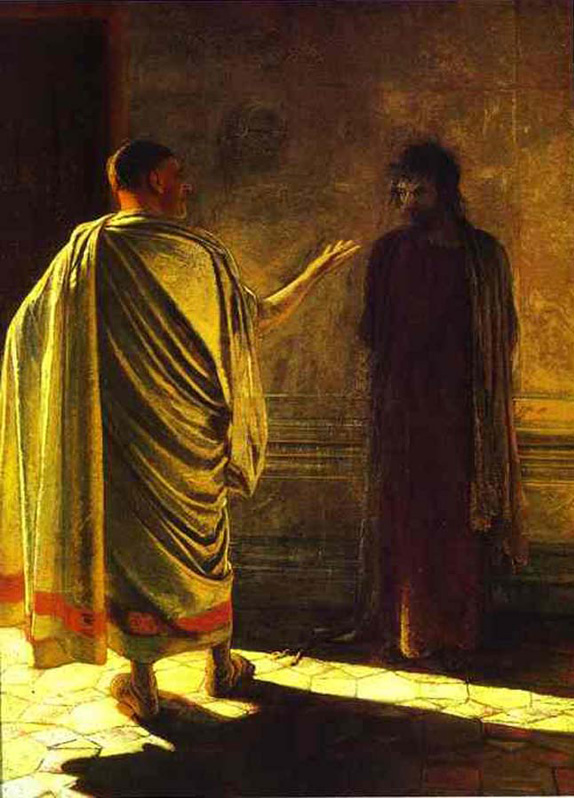
And the questions continued right up to that final barrage of questions Jesus received from Pilate, as He stood before him facing death.

Yes, even Pilate, the upper-class Roman who no doubt considered the Jews little more than rabble – even Pilate sought answers from this Jesus, this teacher whom he would soon judge under man's law.

“Are you the King of the Jews?” [Jn 18:33]

“Where are you from?” [Jn 19:9]

“Do you not you know that I have…power to crucify you?” [Jn 19:10]

And of course that sneering question from Pilate: “What is truth?” [Jn 18:38]

Pilate should have asked, “Who is truth?”, because he was in the presence of the Way, the Truth, and the Life.

Yes, almost everyone Jesus met asked Him questions. It’s as if, somehow, they all knew, if only subconsciously, who He really was. Those He encountered seemed to sense He was more than just a teacher.

What did the centurion say as he stood at the foot of the Cross?
“Truly this was the Son of God” [Mt 27:54].
In today’s passage from Luke, Jesus is again asked a question: "Teacher, what must I do to inherit eternal life?" [Lk 10:25]

Jesus didn’t need to invent an answer, for the answer was already there in the Word of God. And so He answered with a question of His own: “What is written in the Law? [Lk 10:26]

The scholar responded correctly, didn’t he? He simply went to Scripture:
“You shall love the Lord, your God, with all your heart, with all your being, with all your strength, and with all your mind, and your neighbor as yourself” [Lk 10:27].
You see, it’s not necessary to be a scholar to know God and what He expects of us. Indeed, just moments before Jesus had prayed to the Father:
“I give you praise, Father, Lord of heaven and earth, for although you have hidden these things from the wise and the learned you have revealed them to the childlike.” [Lk 10:21]
But not being very childlike, the scholar, hoping not so much to learn as to justify himself, asks Jesus, “And who is my neighbor?” With that Jesus offers us a gift, the Parable of the Good Samaritan, a parable both scholar and childlike can understand:
“A man was going down from Jerusalem to Jericho...” [Lk 10:30]
But what exactly did the Samaritan do? After all, he was a Samaritan, despised by the Jews and thought to be outside the Law. And yet, did he not listen to God’s Word? Did he not obey the Law? Well, at the very least, it seems he listened to his conscience and acted righteously. And this set him on the path to eternal life.

Remember that original question: “Teacher, what must I do to inherit eternal life?” [Lk 10:25] This is what Jesus' answer is all about.

Yes, there were three who encountered the wounded man on the road, weren’t there? But only one of the three did anything to help. How did Jesus put it? “Many are called but few are chosen” [Mt 22:14]

And so today, let’s reflect on our own lives. Who are the wounded you and I encounter? Those who are physically wounded? Or mentally wounded? Or spiritually wounded? Do we even recognize them in the busyness of our lives? Or perhaps we do see them, but turn away, preferring not to be bothered. Anyway, someone else will take care of them.

Is that how we hope to inherit eternal life? As Christians we should know better. To inherit eternal life, we must come to know God, to know Him as the Way, the Truth, and the Life.

But this knowing of God is knowledge of love. As John reminds us: to know the Truth that is God is to know God, who "is Love" [1 Jn. 4:16]. It always comes back to Love, doesn’t it? To love the Lord your God with all your being, and to love your neighbor as yourself. How did Mother Teresa put it? "If you judge people, you have no time to love them."

Yes, indeed, we spend so much time judging others, and so little time loving them. St. James reminded us all of this when he wrote that "mercy triumphs over judgment" [Jas 2:13].

As we look forward to the Year of Mercy declared by Pope Francis, let's make an effort as individuals and as a parish to replace self-absorption with a love for others, to replace judgment with mercy.