The occasional, often ill-considered thoughts of a Roman Catholic permanent deacon who is ever grateful to God for his existence. Despite the strangeness we encounter in this life, all the suffering we witness and endure, being is good, so good I am sometimes unable to contain my joy. Deo gratias!


Although I am an ordained deacon of the Catholic Church, the opinions expressed in this blog are my personal opinions. In offering these personal opinions I am not acting as a representative of the Church or any Church organization.

Wednesday, January 6, 2010

Cold Days in the Midst of "Global Warming"

"Man is certainly stark mad. He can't make a worm, but he makes gods by the dozen." -Michel de Montaigne
___________________________________________


A busy morning for an old retired guy. Up at 5:30 a.m. so I could preach at the 7:00 and 8:30 a.m. Masses. Then, facilitate a Bible Study for an hour, followed by a meeting with several parishioners to plan a novena and celebration in February for Our Lady of Good Success. The afternoon has been far more relaxed and has given me an opportunity to catch up on my reading, write this post for the blog, and prepare for this evening's Bible Study. With any luck I'll be home in time to watch tonight's bowl game.


Of course, throughout it all, I'm constantly grumbling about the absolutely crazy weather we are experiencing here in Florida. As I drove to church this morning at a little after 6:00, the outside air temperature reading was 23 degrees. Yes, I know, all you folks up north wish your weather was that warm...but this is Florida! It's not supposed to get that cold here. This ain't International Falls, Minnesota. And they're predicting more of the same throughout this week and into the next. Of course, the daytime highs will be in the 50s so it's not all that bad...but it's still far below what we normally experience this time of year.


Dear Diane is worried about her camellias surviving the hard freezes and so she's covered them with newspapers and plastic bags. The heck with the camellias, I'm just worried about my surviving, and I suspect a large plastic bag would only aggravate the situation. It's remarkable, though, how quickly one gets acclimated to a new climate. Diane and I moved here from New England just six years ago, and yet whenever the temperature drops below 40 I am extremely uncomfortable. In fact, if I can't wear shorts, I consider it a very bad day.


All of this causes me once again to question Al Gore and his corps of global warming doomsayers who expect melting ice caps to cause the oceans to inundate our coastal plains any day now. The trouble is, where is the warm weather? And it seems to be cold everywhere...the UK and mainland Europe, North America, China -- all are experiencing extremely cold weather. It all makes me seriously doubt the claim that humanity has such a large impact on the world's climate. The world has experienced countless cycles of ice age and warming, all without any input by humans. And I suspect it will continue to experience these cycles in the future.


I read this morning that this winter may turn out to be the coldest in 25 years. Here's what AccuWeather.com had to say:


Nearly the entire eastern half of the United States is enduring bitterly cold temperatures not experienced since 1985. Even Florida, which has been hovering around freezing levels overnight recently, is also feeling the almost-nationwide chill.

"It'll be like the great winters of the '60s and '70s," said AccuWeather.com Chief Meteorologist and Expert Long Range Forecaster Joe Bastardi.

The last time a large swath of severely low temperatures struck the nation was in January 1985. That historic arctic outbreak had below-zero temperatures Fahrenheit stretching from Chicago eastward to New York City, and all the way south to Macon, Ga.


Makes you wonder doesn't it? Especially in light of the recent revelations that some of the world's leading climatologists connected with the Climatic Research Unit at the University of East Anglia were fudging the data to support their global warming theories. Indeed, according to a piece in the London Times, they apparently did all sorts of nasty and very unscientific things:


"(a) the scientists have been manipulating the raw temperature figures to show a relentlessly rising global warming trend; (b) they have consistently refused outsiders access to the raw data; (c) the scientists have been trying to avoid freedom of information requests; and (d) they have been discussing ways to prevent papers by dissenting scientists being published in learned journals."
It all seems to fulfill a prophecy of sorts made by sociologist and historian Robert Nisbet who, in an essay written almost 30 years ago challenged the myth that the Church maltreated Galileo.


"Probably more scientists have been adversely affected – stopped altogether from a given line of research, guided, shaped, propelled, decelerated, forced into non-publication, secrecy, turned down for funds or promotion, and barred from access to laboratory space or archives – because of defiance of conventional wisdom in America since World War II . . . than existed in the whole of the world in Galileo's day."
Nisbet was no Catholic, indeed he could hardly be called a believer, so he had no ax to grind when it came to Enlightenment myths and the Church. If you'd like to read more about Nisbet (who died in 1996) and global warming, check out this essay by Scott Walter on TheCatholicThing.org


This, of course, should remind us of how human and, consequently, how sinful we all are, even the supposedly most rational and objective among us: the scientists. We are all tempted to serve ourselves instead of the truth. That's what Satan does. In his temptations he tries to subvert our innate desire for God -- "the Way, the Truth, and the Life" -- by making us long instead for the things of this world.


There are certainly no lack of problems confronting us today, and I think we humans can honestly claim to be the source of most of them. As Christians we are called to address them by applying Gospel values and the teachings of our Faith. But, personally, I really don't believe that global warming is among them.


Stay warm and God's peace...

Monday, January 4, 2010

Secular Humanist Choir

Paul Nichols, who writes (and draws) the Catholic Cartoon Blog, has penned his idea of what a secular humanist choir would be singing during the Christmas season.

The way things are going in this country, I suspect that we'll soon be hearing this sort of thing during some future Christmas season. Christmas Carols by and for atheists...something to look forward to.

God's peace...

Sunday, January 3, 2010

Forgotten Signs of Reverence

I suppose advancing age could well be the most likely cause, but sometimes I find myself wondering what happened to many of the Catholic customs and traditions I grew up with. But this reflection is driven by more than simple nostalgia; rather it's a sadness that something good has been lost and future generations of Catholics will be poorer for it. I also believe that the practice of many of these customs and traditions were moments of grace, times when we as Catholics opened ourselves up to God's movement in our lives. Let me give you a few examples of some signs of reverence that seem to have been forgotten by many Catholics...


Bowing one's head at the name of Jesus. I still do this. Indeed, I'm unable to do otherwise. My parents and the good Dominican Sisters at St. Augustine School in Larchmont, NY trained me too well. When I was a child virtually every Catholic followed this practice, but today it seems that very few have retained it. It's absence is especially evident when I am preaching and can observe the entire congregation. When the name of Jesus is pronounced I notice only a few gray heads bow while the vast majority remain unmoved. The practice is not, as some would have us believe, just another meaningless tradition that was left in the dust of the pre-Vatican II Church. Not at all. Indeed, this tradition has a Scriptural basis and is as old as St. Paul's Letter to the Philippians:

Because of this, God greatly exalted him and bestowed on him the name that is above every name, that at the name of Jesus every knee should bend, of those in heaven and on earth and under the earth, and every tongue confess that Jesus Christ is Lord, to the glory of God the Father. [Phil 2:9-11]

Additionally, this custom of bowing the head at the mention of Jesus' Name was formally written into law at the Second Council of Lyons, A.D. 1274, convened by Pope Gregory X: 

"Those who assemble in church should extol with an act of special reverence that Name which is above every Name, than which no other under Heaven has been given to people, in which believers must be saved, the Name, that is, of Jesus Christ, Who will save His people from their sins. Each should fulfill in himself that which is written for all, that at the Name of Jesus every knee should bow; whenever that glorious Name is recalled, especially during the sacred Mysteries of the Mass, everyone should bow the knees of his heart, which he can do even by a bow of his head."


As I mentioned above, it can be a moment of grace. It can also be a moment of evangelization whereby we show the world that the name of God is indeed sacred. Here's an interesting comment about this practice: Proclaiming Jesus is Lord.


This leads me to another question: What ever happened to the Holy Name Society, the Dominican sponsored confraternity that promoted reverence for the holy names of God and Jesus Christ? Back when I was growing up almost every parish had one, and what a blessing it was. I know the society still exists, but there seem to be few parishes with active chapters. Maybe I'll look into starting one at our parish.


Genuflecting before the Blessed Sacrament. If you're old enough you will remember how everyone genuflected to the Tabernacle because within it was the Eucharist, the Blessed Sacrament. Perhaps for many it had become (and still remains) one of those automatic "Catholic" things that one did entering and leaving one's pew. Perhaps many gave little thought to what they were doing and why they were doing it. But that's no reason to drop the custom. 

Let me acknowledge that many Catholics still practice this reverent custom, but let me also say that many don't. And it was, at one time, universally practiced. When I was a child the only people who didn't genuflect were those who were physically incapable of doing so.


Indeed, the gradual disappearance of this custom only highlights how many nominal Catholics have abandoned belief in the Real Presence of Jesus Christ in the Eucharist. (As one Protestant friend told me, "If I believed what you say you believe about Jesus being present in your Eucharist, I'd spend my life there kneeling in front of Him.") And for those who think this custom, too, is just another leftover from those pre-Vatican II days, let me remind you that the fathers of the Second Vatican Council called the Eucharist "the source and summit of the Christian life." When you meditate on these words, and allow yourself to understand and accept their full meaning, the need to pay reverence to the Blessed Sacrament is inescapable.


Yes, genuflecting before the Tabernacle is a wonderful reminder that we are in the presence of God, and provides an opportunity to give thanks for this wonderful gift of the Eucharist, the remarkable gift of God's continued and very real presence in our lives.


Dressing Up for God. My previous parish, located in a resort town on Cape Cod, attracted several thousand summer visitors each weekend. And while many dressed appropriately, the attire of many others was appalling. 

Whenever I mentioned this among the clergy, some priests and deacons would always say, "Well, you should be happy they're attending Mass, regardless of how they're dressed." Now this argument never impressed me. Attending Mass, in itself, means little if it is done only to fulfill some sort of cultural collective habit. In other words, I fear that too many Catholics go to Mass on Sunday -- or more usually to a Saturday Vigil Mass -- simply because they have always done so. It's a cultural thing, something they do, perhaps even a hedging of their bets so to speak, a kind of superficial form of Pascal's wager. And so they see no need to alter their behavior to conform to and reflect the reality of what is actually occurring at Mass. If they truly understood and believed what is happening before them on the altar, they would approach that altar with every sign of respect.


These same people, who come to Mass wearing flip-flops and shorts and tank tops or worse, would never dress that way for a friend's wedding or a relative's funeral because it would be a sign of disrespect. They dress to the nines when attending Christmas parties or dinner on a cruise ship, but can't even cover their bellies when they come to taste the Lord at His table. 

Once again, it seems to be just another symptom of a lack of belief in the Real Presence. Or perhaps they simply have come to believe that dressing to meet Almighty God at Mass is somehow passé and no longer applies in today's less formal society.

But dressing for Mass is simply a matter of showing proper respect, not only for God, but for each other. It's not, and should never be, a matter of showing off one's finery. Dressing with that intention would be sinful. It's less a matter of wearing fine clothes than it is of not wearing obviously inappropriate clothing. After all, many people don't have fine clothes. And some others must attend Mass immediately after or before work, often hard work that demands clothing that is anything but fine. Such circumstances should never keep a person from the Sacraments. But these are relatively rare exceptions. In most circumstances people should come to Mass wearing modest, clean clothing that mirrors the respect they have in their hearts.

I could go on and mention that other sign of disrespect, the all-too-common practice of leaving Mass immediately after receiving the Eucharist and not bothering to stay for the final blessing. And there are dozens of other wonderful Catholic customs and traditions that have lost much of their popularity over the years, but these will do for now. Actually, if you have any you'd like to pass along, use the comment feature and share them with others. 


And speaking of comments, I have been forced to moderate all comments as a result of my little foray into NCAA football. A few commenters used highly inappropriate language. And I've also been receiving some rather odd comments in Chinese, which I assume are some form of spam. In addition to these, the only comments I reject are those that really don't address the subject or are obvious promotional ploys.

Homily: The Epiphany of Our Lord

Readings: Is 60:1-6; Ps 72; Eph 3:2-3a,5-6; Mt 2:1-12 
_________________________


I can recall, as a child, not knowing quite what to make of the Magi, the three kings or wise men as we called them. To me they were romantic, mysterious figures -- dressed in their finery, perched high on their camels, and bearing those interesting gifts. I knew what gold was, and assumed that frankincense was something similar to the incense we used at High Mass. Of course, myrrh was a bit of a mystery, and to some extent remains so to this day.

It wasn't until I was in eighth grade, when Sister Francis Jane had us read T. S. Eliot's "Journey of the Magi," that I came to a clearer understanding of the men and their mission. The opening lines of this poem dispelled my earlier romantic notions about how the Magi came from their distant homelands to greet this unknown King.


A cold coming we had of it,
Just the worst time of the year
For a Journey, and such a long journey;
The ways deep and the weather sharp,
The very dead of winter.


What caused them to make this difficult journey to Bethlehem? Why did they, and apparently no one else, recognize the signs and feel compelled to make this remarkable pilgrimage? And who were these men? Well, one thing we know for certain: they were Gentiles, not Jews.

Were they kings? Probably not. Were they astrologers, as has often been claimed? Also, probably not, at least not in today's superstitious sense. More likely, the magi were the sages of their people -- men committed to the propagation of wisdom; men committed to finding the truth.And it’s this search for truth that brings them to a stable in a cave in the nondescript little village of Bethlehem.


The Hebrew Scriptures, what we call the Old Testament, was not unknown among the people of the ancient middle east. And as true "wise men," they were probably familiar with these Scriptures, and with Micah's prophecy of Bethlehem as the birthplace of a great King from the House of David.


Armed with God's Word, they go, unknowingly, to meet the Word of God Himself. Spurred on by a sign in the heavens, they encounter the One Who will proclaim the Kingdom of Heaven. And led by the Holy Spirit, they find Him to Whom the Spirit always leads.


These wise men came to Bethlehem in search of the truth. And at the end of their journey, they have a revelation. They discover that the Truth is not a something, but a Someone. "I am the Way, and the Truth, and the Life," Jesus tells us. When we follow His Way, we are led to Him, the Truth; and the reward is eternal Life.


But along that Way we will always encounter the Cross. The Magi bring gifts of gold, frankincense and myrrh -- symbols of royalty, priesthood, and suffering. For the Cross is there, even in the stable at Bethlehem. It is in their encounter with this Truth that the Magi come to realize that Jesus is not just a king in the worldly sense, but that He wants to become King of their hearts -- and that enthroning Him in their hearts requires a change in their lives -- a conversion. They came to admire and to honor a new king, but before they return home, they are to be changed in the very core of their inner being.

Later in his poem Eliot describes the shock of this recognition as the Magi realize that they must die to a life that does not include Jesus.


…were we led all that way for
Birth or Death? There was a Birth, certainly,
We had evidence and no doubt. I had seen birth and death,
But had thought they were different; this Birth was
Hard and bitter agony for us, like Death, our death.
 

Yes, the Magi realize that this Jesus is not a king just for the Jews, but that as St. Paul tells us is today's second reading: "…it has now been revealed…that the Gentiles are coheirs, members of the same body, and copartners in the promise in Christ Jesus through the Gospel."
 

It is this promise that the Magi sense -- a promise that brings life, but at the same time requires us to die to ourselves and to the world. And so the Magi discovered that they had to face something called death at the very moment in which they witnessed a birth. But in doing so, they became among the first proclaimers of the Good News. And today, here in this church, on this altar, we do the same. From this manifestation of Jesus to the Magi, to the world, we’re led to the celebration of the Eucharist, the living memorial of the sacrifice of Christ, His death and resurrection. We make a leap in time from the simple, precious days of Jesus' birth to that awesome moment when He offers Himself on the Cross for the salvation of the world.

"…and the Word became flesh." Jesus became man, and this meant that He would die. Our re-birth through Baptism requires that we must die with Him by our sharing of the Eucharist, in which Christ is truly present once again on the Cross at Calvary. For this is the reason Jesus was born. He came into the world to witness to the truth that God the Father wants each of us to be saved through the willing sacrifice of His Son, a sacrifice that we are privileged to share in at every Mass.


In his Gospel, St. Matthew doesn't tell us what happened to the Magi afterwards, but as we read the final words of Eliot's poem, we're allowed to speculate on the outcome:
 

We returned to our places, these Kingdoms,
But no longer at ease here, in the old dispensation,
With an alien people clutching their gods.
I should be glad of another death.


And so we are left with a choice.
 

We can be like the pagans and continue to clutch our gods of sinfulness. We can be like Herod and, rejecting the presence of God in our midst, fight a losing battle that leads not to life, but to death. Or like the Magi, we can accept the universal call of Christ. We can turn to the Truth and carry His message of salvation to the world. For this is what Epiphany is -- a manifestation, a showing. And as Catholic Christians, we are called to manifest Christ's presence in the world by our faith and how we live our lives.
 

In the words of the Solemn Blessing at the end of today's Mass: "The wise men followed the star, and found Christ…May you too find the Lord when your pilgrimage is ended."

Saturday, January 2, 2010

Texas Bowl Revisited

Well, that little post of mine on the Texas Bowl (Navy vs. Missouri) certainly generated a whole mess of attention to an extent that I'm not at all accustomed. Usually about 30-60 people read this blog, and most of them are other Catholic deacons or personal friends. In the past 24 hours over 1,000 people have checked it out, and virtually all of them were interested only in my comments on Navy and Missouri. It would seem I'd get a lot more attention if I wrote about football instead of religion and culture, but I suspect I'd run out of thngs to say after five or ten minutes.

Anyway, to all the Missouri fans who made comments, I thank you for straightening me out on the communication problem that led to the unintentional "battle of the bands" that occurred immediately after the game. Once it was explained that the TV network was the instigating culprit, I understood completely. Media folks tend to fall off the bottom of my list of favorite people. They're right down there with Washington politicians. (I suggest we all pray for them.) I assumed the worst because of some of the problems Navy teams have had with opponents' fans in recent years, although not with either players or bands. Last year's game against Rutgers comes to mind. But I should have known that the Mizzou players and band wouldn't intentionally act so disgracefully.

And so, assuming the information I have received via the comments to my earlier blog is correct, I apologize and trust that Navy will have an opportunity to beat Missouri once again soon.

Blessings for the New Year and Beat Army!

The Persecution Continues

It's never been easy to be a Christian in the Middle East, but today it's become particularly difficult, especially in nations where Islam is the dominant religion.

Plight (and Flight) of Iraqi Chrfistians. In Iraq, for example, attacks on Christians show no sign of abating and send the message that Christians either leave the country or die.

Just this week in Mosul a deacon was shot and seriously injured and a Christian college student was kidnapped by another Islamic group. On Christmas eve another Christian was gunned down in front of his home in northern Mosul.

The killings of Christians has continued to increase as have attacks on churches and convents -- all part of a well-organized program of ethnic cleansing targeting Iraqi Christians, according to Archbishop Louis Sako of Kirkuk. In October the archbishop wrote, "In Baghdad and Mosul, Christians are living in fear. Families don't know where to go—they feel isolated, without protection. Despite it all I urge Christians, especially the young, to be patient and stay, resist despair, assume their responsibilities towards the country and the Church, take part in political life to rebuild the country, make life together stronger, promote a culture of life, peace and security worthy of mankind." (The above photo shows the Church of the Holy Spirit burning in Mosul.)

The various ethnic groups in the Mosul area -- Arabs, Turkmen and Kurds -- all blame each other for the attacks while the government appears powerless to act. And so the killings continue. Since 2003 over 2,000 Christians have been killed and their  numbers have been cut by nearly 50% as Christians depart for safer parts of the country or simply leave Iraq.

Cardinal Emmanuel III Delly, patriarch of Babylon of the Chaldeans and head of the synod of the Chaldean Church, recently stated:


"The situation in some parts of Iraq is disastrous and tragic. Life is a Calvary: there is no peace or security, just as there is a lack of daily necessities. There are continuing shortages of electricity, water, gasoline, telephone communications are increasingly difficult, entire roads are blocked, schools are closed or always in danger, hospitals are on short staff, the people are afraid for their safety. Everyone is afraid of kidnapping, frightened by the intimidation. And what can be said of the unjustifiable kidnappings that take place on a daily basis, harming entire families and often depriving them of their loved ones, even though they have paid tens of thousands of dollars for a release that never happens? Not to mention the increasing number of deaths caused by car bombs and suicide bombings."

Down and Out in Saudia Arabia. One of the worst places on earth to be a Christian is in Saudi Arabia. Approximately 200,000 Filipinos work in the Saudi kingdom, most as domestic workers. Not only are they poorly paid, but they are also treated with contempt by the employers because of their Christian faith.

For example,Norma Caldera, a Filipina domestic worker in Saudi Arabia recently escaped after seven months of harrassment and persecution, all stemming from her Catholic faith. "My life in Saudi Arabia was like a prison and the anguish of those moments was unbearable. Every day I got up early to pray, and every time my colleagues and employers saw me they began to insult and mock me for my Christian faith." When her employers learned that she was a devout Catholic, they immediately cut her pay by 30%. They forced her to fast during Ramadan and to sleep on the kitchen floor. Attending Mass was, of course, out of the question.

The Saudi government turns a blind eye to the persecution of Christian workers and seems even to collaborate in it. Recently another migrant worker from the Philippines, Sylviane Hugilon Baser, died in mystrious circumstances. Saudi authorites have so far provided no explanation of her death and have refused to return her body to her family.

Pakistan leads the way in persecution. As bad as things are in Saudi Arabia and Iraq, it's even worse in Pakistan where a small minority of Christians -- 4 million out of 160 million -- are subject to constant and horrendous persecution. One cause is Pakistan's outrageous blasphemy law which legislates prison or the death penalty for anyone who insults the Quran or Muhammad. Since its enactment in 1986 nearly a thousand people have been arrested and several hundred put to death. It has also led to a form of mob rule in which Christians are assumed to be guilty of violating the law simply because they are Christians. (Above photo shows a Pakistani Christian family after their home was destroyed by a Muslim mob.)

As a result at least 50 Christians have been tortured and killed for this crime and many villages and Christian churches destroyed and burned. Recently thousands of Muslims attacked Christian homes and churches for a false accusation of blasphemy and killed 7 people, including women and children, burning them alive. These killings take place without trial, the result of a rough justice dispensed by angry crowds, incited by their imams or by corrupt prison guards.

This is the sort of justice you can expect from Sharia Law.

Pray that the world listens to the prophetic words of Pope Benedict XVI who, in the talk Regensburg, asked fundamentalist Islam to renounce violence as irrational and contrary to God. At the same time he asked the Western world to once again look at God and religion not as an impediment to reason, but as its completion.

And pray for the brave Christians who live in the midst of persecution.

God's peace...

Friday, January 1, 2010

Texas Bowl: Navy 35, Missouri 13

Navy finished a great season yesterday with a dramatic and unquestioned win over Missouri in the Texas Bowl, beating the Tigers 35-13. Not only was Navy's triple option offense too much for Missouri to handle, but their defense came through repeatedly, especially in the red zone. And Navy quarterback, Ricky Dobbs, despite two turnovers, went on to pass for 130 yards and run for 166. He also made four of Navy's five touchdowns. Here's a recap: Navy Victory in Texas Bowl. As a USNA alum (class of 1967) I was especially proud of these disciplined, intelligent young men.

The only disappointment was the attitude of Missouri's players and band after their loss. I have never seen a Navy opponent act this way: for the first time I can recall, an opponent, in this instance the Missouri team, left the field before and during the playing of Navy's alma mater, "Navy Blue and Gold." And the Missouri band played at the same time trying to drown out Navy's band. Disgraceful, and an insult to these young men and women who will soon place their lives on the line for their country. And an insult to Navy's alumni who have done so in the past. Ah, well, it's just one more example of the ever growing incivility and barbarous behavior of some of our citizens who should know better.

Blessings and happiness for the new year...and Beat Army!

Thursday, December 31, 2009

The End of the Year at the Wildwood Soup Kitchen

Diane and I just got home after a long morning at the Wildwood Soup Kitchen, a morning that left us with more than the usual amount of aches and pains. They're good hurts though and are a fitting way to bring an end to 2009.

Diane and her  team of assistants prepared a wonderful meal of barbecue chicken, scalloped potatoes, green beans and dinner rolls. And, of course, we offered a wide selection of tasty desserts. Apparently our guests enjoyed the meal because we had a good crowd of hungry folks and hardly any leftovers. We delivered or served a total of 239 meals today -- not a record but certainly above average.

A few days from now I'll have the final numbers for 2009 and we'll have a better sense of the growing need in our community. A rough estimate is somewhere n the neighborhood of 68,000 meals for the year -- a rather large number for a little soup kitchen in central Florida.

Thanks to all those who have kept us going through their financial support and their donations of food during 2009. We neither seek nor accept financial support from any governement agency -- federal, state or local -- and so I am amazed that so many people, businesses and organizations continue to help us year after year.

Have a happy and a blessed new year...

Wednesday, December 30, 2009

Democracy? No way!

The above post title should get some folks all aflutter. How can I, a loyal, flag-waving American, be against democracy? Well...first a little background.

Recently I was accused of...well, I'm really not sure what I was accused of because the accuser was so upset he really couldn't articulate his accusation very well. But I know it wasn't something good. He was angry with me because I told him that trying to create a democratic Afghanistan was a "stupid idea." (I probably should have used kinder terms, but I wanted to ensure he didn't misunderstand me. He didn't.)

President Bush was always talking about spreading democracy -- for example, creating democratic regimes in Iraq and Afghanistan. And President Obama, too, throws the word around as if it's the political holy grail, the primary goal of humanity. And yet, if you check the writings of the founding fathers of our nation, I doubt you will find any favorable references to democracy. Indeed, the founders feared democracy because they appreciated the evils that could result from it.

Democracy is rule by the people, the demos, and our founders knew full well that the people could not be trusted to govern themselves, at least not directly. That's why, ultimately, they created a representative republic and insisted on a written Constitution, a document that spelled out the rights of the people and strictly limited the role of the federal government. The government, you see, is of, by and for the people -- the people are sovereign, not the "government" per se -- but if the people run collectively towards a cliff, the Constitution will presumably prevent them from jumping, or at least make it very difficult to do so. Fear of real democracy and its possible consequences was a major factor in the formation of our nation.

This fear was also why the separation of powers became an integral element of the Constitution's makeup. With a government made up of three separate and independent elements -- executive, legislative and judicial -- and with each element exercising only limited powers, the preservation of the peoples' rights and the continuation of this unique form of government would be more likely assured, if not guaranteed.

I mention all this because I have noticed that, like my angry accuser, an increasing number of Americans seem to believe incorrectly that we live in a democracy and are similarly unaware of the dangers inherent in any pure democratic form of government. Nothing guarantees that simple majority rule will lead to the best or even a good result. Indeed, more often than not, particularly when complex or critical issues are addressed, a majority of the people will probably choose one of the worst alternatives.

The problem with democracy, government by a simple majority of the people, is that the people can act without reference; that is, they can act without consideration of any moral and cultural and legal foundations. They can, in effect, do whatever they want. They can respond to the emotions of the moment, free of all precedent and unrestrained by any concept of rights and responsibilities. This, as you might image, can be very problematic when it comes to preserving the rights and liberties of the minority. But even worse, it can jeopardize the nation's continued existence. Once the majority realize they have unrestrained power, they learn how to use government to help them at the expense of others. They also lose sight of the essential elements of their culture, particularly the religious (the "cult" of culture) foundational element. Once that basic element is lost, the culture itself is doomed. Without the foundational cult, nothing can enforce the moral good. Self-interest becomes paramount and common sense goes out the window. Once greed and stupidity are married, the nation will eventually crumble. It will destroy itself through economic and moral collapse, or it will experience a revolution by a persecuted and energized minority, or in its weakened state it will be defeated by external enemies.

That's why I don't believe in democracy.

The trouble is, we seem to be heading in the direction of increased reliance on basic democracy, and I'm starting to see the symptoms of decay that come with it. Legislators become slaves to the latest polling data and, taking the safe approach, cast their votes accordingly. Even safer is to call for a referendum so the people can bypass their representative government entirely. And when the negative unintended consequences appear, the politician can safely blame the people themselves. Expanding popular democracy breeds weak politicians lacking in courage; it gives us representatives who don't represent and legislators who legislate poorly. And since a power vacuum can never remain a vacuum for long, weakness in the legislature leads to increased power in the other two branches -- something we are experiencing today.

I love this country and I trust it will keep or, more accurately, return to the exquisite model given to us by the founders. But I suspect it has progressed too far along the road to decay for that to happen. No nation can last forever, and in today's world, it's remarkable that the United States has managed to survive as long as it has. I'm not a pessimist; I'm simply a realist. We are at the end of an age, and neither I nor anyone else can predict when exactly the next age will begin and what form it will take. Perhaps the Lord of History, the One who will bring all to its planned end, will intervene and save us from ourselves. Now that's something to pray for!

God's peace...
Videos added to the Wildwood Soup Kitchen website

It's only taken me a month, but I finally got around to adding some videos to the website of the Wildwood Soup Kitchen. As you know if you've followed this blog, our local TV station here in The Villages has been very supportive of the soup kitchen and gives us plenty of good publicity. They covered us at Thanksgiving and again at Christmas. I have now placed both videos on the website which represents a major technological breakthrough for us...not really, but it sounds better than the truth which is just plain laziness on my part.


Both videos have been posted on this blog in recent weeks, but if you'd like to check them out in their new "official soup kitchen setting", click here: Wildwood Soup Kitchen News.


Pope Benedict's Christmas Message

As you all know, on Christmas eve Pope Benedict was assaulted as he processed to the altar of St. Peter's Basilica prior to Midnight Mass. But although the 82-year-old pontiff was pulled to the marble floor by his assailant, he was unhurt and went on to celebrate Mass for the faithful. His homily is a Christmas message from which we can all benefit, so I have posted it below in its entirety...


________________________


Dear Brothers and Sisters!

“A child is born for us, a son is given to us” (Is 9:5). What Isaiah prophesied as he gazed into the future from afar, consoling Israel amid its trials and its darkness, is now proclaimed to the shepherds as a present reality by the Angel, from whom a cloud of light streams forth: “To you is born this day in the city of David a Savior, who is Christ the Lord” (Lk 2:11). The Lord is here. From this moment, God is truly “God with us”. No longer is he the distant God who can in some way be perceived from afar, in creation and in our own consciousness. He has entered the world. He is close to us. The words of the risen Christ to his followers are addressed also to us: “Lo, I am with you always, to the close of the age” (Mt 28:20). For you the Savior is born: through the Gospel and those who proclaim it, God now reminds us of the message that the Angel announced to the shepherds. It is a message that cannot leave us indifferent. If it is true, it changes everything. If it is true, it also affects me. Like the shepherds, then, I too must say: Come on, I want to go to Bethlehem to see the Word that has occurred there. The story of the shepherds is included in the Gospel for a reason. They show us the right way to respond to the message that we too have received. What is it that these first witnesses of God’s incarnation have to tell us?

The first thing we are told about the shepherds is that they were on the watch – they could hear the message precisely because they were awake. We must be awake, so that we can hear the message. We must become truly vigilant people. What does this mean? The principal difference between someone dreaming and someone awake is that the dreamer is in a world of his own. His “self” is locked into this dreamworld that is his alone and does not connect him with others. To wake up means to leave that private world of one’s own and to enter the common reality, the truth that alone can unite all people. Conflict and lack of reconciliation in the world stem from the fact that we are locked into our own interests and opinions, into our own little private world. Selfishness, both individual and collective, makes us prisoners of our interests and our desires that stand against the truth and separate us from one another. Awake, the Gospel tells us. Step outside, so as to enter the great communal truth, the communion of the one God. To awake, then, means to develop a receptivity for God: for the silent promptings with which he chooses to guide us; for the many indications of his presence. There are people who describe themselves as “religiously tone deaf”. The gift of a capacity to perceive God seems as if it is withheld from some. And indeed – our way of thinking and acting, the mentality of today’s world, the whole range of our experience is inclined to deaden our receptivity for God, to make us “tone deaf” towards him. And yet in every soul, the desire for God, the capacity to encounter him, is present, whether in a hidden way or overtly. In order to arrive at this vigilance, this awakening to what is essential, we should pray for ourselves and for others, for those who appear “tone deaf” and yet in whom there is a keen desire for God to manifest himself. The great theologian Origen said this: if I had the grace to see as Paul saw, I could even now (during the Liturgy) contemplate a great host of angels (cf. in Lk 23:9). And indeed, in the sacred liturgy, we are surrounded by the angels of God and the saints. The Lord himself is present in our midst. Lord, open the eyes of our hearts, so that we may become vigilant and clear-sighted, in this way bringing you close to others as well!

Let us return to the Christmas Gospel. It tells us that after listening to the Angel’s message, the shepherds said one to another: “‘Let us go over to Bethlehem’ … they went at once” (Lk 2:15f.). “They made haste” is literally what the Greek text says. What had been announced to them was so important that they had to go immediately. In fact, what had been said to them was utterly out of the ordinary. It changed the world. The Savior is born. The long-awaited Son of David has come into the world in his own city. What could be more important? No doubt they were partly driven by curiosity, but first and foremost it was their excitement at the wonderful news that had been conveyed to them, of all people, to the little ones, to the seemingly unimportant. They made haste – they went at once. In our daily life, it is not like that. For most people, the things of God are not given priority, they do not impose themselves on us directly. And so the great majority of us tend to postpone them. First we do what seems urgent here and now. In the list of priorities God is often more or less at the end. We can always deal with that later, we tend to think. The Gospel tells us: God is the highest priority. If anything in our life deserves haste without delay, then, it is God’s work alone. The Rule of Saint Benedict contains this teaching: “Place nothing at all before the work of God (i.e. the divine office)”. For monks, the Liturgy is the first priority. Everything else comes later. In its essence, though, this saying applies to everyone. God is important, by far the most important thing in our lives. The shepherds teach us this priority. From them we should learn not to be crushed by all the pressing matters in our daily lives. From them we should learn the inner freedom to put other tasks in second place – however important they may be – so as to make our way towards God, to allow him into our lives and into our time. Time given to God and, in his name, to our neighbor is never time lost. It is the time when we are most truly alive, when we live our humanity to the full.

Some commentators point out that the shepherds, the simple souls, were the first to come to Jesus in the manger and to encounter the Redeemer of the world. The wise men from the East, representing those with social standing and fame, arrived much later. The commentators go on to say: this is quite natural. The shepherds lived nearby. They only needed to “come over” (cf. Lk 2:15), as we do when we go to visit our neighbors. The wise men, however, lived far away. They had to undertake a long and arduous journey in order to arrive in Bethlehem. And they needed guidance and direction. Today too there are simple and lowly souls who live very close to the Lord. They are, so to speak, his neighbors and they can easily go to see him. But most of us in the world today live far from Jesus Christ, the incarnate God who came to dwell amongst us. We live our lives by philosophies, amid worldly affairs and occupations that totally absorb us and are a great distance from the manger. In all kinds of ways, God has to prod us and reach out to us again and again, so that we can manage to escape from the muddle of our thoughts and activities and discover the way that leads to him. But a path exists for all of us. The Lord provides everyone with tailor-made signals. He calls each one of us, so that we too can say: “Come on, ‘let us go over’ to Bethlehem – to the God who has come to meet us. Yes indeed, God has set out towards us. Left to ourselves we could not reach him. The path is too much for our strength. But God has come down. He comes towards us. He has traveled the longer part of the journey. Now he invites us: come and see how much I love you. Come and see that I am here. Transeamus usque Bethlehem, the Latin Bible says. Let us go there! Let us surpass ourselves! Let us journey towards God in all sorts of ways: along our interior path towards him, but also along very concrete paths – the Liturgy of the Church, the service of our neighbor, in whom Christ awaits us.

Let us once again listen directly to the Gospel. The shepherds tell one another the reason why they are setting off: “Let us see this thing that has happened.” Literally the Greek text says: “Let us see this Word that has occurred there.” Yes indeed, such is the radical newness of this night: the Word can be seen. For it has become flesh. The God of whom no image may be made – because any image would only diminish, or rather distort him – this God has himself become visible in the One who is his true image, as Saint Paul puts it (cf. 2 Cor 4:4; Col 1:15). In the figure of Jesus Christ, in the whole of his life and ministry, in his dying and rising, we can see the Word of God and hence the mystery of the living God himself. This is what God is like. The Angel had said to the shepherds: “This will be a sign for you: you will find a babe wrapped in swaddling clothes and lying in a manger” (Lk 2:12; cf. 2:16). God’s sign, the sign given to the shepherds and to us, is not an astonishing miracle. God’s sign is his humility. God’s sign is that he makes himself small; he becomes a child; he lets us touch him and he asks for our love. How we would prefer a different sign, an imposing, irresistible sign of God’s power and greatness! But his sign summons us to faith and love, and thus it gives us hope: this is what God is like. He has power, he is Goodness itself. He invites us to become like him. Yes indeed, we become like God if we allow ourselves to be shaped by this sign; if we ourselves learn humility and hence true greatness; if we renounce violence and use only the weapons of truth and love. Origen, taking up one of John the Baptist’s sayings, saw the essence of paganism expressed in the symbol of stones: paganism is a lack of feeling, it means a heart of stone that is incapable of loving and perceiving God’s love. Origen says of the pagans: “Lacking feeling and reason, they are transformed into stones and wood” (in Lk 22:9). Christ, though, wishes to give us a heart of flesh. When we see him, the God who became a child, our hearts are opened. In the Liturgy of the holy night, God comes to us as man, so that we might become truly human. Let us listen once again to Origen: “Indeed, what use would it be to you that Christ once came in the flesh if he did not enter your soul? Let us pray that he may come to us each day, that we may be able to say: I live, yet it is no longer I that live, but Christ lives in me (Gal 2:20)” (in Lk 22:3).

Yes indeed, that is what we should pray for on this Holy Night. Lord Jesus Christ, born in Bethlehem, come to us! Enter within me, within my soul. Transform me. Renew me. Change me, change us all from stone and wood into living people, in whom your love is made present and the world is transformed. Amen.

Tuesday, December 29, 2009

Remarkable utterings

Just thought I'd share a few interesting comments made during the past few years by some of our great thinkers. Enjoy!

Rep. Nancy Pelosi (D-CA) finds a way to apply her deep religious beliefs to the U.S. Supreme Court's eminent domain decision (Chicago Sun Times, July 24, 2005): “It is a decision of the Supreme Court. So this is almost as if God has spoken."


Actor Sean Penn, eschewing all thoughts of personal responsibility, blames President Bush for his smoking habit (Wall Street Journal, January 9, 2006: “It makes it very difficult to quit smoking under this administration.” Hmmm...I wonder I he's still smoking. Anyone know?


Rep. John Murtha (D-PA), special friend of the men and women serving our nation in a time of war, offers a glimpse of his deep strategic insight in the midst of a speech to a North Miami audience (South Florida Sun Sentinel, June 25, 2006): "American presence in Iraq is more dangerous to world peace than nuclear threats from North Korea or Iran." 


Former Governor Howard Dean (D-VT), while describing his personal political manifesto, includes one of Marxism's basic tenets (Patriot Post, July 5, 2006): "We know that no one person can succeed unless everybody else succeeds.”


In an August 24, 2008 interview, Tom Brokaw told House Speaker Nancy Pelosi that the Catholic Church “feels very strongly” that life begins at conception. The speaker dug deeply into her vast theological and historical knowledge and replied, “I understand. And this is like maybe 50 years or something like that. So again, over the history of the Church, this is an issue of controversy.”


Actress Rosie O'Donnell reacting to all those aircraft flown into buildings by radical Christians (mediaresearch.org, September 13, 2006): "Radical Christianity is just as threatening as radical Islam in a country like America.”

Former Vice President Al Gore, who apparently has a hobby of generating and joining together random words, graciously shared the fruits of this hobby with those attending the opening of the Tribeca Film Festival, April 27, 2007: “Art, music, film, dance, poetry — all the arts — have long been our greatest tools to explore the regions of imagination that defy our efforts to think rationally about subjects that our emotions tell us are too painful to contemplate.” 

And, of course, no list would be complete without the inclusion of Vice President Teflon Joe Biden, Washington's greatest thinker, a man who lives and breathes a heartbeat from the presidency...


In an interview with CBS News in September 2008, Senator Biden rewrote history by making FDR the president in 1929, almost four years before he first took office. He also gave the television industry an early stimulus package by creating it long before it existed: "When the stock market crashed, Franklin Roosevelt got on the television and didn't just talk about the princes of greed. He said, 'look, here's what happened.'"

In January 2007 presidential candidate Joe Biden gave the nation a straight-from-the-heart description of his opponent, Senator Barack Obama (for which Joe later apologized): "I mean, you got the first mainstream African-American who is articulate and bright and clean and a nice-looking guy. I mean, that’s a storybook, man." Articulate, bright and clean...I'm just trying to imagine what would have happened to any Republican who made such a statement.

Vice presidential candidate Joe Biden criticizingJohn McCain's economic policies at a rally in October 2008: "Look, John's last-minute economic plan does nothing to tackle the number one job facing the middle class, and it happens to be, as Barack says, a three-letter word: jobs. J-O-B-S."

And finally...in a conversation with an American-Indian political activist in 2006, Senator Biden made the following comment (for which he apologized later): "In Delaware, the largest growth of population is Indian Americans, moving from India. You cannot go to a 7/11 or a Dunkin’ Donuts unless you have a slight Indian accent. I’m not joking."

I restricted my selections above to Democrats and those on the left as a small (very small) counterweight to the list prepared by ABC News which included only Republicans and folks on the right.

Enough...

Video: Christmas at the Wildwood Soup Kitchen

As I mentioned in a previous post (December 26), the local media came to visit us at the Wildwood Soup Kitchen on Christmas Day. This included a camera crew from VNN, our cable TV station run by The Villages. If you would like to view the brief story they put together -- including a clip of yours truly pontificating -- you can check it out below. It was a good day.


Blessings,

Deacon Dana

Monday, December 28, 2009

More End-of-the-Year Thoughts

Here I am, resting comfortably in my cushy, overstuffed, down-filled chair, channel surfing among news shows and odd documentaries, eating a leftover piece of pecan pie, and all the while typing these words on my little netbook -- some serious multitasking. Of all these activities, the only one I'm truly enjoying is the consumption of the pecan pie. And it seems the pie has stimulated my few remaining brain cells to generate some personal observations.

Watching a local TV show -- one of those shows that covers local "happenings" -- I happened to catch the last few seconds of an interview of a minister who claimed that we are now "entering a new age of faith." Now this intrigued me and I wish I had caught the entire interview so I could place this comment in some context. Lacking this, I'll simply take his comment literally and agree with him.

As the minister said, we are entering a new age of faith, although it might be more accurate to label it an "age of belief." In this new age of belief we have come to the point where we will believe almost anything. And in each instance, that which is believed has been transformed into a set of foundational precepts, the basis of a faith, a kind of religion with its own pantheon of gods and served by a hierarchy of priests and priestesses. One of the more obvious is environmentalism, but there are others. Materialism, scientism, liberalism -- they all have their adherents who faithfully put into practice their faith's constantly evolving beliefs. Indeed, many among the new elite are fervent believers in all of these faiths, leading me to think that perhaps we should call this new age the "age of insanity" when everyone can believe everything and not experience any sense of contradiction. Makes me wish I could stick around for the next hundred years just so I could watch it all unfold. I hate to put down a good story when I'm smack dab in the middle of it.

I also caught the end of a homily on the Holy Family preached by a bishop who shall go unnamed. It was delivered with all the enthusiasm of a mashed potato sandwich (one of my late father's favorite expressions that he regularly applied to boring speakers). This made me wonder whether those who preach this way actually believe the Good News. If the Good News of Jesus Christ is really true, and if one really believes this, then wouldn't one be a wee bit more enthusiastic? Most people I know, when they have the opportunity to pass along a piece of very good news to those whom they love, do so with some degree of passion. Instead, we are so often subjected to preachers who seem to go to extremes to hide the truth of the Good News behind a think veneer of nonsensical and obfuscatory verbiage.

Loosen up, guys! Tell people about the Good News. Tell them about God and what He's done for us. Let them see and experience your faith so they will want it for themselves. Cause them to realize that their relationship with God is the most important aspect of their lives. Tell them what they need to hear. Do you recall the one thing the people asked John the Baptist when he preached the Good News? People from all walks of life simply asked him, "What should we do?" [Lk 3:10-14] People today are seeking the answer to the same question, and that's what should be telling them.

God's peace...

Sunday, December 27, 2009

Good-bye to 2009

The end of the year always comes as a surprise to me, and I'm not sure why. It really shouldn't. After all, I can interpret a calendar as well as the next person, and I'm well aware that January follows December. And yet here we are, on the 27th of December, and I find it hard to believe that 2010 is about to begin. Maybe it's simply a symptom of advancing age and the seeming compression of time that accompanies it. As a child, anticipated events never came as a surprise; rather they crept out of the future at an agonizingly slow pace. Just as those school-less summer days would pass in warm, glorious slow motion, so too did the long winter months with their cold days marked by early darkness and nightly hours of repetitive and usually meaningless homework. Ugh -- a memory worth forgetting.

Anyway, here we are about to wrap up one year and begin another and, for whatever reason, I'm simply not ready for the transition. So rather than review the past year or make predictions about the next, I think I'll just share a few thoughts that have been percolating in my aging brain these past few days.


My first observation relates to civil government and religion. I am truly amazed at how many Christians place almost total trust in government to accomplish virtually any task, provide any service, ensure justice for all, and achieve and maintain peace on earth. It's as if the modern Christian, in the face of thousands of years of consistently contrary evidence, has decided the city of man must assume a place of precedence over the City of God.


Of course St. Augustine would not agree with this modern tendency to place so much trust in government. He considered those who ruled over men to be no better than a gang of thieves and robbers. (Just a cursory glance at our own Congress should be sufficient to confirm the timelessness of Augustine's observation.) Augustine was pretty clear about this when he wrote, "...what are kingdoms but great robberies? For what are robberies themselves but little kingdoms? The band itself is made up of men; it is ruled by the authority of a prince, it is knit together by the pact of the confederacy; the booty is divided by the law agreed upon" [City of God, Book 4, Chapter 4].

We seem to have forgotten that justice does not come from the world; it is not a gift of man, but is a gift from God Himself. As I mentioned above, the world provides its own convicting evidence. Whenever justice is placed solely in the hands of men, it becomes distorted by man's pride, his sinfulness, and eventually dissolves into something far removed from God's perfect justice. This doesn't mean we abandon our efforts to bring His justice to the world. On the contrary, doing so is part and parcel of the Christian life. But we must also realize that any attempt to achieve justice without reference to God is doomed to failure.

The current political brouhaha over health care reform is a rather nice example. The deals that had to be made with individual senators to ensure their votes call to mind Augustine's prescient comment that "the booty is divided by the law agreed upon." And, of course, no health care reform can be truly just unless it protects the most innocent and vulnerable among us. For almost 40 years God's justice has been abandoned and the world's idea of justice has reigned supreme in our nation and led to the premeditated killing of ten of millions of unborn human beings. Ironically, those politicians who are guilty of this horrendous crime against humanity are inevitably the same politicians who hypocritically apply the mantra "It's for the children" to justify so much of their intrusive legislation.


Observing my countrymen during these difficult times, I'm reminded of Walker Percy's comment in his novel, The Second Coming: "Most Romans worked and played as usual while Rome fell about  their ears."


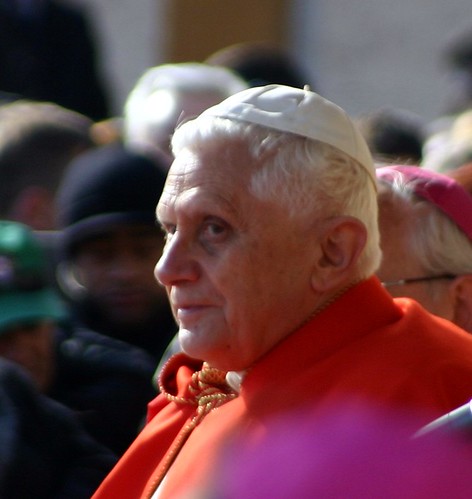
I took this photo during a general audience in Nov 2005
The year 2009 provided another scary moment during this its final week when dear Pope Benedict XVI was assaulted as he processed to the altar for midnight Mass at St. Peter's Basilica in Rome. Fortunately the pope was not injured and the young woman who assaulted him was apparently unarmed. She reportedly suffers from mental illness and had actually attempted to assault the pope once before. This, of course, leads one to wonder about how well the pope is protected from attacks not only by the mentally unbalanced, but also by those with the training and skill to carry out their evil intent. At the same time, however, I would hate to see the Holy Father placed inside the kind of isolating protective bubble that surrounds the American president. I am reminded of the time Diane and I sat only about 30 feet from Pope Benedict during an outdoor audience in 2005. What a privilege that was, and what a joy! I would hope that people could continue to share that experience. I have a feeling that this pope will trust in God and not allow the Vatican's protective services to isolate him from the faithful.

2009 also offers some good advice for parents. The Tiger Woods scandal should convince parents that celebrities do not make good role models for their children. Indeed, I am always amazed when parents hold up professional athletes as heroic figures worthy of emulation. After all, most professional athletes are simply people with extraordinary eye-hand coordination, unique physical skills, and a singleness of purpose in which their profession assumes an exaggerated importance. Much better for Christian parents to encourage their children to emulate the saints.


Although I stated above that I would avoid predictions, permit me to offer one or two. First of all, I predict that the world will not end during 2010. I make this prediction every year and so far I'm batting 1.000. Should the world actually come to an end this year, my average will still be remarkably high, and anyway, none of us will care.


And lastly, I predict that the Middle East, from Lebanon to Pakistan, will only experience more violence, more terrorism, and more insanity throughout 2010. In other words, if you think things are bad now in that part of the world, a year from now you'll think of 2009 as the good old days. Peace there will be a long time coming, if indeed it ever comes. And we must realize that peace isn't always better than war. For example, the peace offered by the world easily evolves into the peace of totalitarianism and slavery. General Sherman's comment that "War is hell," was incomplete because the world's peace can be just as hellish.

Pray for the only true peace, the peace beyond all understanding, the peace of Jesus Christ.

Saturday, December 26, 2009

'Twas the day after Christmas...St. Stephen's Day

Today is a day of thankfulness, a day of praise and joy...and a day of rest and recuperation.

Having remained here in Florida this Christmas (with the intent of never again traveling north during the winter months) and with all of our children and grandchildren enjoying the snowy, frigid weather of Massachusetts, Diane and I spent the holy day with our other family at the Wildwood Soup Kitchen.

As the Thursday cook, Diane prepared the Christmas Eve dinner, assisted by our wonderful team of Thursday volunteers. And so by Thursday evening we were ready for a nice, long night's rest. But since I was scheduled to assist at Midnight Mass, the rest had to be postponed. It was also shortened considerably since we had been asked to help out with the Christmas day meal at the soup kitchen, and this meant setting the alarm clock for 6 a.m.

I confess I was a bit grumpy when that irritating alarm rudely roused me after only four hours of sleep. (I would have made a very bad monk.) But once I got to the soup kitchen and joined all the other volunteers, I was energized. We had a wonderful time and serving our guests was a delight.

I should be used to it by now, but the outpouring of true charity during this season of hope always takes me by surprise. This year, once again, the soup kitchen has been the beneficiary of the generosity of so many people that I am overwhelmed. In addition to the many financial donations that continue to come in from individuals, churches, businesses, and civic organizations, we have received huge donations of food. On Christmas Eve, for example, a local Cracker Barrel restaurant donated 50 of their wonderful pies. The local Winn-Dixie and Publix supermarkets also provided us with much larger than usual donations of bakery goods and other food products. God bless them all!

Even more remarkable though, are the number of folks who volunteered to help us to prepare and serve the special Thanksgiving and Christmas dinners. Indeed, we received so many offers to volunteer that we had to turn away most of those who inquired. We can accommodate only so many volunteers before we run out of both jobs and space. Even the media showed up and our local newspaper ran a front-page story today on our Christmas dinner, which you can read here: The Villages Daily Sun.

Then, to top off this festive day, yesterday evening my brother and some good friends joined us at our home for a wonderful Christmas dinner prepared by Diane.

Martyrdom of St. Stephen (photo taken in 2005 at Basilica of St Paul Outside the Walls, Rome


And so today, St. Stephen's Day, we will rest, and pay homage to this saint, deacon and martyr.

God's peace...