The occasional, often ill-considered thoughts of a Roman Catholic permanent deacon who is ever grateful to God for his existence. Despite the strangeness we encounter in this life, all the suffering we witness and endure, being is good, so good I am sometimes unable to contain my joy. Deo gratias!


Although I am an ordained deacon of the Catholic Church, the opinions expressed in this blog are my personal opinions. In offering these personal opinions I am not acting as a representative of the Church or any Church organization.

Saturday, January 28, 2017

Homily: Saturday, 3rd Week of Ordinary Time

Note: Today, at our daily Mass, we also celebrated the 50th wedding anniversary of our dear friends, Deacon Claude and his wife, Patricia. They spend part of the year here in Florida and in the warmer months return to their lovely home in Penn Yan, NY on beautiful Lake Seneca. When they're here they spend much of their time involved in many of our parish ministries. I was honored that Claude and Patricia asked me to preach at today's Mass. Happy Anniversary, and many more!

-------------------------------------

Readings: Heb 11:1-2,8-19 • Lk 1:69-75 • Mk 4:35-41

I've always been intrigued by that verse in today's reading from Hebrews in which the author describes the patriarchs - Abraham, Isaac, and Jacob - as men who "acknowledged themselves to be strangers and aliens on earth"  [Heb 11:13].

It's seems like such an odd thing to say, doesn't it? After all they were born here on earth, lived on earth, and died on earth. How could they consider themselves aliens? 


That verse troubled me for years...until one day I realized I was getting old...or at least older. It was then, from my perspective as a more mature Christian, that I began to see the earth -- the world we live and die in -- as a fairly hostile place. I came to realize that this world, so hostile to all that I believed, so hostile to our faith, was not our home; that it was really a place of preparation, a place that would lead us to our true home, the home for which we were created. 

But if we let it, the open hostility of this world can drive us to respond not in faith, but in fear. The antidote to that fear is described in that far more famous verse from the same reading of Hebrews:
"Faith is the realization of what is hoped for and evidence of things not seen" [Heb 11:1].
You know, most people, if asked, "What's the opposite of faith?", would probably answer, "Doubt." And yet, that's not what Jesus tells us, is it? In our Gospel passage from Mark, and indeed, throughout all four Gospels, Jesus seems to be telling us that faith is opposed mainly by fear. What did He say to the apostles in today's passage?
"Why are you terrified? Do you not yet have faith?" [Mk 4:40]
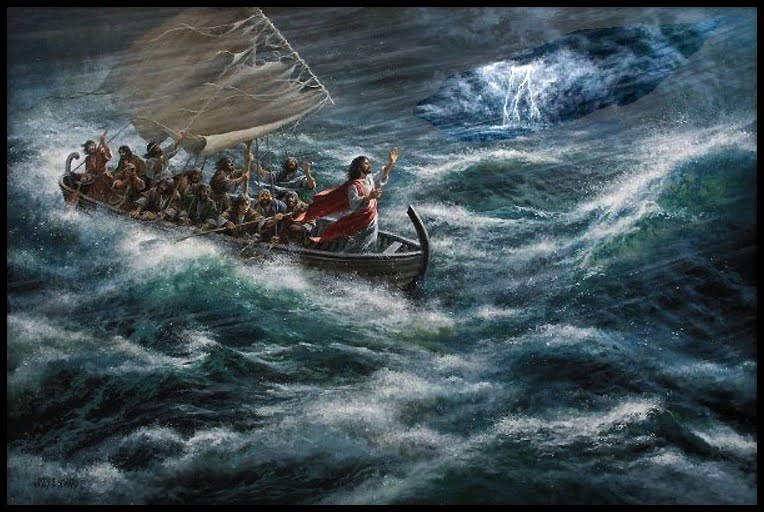
Jesus Calms the Wind and the Sea
Yes, it's fear, isn't it? It's fear in the face of this hostile world that challenges our faith. And so many today are so very afraid.

Fear, of course, is a normal human emotion, one that if it's controlled can actually aid us in our survival. As a Navy pilot I occasionally found myself in rather scary situations. Fear certainly kicked in, but so did my training, and I managed to overcome the fear. My faith was there, too,  supporting me, but I was more focused on simply doing what had to be done.

If we allow fear to control us, it will turn against us, and paralyze us. We see this manifested by the apostles in our Gospel passage. Jesus sleeps, in complete trust in God, but the apostles panic, overcome by fear. That they still call Him "teacher" tells us they do not yet understand who He is. But even in their fear and ignorance there's a glimmer of faith; for they awaken Jesus, and scold Him, hoping He can do something to save them.

But Jesus simply speaks to the sea as if it were a living thing, another being in this hostile world, something that the devil can manipulate.

"Quiet! Be still!" [Mk 4:39]
It's as if He's scolding an unruly child. The apostles are awestruck. And they ask the question that answers itself:
"Who then is this whom even wind and sea obey?" [Mk 4:41] 
Psalm 46:10
It's an answer found throughout Scripture, especially in the Psalms, where God's rule over creation is proclaimed again and again. And it's in the Psalms where we, too, are told to be quiet, to be still, to step away from the storms of our lives and be with God.

The boat, of course, foreshadows the Church, and over the centuries it too will be tossed about by an increasingly hostile world. But as Jesus reminds us again and again, it will be the faith of the Church that saves us, your faith and my faith that save us; for Jesus is never far away, but always there with us, calming our hearts.

And so today, let's pray that the trust and peace of Jesus will fill our hearts, that in our faith we'll know He is always with us, always ready to calm the storms of our lives.

Now...one more thing...

Today is the feast of the great 13-century theologian, St. Thomas Aquinas, a man whose influence on the teachings of the Catholic Church can hardly be overstated. A Dominican, he was a brilliant philosopher and theologian, but also a man of deep faith, a man of prayer, goodness, and simplicity. In addition to being the patron saint of teachers, students, and schools, St. Thomas is also fittingly the patron against storms.
 
Church - St. Thomas Aquinas, Paris
Thomas studied under St. Albert the Great, and the two of them spent a number of years studying and teaching at the Sorbonne in Paris. Today we have another Parisian connection, one that goes back not to the Middle Ages, but to the spring of 1965.

Yes, it was April in Paris of that year when Claude and Patricia first met. Like Thomas Aquinas both were studying in Paris. And less than two years later, they married. I'm sure over the years they've encountered a few storms, but in their deep faith, together they have weathered them all.

And so today we join Patricia and Claude as they celebrate their fifty years of marriage, and call them forward to renew their vows and receive Father's blessing.

Sunday, January 22, 2017

Inauguration

I'm beginning to like Donald Trump...a lot! I especially enjoyed his inaugural address even though I wasn't able to watch or listen to it live. Dear Diane and I spent a good part of inauguration day taking an elderly acquaintance to the doctor. She had fallen and broken her wrist a week or so ago and needed to see an orthopedic specialist. Sadly, the closest who would honor her Medicare and Wellcare insurance was almost an hour away so that's where we had to take her. The entire adventure, from home to home, took over six hours; therefore, we missed the new president's inauguration. But that's OK. The day was a typical, beautiful Florida day, so we had a delightful drive to Clermont, Florida. I got some reading done in the doctor's waiting room and we also met several very nice folks there. The traffic was light, and we stopped for a milkshake on the way home. What more could we possibly desire? It's these little things in life that I've come to enjoy as I shuffle through my senior years.
Oops! As I write this on Sunday evening, we've just been issued a tornado warning by the Weather Service. It's all very exciting, so exciting I've changed the channel from the Patriots-Steelers game to my favorite bunch of weather guessers on Orlando's channel 9. Dear Diane and I are ready to jump into the interior guest bathroom in the event of a tornado. Lots of thunder and lightning, very high winds, and torrents of rain -- it's all raging right now outside our doors. Interestingly, this storm system is moving through the area at 60 mph, much faster than most of the storms that visit us here in central Florida. I remember outrunning a storm like that years ago in my Navy helicopter. It was roaring across the South China Sea at over 70 mph and I had to race it back to the ship. Fortunately I won that race. (I will take a break until the weather improves.)
The storm is now over and we were, thankfully, untouched by tornadoes. And the Patriots won!

As I said above, I'm beginning to like Donald (now President) Trump. I've learned to measure people by their enemies. And when one looks at who hates President #45, it's hard not to like the man. Just consider all those who have convinced themselves his presidency is illegitimate: the same people who ranted when, during the campaign, he gave one of his famous off-the-cuff comments that he might not accept a Hillary victory. Well, these folks have taken non-acceptance to a new level. 

One particularly interesting Trump-hater is the Reverend Al Sharpton who along with his good friend, the Reverend Jesse Jackson, has perfected the profitable art of race-based extortion. Rev Al is very upset, certain our new president's election wasn't legitimate. In this he agrees with US Rep. John Lewis of Atlanta, a man who has done little of note since he was beaten up by thugs decades ago on a bridge in Selma. But because of that beating, we are not permitted to question his current absurdities. Both men, along with their admirers, are apparently convinced that the Russians perpetrated a Slavic version of the Vulcan mind-meld on the American people, causing them to shift allegiance from Hillary to Donald during the final days of the campaign. Rev Al, of course, is no more than a race-pimp, a walking, talking irrelevance who need not be taken seriously...and so I don't.

When considering haters, one can't ignore Madonna and her apparently unfulfilled desire to blow up the White House. Speaking to a sympathetic mob at the Women's March, she stated that she had instead chosen "love" and then proceeded to spew forth a stream of hate-filled rhetoric. The mainstream media, of course, were thrilled by her inarticulate diatribe even though she dropped a load of f-bombs and other obscenities on live TV. Such a lovely woman. 

I couldn't help but note that abortion seemed to be the overriding issue for those on the Women's March. For a gathering that speaks so much about love they sure do enjoy killing innocent unborn children. It boggles the mind.

Oh, yes...almost forgot. Michael Moore also addressed the Women's March. He was particularly upset with those women who voted for Donald Trump, calling them “victims”  of “misogyny and the sexism that is still so prevalent and ingrained.” Like most on the left, Moore believes that anyone who disagrees with him is either evil or crazy. 

Back to the president and the media...Did you hear Chris Matthews and the other MSNBC jokesters compare President Trump to Hitler and Mussolini? Or how about Democrat Representative Yvette Clarke of NY who was distraught because of the new president's fascism? In her words:
“You know, we may have fallen short on election day, but we did carry the popular vote. And, so, there are many more Americans who are in tune with the fact that we’re in the 21st century. And we’re not turning back the clock. We’re not going to stand for the type of, if you will, fascism — and I’m going to use that word — that many use to their advantage while suppressing and oppressing marginalized communities in this nation.”
One suspects that the representative doesn't have a clue about the real meaning of fascism. But who cares? Fascism is one of those scary words -- like racist, sexist, Islamophobic, etc. -- the left loves to toss around when speaking of conservatives. 

I also found it odd that the less-than-dynamic duo -- Republican Senators John McCain and Lindsey Graham -- seem a bit confused about the new leader of their party. Senator McCain claimed today that he was unsure whether he had confidence in President Trump. This seems a rather odd thing to admit before the man has completed two days in office, but I suspect the senator's evaluation of the president might be colored by a few personal concerns; i.e.,  he hates Donald Trump. Senator Graham also expressed confusion today when he stated: “I don’t know what America first means.” If that's true one can only assume he paid no attention to Donald Trump during the campaign. Of course, it's pretty apparent that he too hates Donald Trump.

The next four years should be interesting indeed.

Saturday, January 7, 2017

News from Israel: Old and New

I thought it might be interesting to share a few recent news items out of Israel -- some relate to current events while others touch on the nation's ancient roots. The first item says much about the attitude of the United Nations with regard to the state of Israel.


UNRWA School in Gaza
UN Schools Teach Palestinian Children to Hate Israel and Jews. In the West Bank and Gaza the United Nations operates a number of schools attended mainly by Palestinian children. These schools, which receive funding from the United Nations' Relief and Works Agency (UNRWA), use textbooks provided by the Palestinian Ministry of Education. As you might imagine, these textbooks are strongly anti-Israel. They purposely do not recognize the existence of Israel, even excluding the country from maps of the region. Equally disturbing, the books claim that the holy sites in Israel are exclusively Muslim sites, fail to mention their Jewish origins, and even accuse the Jews of trying to control them illegally. The books also contain no historical reference to the Jews or the Hebrew language. In effect these UN schools simply continue the racism and antisemitism that typify the official Palestinian position. Is it any wonder that peace between Israel and the Palestinians is so illusive since one side refuses to accept the existence of the other? It also explains the recent anti-Israel resolution passed by the UN, a resolution which the Obama administration supported by its refusal to exercise its veto.

Gaza-based Jihadist: Ban Christmas. If you're a Jihadist (aka, a terrorist) a good place to hang out is in Gaza where you will be well protected by the Palestinian authorities. You'll also have access to some cool textbooks. Anyway, one of these jokers, who's been given the label of "Senior Islamic State Jihadist," goes by the name of Abu Omar Almaqdesi. (Let's just call him Abe.) It seems Abe has been very vocal of late. Discussing recent terrorism in Turkey, Germany, and Jordan, he announced that such attacks are "the price these states must pay for positioning themselves as part of the Crusader Coalition of infidel countries fighting against Islam." Just a thought, but I suspect the German. Turkish, and Jordanian governments (or, for that matter, the US government) do not consider themselves as part of a Crusader Coalition. Too bad. If they did we might actually get somewhere in our misnamed war on terror. 

Abe also added a few seasonal comments relating to Christmas: "If somewhere there are Christians who insist on celebrating Christmas with the support of the heretic authorities, one must unleash upon them all one's might and deploy all the available means." He went on to explain that "all methods are admissible when it comes to preventing blasphemy against Allah and his commandments. Yes, including killing and blowing up." Then, apparently getting into the Christmas spirit, Abe added, "But...we believe that first you should act politely and explain that living in Islamic countries is conditioned on accepting Sharia and refrain from openly practicing rituals other than Islam." I guess after you've been polite, you can go ahead and blow them up. Don't you just love these guys? Abe sounds like a prime candidate for an extended vacation at Gitmo.

Having been promised by God to Abraham about 4,000 years ago, the Holy Land is a remarkable treasure trove for archaeologists. Like much of the Middle East, modern day Israel has lots of interesting stuff beneath its surface just waiting to be uncovered. Here are a couple of cool stories I found particularly interesting.

Egyptian Slab -- Ancient Hebrew? Inscriptions
Hebrew is #1. A Canadian archaeologist, Douglas Petrovich, has generated a whole lot of controversy among his colleagues by claiming that the Hebrew alphabet might just be the world's oldest. One can only assume his claims will not be well-received in Gaza. Petrovich believes that the Hebrews, when they were in Egypt, converted the local hieroglyphics into their own alphabet so they could express their Hebrew language in written form. He dates this alphabet to almost 4,000 years ago. He also claims to have found specific Biblical references from Genesis and Exodus -- to Moses, Ahisamach and Asenath -- as he translated various inscriptions. He's taking a lot of heat from the skeptics, but who knows? He might be right. After all, we know God was partial to Hebrew.


One of the many Temple Floor Tiles recovered
Second Temple Floor Tiles Discovered. Jerusalem's
second Temple, the one started by Herod and destroyed by the Romans in 70 A.D., is now covered by a Muslim shrine. This makes excavations a bit tense since the Muslims do not want Jewish access to this holy site. The second Temple is also the Temple of the Gospels at which Jesus and his disciples worshiped. As a result of excavations that began in 2005, over 600 of the Temple's floor tiles have been found and many have been restored. These are the only known physical elements of the Temple so they are considered extremely important. They are also of interest to Christians since Jesus quite possibly walked on many of these floor tiles.

I find it amazing that today, thousands of years after these events, we continue to discover such wondrous things. And so often these finds support the Biblical narrative that so many have considered unreliable at best. It would seem that God delights in leading us to that which magnifies His Word.

Homily: Christmas Weekday - Saturday

Readings: 1 John 5:14-21; Ps 149; John 2:1-11

___________________
 

The wedding feast at Cana provides a prophetic moment, a time for beginnings, a unique moment between our Savior and His Mother.

Now in those days among the Jews a wedding celebration was usually held at the home of the groom and often lasted a week or more. As you might imagine this involved a lot of food and a lot of wine. For as the rabbis happily tell us, "Where there is no wine, there is no joy."

Mary was probably a friend of the family, and she might well have helped with the preparations for the feast. And so she notices the potential embarrassment of the family running out of wine. Nobody asks her to help. After all, what could she possibly do? But her heart is stirred; she pities the unfortunate couple and she acts as an intercessor, a mediator with her Son.


But Mary doesn't ask Jesus for a miracle, does she? At least not directly. She merely tells Him: "They have no wine" [Jn 2:3].

With this simple statement Mary teaches us the basics of intercessory prayer. We need only state the problem and then let God decide how best to solve it. Too often we find ourselves telling God how to do things, as if we're the boss and he's the employee.

Jesus, of course, knows full well what Mary is asking and replies with words that seem strange to us:


"Woman, how does your concern affect me? My hour has not yet come" [Jn 2:4].
Some people are disturbed by His calling her "Woman." But it's important to realize Jesus is not being disrespectful to His Mother. Quite the opposite. Unlike its impersonal connotation in English, among the Jews "Woman" was a title, a title of respect. Indeed, in his Gospel John never calls Mary by her name. And later, much later, John has Jesus using that same title again, when he speaks to Mary from the Cross:
"Woman, behold, your son" [Jn 19:26]; and to John himself: "Behold your mother" [Jn 19:27].
Also a better translation of Jesus' comment might be as St. Jerome translates it into Latin: "Quid mihi et tibi?" or "What to me and thee?" or perhaps, "What are you asking of me?" We can almost hear Jesus saying, "Oh, is it that time already? Is the Father asking you to introduce me to men?"

Indeed, just consider Mary's indispensable role in God's plan for humanity. She is present at both of His human beginnings: the Incarnation and His public ministry. But she is not merely present. It is Mary's word, her fiat to Gabriel that permits the Incarnation. And it is her word at Cana that launches Jesus into His ministry. This very human request at a wedding feast begins His public journey to His "hour" - the hour of His salvific Passion, Death and Resurrection.


The Annunciation
Yes, it is through Mary's human word that the Divine Word enters into the world. She is present and active at every key moment. But in John's Gospel she appears only twice, for it is Mary who frames her Son's ministry: present at the very beginning and at the end.

Her last words in Scripture are spoken here at Cana, and offer us a perfect summation of her role: "Do whatever He tells you" [Jn 2:5]. Here and in every encounter with Mary in Scripture, she points always to her Son, offering us a permanent invitation to obey Christ in all things.

We can safely assume that God's plan included Jesus working this miracle at His Mother's request, since the Holy Spirit saw fit to include it in John's Gospel. And as the sinless one, she strives always to do the Father's will.

Here at Cana is the Father speaking through her to her Son, to His Son? "Now is the time, my Son. Your saving mission begins today."

Did God place the "hour" of Jesus into Mary's hands, just as He placed the Incarnation itself into her hands?  I've always thought so.

Let us never forget that Mary is the new Eve, the symbol of the Church, the one who will protect the Church, interceding for it with her Son. And just as she does at Cana, she will intercede for us even when she isn't asked.


Friday, January 6, 2017

There Oughta Be A Law...Not!

Chuck Schumer Ranting
For the past few days, since the start of the new congressional session, our federal legislators of both parties have been racking up the live-shots on TV news. I suppose they just can't help themselves. It probably has something to do with the politically oriented personality, a psyche that seeks and often demands constant attention. (This character trait is why nation-wide term-limits will always be an unattainable goal.) In their defense, though, I'll agree that the media, especially the 24-hour news-focused television media, have provided one of the more effective means of getting a politician's message and face in front of the people. And as agents of the status quo, they can't be expected to try something new.


Donald Trump Cheering
Our president-elect, however, is anything but a friend of the existing order. Thanks to years of media exposure, his face and his voice are almost universally recognized. He need not  introduce himself to the nation; it knows him already. Through his business experience and his unorthodox campaign it would seem he has come to realize several important things: (1) the people don't want another talking head for a president; (2) the media tend to filter what he says through their own political and ideological biases; and (3) keep the message simple, concise and clear. And so, instead of seeking out the TV cameras to communicate, he's chosen to go directly to the people with tweets of 140 characters. Not only do the people like it, but it's also proven to be extremely effective in producing the results he seeks. 

As one might expect, the mainstream media is apoplectic about Mr. Trump's use of Twitter because he's been able to bypass them as he communicates to the nation, thereby threatening their continued relevance. The opposition politicians -- most Democrats and a few Republicans -- join the media in their disdain of his tactics. They rant and rave from the House and Senate floors in hour-long diatribes that nobody listens to. It's all quite remarkable.

One thing I've noticed is the number of these legislators who, in praise of themselves, focus almost entirely on the number of laws they've enacted and of all the new legislation they're just aching to pass. Fortunately, a few of them take an opposing view and are more concerned with the laws they'd like to overturn. The repeal of so-called Obamacare (the Affordable Care Act) is at the top of most Republicans' lists, and I certainly have no problem with that. Any law that places the healthcare of the individual in the hands of incompetent government bureaucrats must be repealed. And for most citizens it's proven to be anything but affordable. It is also far too complex and like our tax structure is incomprehensible, not only to the average citizen, but even to the supposed experts. It has to go.

I have come to appreciate Mr. Trump's simple approach to things political. Our founding fathers were of a similar mind when it came to the enactment of laws. Laws, they believed, should be clear and simple so they can be easily understood by the citizen. One cannot obey a law that cannot be understood. And there shouldn't be too many of them. Laws are necessary to prevent societal anarchy, but a constant increase in laws means a constant decrease in freedom. Too many laws also lead to the growth of government and the creation of agencies needed to interpret and enforce the laws. This too impinges on our freedom. And our laws should not contradict one another, but should reflect a continuity of purpose and result, one that supports the moral foundation of the republic. 

We have strayed far from this understanding of the law. At all levels of government our laws are too many, too complex, and too arbitrary.  Even more disturbing, the executive branch has circumvented the legislature by issuing a constant stream of executive orders which it enforces as if they were laws. And the judicial branch has evolved to function as a kind of super-legislature that can enact its own laws without any effective oversight.

Can we overcome these near-fatal faults and regain our freedom as citizens of this great republic? I'm not particularly optimistic, largely because of the sharp divisions that exist among the citizenry. Racial and ethnic divides, once thought to be lessening, have in recent years intensified. The people we elect to represent us show a remarkable disdain for the good of the people and focus instead on that which will aid their reelection. And as religion is increasingly forced from the public square, the nation seems to have lost its moral compass.  We murder the innocent and inconvenient and label the good as evil and the evil as good. 

Can all this be changed? Yes, it certainly can, but not by man's doing. It will take the movement of God, the Lord of History, to save us from ourselves. All we can do is stay faithful, never be fearful, and trust in God's mercy.

Pray for our nation and for those we have elected.

Tuesday, December 27, 2016

One Thing After Another...

We seem to live in an odd world in which the strange has become normalized.  

Shakespeare, just another dead white male. Consider the University of Pennsylvania (or simply "Penn," as it prefers to be called). Penn is an Ivy League school that commands big bucks for offering its students, in the words of the Penn administration, "an unparalleled education informed by inclusivity, intellectual rigor, research, and the impetus to create new knowledge to the benefit of individuals and communities around the world." I suppose that means they promise some sort of education to their students. To confirm both the inclusivity and intellectual rigor of a Penn education, activist students -- apparently a horde of frenzied English majors -- tore down a portrait of William Shakespeare, whom they dislike, and replaced it with a photo of Audre Lorde, whom they esteem. Lorde, it seems, is a black, lesbian poet who quite probably, like her student devotees, believes she is far more relevant than the Bard. 

The head of Penn's English Department, an academic named Jed Esty, decided that the portrait should not be returned to its former place of honor because Shakespeare, a white male, was the antithesis of diversity. And for those of you who might be paying for a child to attend Penn, listen to what else Professor Esty had to say:
"Students removed the Shakespeare portrait and delivered it to my office as a way of affirming their commitment to a more inclusive mission for the English department...We invite everyone to join us in the task of critical thinking about the changing nature of authorship, the history of language, and the political life of symbols."
The problem for the few thoughtful students at universities like Penn is that to succeed they must parrot this gibberish in their papers and on their exams. Failure to do so would be seen as symptomatic of reactionary uniformity, the opposite of the progressive diversity (paradoxically, a diversity that demands conformity) the school hopes to instill in its charges. You can read more about this incident at Penn here.

Wounded but not healed. After the terrorist attacks of 9-11, the U.S. Congress provided $7 billion in compensation to the families of the victims of the attacks. Each family received an average of $1.8 million. I mention this here not because I disagree with the compensation but simply to make a comparison with the following.

Ten years ago, Dusty Kirby, a Navy corpsman serving with the Marines in Iraq, was severely wounded by an Iraqi sniper. The bullet shattered his jaw and caused serious damage to his mouth. Even after a life-saving surgery and 30 subsequent operations Dusty remained in excruciating pain and suffered from brain injury and PTSD. He could not chew food, speak normally (he'd lost 1/3 of his tongue), or smile since he had almost no teeth left. 

Then, after almost ten years, Dusty turned to the Marine Corps Law Enforcement Foundation an organization that, through its affiliate Marine Assist, arranged for specialized reconstructive surgery at New York's Lenox Hill Hospital. The result was miraculous. The surgeons repaired his jaw and later provided a completes set of dental implants. He can smile, eat and speak. Here's a news story on this young hero.


To me the sad thing about this story is that Dusty Kirby, a Navy corpsman whose service was dedicated to healing wounded Marines, had to turn to an outside organization to receive the healing he needed. These surgeries were not paid for by the United States government who apparently did not consider it important to return this young man to normalcy.

We can pay $1.8 million to the families of 9-11 victims who sadly were in the wrong place at the wrong time, but then treat our warriors horribly. These underpaid men and women return again and again to the war zone, placing their lives on the line to ensure our security. The very fact that the Marine Corps Law Enforcement Foundation, Marine Assist, and many other similar organizations have to exist is a scandal. 

And what about our senior officers and Defense Department officials, you know, the folks whose job it is to care for the people under their command? Do we ever hear them screaming about the poor treatment wounded veterans receive? How many have resigned in protest? How many have taken the case to the public? 

Obama and Israel. Look at a map of Asia and Africa. Draw a line from Turkey south to Somalia and then expand that line into a large rectangle that stretches eastward to Pakistan. Within that box there's one democracy, Israel. All the rest are either military or theocratic dictatorships. They are all Muslim majority nations. And they all hate Israel. By the way, if you're using a map printed by the Palestinian Authority, you won't find Israel on it.

The United Nations, an organization made up largely of nations ruled by thugs, passed its latest anti-Israel (actually anti-Jewish) resolution and for the first time the United States failed to exercise its veto. Our ambassador instead abstained, which it the same as voting 'Yes' since it yields an identical result.

We therefore sided with the terrorists and the nations that support them. This, of course, is nothing new for our president who just thinks the world of his friends who run Iran, the same nation that his own State Department claims is the world's leading supporter of terrorism.
Rouhani and Obama Celebrating

I'll write more about this at a later date. Let me just say that January 20th can't come soon enough.

Carrie Fisher, R.I.P. I really don't pay too much attention to show biz types, their work, their lives, and their deaths. But I was especially saddened to hear that Carrie Fisher died today at the age of 60 after suffering a major heart attack last week aboard a United Airlines flight from London to LA. 

Because Fisher became ultra-famous as a teenager in her role as Princess Leia in the first of the Star Wars movies, most of us probably never accepted the fact that she had aged along with the rest of us. I know I'll always see her as the young, spunky, intergalactic heroine she played so well. 


Princess Leia, Armed and Dangerous
The daughter of two genuine Hollywood celebrities -- actress Debbie Reynolds and crooner Eddie Fisher -- Carrie Fisher suffered much during those 60 years. Drug and alcohol abuse, mental illness, strained and shattered relationships all contributed to a deep sadness that seemed to plague so much of her life. 

But it's important to realize that she was more than an actress who reached her peak of fame 30-40 years ago. She was also an extremely talented writer. I'm not a big fan of Hollywood fiction (or non-fiction), but I truly enjoyed her autobiographical novel, Postcards from the Edge, which I suspect was an honest and painfully humorous depiction of the humanly dysfunctional film industry. She wrote a number of other best-selling novels and was in demand as a screen writer and fixer of scripts. 

I'm sure she will be missed by those who knew and loved her. I pray that the Lord receives her with mercy. Rest In Peace.

Tuesday, December 20, 2016

Homily: December 19

Readings: Jgs 13:2-7,24-25; Ps 71; Lk 1:5-25
Angel Announces the Birth of Samson
Some years ago I found myself in a long discussion about miracles with a New Testament scholar. To be blunt, he didn't believe in them. He rejected everything from Jesus changing water into wine at Cana all the way to the Resurrection. And, of course, he accepted none of the miracles described in the Old Testament. He was so caught up in the modern spirit of the age that he saw miracles as a scandal. God, he believed, can act only in ideas or thoughts, but certainly not in the material world.

Of course if God does not possess creative power over the material universe, then, quite simply He isn't God. And what is the Incarnation if not God moving in the world.

Today's readings show us how God can move and act in ways miraculous. They speak of trust – trust that God will do as He promises, even when those promises seem impossible. They speak of hope and belief in the miraculous. They speak too of our relationship with God, for God wants us to trust in Him. He wants us to accept that the world is powerless in the face of His majesty. And when we turn to the Lord, when we accept Him as our salvation, He will be our refuge from the idiocies and hatreds of the world. And they also speak of preparation, a fitting theme for the week before Christmas. 


In our first reading from Judges we encounter a foreshadowing of the birth of John the Baptist. Like Zechariah in the Gospel, Manoah's wife was visited by an angel who told her she would bear a son, a very special son, a son blessed by the Lord. He would be called Samson. We encounter a similar event elsewhere in Scripture, in 1st Book of Samuel when Hannah was promised a son, the prophet Samuel.

Each of these women, who had long despaired of being mothers, was granted the gift of a child. And their sons became great, each in his own way a herald of the Messiah who is still to come.

In today's Gospel passage Luke describes the angel's promise of a son to the elderly Zechariah. I don't know about you, but I've always felt a little sorry for Zechariah. He'd finally been chosen, in what amounted to a priestly lottery, to enter the Temple's Holy of Holies, an honor that happened only rarely.

And there he was, this faithful, aging, Jewish priest, fulfilling his duties when the angel Gabriel appeared to him. Now that had to be quite a shock. After all, angelic apparitions aren't very common. But even more shocking is what Gabriel told him:

"Do not be afraid, Zechariah, because your prayer has been heard. Your wife Elizabeth will bear you a son, and you shall name him John" [Lk 1:13]
Gabriel Appears to Zechariah
God had heard his prayer, the angel told him, but maybe Zechariah had long ago stopped praying that prayer, had stropped asking for the son he now believed he and Elizabeth would never have. But that's how God is sometimes. We ask and we receive, but occasionally it can take awhile; for God works in His time not ours.

Gabriel went on to relate wondrous things about this son who had yet to be conceived. But Zechariah seemed to ignore all those wondrous things, and instead focused on the conception issue. That was the problem for Zechariah; and he just couldn't help himself. He had to explain the situation to Gabriel: "For I am an old man, and my wife is advanced in years" [Lk 1:18], as if Gabriel and God don't already know this.

Yes, how often you and I do the same thing? How often are our prayers filled with explanations, in case God hasn't grasped the details.  How much of your prayer centers on your wants and your will, and how much is in praise and thanksgiving for the manifestation of God's will in your life? Most of us are probably a lot like Zechariah who instead of saying, "Thank you, Lord, for hearing my prayer," proclaimed his doubts by asking, "How shall I know this?" [Lk 1:18]

It was this proclamation of doubt that betrayed his weakness of faith, his unwillingness to accept that "nothing will be impossible for God" [Lk 1:37]. The irony is that later Gabriel uses these very words when he tells Mary of Elizabeth's pregnancy. Yes, with God all things are possible. It's an irony that also displays God's sense of humor.

And so, in today's encounter with the Word, we see the time for preparation drawing to a close, as the world readies for the appearance of its Savior. Can the story of Elizabeth and Zechariah help us to think about the coming of the Lord?

Now is a time to set priorities. Now is a time to decide how to spend these last hours of Advent before they are gone. What matters most to us? 

Can we ask for guidance and grace to spend these brief days in a way that recognizes the core realities of redemption and justice? 

Do we need to turn our hearts toward our family, our children and grandchildren, in some new way, offering love and forgiveness and peace?

Can we open our minds to God's Holy Word, allowing Him to teach us?

And Recall the words of our Responsorial Psalm. Can we make them our prayer today?

"For you are my hope, O LORD; my trust, O God, from my youth. On you I depend from birth; from my mother's womb you are my strength" [Ps 71:5-6].
Can we abandon ourselves to Him and His Divine Mercy, and allow Him to refine and purify us?

Can we turn to the Holy Spirit, asking Him to fill our hearts and minds with God's truth, God's
wisdom?

May the Spirit of wisdom, the Spirit of love guide you this day – and may you have a blessed Christmas season this year!

Monday, December 12, 2016

It's a Dog's World

For almost three years Diane and I have shared our home with a wonderful little dog named Maddie. Now almost nine years old she is a rescued Bichon Frise who has seemingly adapted well to our household. Last evening I took a photo of of her doing what she does best (below). As you can see, she makes herself comfortable wherever she likes, and in this instance has made good use of one of Diane's Christmas pillows and a red throw. The deep dents in the white sofa cushions are the result of her testing out various napping spots. She prefers the extra-soft, down-filled cushions on the living room sofa and chairs...as do I. Fortunately, Bichons don't shed so I need not follow her around with a vacuum cleaner.
Maddie's a very happy little critter and complains only when we leave her alone for more than a few moments. She also smiles a lot which is a common trait among Bichons, a remarkably sociable and friendly breed. Right now she's resting on the bed in the guest bedroom from which she has a commanding view of our front yard. She seems to believe her primary job is to warn us when anyone steps foot on the property. I consider this adequate work for her room and board; but because she also offers us real affection, we provide her with all kinds of tasty treats -- a true symbiotic relationship.

Among her favorite treats are the large sized milk-bones (see photo below), the kind marketed to big dogs. But when given one of these treats Maddie won't eat it, at least not right away. She will walk throughout the house, milk-bone sticking out of her mouth, sometimes for an hour or more. Then she'll usually "bury" it under a throw pillow and retrieve it the next day. Eventually she will eat it but not before completing this ritual of instinctive canine behavior.
Maddie and I walk together for a mile or two every morning and every evening. The Villages is home to many dogs, so we often encounter several as we stroll through the surrounding neighborhoods. Interestingly, Maddie has never barked or growled at or tried to attack another dog, regardless of the other dog's attitude. Based on her reaction to the dogs we encounter, I've concluded that she places dogs in one of three categories. 

First, there are the nasty little -- and some not so little -- dogs. They represent perhaps 20% of the dogs we meet on our walks and include the small yappers and ankle-biters that really care little for other living beings. The category also includes a few -- and only a few -- large dogs that view other dogs as prey. For example, we sometimes encounter a large Akita who growls whenever it sees another human or canine. Maddie senses the nastiness of all these dogs long before they approach and simply encourages me to avoid them.

Maddie seems to lump many other dogs into the second category. These are the indifferent dogs and represent maybe a third of the dogs we meet. Maddie tries to approach them, wagging her tail in friendship, but they simply ignore her and continue on. These rejections of her offered affection always seem to surprise her. but she quickly puts it behind her. 

The final category includes what I call the dogs with good hearts, the dogs that simply enjoy the presence of humans and other dogs. Maddie herself falls in this category, so I suppose it's natural that she would gravitate to others of her kind. When she spots one approaching, she will often just sit down and wait for them to arrive. They then sniff and play and enjoy each other.

As an aside, I've often noticed that the person on the other end of the leash mimics the behavior of the dog (or vice versa): grumpy, indifferent and happy dogs tend to be accompanied by grumpy, indifferent or happy human beings respectively.

Speaking of happy dogs, someone recently sent me a link to a video of a rescued Pit Bull named Brinks who smiles constantly -- certainly among the happiest-looking dogs I've ever seen.  I've included two videos of Brinks, the one my friend sent me and another of Brinks walking through his Brooklyn neighborhood. This is one neat dog who has apparently become a YouTube celebrity.


Actually, the Pit Bull is a wonderful breed, a naturally friendly and protective dog that makes an excellent family pet. Sadly the breed has been often mistreated and misused by far too many people resulting in its rather bad reputation. In fact, one neighborhood dog is part Pit Bull and he and Maddie have become fast friends. He's about four times her size but that doesn't seem to bother her at all. His name happens to be Trump (no relation), a name he was given long before the onset of the recent presidential race. On our twice-daily walks Maddie insists we go out of our way to visit Trump. 

Over the years our family has been blessed by many good dogs, both large and small, but I really think little Maddie is my favorite. 

By the way, according to the Harvard Health blog: “The evidence reviewed by the AHA indicates that dog owners are more likely to exercise, have a better cholesterol profile, have lower blood pressure, be less vulnerable to the physical effects of stress, and be more likely to survive a heart attack.” Sounds like a good reason to bring a dog into your life.

Saturday, December 3, 2016

Flannery O'Connor, the devil, and today's Holy Innocents

I've been re-reading a lot of Flannery O'Connor lately, both her absolutely perfect fiction and her enlightened and enlightening non-fiction. If you've never read her work, your life is grossly incomplete and needs a little shot of Flannery to make it half-full again. Her work is always grace-filled, always surprising. But it's also (at least to me) gloriously optimistic because it tells of the effects of God's redemptive act in the lives of His creatures, even in the midst of tragedy.

So many people in our confused world are half-empty pessimists because they ignore the showering of God's grace in their lives. Either that or they reject out of hand the very idea of God's active presence in the world. For these, God has no role in all that He created and all that He maintains through His love. They evict God from their lives, and Nietzsche's claim that "God is dead!" becomes the watchword of their closed, truncated worlds. They either slide into a deep, suicidal despair or they grab hold of an ideology that assumes man (that's us) is actually in charge and can bring about a perfect world. As Flannery O'Connor wrote to a correspondent:
"The Liberal approach is that man has never fallen, never incurred guilt, and is ultimately perfectible by his own efforts. Therefore, evil in this light is a problem of better housing, sanitation, health, etc. and all mysteries will eventually be cleared up. Judgment is out of place because man is not responsible" [The Habit of Being, p. 302].
And so man becomes godlike, seemingly in charge of his little world. But because he is a tiny god in a massive, sprawling universe, he is not responsible and can escape judgment. And although he must contend with an array of forces, Satan isn't one of them. If a personal, loving God doesn't exist, neither can personified evil. The devil, then, becomes a fiction.

How many people today actually believe the devil exists, that he is a personal entity, a rebellious and fallen creature? How many believe God's grace is a very real and active force in the lives of individuals and in human history? At one time, at least in our Western Civilization, the vast majority of people believed with absolute certainty that Satan and grace were indeed very real. But no longer. 

Shortly before she died In 1964, Flannery O'Connor, addressing the plague of relativism that has infected so many today, anticipated the thought of Pope Benedict XVI and his condemnation of the "dictatorship of relativism" when she wrote:
"Those who have no absolute values cannot let the relative remain merely relative; they are always raising it to the level of the absolute" [Mystery and Manners, p. 178].
On another occasion, discussing her fiction, she wrote something that got me thinking about how the devil, certainly without intention, moves God's plan forward:
"From my own experience in trying to make stories 'work,' I have discovered that what is needed is an action that is totally unexpected, yet totally believable, and I have found that, for me, this is always an action which indicates that grace has been offered. And frequently it is an action in which the devil has been an unwilling instrument of grace" [Spiritual Writings, P. 128]
That last phrase -- "the devil has been an unwilling instrument of grace" -- was a bit of a shock to me. But then I found myself thinking of Satan's greatest success in our modern world: the plague of abortion. Since January 22, 1973, when the Supreme Court sanctioned abortion through its infamous Roe v. Wade decision, well over 50 million unborn children have been killed in our country, not to mention the hundreds of millions of unborn slaughtered throughout the world. Satan is surely pleased as he revels in the deaths of so many innocents and in the guilt of those who took their lives. 

And yet, where are these millions of innocents now? In their sinlessness, dressed in the robes of their martyrdom, they are in God's eternal presence. They join the saintly members of Christ's Mystical Body; and there, among the heavenly host, they prayerfully intercede for those who took their far too brief lives. Indeed, they pray for us all, for a world that has lost its way. And can any prayers be more efficacious than their prayers, the prayers of the completely innocent?

What, then, has Satan done? In his lust for death he has been "an unwilling instrument of grace." He has unwittingly raised up an army of prayerful saints, millions of God's most precious creatures determined to destroy all of Satan's works. Baptized in the blood of martyrdom, all those aborted babies, through their prayerful intercession are now instruments of God's grace, living signs of His love and mercy. This, then, is another of God's great paradoxes: the slaughter of these innocents, one of the modern world's great evils, has become a blessing that will change the world. Yes, God certainly has His ways doesn't He? For "We know that all things work for good for those who love God" [Rom 8:28].

Satan, as Lucifer, might have been the greatest of God's creations, but as the "light-bringer" he could only reflect God's eternal light. With Satan's fall from grace, having torn himself away from God's love, he can bring nothing but darkness. Flannery O'Connor realized that his works, more often than not, led to the wondrous manifestation of God's grace. "In my stories," she wrote, "a reader will find that the devil accomplished a good deal of groundwork that seems to be necessary before grace is effective" [Spiritual Writings, P. 128]

If God's grace were visible, it would fill the world, bringing light even to those hidden dark corners, just begging every person to reach out for it, to grasp it, to bathe in it. But that grace really is visible, for it's present in the sacraments of the Church, those "grace-giving outward signs" that free us from our sinfulness. Our Church, then, is a Church, not for the smug and the self-righteous, but for sinners who come to experience God's mercy and forgiveness. Yes, it's through an awareness of our sinfulness that we can approach God in repentance and come to accept His saving grace.