The occasional, often ill-considered thoughts of a Roman Catholic permanent deacon who is ever grateful to God for his existence. Despite the strangeness we encounter in this life, all the suffering we witness and endure, being is good, so good I am sometimes unable to contain my joy. Deo gratias!


Although I am an ordained deacon of the Catholic Church, the opinions expressed in this blog are my personal opinions. In offering these personal opinions I am not acting as a representative of the Church or any Church organization.

Sunday, November 6, 2022

The President, the Economy, and Other Important Stuff

Let me begin by saying something that’s been apparent since President Biden took office on January 20, 2021. Everything our President knows about economics could be etched on the head of a pin with a jackhammer. Okay, that was a bit hyperbolic, but based on his political record during all those years as a senator from Delaware and as Barack Obama’s Vice President, Joe Biden really hasn’t learned very much. One suspects he’s been well-controlled by a team of handlers since he first ran for the U.S. Senate back in the early 1970s.

I’m not the only one who thinks ill of our President’s capabilities. Back in 2016, when Vice President Biden was competing for the Democrat nomination for President, his boss wasn’t too flattering about Joe’s abilities. An aide quoted Obama saying, “Don’t underestimate Joe’s ability to f**k things up.” Crude but revealing. Obama isn’t alone among those who know Joe well. As Robert Gates, President Obama’s defense secretary, once put it, Biden has “been wrong on nearly every major foreign policy and national security issue over the past four decades.” Judging by his actions during that past 20 months, Joe hasn’t changed. But yesterday, campaigning for a truly incompetent senatorial candidate in Pennsylvania, Obama and Biden stood on a stage hugging each other as Joe called those who disagreed with their far-left policies “idiots.”

But let me focus on the economy President Biden has given us. I’m not an economist. Although I took lots of economics courses in graduate school, they had little positive effect. I sat through courses in macroeconomics, microeconomics, and international economics. I even studied econometrics one quarter. I managed to get an A in that course, but I remember absolutely nothing, except that the professor was a bit creepy…but I won’t go into that. Heck, it was the early 70s, a time of ubiquitous creepiness. And yet, through it all, and with the help of a few books by Milton Friedman, Jude Wanniski, and Arthur Laffer, I actually learned a few things that have inexplicably remained in my aging brain. For example:

  • The Law of supply and demand actually works. Ignore it at your peril.
  • Inflation is caused by government and by no one else, because only government creates money. Inflation results from government printing too much money so it can spend lots of money. This leads to all that money chasing too few goods, so prices rise. But in a real sense inflation’s root cause is the demand by citizens for government largess. That’s right, folks, you and I are the real cause because too many of us love to receive “free money” from the government. The solution? Stop asking the government for expensive goodies, and instead tell the folks you elected to slow the increase in the quantity of money; that is, tell them to stop spending so much. After all, it’s not their money; it’s ours. And because the folks that create all that money always want more of it, they increase taxes, something that only makes things worse because it drives up the prices of goods and services. If you and I hope to see inflation drop, then, we must vote for politicians that intend to reduce spending and cut taxes. Nothing else will work.
  • Speaking of taxes, here’s another truth: If you tax something, you will ultimately get less of it. Taxation is a cost to both producer and consumer. Taxation, then, has a significant effect on the basic law of supply and demand. If the government taxes something, its cost is reflected in the prices paid at every level. Demand then decreases, affecting supply.
  • I’ve never been a believer in taxing businesses, for the simple reason that businesses really don’t pay taxes, at least, not as you and I do. I don’t mean they’re tax cheats, not at all. Like you and I, they write their checks to the U.S. Treasury. But if we take a close look at taxation, we’ll note the differences between businesses and individuals. When the government increases personal taxes, you and I can try to increase our income, but that’s not easy, at least not in the short term. Most often our only real alternative is to spend less by cutting back on our expenses, which has a negative effect on the economy. Businesses are different. If government increases their taxes, businesses look for ways to reduce production, equipment, and other variable costs, and seek means to increase sales. But they also take a hard look at their workforce. Cutting their workforce and expanding technology can be an effective means to lower costs. Increasing taxes on business, then, often leads to increased unemployment. But cost-cutting steps take time to implement, so businesses have only one other option: they raise prices, thereby passing on the increased cost of taxation to their customers. The result? Increased taxes on businesses are ultimately paid for by you and me because the stuff we buy costs more. Over-taxation of businesses and individuals, then, has both short- and long-term negative consequences.
  • Energy is a key driver of modern economies. Drastic changes in energy production or energy sources will cause major disruptions to the nation’s economy. This is especially true when we try to replace highly reliable energy sources with far less reliable alternative sources. Clueless politicians simply do not understand or ignore the hidden costs, the national security implications, and the additional infrastructure demands that arise when they make major policy changes on such critical issues as energy.
Now these truths are neither accepted nor understood by our President. In fact, President Biden seems to believe that prosperity comes not from the free-market economy but from the government. This, to use one of the President’s favorite terms, is pure idiocy. A government-run economy is simply socialism; and socialism, whenever and wherever it has been tried, has failed miserably. To believe in socialism, then, is to be historically ignorant. In truth, to be a socialist is to be remarkably stupid. Okay, that’s a bit harsh. Only the useful idiots recruited by the hard-core socialists are the stupid ones. The hard core, the true believers, are well aware that socialism in all its forms does not bring about the paradise they promise. Unlike the useful idiots, they know the truth; and the truth is that socialism will give those in charge near unlimited power. And power is what they seek. Back in 1962 one of my professors at Georgetown, referring to the problems that plagued Ancient Greek democracy, said something I’ve never forgotten: “Power is sweetest when it is wielded secretly.” Perhaps behind the scenes at the White House there are a few folks savoring the sweetness of the power they have managed to acquire.

Watching and listening to our President, one senses there is a cadre of true believers who secretly run the show and set policy. Ideologically they obviously reside among the far left and have had no difficulty moving “moderate Joe” in their direction. They seem to have been less successful controlling our Commander-in-Chief during his public outings, hence the repeated gaffes and embarrassing senior moments. Even discounting his age, I think I can confidently predict that Joe Biden will be a one-term President.

Tuesday, November 1, 2022

Vets - Vietnam Era

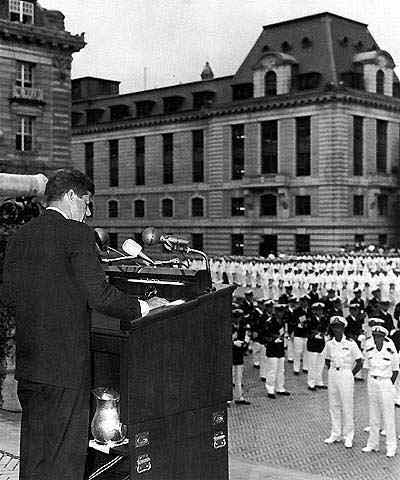
In the photo below JFK, President and combat veteran, was speaking to our USNA Class of 1967 during our Plebe Summer on August 1, 1963. We had reported to the Academy just a few weeks earlier on June 26, thus beginning our four-year grind as Midshipmen. This was, of course, a necessary prelude to the careers that many would follow. Sadly, President Kennedy died just a few months later in Dallas. 


Normally I don’t do this, but a Naval Academy classmate, Bruce Wright, posted the following on FaceBook today, so I decided to share it. It pretty much sums up what many of us experienced back in 1967 and in the years that followed. It’s a bit “stream-of-consciousness” but tells the story well. 
—————————
We left home as teenagers or in our early twenties for an unknown adventure. We loved our country enough to defend it and protect it with our own lives. We said goodbye to friends and family and everything we knew. We learned the basics and then we scattered in the wind to the far corners of the Earth. We found new friends and a new family. We became brothers and sisters regardless of color, race, or creed. We had plenty of good times, and plenty of bad times. We didn’t get enough sleep. We smoked and drank too much. We picked up both good and bad habits. We worked hard and played harder. We didn’t earn a great wage. We experienced the happiness of mail call and the sadness of missing important events. We didn’t know when, or even if, we were ever going to see home again. We grew up fast, and yet somehow, we never grew up at all. We fought for our freedom, as well as the freedom of others. 

Some of us saw actual combat, and some of us didn’t. Some of us saw the world, and some of us didn’t. Some of us dealt with physical warfare, most of us dealt with psychological warfare. We have seen and experienced and dealt with things that we can’t fully describe or explain, as not all of our sacrifices were physical. We participated in time-honored ceremonies and rituals with each other, strengthening our bonds and camaraderie. We counted on each other to get our job done and sometimes to survive it at all. We have dealt with victory and tragedy. We have celebrated and mourned. We lost a few along the way. When our adventure was over, some of us went back home, some of us started somewhere new, and some of us never came home at all. We have told amazing and hilarious stories of our exploits and adventures. 
A bunch of us: Navy and Marine helicopter pilots
We share an unspoken bond with each other, that most people don’t experience, and few will understand. We speak highly of our own branch of service and poke fun at the other branches. We know, however, that, if needed, we will be there for our brothers and sisters and stand together as one, in a heartbeat. Being a Veteran is something that had to be earned, and it can never be taken away. It has no monetary value, but at the same time, it is a priceless gift. People see a Veteran and they thank them for their service. When we see each other, we give that little upwards head nod, or a slight smile, knowing that we have shared and experienced things that most people have not. 

So, from myself to the rest of the veterans out there, I commend and thank you for all that you have done and sacrificed for your country. Try to remember the good times and make peace with the bad times. Share your stories. But most importantly, stand tall and proud, for you have earned the right to be called a Veteran. I’m a VETERAN! If you are a Veteran, please Stand Tall and Proud.
—————————————
And let me add just a thought: to all the veterans who read Bruce’s words, be thankful that God gave you the opportunity to serve others. You and I survived, but that was God’s doing, not ours. But through it all, we were willing to do as Jesus reminded us: “Greater love has no man than this, that a man lay down his life for his friends” [Jn 15:13]. When you come right down to it, that’s what we were all willing to do. Blessings and God’s Peace.


Friday, October 28, 2022

Snippets of Sad News

Every so often, as I scan the daily news, I’m reminded of how much sadness there is in the world. Some of it is expected; for example, the death of a celebrity who has lived a long life. It’s saddest perhaps for family and close friends left behind, and I suppose for loyal, diehard fans, but for most of us it’s just another story touched with nostalgia, one that also reminds us of our own mortality. Other sad stories make us scratch our heads in wonder, as we try to fathom the motives that lead people to do strange and seemingly inexplicable things. I like to understand the motives of others, but today, although motives are often veiled, we can sense the presence of real evil. And some stories are sad for only a few, while others publicly celebrate the same news. 

Here are just a few stories that popped up on my iPad today, stories that generated sadness among some and other emotions in the hearts and minds of others.

Catholic Voters in Swing States. Here’s a story that generated sadness among some of my Catholic friends who reside on the political left. In a poll conducted by the Trafalgar Group in mid-October, Catholics in the key swing states of Arizona, Florida, Georgia, Nevada, Ohio, and Pennsylvania overwhelmingly rejected President Biden. The president’s average disapproval rating among Catholics in these states was 62.2%, while his approval rating was a mere 35.4%. For Democrats, who must ride his coattails even though they’d prefer to ride almost anything else, this news was especially troubling. I called one of my more liberal pals to get his reaction, and he simply asked, “Don’t they realize the president is a devout Catholic?” Perhaps, I suggested, he might want to listen to the American bishops who have come out strongly against the president for his rejection of almost the entire range of Catholic moral teaching. Maybe the results of this poll show us that many Catholics have listened to and agree with our bishops. I must admit, the news didn’t sadden me.

The Funeral of a Parishioner. Late this morning I assisted our pastor at the funeral of a parishioner, a woman named Carol Buyarski. It was a beautiful funeral Mass, attended by a large gathering of family and friends. There’s always an element of sadness when a loved one dies, the sadness of grief and separation, but never a sadness resulting from death itself. As Christians we believe our lives here on earth are simply the beginning. As T. S. Eliot once wrote, “In my end is my beginning,” a phrase I believe he borrowed from Mary, Queen of Scots. But whatever it’s source, it’s a wonderful phrase because it’s true. For the faithful, the end of this life is merely the beginning of something wonderfully eternal, a life in the Presence of God. As St. Paul reminds us: "What no eye has seen, nor ear heard, nor the heart of man conceived, what God has prepared for those who love him” [1 Cor 2:9]. And so, at the funeral I found myself listening to others talk about Carol, this good woman who brought so much good and joy and peace to the lives of others. I thought how good it was that she had lived her 78 years well. But then I recalled that she and I were both born on September 13, 1944, a remarkable coincidence. Of course, I don’t believe in coincidence. Anyway, this brought to mind something my mother said to me years ago. I was probably 8 or 9 years old and we were attending the Irish wake of a relative, one of those older relatives whom I really didn’t know well. Looking at the old man lying peacefully in his casket, I turned to my mom and asked “What did he die of?” Her response meant little to me at the time, but I never forgot it. “Oh, I suppose he just died of old age.” You guessed it, he was 78. Now that’s sad.

Jerry Lee Lewis Dies Today at 87. Okay, I know, you don’t have to remind me, Jerry Lee Lewis was by no means a paragon of virtue. I believe he was married seven times and one of those marriages, his third, was to a cousin who was, as I recall, all of 13 years old. And throughout it all, drugs, booze, and infidelity were a major part of his life. Yes, indeed, Jerry Lee was a sinner, and a very public one. But if you’re a fan of true 50’s rock ‘n roll, you know full well you loved Jerry Lee’s music. Maybe I should say you loved his entire performance, something that was outrageously unique and virtually unrepeatable. At the age of maybe fifteen I managed to attend a “show” (that’s what we called concerts back then) that included Jerry Lee Lewis. It was a rollicking, absolutely amazing show. No one could imagine — I certainly couldn’t — that anyone could give us that kind of brash, wild and crazy experience. Everyone in the theater was on their feet, totally involved in the music, as Jerry Lee sang and pounded out “Whole Lotta Shakin’ Goin’ On” followed by “Great Balls of Fire.” He had managed to blend Gospel, rockabilly, Country-Western and ended up giving us the purist form of rock ‘n roll. Later in life he redefined himself as a Country-Western star. As for his lifestyle, yes, he was a sinner, but unlike most celebrities he admitted it. One thing you can say about Jerry Lee Lewis: he was no hypocrite. He also believed in Jesus Christ as his Lord and Savior, and I hope spent some repenting time with his Lord during his last days. As Sr. Francis Jane, O.P. once told our eighth-grade class, “If you get there, you might be surprised whom you will meet in heaven.” I am saddened at Jerry Lee Lewis’ death because he will no longer play that piano as no one else ever has. May he Rest In Peace. 

Wednesday, October 26, 2022

OK, Here's What I'm Reading

In recent weeks I've had several of my Bible Study participants ask me what I'm currently reading. I'm not sure why they'd want to know; after all, my reading habits are likely no more interesting than anyone else's. Anyway, my tastes in books can also be a bit off-putting to some folks. For example, I rarely read modern novels, and by "modern" I mean anything written during the past 30 or 40 years. There are exceptions; indeed, one of the books I'm currently reading would certainly be labeled a modern novel, but I was introduced to other works by the same author and enjoyed them. The reason I avoid most modern fiction? There's far too much of it and I have so little time to sort out the bad from the not-so-bad. There's really very little good. I hate to waste precious time (and inflationary cash) on something not worth reading, so it's safer to wait several decades and ask a few simple questions:

  • Is it still in print? This isn't always a good benchmark, but it does limit the field. Multiple printings tell us little about the critics, but a lot about the general public; and I trust the latter more than the former. The public isn't always right, but it's more right than most critics.
  • The above leads to another set of criteria: Who likes it and who doesn't? Is it on the "must read" list of someone I know and trust? Or is it on the "hated list" of someone whose opinions I regularly dismiss as foolish? A "yes" answer to both questions is a definite plus.
  • Is it a seminal work, one of those truly influential books that has changed the world? Its impact might have been horribly negative, like Mein Kampf or Das Kapital, or very positive, like Augustine's Confessions or Russell Kirk's The Conservative Mind. I read them all, since ignoring them leaves one ill-equipped to cope with their consequences.
  • Finally, is it a book I will simply enjoy? For example, Flannery O'Connor's letters, published posthumously as The Habit of Being is one of those books to which I often return. O'Connor was always interesting and usually quite funny. I also enjoy the works of Jane Austen, Gene Wolfe, Alice Thomas Ellis, G. K. Chesterton, V. S. Naipaul, P. G. Wodehouse, Evelyn Waugh, Mark Helprin, Maurice Baring, and so many others.
At any given time, I'm usually reading more than one book, all stacked neatly on the table next to my comfortable, squishy easy chair in our living room. Diane thinks this is weird, but it works for me. I simply choose the book that seems to suit my current mood, something that changes often enough. If a book is interesting and well-written, I have no trouble picking up where I left off when I last put it down. And so, here are a few of the books I've recently read or am reading now. 

Winter's Tale, by Mark Helprin (1983). Helprin is a wonderful writer, and I often find myself checking to see what he's published lately. I've read many of his works, novels and short stories -- I especially liked A Soldier of the Great War -- but somehow missed this novel, one of his earlier works. A remarkable love story, touched with fantasy, but for me utterly believable. 

The Seven Storey Mountain, by Thomas Merton (1948). I first read this book when I was a freshman at Georgetown, but that was 60 years ago. As I recall I found it too personal and too spiritual. But what did I expect? After all, it's an autobiography of a man who becomes a Trappist monk. Personal and spiritual? Well, yeah! Right now, I'm smack dab in the middle of it and truly enjoying it. It takes me back to the Church and the world I experienced in my youth. And reading Merton's life, I encounter pieces of my own and my struggles to make my way past many of the same obstacles that confronted the author. Interesting that I didn't recognize any of this during my first reading when I was 18. As college freshmen we were sure we were oh so smart, when in truth we were amazingly stupid.

The Stripping of the Altars 1400-1580, by Eamon Duffy (1992). This absolutely fascinating (and very long) book is another through which I'm now making my way. It's one of those books that has changed how many people, both Catholics and Protestants, understand the role the Catholic Church played in the lives of the English people before and during the early years of Reformation. Duffy focuses on a particular period (1400-1580) and demonstrates that late medieval Catholicism remained the religion of the people throughout. He also writes convincingly of the means by which this truth has been grossly distorted. 

Lost in the Cosmos: The Last Self-Help Book, by Walker Percy (1983). With this book, Percy, a medical doctor and successful novelist, offered us a work of non-fiction designed to help you and me discover, as he phrased it, "who you are not and even (an outside chance) who you are." Percy looks intently, and with his own brand of humor, at man and the universe in which God has placed him and tries to make sense of it all by providing us with a cosmic survival guide. I just finished reading the book, enjoyed it immensely, but in truth preferred Percy's novels, especially The Moviegoer and The Second Coming.

The Madness of Crowds: Gender, Race and Identity by Douglas Murray (2019). If you're sick and tired of all the wokeness that is continuously streamed into your life and that of your family, then this is the book for you. Douglas Murray, a British political commentator and an editor at The Spectator, takes a hard look at the plague of identity politics, its Marxist roots, and its manifestations regarding race, sexuality, and gender. He also examines how technology and the online culture it has spawned has negatively altered human relationships. It's a wonderfully researched and well-written book. You might consider giving copies to grown children and grandchildren, assuming they can still read and have the attention span necessary to make their way through almost 300 pages.

Here are two others on the subject of Sacred Scripture, books that tell us much about modern Scriptural scholarship.

The Case for Jesus (2016), by Brant Petre. This little book should be read by all Christians who have become confused thanks to the work and commentary of so many of today's New Testament scholars. Brant Petre, a Catholic Scriptural scholar, lays bare the false assumptions and conclusions of the form critics who unfortunately have led so many Christians astray and been the cause much lost faith. Focusing on the Gospels, Petre digs deeply into the original manuscripts, as well as the works of Early Church Fathers, proving, as the Church has always taught, that the Gospels were actually written by Matthew, Mark, Luke, and John and relate the truth about the life and public ministry of our Lord, Jesus Christ. Although written for the layperson, Petre provides detailed references and documentation for anyone who desires to pursue the subject in greater depth.

The Decline and Fall of Sacred Scripture (2021), by Scott Hahn & Benjamin Wiker. Here we have another wonderful book focusing on the truth of Sacred Scripture and the attempts by many scholars to turn the Bible into just another book of tall tales. The authors provide an overview of the degradation of Scriptural scholarship over the centuries, and its negative effects on the faith of millions of Christians. From Marsilius and Ockham in the late medieval period, through the Reformation, and into our modern times, we are shown how Sacred Scripture has been radically attacked by generations of scholars who, in the words of one reviewer, left "an incoherent mess" in their wake. 

Doors in the Walls of the World, by Peter Kreeft (2018). I've been reading Peter Kreeft for decades and he never disappoints. This little book is no exception. Its subtitle, Signs of Transcendence in the Human Story, is a perfect description of its content. Although barely 125 pages, it took me several evenings to make my way through it. Almost every page left me with something to think about more deeply and I found myself questioning my own habits of thought. Here's just one example, from p. 43: 

"Divine design is either nothing or everything; and if it is everything, then it extends even to randomness and apparent meaninglessness, to the puzzling presence of evil and the absence of scientific proofs. The hypothesis of faith may not be provable, but it is believable. The doors in the walls of the world may be only loose threads, but they are there."

Because I've long accepted God's omniscience and omnipotence, I had never believed in mere coincidence. Here Kreeft extends this to include a rational disbelief in both randomness and meaninglessness. It's a wonderful book.

And that's enough. Blessings and God's peace...


Thursday, October 20, 2022

Evangelization and Truth

In my last post I suggested that perhaps it's time for our bishops to act and defend the Church's teachings, especially when these teachings are dismissed by nominally Catholic politicians as irrelevant or just plain wrong. I see this as part of the bishops' responsibility for evangelization. In today's post, I hope to extend that seme responsibility to all of the faithful, to you and to me, as we make our journey through the small slice of time and space in which God has placed us. In our parish Bible Study, we're currently studying the opening chapters of the Acts of the Apostles, so I thought the example of St. Peter would provide us with a good starting point.

In chapter four of the Acts of the Apostles, we find a Spirit-filled Peter standing before the local authorities, with the young apostle, John, at his side. The two apostles faced a crowd of local notables: the high priest, Caiaphas; his predecessor and father-in-law, Annas; and a collection of Jerusalem's most distinguished "leaders, elders, and scribes." This was the Sanhedrin, a kind of governing council and supreme court. Largely aristocratic, the Sanhedrin's members included representative of the most influential noble and priestly families. 

Although the Sanhedrin possessed significant power, they remained subservient to the Roman authorities. Most of these men were probably Sadducees, although the Sanhedrin also included Pharisees and others among its members. The Sadducees were responsible for maintaining the Temple and many were counted among the priests who performed the Temple sacrifices. Theologically, though, they differed greatly from most contemporary Jews, especially the Pharisees. Sadducees did not accept the immortality of the soul, rejected the idea of an afterlife and the resurrection of the dead, and did not believe in the existence of angelic or spiritual beings. As you might expect, they tried to make this life as comfortable as possible. They would have agreed with the old Schlitz beer commercials of the 1970s: "You only go around once...grab all the gusto." We can understand, then, why they did not appreciate anyone who threatened to upset the status quo, especially their relationship with the Romans.
Why were Peter and John standing there facing these men? The drama began the previous day when Peter and John passed through the Temple gate and encountered a beggar, a man crippled from birth. Peter said to him:
“I have neither silver nor gold, but what I do have I give you: in the name of Jesus Christ the Nazorean, rise and walk” [Acts 3:6].
The man was instantly and completely healed. Peter had then gone on to proclaim the truth about Jesus Christ to the Jewish crowds gathered within the Temple precincts at Solomon's Portico. His preaching led to a remarkable result:
"...many of those who heard the word came to believe and the number of men grew to about five thousand" [Acts 4:4].

This, of course, was too much for the Jewish authorities who had the two apostles arrested. After a night in custody, Peter and John were brought before the Sanhedrin for questioning. They were asked a single question:

“By what power or by what name have you done this?” [Acts 4:7]

Inspired by the Spirit, Peter gave the perfect response, a brief but remarkable sermon:

“Leaders of the people and elders: If we are being examined today about a good deed done to a cripple, namely, by what means he was saved, then all of you and all the people of Israel should know that it was in the name of Jesus Christ the Nazorean whom you crucified, whom God raised from the dead; in his name this man stands before you healed.

He [Jesus] is ‘the stone rejected by you, the builders, which has become the cornerstone.’ There is no salvation through anyone else, nor is there any other name under heaven given to the human race by which we are to be saved”
[Acts 4:8-12].

Here we have a true homiletic gem. Within it we find a statement that offers us one of Christianity's absolute truths. Reread Peter's last sentence in which he provides the perfect declaration of salvation that comes to the human race only through Jesus Christ.

In Peter's words we encounter the universality of the Christian message, a message we are called to proclaim to every human being. Just consider Jesus' final words to the disciples before His Ascension to the Father:

“All power in heaven and on earth has been given to me. Go, therefore, and make disciples of all nations, baptizing them in the name of the Father, and of the Son, and of the holy Spirit, teaching them to observe all that I have commanded you. And behold, I am with you always, until the end of the age” [Mt 28:18-20].

This is a command by Jesus, a three-fold command: (1) make disciples of all nations; (2) baptize them; and (3) teach them. And it's followed by a promise: "I am with you always." If we are called to "make disciples of all nations," Christianity, then, is truly catholic. With these words, we realize God desires all to be saved through Jesus Christ [Acts 2:21; 1 Tim 2:3-4; 2 Pt 3:9] Although "for God all things are possible" [Mt 19:26], He instructs us to help bring this about through sacramental Baptism, supported by the continued presence of Christ's Holy Spirit in the teaching authority -- the Magisterium -- of the Church.

We are called to follow Peter's example and always proclaim the truth to those who do not believe. The problem, however, is that so many Christians, including many Catholics, seem either to reject this command of Jesus or simply fear to express the truth. Too many of us have grown a bit wobbly when it comes to evangelizing in truth. We either water down the Church's teaching or fall prey to a kind of syncretism in which all religions are considered okay. Once, while teaching a course on World Religions to a class of Catholic catechists and teachers, I was surprised when many thought there was no need to evangelize Jews, Muslims, Buddhists, or others who reject our Christian faith. As one high school teacher said, "As long as they follow their religion's teachings, I'm sure they'll be okay with God." Well, that may be true, but that's God's call, not ours. We're called to obey Him, to evangelize, to follow the example of the apostles. We must always remember: you and I cannot convert anyone; we simply plant seeds, or water and fertilize the seeds others have planted. God, and only God, brings all to fruition.

Like the apostles, we Christians have been commissioned to proclaim the Good News of Jesus Christ to the world, the entire world. This doesn't mean we do it arrogantly or haughtily. Not at all. We are commanded to do all this with love, but to love without forsaking the truth. As Peter told the beggar: "...what I do have I give you." We must do the same, give whatever we have, however the Spirit inspires and equips us. We must also live the truth of Jesus Christ so others will recognize Jesus Christ in us, just as we see Jesus Christ in them. And in doing so, we must also be ready to stand for the truth even at the cost of our lives, these days an increasingly likely possibility.


Wednesday, October 19, 2022

It’s Time for Our Bishops to Act

The other day, during an appearance on MSNBC’s “Morning Joe” program, a senior White House official, Keisha Lance Bottoms (former mayor of Atlanta, but now the director of the White House Office of Public Engagement), was asked about the extent of President Biden’s support for abortion. The program’s co-host, Willie Geist, asked Bottoms, “Does the President, does White House, believe there should be abortion available without limits in the country?” As you might expect from this White House, Bottoms did not provide a clear “Yes” or “No” response, but instead said the following:
“What the president believes is that there should be a fundamental right for a woman to choose what to do with her own body and the President has said this time and time again, that there are basic, fundamental rights, access to health care, this access to health care includes women across this country. And what we expect to see is that, especially college-aged women, women who’ve had to face these very difficult choices will be reminded of this, especially during this season. And it’s something that we can’t ever put too far behind us because, again, we know that elections matter and we know that congressional Republicans want to take us back. I’m 52 years old. In my lifetime, I’ve always known that a woman has a right to make decisions about her own body and what we are seeing being put forth by congressional Republicans right now takes us back more than 50 years.”
It would seem her response confused even the folks at MSNBC; and Geist, trying to elicit a more definitive answer from Bottoms, asked: “So, does that mean the President supports abortion at any time during the pregnancy, whether it’s 3 weeks or 30 weeks?” To this, Bottoms replied: 
“What the President has said very publicly is that he supports a woman’s right to choose. I’ve never heard the President give a timeframe on that. But he has said that he believes that a woman has a fundamental right to make decisions about her own body and her healthcare choices.”
I’m pretty sure this is White-House-Speak for a “Yes” answer, that the administration is telling us President Biden supports abortion at any time during a woman’s pregnancy. Ms. Bottoms certainly didn't say otherwise.

The next question, then, should be asked of the Catholic Bishops of the United States. If President Biden, who frequently declares himself to be a "devout Catholic," absolutely denies the Church’s consistent magisterial teaching on life and a host of other moral issues, should he be allowed to partake in the Church’s sacramental life? Just consider the scandal the President causes as he publicly attacks the Church by denying its teachings and, as one parishioner remarked the other day, “…just gets away with it. Where are our bishops?”

Yes, indeed, where are our bishops? One priest told me they likely hesitate to get involved in what they view as political issues, something that might influence elections. I think my response surprised him. I simply said the Church has always taught that the goal of evangelization is to ensure the Good News of Jesus Christ reaches individuals and also penetrates and transforms cultures, highlighting and lifting up those aspects of culture relevant to the Gospel. 

Too often today we live our Christianity strictly as individuals. Even in societies with large and majority Christian populations, Christian influence on laws and institutions, on education, science, entertainment, sports, and the arts is lacking or completely absent. Some say that this is fine and in keeping with our Constitutional freedoms. And I agree, at least partially. Our Constitution guarantees our religious freedom, prohibiting the government from establishing a state religion, but also prohibiting that same government from "prohibiting the free exercise" of religion by the people. If that's the case, and it is, we can certainly exercise our Church's primary task: evangelization. As Jesus commanded the disciples right before He ascended to the Father:
"Go, therefore, and make disciples of all nations, baptizing them in the name of the Father, and of the Son, and of the holy Spirit, teaching them to observe all that I have commanded you. And behold, I am with you always, until the end of the age” [Mt 28:19-20].
As Pope St. Paul VI reminded us:
“…The split between the Gospel and culture is without a doubt the drama of our time, just as it was of other times. Therefore, every effort must be made to ensure a full evangelization of culture, or more correctly of cultures. They have to be regenerated by an encounter with the Gospel. But this encounter will not take place if the Gospel is not proclaimed” [Evangelii Nuntiandi, 20]
This teaching was echoed by Pope St. John Paul II who wrote: 
“A faith that does not affect a person’s culture is a faith 'not fully embraced, not entirely thought out, not faithfully lived.'” [Christifidelis Laici, 59]
It’s time to act and restore a culture of life in our nation and in the world. We each have a part to play in this drama, but our bishops should lead the way and set the example for the faithful.


Tuesday, October 18, 2022

Homily: Feast, St. Luke, Evangelist

I didn't actually preach this homily today, since the celebrant decided to preach, which is certainly fine with me. But since I had prepared a homily for St. Luke's feast day, I thought I might as well post it here.

____________________________

Readings: 2 Tim 4:10-17b; Psalm 145; Luke 10:1-9  

____________________________

Today we celebrate the feast of St. Luke, evangelist and companion of Paul – author of the Gospel that bears his name and also the author of Acts of the Apostles. Of all those early Christians, those we read about in the Gospels and in Acts, Luke is the one I’d most enjoy meeting and spending some time with.

He was a physician – “beloved physician” Paul calls him – and therefore like Paul an educated man – something that’s evident by the quality of his writing. Most scholars believe he was a Greek and a Gentile, but whatever his background, it’s apparent Luke was in the first wave of Gentile converts to the Faith. 

His Gospel was aimed at the Gentiles, those unfamiliar with Jewish Law and custom. In other words, he wrote for folks like you and me, so his approach is quite different from the other Synoptic gospels. For one thing, he rarely quotes the Old Testament, and never refers to Jesus with the Hebrew title of Rabbi, but always with the Greek title of Master. Unlike Matthew, Luke doesn’t trace Jesus’ genealogy from Abraham (the founder of the Jewish race) but from Adam (the ‘founder’ of the human race). 

Luke gives women a more prominent place in his Gospel. The nativity and infancy story, much more extensive in Luke’s Gospel, is told from Mary's point of view. And it’s through Luke that we know about Elizabeth, Anna, the widow of Naim, and the woman who anointed Jesus’ feet.

Luke also gives us some of the most beautiful parables, for example, the Prodigal Son; and only Luke relates the parable about the non-Jew, the Good Samaritan. Without Luke we wouldn’t have the road to Emmaus or those three great canticles -- Mary’s Magnificat, Zechariah’s Benedictus, and Simeon’s Nunc Dimittis – canticles we pray every day in the Liturgy of the Hours. But what I like most about Luke’s Gospel is the emphasis he places on prayer and praise, and the mercy and goodness of God. He describes Jesus praying at all key moments of his life.

What sort of man was Luke? Well, in today’s first reading we get a glimpse of the real Luke. Writing to Timothy, Paul describes how he’s been abandoned by co-workers and friends except for two key companions.

Onesiphores, had traveled far and found Paul, seemingly without help from the Christians in Rome. And Luke who had remained with Paul, endured the imprisonment with him and cared for him. It would seem Luke’s friendship was important to Paul. Cut off from his own community, perhaps unappreciated by the Roman Christians, Paul faced certain execution, and was unable to move about and preach the Good News. We sense his loneliness. 

Luke, trying to complete his texts, found himself attending to Paul who was probably held in some sort of house confinement or possibly even imprisoned. We can only imagine what this friendship might have cost Luke personally. He probably wondered whether he’d also be caught up in Rome’s campaign to destroy the Christian message. But his loving care remained authentic, and he stayed beside his friend.

True friendship is a uniquely human experience and is often most clearly shown by the small acts of care and attention one person shows for his or her friend. It’s also a simple thing, something in which even a child can participate. And yet it has a divine element as well. Listen, again, to these words from today’s psalm: 

“Your friends make known, O Lord, the glorious splendor of your Kingdom” [Ps 145:12].

Yes, the compassion and love that are the signs of friendship are also signs of the Kingdom of God, signs of God’s grace. Knowledge of the Kingdom is made possible by experiencing the quality of love that a friend bestows.

The Gospel, too, invites this insight. Friendship brings a Spirit of Peace with it; and where the Spirit of Peace is found, one discovers true hospitality. It is, then, in the heart of true friendship that the lost, the lonely, the abandoned, the imprisoned, the hurting, and the broken find encouragement and are made whole and healthy and strong again.

Saint Luke is the patron of physicians, not just because he was one himself, but because he was a healer of the both the heart and the soul. He was a true friend to Paul, who no doubt was in great need of consolation. 

But St. Luke is also recognized as a friend of the poor and the outcast, because he recorded how Jesus took pains to care for the least, the most rejected, the impoverished. At the Last Supper, Jesus set the example for all of us saying, “I call you friends,” because a friend will lay down his life for the other.

Luke, recognizing the divine character of this most human of relationships, followed the Lord’s example. Perhaps, then, we should honor St. Luke as the patron saint of friendship.


Friday, September 30, 2022

Pope Francis, Giorgia Meloni, and Me

Every so often, probably more often than I would like, someone will ask me, "Deacon, what do you think of Pope Francis?" The questions come from across the entire spectrum of Catholic opinion. But most who ask me about the pope are simply looking for direction and understanding. Occasionally, though, I suspect I am being baited by those few who intend to argue a point, whether theological, ideological, or simply political. They hope to hear me state either my total agreement with the Holy Father or my complete disagreement. I always disappoint them because I'm never in complete agreement or disagreement with any mere man or woman, even the pope. I try to weigh what others say against what I know to be the truth, particularly the revealed truth given to us by Jesus Christ and taught to us by the Church He founded. 

Do I agree with everything Pope Francis has said and written? Probably not, but this might well be the result of a lack of understanding on my part. This came to mind today when I read some of the comments made by the newly elected Prime Minister of Italy, Giorgia Meloni. Many on the left, including our president, have accused her of fascist sympathies. This, of course, is completely absurd and demonstrates either their ignorance -- they don't know what fascism is -- or their willful dishonesty by accusing their enemies of their own ideological beliefs, a common tactic of the left.

Here's how the new prime minister describes her beliefs that center on the family, her Christian (Catholic) faith, her patriotism:

"Why is the family so frightening?  There is a single answer to all these questions. Because it defines us because it is our identity. Because everything that defines us is an identity, and for those who would like us to no longer have an identity and simply be perfect consumer slaves.”

Then, describing those she calls "financial speculators," she says: 

“They attack national identity, religious identity; attack gender identity and family identity. I can’t define myself as Italian, Christian, woman, mother. Now I must be citizen X, gender X, parent one, parent two. I must be a number because when I’m only a number, when I no longer have an identity or roots, then I will be the perfect slave at the mercy of financial speculators.

We will defend the value of the human being -- every single human being.”

If these are the words of a fascist, then I guess I'm one too. Of course, what she said really represents the core beliefs of a Christian society. And I especially liked what she had to say about herself, a self-appraisal summed up in a few choice words:

“I am Giorgia, I am a woman, I am Italian, I am Christian. You can’t take this away from me!”

As you might expect, such a simple, straightforward self-description drives the woke crowd in Washington and Brussels to distraction. She actually cherishes her unique identity: the name she received at her Baptism; the sex with which God blessed her at conception; the nation and culture in which she was born and raised; and the Christian faith that rules her life. As she stated, "You can't take this away from me" because they are all gifts from family, from God, and from a culture.

In her autobiography Giorgia Meloni waxed eloquently on the evil of political correctness:

“You see, political correctness is a shockwave, a cancel culture that tries to upset and remove every single beautiful, honorable, and human thing that our civilization has developed...It is a nihilistic wind of unprecedented ugliness that tries to homogenize everything in the name of One World. In short, political correctness – the Gospel that a stateless and rootless elite wants to impose – is the greatest threat to the founding value of identities.”

I've included all this just to give you a sense of who Giorgia Meloni truly is, so you won't be led astray by the woke, mainstream media, a media that truly despises this woman. But now let's look at what she has said about her Catholic faith and Pope Francis. The following brief comments are sufficient. 

She said this about Pope Francis:

“Maybe it’s age, maybe the memories, but even though I’m Catholic and I’ve never allowed myself to criticize a pope, I admit that I haven’t always understood Pope Francis...Sometimes I feel like a lost sheep, and I hope one day to have the privilege of being able to talk to him, because I’m sure that his big eyes and his direct words can give meaning to the things I don’t understand.”

When I read those words, I almost fell out of my chair, because they reflect my own sentiments almost exactly. I have found so much that is good and valuable in what the pope has said and written, and yet, like Giorgia Meloni, there is much that I simply do not understand. I, too, will not openly criticize the Holy Father, but perhaps in an upcoming post I might share some of my misunderstandings. In the meantime, all of us should pray daily for Pope Francis, the Vicar of Christ, and successor of St. Peter. And pray, too, for Giorgia Meloni. I suspect she might need a lot of God's help as she tries to drain the Roman swamp.

Tuesday, September 27, 2022

Homily: Memorial of St. Vincent de Paul

Readings:  1 Cor 1:26-31; Psalm 112; Mt 9:35-38

A wonderful day today, the memorial of our parish’s patron saint, St. Vincent de Paul, who devoted his life and ministry to serving the poor and the forgotten, and had a lasting impact throughout the world. How blessed we are that he intercedes for the good of our parish and the needs of our community.

Back in May of 1985, on a business trip to Europe, I spent a weekend in Paris. It wasn’t planned as a pilgrimage, but it kind of turned into one. I visited Notre Dame Cathedral and Sacre-Coeur, but I also went to the Lazarists Mission where the remains of St. Vincent de Paul are interred. His remains are inside a waxy effigy that’s not easy to find, but I’d been tipped off in advance and so managed to find the saint.

As I spent a few minutes in prayer, I noticed the small crucifix in his hands. Later I was told by a friend that Vincent was called to the bedside of King Louis XIII in May 1643 and held that crucifix before the eyes of the dying king. That this man, so devoted to the poor and dispossessed, should have been called to the bedside of the king tells us much of the effect Vincent had on every element of French society. St. Vincent’s deep love for the poor was not so exclusive that he couldn’t assist a king in his dying hour. As St. Paul reminded us in today's reading:

“God chose the weak of the world to shame the strong, and God chose the lowly and despised of the world, those who count for nothing, to reduce to nothing those who are something…” [1 Cor 1:27-28]

You can be sure Vincent reminded the dying king that he would leave this world powerless and in poverty, and yet would still be showered by the Father’s love. After all, at the very heart of the Gospel are those words from John, “For God so loved the world that He gave His only Son…” [Jn 3:16] -- precious words that reveal to us the cost to the Father’s heart: ‘He gave…”

This shouldn’t surprise us, here in a parish dedicated to this remarkable saint, who mirrored God’s loving care for those forgotten by the world. We, then, are called to be a community of love, a work in progress, with a heart that strives to emulate Vincent and serve all who come to us in need.

The love in St. Vincent’s heart, and I hope in ours as well, is the same love of God Paul told the Romans “has been poured out into our hearts through the Holy Spirit that has been given to us” [Rom 5:5]. Yes, indeed, it’s the Holy Spirit who works through us to do God’s work in the world. And that’s what we must always remember…

As the Psalmist reminds us: Non nobis, Domine, non nobis…Not to us, Lord, not to us, but to your name give glory. It’s God’s work, not ours. It’s for God’s glory, not ours. You and I must draw our inspiration and strength, just as St. Vincent did, from Jesus Christ crucified, from Jesus whose Good News broke down the barriers that separate us, making peace by the Blood of His Cross.

I have a feeling that St. Vincent, were he here with us today, would just say one word to us: “More!” Not more for ourselves, but more for the poor, the forgotten of the world…more justice for them, more time for them, food for the hungry, healing for the suffering, more love. Because St. Vincent recognized Jesus’ presence in the poor, he would ask us not only to do more, but also to do all with the gentleness and love of Jesus.

He was motivated, not by politics or sociology or any human cause, but by the love he had for the person of Jesus Christ. As St. Vincent often said, “Nothing pleases me but in Jesus Christ.”

And like Jesus in today’s Gospel passage from Matthew, St. Vincent was always on the move, always sharing God’s love with those who most needed to experience it, always sharing God’s Word with those who most needed to hear it.

Jesus’ plea in the Gospel echoes through the centuries. The harvest today is even more abundant and there are certainly not enough laborers. Far too many Christians seem to believe only the clergy and religious are called to do God’s work in the world. But in truth we’re all called to serve, to serve others, and to witness to Jesus, every single one of us. As the Fathers of the Second Vatican Council instructed the laity:

“They are consecrated for the royal priesthood and the holy people, not only that they may offer spiritual sacrifice in everything they do, but also that they may witness to Christ throughout the world.”

Here the Fathers simply followed the command of Jesus who, right before His Ascension, told the disciples:

"But you will receive power when the Holy Spirit comes upon you, and you will be my witnesses in Jerusalem, throughout Judea and Samaria, and to the ends of the earth" [Acts 1:8].

Yes, indeed, Jesus calls each of us, so that through the Holy Spirit we can make disciples, and serve, and witness wherever we are, in Wildwood, in The Villages, and to the ends of the earth.


Thursday, September 22, 2022

Homily: Thursday 25th Week in Ordinary Time

Yesterday afternoon, I was asked by St. Lawrence Parish in Bushnell, Florida if I would help them by conducting a Liturgy of the Word with Communion this morning. Their pastor apparently had a commitment, so they sought out a deacon to assist. St. Lawrence is only a 30-minute drive from my home, so I was happy to help out. My homily follows:

____________________

Readings: Ecclesiastes 1:2-11; Psalm 90; Luke 9:7-9

First, believe me, it’s a joy to be here with you at St. Lawrence Parish. You might not know this, but 19 years ago, when I arrived here in the Orlando Diocese I was assigned to this parish. In those days St. Vincent de Paul was a mission church of St. Lawrence Parish, and I can remember coming here frequently to attend parish council and other meetings. But things have certainly changed, haven’t they?

I usually preach on or at least touch on the Gospel reading, but today I decided to offer a little change of pace. I decided instead to focus on our reading from the Book of Ecclesiastes, mainly because it’s a reading that’s too often avoided, and I thought you deserved better.

Let me set the stage with a little personal history.

I’ve always been interested in astronomy, and even studied it in college. I always saw it as a science where one comes closer to grasping the splendor of God’s creation as well as His awesome power.

I also spent many years as a Navy pilot, and when at sea would enjoy looking at the stars. In mid-ocean, away from the lights of civilization, the effect is remarkable. The stars are a hundred times brighter, the planets are clearly defined, and our galaxy, the Milky Way, lives up to its name. In near-total darkness you can see the entire sky from horizon to horizon, almost as if you’ve left the earth and are there in space in the midst of creation.

I recall one night particularly well. I tried to read a little Scripture each day, and I had just read the first two chapters of Ecclesiastes, which include today’s first reading. Those verses had disturbed me, as I suppose they have disturbed many people.

If we take it literally, Ecclesiastes is a depressing, almost fatalistic, book. Some call it the most depressing book in the bible, and even question why it was included in the first place. It seems to say that everything that will be has already been, that nothing is new, everything just repeats itself, again and again. Rain falls, making streams which flow into rivers and then to the ocean, only to be vaporized and return again as rain. On and on it goes. Life is just a vicious and frustrating circle. What goes around comes around.

And the author doesn’t just address nature. He also implies that human activity is equally futile, implying that working hard is a waste of time. Why bother? You’ll never really enjoy the fruits of your labor. Someone else will, someone who won’t appreciate you or your work.

The author, Qoheleth, shouts to the world: All that we do is vanity.

As I said, when we take this at face value, it can sound very depressing. And I’ll admit, it depressed me that night at sea 30 years ago.

Then I went up on deck and looked up at the stars. How long had they been there? Billions of years. The distances are so vast we can’t begin to comprehend them, except abstractly through mathematics. How powerful and eternal is the God who made it all! And how small and insignificant are we.

As all these thoughts went through my mind, I recalled the words I had just read moments before:

“What has been, that will be; what has been done, that will be done. Nothing is new under the sun. Even the thing of which we say, “See, this is new!” has already existed in the ages that preceded us. There is no remembrance of the men of old; nor of those to come will there be any remembrance among those who come after them” [Eccl 1:9-11].

Suddenly I understood what Qoheleth meant by “All things are vanity” [Eccl 1:2] – or a more accurate translation of the Hebrew, “all things are mist (or breath).” In a sense, he meant the same thing that St. Thomas Aquinas meant when, near the end of his life, he looked back on his remarkable work and said, “It is all straw.”

Ecclesiastes is now among my favorite books of the Old Testament. It’s a very unique book, really the Bible’s only book of philosophy, for it is based solely on human reason. God is silent in the book, until the very end.

The author was obviously a man of position, highly regarded for his wisdom. Indeed, his name means “teacher.” And he’s telling us that time conditions life, so no human achievements – all those “under the sun” things -- have lasting value. In the overall scheme of things, he tells us, our seemingly important human work is really futile.

Qoheleth really asks the question that the rest of sacred Scripture was written to answer: What is the purpose of life? Is there a purpose? For what we need most of all – meaning and purpose and hope in our lives – is precisely what Qoheleth questions.

This is a dangerous question because if we can’t answer it, we are left with the world’s worst news, that life is meaningless. By including Ecclesiastes in Sacred Scripture first the Jewish rabbis and then the Church showed tremendous confidence in their ability to provide a real answer.

For the Jews, the answer was trust and hope, trust in God’s faithfulness to His Covenant and hope in the promise of a Messiah. For the Church, the answer isn’t the hope of a Messiah, but His reality in the person of Jesus Christ.

And so, instead of the worst news, we have the Good News; we have the Gospel of Jesus Christ, and what a positive answer this is!

Jesus, the eternal, creative Word of God, He who created this immeasurable, incomprehensible universe, actually became one of us to show His infinite love for us.  From Jesus we learn there actually is human work that’s not “under the sun” – human work that’s truly “out of this world” – the work of building the Kingdom of Heaven.

We’re not here just to live from day to day, filling our stomachs and our bank accounts, until we die and disappear from human memory. No, we’re here to build up the mystical Body of Christ, the kingdom of loving souls, and death is not the end, but just the beginning.

Secondly, vanity and despair are not the meaning of life. Love is the meaning of life. God created us out of love because love is His very nature. And He asks us to return that love to Him and share it with each other.

We discover later that Qoheleth recognizes this, because at the very end of his book, he tells us:

“The last word, when all is heard: Fear God and keep his commandments, for this concerns all humankind; because God will bring to judgment every work, with all its hidden qualities, whether good or bad" [Eccl 12:13-14].

Qoheleth exposes the God-shaped hole in the human heart. It’s a hole that can’t be filled by anything in the world, for nothing material is great enough to fill that emptiness. Only one thing can fill it, and it isn’t a thing; it’s a Person: Jesus Christ, who came to conquer death and evil. The Book of Ecclesiastes asks the question, and Jesus Christ is the answer.

In St. Augustine’s famous words, “Thou hast made us for Thyself, and therefore our hearts are restless until they rest in Thee.”


Wednesday, September 21, 2022

Polls and Their Interpretation

Just a few thoughts about the midterm election polls and their misinterpretation not only by the media but also by both political parties. I’m particularly concerned with the question asked by almost all pollsters. The question might be phrased somewhat differently by each pollster, but essentially they all ask: “What’s the most important issue for you in the midterm elections?” The question might be followed by a list of several issues from recent headlines; for example: crime, border security, national defense, Communist China, immigration, education, inflation, abortion, democracy, the president, and many others.

The left has been enthused about what they believe to be a growing number of voters who name abortion as their key issue, assuming this will drive their voting decisions. And they may well be correct, but not perhaps in the way they think. Let me explain.

The other day I received a request via text message to take part in a poll. I usually ignore these requests, but for some reason I figured, what the heck! I’ll give it a try. It didn’t take long to realize this was no politically neutral poll. It was obviously created to support a particular Democrat candidate who is running for Florida Attorney General. The questions were worded in a way that denigrated conservative viewpoints and extolled the candidate’s leftist beliefs. As expected, one of the questions asked me to identify the issue most important to me as a voter. I selected “abortion” simply because it is my driving issue. I have never voted for a “pro-choice” candidate at any level and never will. In fact, when faced with two candidates who both support abortion, I have simply not voted for either. To me, anyone who supports abortion is in a state of severe moral confusion and cannot be trusted to respond correctly to any moral issue.

Anyway, my poll response got me thinking, so I sent an email to a bunch of folks whom I know are pro-life. I just asked them the same question I’d been asked and listed many of those hot issues. Of the 24 folks who responded, 21 selected “abortion.” My conclusion, then, is something the pro-abortion crowd doesn’t want to hear. Many of those who say their primary issue is abortion are probably pro-life, and not pro-choice. I suppose we’ll just have to wait until November 9th to find out.

Saturday, September 17, 2022

Islands of Hypocrisy

Before moving to Florida, Diane and I spent 25 years in a wonderful old home in Harwich Port on Cape Cod. A large 11-room home — what we liked to call “11 one-room houses hammered together over almost 200 years” — it was perfect for us and our four children. In truth, though, it evolved into a 25-year fixer-upper, probably why I got such a good deal when I bought it. But despite its shortcomings, it fulfilled all three of the real estate industry’s key priorities: location, location, and location. We were blessed to live close to the water so our children could take a two-minute walk to a beautiful, sandy beach on Nantucket Sound. Our quaint village’s downtown was also a short walk from our home, and the local library was just around the corner. Although it was a nice place to live, we could not afford to stay there in retirement, and so we made our way to Florida.

Across the water, almost due south of our former home, is Nantucket Island, made famous by Herman Melville’s brilliant 1851 novel, Moby Dick. Today, however, Nantucket is perhaps better known as the home of our younger son, Brendan, an electrician who helps the elites keep their lights on and power their Internet connections with their brokers. Nantucket is also the home — okay, one of the homes — of many so-called celebrities. For example, John Kerry, our nation’s climate czar, has a rather large home on Nantucket which he visits seasonally in his private jet. I can’t say for sure, but considering how much time he spends jetting around the world to ensure the peasants freeze in the winter and suffer heatstroke in the summer, I assume he must own the world’s only electric airplane. After all, if he owned a real jet that consumed thousands of gallons of jet fuel and polluted our upper atmosphere…well, that would be sheer hypocrisy. But as it turns out, Kerry is no stranger to hypocrisy, a trait he demonstrated  years before when he “served” on swift boats in Vietnam, shopped for medals, and then publicly denigrated has fellow veterans. If you want the truth about Kerry’s Vietnam service, read John O’Neill’s book, Unfit for Command. O’Neill, a true hero and my Naval Academy classmate, lifts the veil behind which Kerry tried to hide that truth. Today, though, Czar Kerry is a beloved Nantucket resident, a kind of town character who loves to ask the tourists such questions as, “Do you know who I am?” as he exercises head-of-the-line privileges at the local coffee shop. Always generates lots of laughs.

But enough about Nantucket. There’s another island across Nantucket Sound, this one southwest of our former home, and it’s called Martha’s Vineyard, or simply “The Vineyard” by those in the know. It too is the summer home of many of our nation’s wealthiest elites, and in this it surely eclipses Nantucket. If you’ve never visited the island, and think it might be nice to vacation there next summer, I suggest you first download the Zillow app, search for Martha’s Vineyard, and check out the home values in Edgartown or Chilmark. Then take a moment to check the summer rates for hotels and B&Bs. You’ll quickly discover that Martha’s Vineyard really isn’t for folks like you and me. The homes are both amazing and amazingly expensive, with very few valued under $1 million and many worth far more. The island is also home to those hard-working folks who must keep all those expensive homes running and beautiful. Other men and women provide the societal infrastructure that allows the wealthy to enjoy their summers. Because it’s not easy to find affordable housing, many workers commute on the ferry from mainland Cape Cod or live with others in temporary quarters provided by employers. Yes, indeed, Martha’s Vineyard is really for the wealthy elites.

Although it pretends to be an earthly paradise for the select, Martha’s Vineyard lacks one thing: undocumented migrants, those we once called illegal aliens. This is true of most wealthy communities, regardless of location. Of course, island businesses import plenty of foreign nationals every summer to staff hotels, restaurants, and landscaping firms, but they’re all sent home on Labor Day. Good heavens! If they stay any longer, they might just decide to settle in permanently. 

The difference between places like Martha’s Vineyard and the communities spread out along our southern border is striking. In the latter you will encounter thousands of migrants. Indeed, thousands cross the border every day and inundate these border communities which are far from wealthy. Many, probably most, citizens of these border cities and towns have Latin American roots and are not pleased with the local consequences of this border crisis. Interestingly, the Democrats now wonder why so many of these folks are deserting their party. 

Although the immigration policies of the federal government are the direct cause of our unsecured, open border, that same government has done little to solve its self-generated problems. Deadly drugs like fentanyl, that originate in Communist China and are processed by Mexican drug cartels, pour across the border daily and kill thousands of young Americans. The cartels also engage in widespread and highly profitable human trafficking resulting in the unspeakable degradation of so many woman and children. Closing the border would certainly help, but the Biden administration wants an open border, since it assumes these illegal immigrants will give thanks by voting for Democrats in future elections. Since many migrants come here to escape the despotic socialist governments of their native countries, I suspect they will be far more likely to vote for candidates who represent freedom rather than tyranny. The very fact that they’ve risked everything, even their lives, to get here shows they’re not stupid. And only stupid people vote against their own best interests.

Let me share a recent experience. I bought a new clothes dryer the other day and the two installers were immigrants from Venezuela. These two bright, hard-working young men told me they came here to escape the socialism that has all but destroyed their native land.  Both arrived only a couple of years ago. Both are husbands and new fathers and hope their children will grow up in freedom. I heard the same last week from a young repairman who came here from Cuba only last year. How they will vote is no mystery.

But the elites don’t understand this. To display their virtue, wealthy liberals, safely tucked away in their gated compounds and island retreats, like to describe their communities as sanctuaries open to all migrants, so long as none actually show up on their doorstep. (The Martha’s Vineyard welcome sign below is a popular yard sign on the island.)

This NIMBY attitude was clearly manifested this week when Florida’s Governor Ron DeSantis flew 50 Venezuelan migrants to Martha’s Vineyard. Unlike President Biden, who has flown tens of thousands of migrants to destinations all over the country and has consistently done so under the cover of darkness, DeSantis and the other Republican border state governors hide nothing and fly or bus migrants openly. The reaction from liberals? DeSantis must be a Nazi and Biden is obviously a saint. Oh, yes, the city of El Paso, Texas, run by Democrat politicians, is also busing migrants to New York, but about this we hear nothing but silence from the northern Democrats. Go figure! 

Remarkably, Martha’s Vineyard’s civic leaders stated they simply don’t have the resources to care for these 50 migrants. This from one of the wealthiest communities in the country, an island with thousands of empty hotel rooms now that the tourist season is over. So, what did they do? The next day the governor of Massachusetts ordered the National Guard to remove these 50 migrants and transport them to a military base on Cape Cod. Problem solved! The pesky brown folks from Venezuela are now off the island and the elites can relax knowing their beloved Vineyard will not be contaminated by actual migrants. They seemingly prefer the virtual migrants who reside on their yard signs. Racism and hypocrisy remain alive and well. 

Just to emphasize this, NBC's media outlet posted the following tweet about the Florida governor's actions:
"Florida Gov. DeSantis sending asylum-seekers to Martha's Vineyard is like 'me taking my trash out and just driving to different areas where I live and just throwing my trash there," a founding member of a foundation that helps refugees says."

Oh, yes, those trashy migrants certainly don't belong on Martha's Vineyard. As you might expect, the backlash was significant, and NBC deleted the tweet.