The occasional, often ill-considered thoughts of a Roman Catholic permanent deacon who is ever grateful to God for his existence. Despite the strangeness we encounter in this life, all the suffering we witness and endure, being is good, so good I am sometimes unable to contain my joy. Deo gratias!


Although I am an ordained deacon of the Catholic Church, the opinions expressed in this blog are my personal opinions. In offering these personal opinions I am not acting as a representative of the Church or any Church organization.

Tuesday, August 18, 2020

Joe Biden vs. Navy Lives

During my years in the Navy I had more than a few interactions with our special warfare troops, specifically our Navy SEALs and their forerunners, the Underwater Demolition Teams (UDT). The SEALs are remarkable, extremely competent warriors whom our nation calls on to carry out the kind of special operations few others can do. Years ago, as a Navy helicopter pilot, I occasionally flew small teams of SEALs out over the Pacific so they could practice their night, over-water parachute jumps. Although I would never doubt their courage, as a pilot I question anyone’s decision to jump out of a perfectly good aircraft, especially at night and over the ocean. But that’s the kind of men they’re are. They do what has to be done, even in training.
Jumping from a Perfectly Good Aircraft
Something else most people don’t know about the SEALs is their intentional avoidance of publicity. Indeed, the less said about the SEALs in the media or anywhere else, the happier they are, something that applies to most special warfare forces. Politicians probably don't understand this since publicity is something on which they thrive. 

There are, of course, important reasons for the SEALs' avoidance of media attention. Because most of the operations conducted by SEALs are highly classified, and for good reason, media coverage can jeopardize other related operations, intelligence sources, and even national security. Indeed, the very existence of SEAL Team Six (it's official name today is Naval Special Warfare Development Group or DEVGRU), considered to be the nation's premier counter-terrorism team, was actually classified. 

Media coverage can also endanger the lives of SEALs and their families. This is especially true these days when most special operations focus on terrorist groups that would love to know the units responsible for destroying their people and assets. The Department of Defense, therefore, does not release the identify of individuals, unit names, or even which special warfare forces were involved in an operation. Not only does this offer these warriors and their families some protection from retaliatory attacks, but it's also best to keep the enemy in the dark and guessing about who’s just hammered them.

At a Pentagon briefing the day after the raid that killed Osama bin Laden on May 1, 2011, a senior defense official was asked if it were a Navy SEAL team that found and killed the world’s most wanted man. The official's terse and proper response was: “Not going to comment on units or numbers.” That same evening, however, Vice President Joe Biden, in an address at a public event in D.C., told the world that Navy SEALs we’re responsible for taking out the terrorist leader. Hearing this, most folks considered it fine praise for our Navy special operators. But not the members of SEAL Team Six. They were shocked that the Vice President had named the SEALs as the operators involved in the mission. Most told their families to remove any references to them or the SEALs from social media because intelligence folks had already heard chatter and expected the terrorists would attempt some form of retaliation.

Three months later, on August 6, 2011, a CH-47 Chinook helicopter was shot down in Afghanistan. All 38 aboard died, including many members of Seal Team Six. Far too many questions stull remain about this incident, and many SEALs believe it was a well planned attack by bin Laden's allies, the Taliban, in retaliation for the earlier raid. 

Here’s a brief news video from 2012 highlighting the family of one of those SEALs killed by the Taliban.


I'm no conspiracy theorist, largely because I believe most politicians and government bureaucrats are too stupid to put together a fool-proof conspiracy. Stupidity, however, can result in errors with horrendous consequences that must be blamed on others or simply on bad luck in order to protect those actually responsible. Several books have been written about that fateful morning in Afghanistan; among them is Betrayed, written by the father of one of the SEALs who died that day. Or you can get a sense of the troubling issues by reading this brief article: Who Betrayed Navy SEAL Team Six?

I suppose we can give then Vice President Biden the benefit of the doubt and assume that, in his enthusiasm over the success of the mission, he simply wasn't aware of the long-standing protocol prohibiting the naming of units involved in such operations. Interestingly, though, for someone so thrilled about the mission's success, the Vice President later admitted he had advised President Obama, "Mr. President, my suggestion is, don't go."

One can only guess what "Uncle Joe" would say today if he ever allowed a reporter to question him about this, or really about anything else. But I suspect his response would begin with "C'mon, man..."

Saturday, August 15, 2020

Homily: Solemnity, Assumption of the Blessed Virgin Mary


Readings:  Rv 11:19a; 12:1-6a, 10ab; Psalm 45; 1 Cor 15:20-27; Lk 1:39-56
____________________
A warm welcome this morning to the members of our own Marian Servants of the Word Incarnate, who have gathered here today on this most special day, their Day of Commitment. And how fitting that we should celebrate their commitment as Marian Servants today, on the Solemnity of the Assumption. For Mary, the lowly servant of God who proclaimed the greatness of the Lord, was raised to new heights and glorified.
Yes, indeed, the Almighty has done great things for her. And now, in the eternal presence of Father, Son and Spirit, she continues to do God’s work – she lifts up the lowly, fills the hungry with good things, and challenges us all to join her in God’s work in the world.
Some years ago, Diane and I spent a week in Venice. We visited the Frari Basilica, just so we could see Titian’s amazing painting of the Assumption. It's a three-tiered painting: the Apostles below, gazing up in awe; Mary in the center, looking equally astonished, being lifted up and surrounded by angels; and above it all, the Father, with a crown for the Queen of Heaven and Earth.
Believe me, just to see that painting was worth the airfare, for it reminds us of the greatness of today’s solemnity. (I've always considered it the greatest of all paintings.)
Titian's "Assumption of the Virgin" (Click to enlarge)
The Assumption, though, wasn’t officially declared a dogma of faith until Pope Pius XII did so on November 1, 1950. Even so, this dogma of Mary’s assumption into heaven wasn’t something new; it simply confirmed long-held beliefs regarding the uniqueness of Mary.
In the Eastern Church we find homilies on the Assumption, or the “Dormition” as it’s called in the East, dating back to the fifth century. And in the Byzantine Catholic rite there’s a beautiful prayer that echoes this anticipation of resurrection:
“In giving birth you kept your virginity; in your Dormition you did not leave the world, O Mother of God, but were joined to the source of Life. You conceived the living God and, by your prayers, will deliver our souls from death.”
The Church, then, has long been celebrated Mary’s singular participation in her Son’s Resurrection by which she was taken up body and soul into heavenly glory when her earthly life had ended. For us the Assumption offers a glimpse of what we can expect of our own resurrection on the last day; for it is the destiny of all those in Christ. As St. Paul tells us in our 2nd reading, we shall be raised up from the dead with a glorified body like that of Christ Himself to experience complete and perfect union with God.
In a sense, though, Mary’s body is extraordinarily special; for Mary, conceived without sin, carried in her body the Incarnate Body of God Himself. As the Council of Ephesus confirmed, as the Mother of Jesus Christ, she is also the Mother of God. Yes, these two are joined not only as mother and Child, but also in a mystical, mysterious way, so that when her life on earth was ended, God glorified her, both body and soul.
We see the implications of this in our first reading, from the Book of Revelation, a passage chosen not for its literal meaning, for still for more than a mere convenience of words. We recognize Mary as the woman clothed with the sun, with a crown of twelve stars, and with the moon under her feet -- as one who is above all creation.
Although this passage certainly applies to the Church, still Mary is Mother many times over -- Mother of God, Mother of us all, and Mother of the Church -- the symbol of what we all should be.
Today, then, we celebrate Mary as Theotokos, the God-bearer, the Mother of God, and Our heavenly Mother. But she’s more than that. As a disciple of Jesus Christ, she’s also our sister. As the perfect disciple, she’s our model, our model of how to live the Christian life, our model of faith and hope.
Theotokos
She is among "the first-fruits" that Paul refers to, the first fruits of "all those who belong to Jesus" and who share in His triumph. We see her in this role most clearly in today's Gospel passage from Luke.
The young Mary, now Mother of the Incarnate God, is told by Gabriel of her aging relative’s pregnancy. In a humble act of love, Mary makes the difficult journey from Galilee to Judea to visit Elizabeth.
Mary, servant and first disciple, is greeted by her kinswoman, Elizabeth: “Blessed are you among women...” Not to be outdone, Elizabeth’s son, John, “leaped in her womb” at Mary’s greeting.
"Blessed are you among women..."
Mary responds in humility and acknowledges the grace that fills the whole scene: her Son is the reason for the leaping with joy.
“My soul proclaims the greatness of the lord; my spirit rejoices in God my savior” [Lk 1:46-47].
All three, Mary, Elizabeth, and John, are filled with the Holy Spirit, filled with joyful anticipation of the fulfillment of God's promise of a Savior.
How fitting for us today, that the world’s Savior was greeted first by a child in the womb, an unborn infant who responded to the Holy Spirit’s revelation of the King of Kings. Mary, then, filled with the Spirit and full of grace, the first and best of Jesus’ disciples, receives wholeheartedly the beauty and bounty of God. Through the power of the Holy Spirit we, too, experience God’s indwelling presence, his kingdom; for through the Spirit God reigns within each of us. 
Think of the scene – this encounter of two gifted women almost overwhelmed by the love of God, a scene that offers us a glimpse of how our God visits us in the ordinariness of our lives.
In this simple scene we see how God, the Presence that holds us up, remains with us in all our human activities. As Paul reminded the philosophers of Athens: 
“In Him we live and move and have our being” [Acts 17:28]. 
It’s through these daily, ordinary encounters with God, that you and I experience God’s tender mercies.
As our model of faith and hope, Mary shows us all how to live as God’s humble servant. She accepted her mission with uncompromising faith and obedience. She acted with unwavering trust because she believed God would fulfill the Word he had spoken. Her great hymn of praise echoes the song of Hannah and proclaims the favor of the Lord: God exalts the lowly and he fills the hungry.
What a gift God has given us in Mary!
And so, today, as we experience God’s indwelling presence in the Eucharist, let’s ask Mary, our Mother, to intercede for us, so that, through the Holy Spirit, we might receive the Body and Blood of her Son worthily, all for the Glory of God.

Friday, August 14, 2020

Beware of “Experts”

Have you noticed the confusion among the experts who lecture us daily on every aspect of the COVID-19 pandemic? For example, when it comes to masks, over the past few months we’ve heard almost every permutation and combination: don’t wear masks; wear masks; don’t wear masks with vents; don't wear homemade cloth masks; any mask is good; wear masks everywhere; don’t wear masks outside...on and on it goes. We’ve encountered similar disagreement over the efficacy of such preventative medications as hydroxychloroquine and tafenoquine, among others. And listen to the experts on the availability of a vaccine. No vaccine can possibly be available until late 2021...okay, maybe early 2021...or maybe even the fall of 2020. 

“Expert” consensus on these and many other seemingly key issues remains elusive. This, of course, is to be expected, because the range of expertise of most experts is actually quite narrow. And when an issue arises that’s even slightly outside their narrow area of expertise...well, they guess. Or they rely on the latest "study" even though they can verify neither the accuracy nor the reliability of the study. We encounter more conflict among experts when they're faced with unknowns where standard approaches may or may not be effective. And so, subjectivity soon replaces objectivity, and expertise becomes tainted by ideology and politics. It all leads to even more confusion and division not only among the experts but also among folks like you and me. 

The media, since they rely almost completely on their expert sources for relevant information, are also plagued by confusion. Adding to their confusion is the inability of many experts to express technical concepts without using jargon that means little to the rest of the world. During my years as a naval officer and aviator, I had to deal with the media on numerous occasions. I made every effort to use proper naval and aviation terminology but to provide easily understandable explanations of  those terms, thinking this would lead to accurate reporting. Boy, was I wrong! The media didn't just get it wrong sometimes; they always got it wrong. As you might imagine, I believe very little of what I read, hear, or see in the media, and try to go straight to the original sources. 

The media, too, especially today's media, are horribly infected by ideological biases that tend to color their reporting. One cannot help but notice this in the media's coverage of the COVID-19 policies of two governors: Andrew Cuomo of New York and Ron De Santis of Florida. Florida which has a larger population than New York, has a per capita death rate 1/4 that of New York's. In fact, Florida seems to have handled the pandemic far better than New York in every measurable way. And yet the media praises Cuomo and savages De Santis. One suspects politics has infected the coverage.

Because I'm well into my "senior" years, as are many of those to whom I minister, I thought it might be meaningful to check out a fairly reliable source and see what the Center for Disease Control (CDC) has to say about the mortality rate among older COVID-19 patients. Here's some of the most relevant current data: 
  • Americans 85 or older, who represent about 3% of the country's population, account for one-third of COVID-19 deaths.
  • American 75 or older, who represent only 7% of our population, account for 59% of COVID-19 deaths.
  • Americans under the age of 55 make up 70% of our population but account for only 6% of the COVID-19 deaths.
  • COVID-19 deaths among Americans under the age of 15 is statistically irrelevant, far less than deaths from many other causes, including influenza.

Another interesting discovery was the CDC's description of COVID-19 deaths as "Deaths involving COVID-19" and not deaths caused by COVID-19. One suspects that this criterion might lead to a statistically higher death rate. Other issues, including many unreported mild cases among younger people, also drive the death rate higher. A larger numerator and a smaller denominator can have a significant effect on the reported data.

Nearly half of all COVID-19 deaths are linked to nursing homes -- another relevant issue for us older folks. Nursing home deaths were at an especially high rate in those states (NY, NJ, PA, and others) that forced elderly COVID-19 patients to return to nursing homes after having been diagnosed in hospitals -- a policy that led to thousands of unnecessary deaths. Yes, the "experts" can, on occasion, be very stupid.

For those of us who'd like to extend our long lives by a few more years, I suppose the best approach is simply to take good care of ourselves. I pay little attention to both experts and media, and try to rely more on the application of basic common sense. So far it seems to be working.

COVID-19 Bible Study Reflection #14: Joyful Prophet

Many Christians, when they think of the Old Testament prophets, picture in their mind’s eye odd-looking men roaming the Holy Land and telling the Jews to straighten up and fly right or lots of very nasty things will happen to them. Yes, it’s all doom and gloom, fire and brimstone, sack cloth and ashes. To be honest, sometimes that’s exactly what the prophets did, because among their many roles was their call to be the moral conscience of the people. To fulfill that role, they acted as guides along the path to salvation calling God’s people to repentance and to moral and religious change.

But the prophets weren’t just the bearers of bad tidings. They had another role. More often than not, they were God’s messengers, His visionaries. They were the proclaimers of the Good NewsI suppose we could call them the first proclaimers, the ones sent by God to tell His people that something wonderful, someone wonderful, was coming.

These prophets, then, so often depicted as fierce, angry men, were actually among the most joyful men of the Old Testament. God, you see, had given them a glimpse, a vision of what was to come, a vision that filled them with expectant joy. Any sadness they experienced was most often the result of the people’s refusal to listen.
The other evening, as I prayed for the soul of a friend who had just died, I turned to the Office for the Dead, part of the Church’s Liturgy of the Hours. One of the optional hymns included in this Office is the thirteenth-century hymn, “Dies Irae.” As an altar boy back in the pre-Vatican II days, I often heard the Latin version of this hymn chanted as a sequence during Requiem Masses. Quite beautiful, especially in Gregorian Chant, it's far too long to include here in its entirety, so I’ll just provide a link to it – Dies Irae. You can read it at your leisure, in ether Latin or an English translation. If you’d like to hear the hymn in Gregorian Chant, click here.
Dies Irae is best translated as “The Day of Wrath.” As you might imagine, it’s all about the Final Judgment, the “day of the Lord.” The hymn was inspired by the opening verses of the Book of Zephaniah. The prophet begins with this proclamation of God’s Word:
“I will utterly sweep away everything from the face of the earth,” says the Lord [Zeph 1:2].
…and concludes with:
“A day of wrath is that day, a day of distress and anguish, and day of ruin and devastation, a day of darkness and gloom, a day of clouds and thick darkness…” [Zeph 1:15].
These two verses, and the 12 verses that fall between them, are not what we would normally consider a cheerful message, but cheer was not Zephaniah’s intention. Indeed, in the first two chapters of his brief book of prophecy, Zephaniah chastises the people for turning away from the one, true God and embracing false and foreign gods. He goes on to depict a future dark and grim, a time of punishment, a day of judgment. Most scholars believe Zephaniah wrote these words early in the reign of King Josiah (640-609 B.C.) when Assyrian influence was greatest, and years before Josiah instituted his religious reforms. From the text, however, it’s obvious that Zephaniah’s prophecy of judgment applies not only to Israel and Judah, but to all nations.
Note: Interestingly, to my knowledge – and I may well be wrong – Zephaniah is one of the few Old Testament books to which there are no direct New Testament references.
The prophets, however, are not all darkness, and Zephaniah is no exception. In chapter three he completes his prophetic proclamation with a joyful description of the future God has planned for His people. We actually hear part of it in the first reading of Advent’s Gaudete [Rejoice!] Sunday (Year C):
“Shout for joy, daughter Zion! Sing joyfully, Israel! Be glad and exult with all your heart, daughter Jerusalem! The Lord has removed the judgment against you, he has turned away your enemies; the King of Israel, the Lord, is in your midst, you have no further misfortune to fear. On that day, it shall be said to Jerusalem: Do not fear, Zion, do not be discouraged! The Lord, your God, is in your midst, a mighty Savior, Who will rejoice over you with gladness, and renew you in his love, Who will sing joyfully because of you, as on festival days” [Zeph 3:14-18a].
It’s a future that appears to be centered on one event, on an arrival: “The Lord, your God, is in your midst, a mighty Savior.” The prophet, though, was also called to prepare God’s people for this arrival; therefore, he prefaced his revelation by telling God’s people how they are to receive their Savior:
“…I will leave as a remnant in your midst a people humble and lowly, who shall take refuge in the name of the Lord” [Zeph 3:12].
A remnant, humble and lowly? Is Zephaniah speaking to the Jewish people of his own day? Or are his words instead aimed at those who later will be carried off into exile after the fall of Jerusalem, only to return as a “remnant”? Perhaps the Spirit is using Zephaniah’s words to address the Jews of Jesus’ time, the time of salvation. Or is he addressing us, we who have received a mighty Savior in our midst and who continue to receive Him in His Eucharistic Presence? Indeed, there is an evident liturgical presence in Zephaniah as the prophet proclaims the renewal of communion between God and His people.
I think we can answer each of these questions with one word: Yes! After all, the words of Zephaniah are the Word of God, inspired by the Holy Spirit and given to the chosen people and to the Church for the salvation of all God’s people. In that sense, they are as timeless as all of Sacred Scripture.
Zephaniah revealed that God would leave a “remnant” in the midst of the world. But what about that remnant? It that another way of describing those to whom God will grant His salvation? Is “remnant” simply another word for us, the Church? Or does it include only some within the Church? What about all those others -- other Christians, Jews, Muslims, Hindus, Buddhists, and so many others? Who’s included and who’s excluded? Or do such questions completely miss what God is telling us?
Perhaps we spend far too much time asking questions. Perhaps this remnant is exactly what the prophet says it is: “a people humble and lowly, who shall take refuge in the name of the Lord.” God so often takes the weak and powerless, and through them does wondrous things.
In the last days, then, is this remnant of humble, lowly ones called to prepare the way for the Lord’s return? Are they called to be the evangelists of the last days? The Church’s response is an emphatic “Yes!” Indeed, for 2,000 years the Church has taught that we are in “the last days,” which began with the Incarnation. St. Peter actually preached this on that first Pentecost Sunday by quoting the Prophet Joel:
“It will come to pass in the last days,” God says, “that I will pour out a portion of my spirit upon all flesh. Your sons and your daughters shall prophesy, your young men shall see visions, your old men shall dream dreams” [Acts 2:17],
If we accept this, if we believe God is calling us to join His holy remnant in preparation for His ultimate return, it makes sense, then, to try to understand what God desires of us.
God’s Word, though, particularly His expectations, can be a bit scary, especially when we place them alongside the reality of our lives. Do you remember the seven gifts of the Holy Spirit [Is 11:2-3]? Remember the last of these seven gifts? That’s right: Fear of the Lord. I’ve often thought this remarkable gift describes my partial comprehension of the vast difference between God and me, an awe-inspiring difference that cannot but inspire deep humility as well. Once again, how did Zephaniah put it? “…a people humble and lowly…”
The world, of course, rejects this. To be lowly today is to be a loser, a loser in a society where anyone who’s anyone strives to be a winner. Fame and fortune beckon and the lowly will be left behind. Have you ever noticed that those worldly winners always define themselves by their work, by how they make their living, not by how they live?
This becomes evident when you attend a get together of people you’ve never met, say a cocktail party. Among the first questions people ask is, “What do you do?” Of course, here in The Villages it’s usually, “What did you do?” Anyway, just to create a little confusion, I sometimes answer with: “I struggle to be humble in the presence of God and man, usually with little success, and I try to work out my salvation with ‘fear and trembling.’ How about you?” [See Phil 2:12]
As you might imagine, the responses vary.
Yes, humility’s not something we see a lot of these days. As my father used to say, only partially in jest: “Humility’s a strange commodity. Once you know you have it, you just lost it.”
But what about Zephaniah? What else does he tell us? How are we to receive the Lord? Foreshadowing Jesus, who told His disciples time and again not to be afraid, Zephaniah tells us the same thing. Here again are his words:
"Do not fear...The Lord...will rejoice over you with gladness and renew you in His love...will sing joyfully because of you" [Zeph 3:16-17].
What a marvelous image: God rejoicing over us with gladness and singing joyfully. What a wonderful encapsulation of the Good News of Jesus Christ, all uttered by this Old Testament prophet centuries before that first Christmas in Bethlehem. Dear Zephaniah, who was not only a prophet but also a prince of the royal house of Judah, tells us clearly that we are to welcome the Lord and receive him with humility and without fear.
But that’s not all. He tells us one more thing: to “Shout for joy!” That’s right…we are to “Sing joyfully…be glad and exult with all your heart.” This, the prophet reveals, is what waiting for the Lord, is all about. We are to greet the Lord with joy, with so much joy that our hearts are ready to burst.
Several years ago, on our way up north to spend Christmas with our family, Diane and I stopped by Jacksonville to see dear old friends, a retired admiral and his wife, Scott and Marnie. I had flown with Scott back in our Navy days, but now he was dying of cancer and we wanted to see him once more.
That day as we ate lunch together, Scott’s drawn face suddenly filled with peace. He smiled and said, “You know, Dana, I’m so looking forward to seeing our Lord, I can hardly stand it. Isn’t that weird?” Scott died exactly one week later. And do you know something? That comment, made over a salad at a Longhorn restaurant, was a gift. Speaking with us several weeks later, Marnie said, “Scott saved me from a lot of grief because he was so joyful about the life to come.”
Yes, we are to welcome the Lord with joy, however and whenever He might come to us. And hundreds of years after Zephaniah proclaimed God’s Word to the world, St. Paul told us much the same thing. In his Letter to the Philippians, the Apostle tells them and us:
"Rejoice in the Lord always. I shall say again: rejoice!" [Phil 4:4]
…and then goes on to counsel against fear:
“The Lord is near. Have no anxiety at all” [Phil 4:5-6].
That’s right, fear not. And by putting aside this fear, Paul tells us:
“…the peace of God that surpasses all understanding will guard your hearts and minds in Christ Jesus” [Phil 4:7].
I am reminded again of the words of my friend, Scott: “I’m so looking forward to seeing our Lord I can hardly stand it.” Here, indeed, is the peace of God that surpasses all understanding. This is the Good News, brothers and sisters. When God’s peace fills your heart, when you can look to the Lord with joy regardless of the circumstances, you know you’ve accepted the Good News in its fullness.
The Good News, the Gospel, never leaves anxiety or despair in its wake. Only the bad news does that, only the work of Satan brings fear and discord and conflict.
What, then, can we learn from all this?
First, there’s humility. True humility, though, comes from prayer, the struggle to comprehend God’s holiness, His complete “otherness,” and the vastness of His creation. Fortunately, we have Jesus as our perfect example. As St. Paul reminds us:
“…he emptied himself, taking the form of a slave, coming in human likeness; and found human in appearance, he humbled himself, becoming obedient to death, even death on a cross” [Phil 2:7-8].
Here we encounter a humility “that surpasses all understanding,” a humility founded on God’s great love for us. This is why Zephaniah and Paul and Jesus Himself tell us not to fear, because we are loved so greatly.
This then, and the gift of our redemption, will lead us to receive Him with joy. For joy, too, should be our natural response to the Good News, to every encounter we have with Jesus.
After all, aren’t you joyful when you hear that a loved one has been healed of a life-threatening illness, that he or she can once again experience life to the fullest? Well, that’s what the Gospel is. It’s the Good News that humanity has been healed, that God has given all of us the gift of life. But this spiritual healing is so much greater than any physical healing. And the life we receive from it? Well, it’s eternal life.
If that’s not a cause for joy, then nothing is.

COVID-19 Bible Study Reflection #13: This Is the Day


This is the day the Lord has made; let us rejoice in it and be glad” [Ps 118:24].
We all know these words, don’t we? And I’m pretty sure most of you have sung them, since they form the lyrics of that peppy little hymn written back in the 70s, “This Is the Day.”
What some folks don’t know is that those words come right out of Sacred Scripture, from Psalm 118. And because the psalms were written to be sung, and were indeed sung by Jews, including Jesus and His disciples [Mt 26:30], it’s fitting that we too should sing these same inspired words.
The psalms form a major element of the prayer life of the Jewish people, for they tell the story of God, His People, and their prayerful relationship. Although the Book of Psalms forms an integral part of the Old Testament, we encounter many references to psalms throughout the New Testament. In fact, included among the “Last Words” of Jesus, spoken from the Cross, are several direct quotes from or references to the specific psalms. [See Ps 22:2,16-19; 31:6; 69:22]
The Church considers the psalms an extremely important part of its liturgical prayer, so important they’re included in the Liturgy of the Word throughout the liturgical year. And if you pray the Church’s daily prayer, the Liturgy of the Hours, you’ll find yourself immersed in the psalms.
As you might recall, we addressed the psalms in one of our earlier reflections (Reflection #8), in which you were encouraged to include them in your daily prayer and Scripture reading. One of the wonderful things about beginning to read and pray the psalms is that you encounter so many familiar expressions and phrases and find yourself saying, “Oh, that’s where that came from…”
I’ve always believed the psalms offer us a unique view of the ever-changing relationship between God and His People, between God and you and me. That relationship changes constantly not because of God, but because of us. The psalms are filled with questions, our questions, the kind of questions you and I ask of God every day:
Why did this bad thing happen?
Has God abandoned us?
How does He want me to live?
Will God protect me and those I love from evil?
How should I relate to others, especially to those who despise me?
Will God forgive me?
These and so many other very human questions are all found in the psalms, along with many of God’s answers.
The psalms can sometimes outrage and offend us because of the attitudes expressed by the human writers, attitudes we don’t expect to encounter in prayer. And yet, are these attitudes really so different from those you and I sometimes harbor secretly in our hearts? The difference between the psalmist and us is his willingness to express them openly in his prayer, to lift them up to God as if to say:
“Lord, this is how I feel in the depth of my heart. If I am wrong, correct me. Help me to deal with all that afflicts me. Teach me Your ways.”
I really believe it’s this deep humanity found in the psalms that makes them so readable, so captivating, and brings us back to them again and again. They overflow with human emotion, every emotion you can imagine: anger, empathy, fear, despair, faith, uncertainty, joy, sadness, hope, loss, gain, revenge, forgiveness, happiness, hatred, love…it’s all there in the psalms. The transparency with which these raw emotions are displayed for all to see can shock us, for so many of us are accustomed to hiding our passions beneath a protective veneer. In the psalms it’s all out in the open, up close and personal.
We should, then, savor the psalms as we encounter them in the liturgy; but too often we just breeze through them, don’t we? We join the cantor and sing the response; then go on to the next reading. And yet, throughout the Liturgy of the Word, only in the Responsorial Psalm is the congregation actively, vocally involved. How often do we really listen to the words we pray, the words we sing? These words are the Word of God and offer countless insights into God’s love for us and the response He seeks from us They must, then, be important.
Let’s return to the beginning of today’s reflection, to those words from Psalm 118:
“This is the day the Lord has made; let us rejoice in it and be glad.”
Here the psalmist sings of the present -- not the past, not the future. This is the day,” he prays; and because the Lord has made this day, and because all that the Lord creates is good, this day must also be good. This, then, is reason to rejoice, “to be glad.” The present is a gift, not a time for worry or for fear.
Jesus tells us the same thing, doesn’t He? Recall His Word from the Sermon on the Mount:
“Therefore I tell you, do not worry about your life, what you will eat or drink, or about your body, what you will wear…Do not worry about tomorrow; tomorrow will take care of itself” [Mt 6:25,34].
Talk about counterintuitive and counter-cultural words! We all worry about tomorrow, don’t we? In fact, we have built multi-billion-dollar industries focused on just that. Consider, for example, the insurance industry, completely dedicated to lessening our worries about what might happen tomorrow. In today’s increasingly complex, materialistic, and unpredictable world, we insure almost everything — car, home, life, health, businesses, even pets — out of fear that these might be taken from us, leaving us with nothing but our immortal souls.
And here’s Jesus telling us those souls are far more important than everything else [Mt 16:26]. Don’t worry about tomorrow, He commands; focus instead on today. Does this mean we should cancel all our insurance policies? No, I think we can continue to pay the premiums. Indeed, in a sense I suppose a few insurance policies can help us respond more positively to Jesus’ command not to worry. I’m certainly not going to question an industry that tries to free us from some earthly worries. I’ll let the moral theologians tackle that one.
The future – our earthly future -- will always remain a mystery. In truth, we can only guess what will happen. And the past? Well, it’s already happened. It’s gone and irretrievable. Although we shouldn’t dwell on the past, we can learn from it and avoid mistakes already made – a good reason to make a daily examination of conscience, a good reason for the sacrament of Reconciliation.
I suppose we’re stuck with the present, aren’t we? It’s really the only part of time – the time of our lives -- over which we have some control. The present is where we are. The decisions and choices of the present can help us overcome the faults and confusion of the past and lead us to the future God desires for us. “This is the day…” He challenges us, “Rejoice!”
In our hearts we know this is true. We should rejoice. We should be glad about it. And do you know why? Of course, you do. Because we are loved. We are loved by our God who created each of us, who gave each of us the gift of life in a unique act of love. He wants us to rejoice in that gift, even in the midst of life’s challenges, even as we face the uncertainties of the future. So often, though, our response is littered with many of those emotions found in the psalms. And it’s here that we encounter the vast disparity between God and us. God only loves!  He can do nothing else because of Who He is. As St. John reminds us, “God is love” [1 Jn 4:8,16]. He despises none of His children, even those who have fallen prey to the worst of evils. He extends His forgiveness and His mercy to all. We need only repent and accept His gift of grace.
What does all this mean? How do we deal with it? How do we live this life that God’s given us?
First, let’s get back to the basics. We were created in God’s image and likeness. And because “God is love,” we were created to love, to be imitators of God, to be as generous and as giving of ourselves as God is. We were created to do good and reject evil.
We encounter this plea to be imitators of our God throughout Sacred Scripture. In the Torah, we hear this command, this call to holiness:
"Sanctify yourselves and be holy; for I, the Lord, your God, am holy" [Lv 20:7].
It’s a call repeated throughout the New testament. For example, Jesus instructs us:
"So be perfect, just as your heavenly Father is perfect" [Mt 5:48].
Jesus also teaches us to live the Beatitudes: to be humble, merciful, meek, compassionate, and righteous [Mt 5:3-12]. He commands us to feed the hungry, give drink to the thirsty, clothe the naked, comfort the sick, visit the imprisoned – to see Him in all who are in need [Mt 25:31-46]. But that’s not all. Jesus also tells us:
"If you love me, you will keep my commandments" [Jn 14:15].
In His Sermon on the Mount He reveals the depth of meaning, the spirit of the Ten Commandments, and later goes on to instruct us that "The whole law and the prophets depend on these two commandments":
"You shall love the Lord, your God, with all your heart, with all your soul, and with all your mind. This is the greatest and the first commandment. The second is like it: You shall love your neighbor as yourself" [Mt 22:37-40].
Now that’s a lot of stuff we’re asked to do. But it's not impossible. For with God, and fueled by His grace, all things are possible. And that’s the key: we need God’s help.
Remember, too, we are called to do all this because of God’s promise to us, that we are His children, adopted sons and daughters who will share in Christ’s glory. St. Paul describes it well
For those who are led by the Spirit of God are children of God. For you did not receive a spirit of slavery to fall back into fear, but you received a spirit of adoption, through which we cry, "Abba, Father!" The Sprit itself bears witness with our spirit that we are children of God, and if children, then heirs, heirs of God and joint heirs with Christ, if only we suffer with him so that we may also be glorified with him [Rom 8:14-17].
Note that suffering, too, will accompany us on our journey. But we do not suffer alone. It is a suffering with Jesus -- "To take up our cross daily and follow Him" [Lk 923] -- in which He shared our burdens and out suffering [Mt 11:30].
The fulfillment of God’s promise, though, is beyond our imagining:
"What eye has not seen, and ear has not heard, and what has not entered the human heart, I have prepared for those who love me" [1 Cor 2:9].
Living a grace-filled life, then, is not impossible. Through prayer and the soul restoring grace of the sacraments, God provides us all we need to live holy lives. When our journey on this earth is over, when we stand before the Just Judge, we all hope to hear the words of the Lord saying:
"Come, you who are blessed by my Father. Inherit the kingdom prepared for you from the foundation of the world" [Mt 25:34]
Let us, then, learn from the past, not worry about or fear the future, and live this day in faith, filled with God’s grace. Let us rejoice and be glad!

Friday, July 31, 2020

COVID-19 Reflection #12: Discipleship Revisited

This is the 12th of my COVID-19 Reflections written primarily for my Bible Study regulars who have been unable to get together since our nasty virus made its appearance. Once again, I focus on the call to discipleship. 

And if you're really a glutton for punishment and want to watch videos of me preaching these reflections, you can find these videos here on YouTube: Bible Study Reflections

Blessings and good health to all.
_____________________________

About 25 years ago, my former spiritual director concluded one of our sessions by saying, “Being a disciple of Jesus Christ is a full-time job.”
We had just spent most of an hour talking about how we tend to compartmentalize our lives and fail to realize that discipleship must drive every aspect of life, transcending and permeating our very being. Yes, indeed, a “full-time job.” So, let’s take a look at the Gospels and see what this job entails.
When we read the Gospels, two major themes become obvious. 
The first is the story of the Incarnation, of Emmanuel, God with us. It’s the living revelation of the Good News of Jesus Christ, the Son of God, the Redeemer of humanity who became one of us. Jesus revealed the Father to us, taught us, healed us, sacrificed His life for us, rose from the dead with the promise, the hope, of eternal life, and gave us the gift of the Holy Spirit to guide us on our journey. It’s quite a story, isn’t it?
But throughout the Gospels another theme becomes evident: the path to discipleship. As we follow Jesus Christ in the Gospels, we also witness men and women on their spiritual journey in response to Jesus’ call.
Some respond at once and, filled with the Holy Spirit, follow Jesus on the Way [Mk 10:46-52]. Others respond but hesitate, struggling to understand and accept the fullness of the call [Jn 3:1-21]. Some, touched by doubt and weighed down by the burdens of their earthly lives, listen to the Word and come to accept the gift of faith [Lk 17:5-6]. Despite all their doubts and struggles, many persevere, and God blesses them with the gift of the Holy Spirit who reveals all [Jn 16:13].
Sadly, though, so many turned away from Jesus unable to accept Him as “the Way, the Truth, and the Life” [Jn 14:6]. Some considered Jesus a threat [Mt 2:3-4]; some were shocked by His teachings [Jn 6:60-66]; and others refused to turn away from the path they followed, from their own ways [Lk 18:18-23].
Yes, it’s all there in the Gospels – the good, the bad, and the ugly – but it’s all there to teach us and help us on our own journeys of discipleship. 
Today, as you and I make a brief visit to the Gospel, let’s try, following the lead of St. Ignatius of Loyola, to place ourselves in the person of the disciple who encounters Jesus. In other words, instead of seeing the Gospel as an encounter between Jesus and another, make it a meditative, personal encounter between you and Jesus. Share the encounter, take part in it, experience Jesus in the Gospel and realize He’s waiting there for you as well.
In the Gospels, of course, we find many wonderful encounters between Jesus and others. Our reflection, though, will focus on only one, an encounter described beautifully in the Gospel according to John [Jn 4:4-42].
I know you’re all familiar with the passage, but God’s Word never gets old. It always teaches us anew. Take a few minutes now and turn to the Holy Spirit in prayer, asking Him to let the scene come alive in your heart. Then reread the passage…Do it now!
_______________________
We find ourselves in a small village of Samaria. Because of centuries-long hostility between Jews and Samaritans, most Jews avoided Samaria and its people whenever possible. But not Jesus, who came for all, calling everyone to repentance and faith [Mk 1:15].
Interestingly, Samaritans make several appearances in the Gospels. We all know the Parable of the Good Samaritan [Lk 10:25-37], in which the despised foreigner and heretic proves to be far more charitable than either Jewish priest or Levite. Only the Samaritan fully understands the commandment -- “Love your neighbor as yourself” [Lv 19:18; Mt 19:19] – and actually lives it.
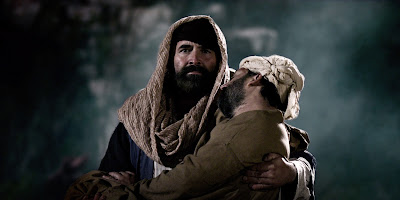
"Then he lifted him up..." [Lk 10:34]
And who can forget the ten lepers who begged Jesus for healing? Jesus healed all ten, but Luke tells us the rest of the story:
"And one of them, realizing he had been healed, returned, glorifying God in a loud voice; and he fell at the feet of Jesus and thanked Him. He was a Samaritan. Jesus said in reply, 'Ten were cleansed, were they not? Where are the other nine? Has none but this foreigner returned to give thanks to God?" [Lk 17:15-18]
"One of them, realizing he had been healed, returned"
Jesus, then, didn’t hesitate to highlight the faith and works of Samaritans, if only to remind the Jews that they had no monopoly on God’s love or His truth, and that He had come for the salvation of all.
With this in mind, we watch as Jesus and the apostles enter this Samaritan village and make their way toward the well.
With the sun directly overhead, the air is thick with heat, and the horizon shimmers in the distance. The village is quiet for it’s the kind of day when few dare to venture out under the mid-day sun. The village women usually go to the well in the early morning, or when dusk brings a cooling breeze. Chattering and laughing, sharing the latest gossip, their communal walks are as much social events as necessity – yes, a welcome break in a day filled with the hard work of maintaining a home.
But today, as Jesus approaches the well, He spots a solitary woman making her way toward us along the path. He expects to see her, for He knows she makes her way to the well every day at noontime, and always alone. It’s the one time she knows no one else will be there. For her, there’s never any banter or gossip -- no laughter, no singing to make the path smoother, no friendly hand thrown out to steady the jar when she stumbles. 
She tells herself she doesn’t care. She tells herself it means nothing to her. Bunch of chattering fools. Who needs them? 
She pretends that this solitary walk in the midday heat is her choice.
I prefer being alone. Besides, I never have to wait -- No one’s in my way, no petty quarrels, no children underfoot. No people…No problems…No snide remarks…
Of course, it hadn't always been this way. Once, in another village, in another lifetime, she’d been a part of it all -- the laughing, the singing, the trivial chatter that said so little, but meant so much. 
Yes, once she’d taken her place among the women…as wife, neighbor, friend. But that was years ago, and many men ago. 
In a world that was rarely kind to widows and orphans and especially to the divorced, she’d learned how to make her own way. 
In a world where the weak and powerless were often tossed aside and forced to move in the shadows, she’d learned how to be strong. 
In a world that measured a woman's worth by her relationships to father, husband, brother, and son, she’d learned how to be a survivor without them. 
But that survival came at a price – and for her, one small part of that meant going to the well alone. 
“Amen,” she says aloud. So be it.
There had been five men in her life, and the current one, though not her husband, isn’t as bad as some, and better than most. 
Things could be worse, she thinks, and then laughs aloud. The well could be dry.
As she walks along the path, the heat rises in waves, scorching her feet right through her worn sandals. Sweat trickles down her back, and she tastes the dust deep in her throat. The large jug, though empty, feels especially heavy today. The trip back to her home will be a long one. 
And then, looking up, she sees Him -- a stranger -- sitting at the well.
"Give Me a Drink."
Later, much later - when everyone asked her about that day: about what He said and what He did, she would answer:
He told me about water, and about thirst…and we talked about Jerusalem and mountains and worship and eternal life. He told me about spirit and truth, about so very much besides. And He told me about myself. He told me everything, and I finally understood the difference between surviving and living.
Yes, indeed, Jesus knew all about her her past, and offered her a future in which the past didn't count. 
He knew all about her present, and yet, instead of condemning her for her sins, He loved her for her weaknesses and turned them into strengths. How did He do that?
He knew why she went to the well at noon, and yet he still trusted her to proclaim the Good News to her neighbors. 
Come and see a man who told me all that I ever did…” [Jn 4:29, 39]
Imagine the courage it took for her, of all people, to run back into the very heart of the village, to proclaim that message to her disapproving neighbors! What boldness! What faith!
They, too, knew everything she had done…or thought they did.
Come and see! She said, to anyone who would listen. Come and see! He’s waiting for you. Can this be the Christ? And, as John tells us, they came:
“Many Samaritans from that town believed in Him because of the woman’s testimony” [Jn 4:39].
Was it her passion, her boldness? Or was it something else? What made them believe her? Perhaps it was the living water, the Word of the Word of God, that she shared with such unbound enthusiasm.
Brothers and sisters, Jesus also knows everything about you and me. He knows every sin and every act of kindness, every strength and every weakness.
Notice, too, how wrong we often are about ourselves, how limited our self-knowledge. What the Samaritan woman saw as a strength – her avoidance of others, her self-imposed isolation, her toughness – Jesus recognized for what it was, weakness.
It’s to that weakness that He calls her, sending her out among them, turning the sinner into a missionary.
This is what Jesus always does when He has serious work to accomplish in the world: He calls us to the task through our weaknesses. And by doing so reveals God’s greatness all the more.
Notice, too, that this Samaritan woman was given a choice. She could have filled her jug and returned home, but instead she left the jug behind and ran off to spread the word about the Word. It’s the same choice given to the Apostles as they mended their nets and heard Jesus say, “Come, follow me.” The call to discipleship always involves a choice, and always involves leaving something behind.

What about you and me? Will we fill our water jugs, turn our backs on Jesus, and go home? Will we mend our nets and let Jesus walk on by? Can we set aside the things of our lives, the jugs and nets, our willful natures, our possessions, our sinfulness, all that's keeping us from answering His call? Every life has its water jogs and its nets. Can we leave them behind and abandon ourselves to live according to God's will?

The Good News is in the promise of Jesus, given to the Apostles at the Last Supper:
"Whoever loves me will keep my Word, and my Father will love him, and we will come to him and make our dwelling with him" [Jn 14:23].
With Christ deep within you, and seeing Christ all around you in others, your life can become a gift to the world, a visible sign of His love and His final coming.

So, you see, Christ wants to dwell within you, to make you a God-bearer like Mary, so you can carry Him to others. 

Our nameless Samaritan woman listened to Jesus and responded. She not only became a disciple, but she also became something more: before Peter, before Paul, she became a missionary for Jesus Christ, taking the Word to others.

And perhaps most revealing for you and me, she became that missionary but never left her hometown. She never left her village.